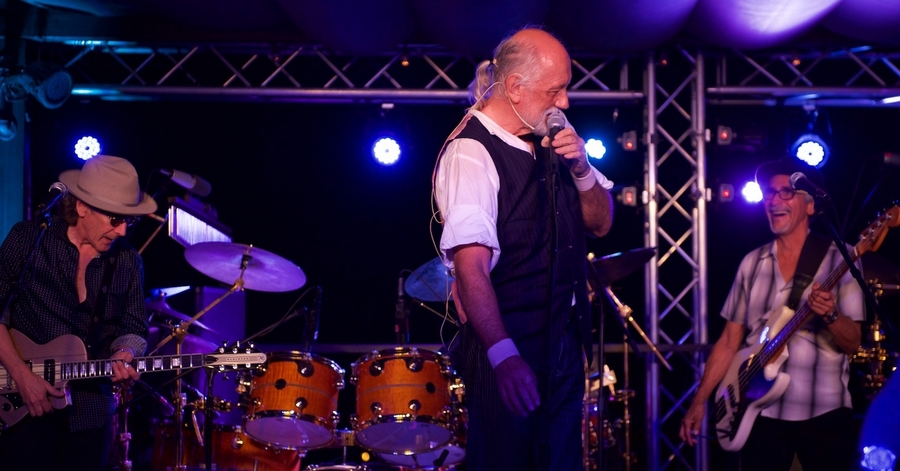
Starting on January 5, the Mick Fleetwood Blues Band will be performing a series of Tuesday night shows at Mick Fleetwood’s popular Fleetwood’s on Front Street restaurant in Lahaina, Maui. This Tuesday’s show will feature former Fleetwood Mac guitarist Rick Vito.
Click HERE to buy tickets for show on the 5th (with Rick Vito), 12th, 19th, and 26th.
On a December night in 1968, guitarist Rick Vito left Kutztown University and drove with musician friends to the old Electric Factory in Philadelphia to see Fleetwood Mac — then a burgeoning blues band fronted by extraordinary guitarist Peter Green.
That night, Vito saw his future.
Twenty years later, Vito became the guitarist in Fleetwood Mac, replacing Lindsey Buckingham.
On Thursday Oct. 24, Vito, now 63, returns to Kutztown University for its Rockin’ Alumni Showcase, sharing a bill with country singer Mark Wayne Glasmire, a Bethlehem native and fellow Kutztown University alumnus. The concert is part of a series to showcase the newly refurbished Schaeffer Auditorium.
In a phone call from his home outside Nashville to promote the show, Vito said Kutztown in many ways was the starting point for a career in which he also played with blues legend John Mayall, Bob Seger, Bonnie Raitt and Jackson Browne.
Here’s a transcript of the call:
LEHIGH VALLEY MUSIC: Tell me what you can about the Rocking Alumni Showcase?
RICK VITO: “Well, part of it, anyway, is the reopening of Schaeffer Auditorium. When I attended Kutztown, I started my professional career opening up for Muddy Waters at the first Kutztown University Blues Festival in, I believe, ’69. I’m not sure.
“So for me, it’s sort of a full circle – coming back to Kutztown and doing a blues show in the newly refurbished Schaeffer Auditorium.”
Yeah, when they opened the auditorium, I wrote a story. It really does look amazingly good. And then they were telling me all of the history behind it and mentioned your show, and I thought, “Wow, I’ve got to write about that.”
“Thanks.”
What can you tell me about your time at Kutztown? What do you recall about it?
“Well, you know, I guess anybody who goes to college, it’s a coming-of-age time. You kind of figuring out who you are and what you want to do with your life. I started off trying to establish myself as an art student, and that didn’t really work out and so I just did some general courses until I realized that I had friends and enjoyed the activities in the theater department, so I switched my major to theater.
“But I was always a musician, although I’m unschooled, and so I wasn’t interested in doing formal music study, but it was my passion. And it was such an exciting time musically in the ‘60s, and we could just take a short drive into Philadelphia to see Jimi Hendrix or Cream or all the happening guitarists of the day – Jeff Beck, everybody came through, either in Philly or New Hope.
“And so I always felt like Kutztown was sort of an out-of-the way place, but looking back on it, really it just was a short drive to anything I really wanted to see. And, in fact, a group that I was very fond of – Delaney Bonney and Friends – used to play in the area, and I used to go to see them and introduced myself to them and gave them some things that I had recorded and they invited me at one point to sit in with them live at Lehigh University.
“And I guess that made a good impression – it was a good night; got a great response. And so they invited me, when I finished school, to move out to L.A., which is what I did. And they hired me.
“So, Kutztown, as it turns out, it was a good place for me to be and where I was supposed to be.”
Yeah, as I prepared for this interview, I read in several places about you meeting with them, and it didn’t include the Lehigh University angle, so I’m glad you mentioned that. So let me sort of ask a little bit deeper question: The stuff that you learned there and the times performing there – does that in any way relate to you still today? To what you’re doing today?
“Well, I think going on stage is always a good learning experience, so I was supporting myself apart from my tuition, as a musician, playing locally at Kutztown and various colleges in the area – clubs. And also the theater experience, I tried to tie that into being a good performer and just being aware of certain communication in a big place with your audience. So I would guess that would be – it was the first jumping-off point to life in the profession. It started there.”
Yeah. You have played with so many greats – Bob Seger, Bonnie Raitt, Jackson Browne, Boz Scaggs. Do you have a favorite time – at this point in your life, looking back – do you have a favorite time in your career?
“Well, I think after I turned 30, I started to get more comfortable with everything I was doing. And almost around the same time that I turned 30, I started working with Bonnie Raitt for the second time. I worked with her as a substitute in ’77 and did the gig full-time for a couple of years when I was 30. And that was just a great experience. It was a great job and I liked her. And that led to work with Jackson Browne, which I really enjoyed, which led to work with Bob Seger, which I really enjoyed.
“And then in my mid-30s, I got asked to join Fleetwood Mac, and that was the most incredible experience – to be a member of a band of that caliber for four years. And so I’ve got to say that my 30s and very early 40s were my favorite times. Just a lot of things came along. I had just established myself, I guess, to the point where I had a good reputation and things came to me easily.”
Let me just ask you to talk a little bit about your time in Fleetwood Mac. The first question I would ask is what was it like to replace somebody as prominent as Lindsey Buckingham? And then talk about your time with the band a little bit, if you could.
“Well, I had a lot of experience going into band situations and replacing somebody who had established themselves. You know, when I joined John Mayall, I wasn’t directly replacing them, but I was in a line of guitarists that included some of the greats, like Clapton and Peter Green and Mick Taylor. So you have to have that in mind and bring your ‘A’ game to the table, pretty much. With Jackson Browne, I was replacing David Lindley. So you have to really kind of step up to the plate, and this is your time to shine.
“So I had that in the back of my mind for many years, and so I think I was able to do that pretty successfully. That’ why I got the gig. And so when it came to Fleetwood Mac, I was a big Peter Green fan. I wasn’t necessarily a Lindsey Buckingham fan. His style was way too different than the kind of stuff I did, but we weren’t doing a lot of his tunes. We only did ‘Go Your Own Way’ and a couple others that he co-wrote that were ensemble songs.
“So it wasn’t a difficult thing for me – I never felt like I was stepping into his shoes or anything like. If anything, I was bringing a little bit of Peter Green back in – that sound – back to the band in the songs that I did in my performances during the shows.
“That’s generally how that whole thing worked. I had been used to doing that kind of thing for a number of years.”
Did you leave the band before Lindsey returned, or was that part of the same thing?
“No, actually, the whole group started to splinter around ’91. Christine [McVie] announced that she was leaving and then Stevie [Nicks] said, ‘If Christine’s leaving, I’m leaving.’ And that kind of threw the band into really a kind of uncertain phase, and then Mick and John and Billy [Burnette, who also came in to replace Buckingham with Vito] continued on with Dave Mason and Bekka Bramlett for a version of Fleetwood Mac that went on for a couple years. And it wasn’t until quite a few years after that that the original band – not the original band but the original ‘70s version of Fleetwood Mac – decided to reform, I guess, for the [President] Clinton inauguration. And then, I guess, decided to stick after that after a while. But he was out of the band. He was definitely not a member of Fleetwood Mac for a number of years until that thing came along.”
In preparing for this interview, I looked back through our archives and found a story about when you played with Fleetwood Mac at Stabler Arena at Lehigh in 1990. Do you recall that show at all?
“Where’s Stabler Arena?”
It’s Lehigh University’s concert hall – auditorium.
“Uh, well, I do remember doing a gig in the area – that was probably it. I remember that it was a smaller sports kind of arena.”
Yup.
“That sound right? I couldn’t hear anything in there, and I remember I felt so bad [Laughs] I had a bad night, and I looked over Robert Plant [singer from Led Zeppelin] was sitting there. And I thought, ‘Oh, man, this is just [laughs], it was a bad night for me personally. That’s kind of what I remember about that, but a lot of friends had showed up and I felt like, ‘Oh, man,’ [Laughs]. But they happened every now and then.”
You still occasionally play with Mick Fleetwood Blues Band, yes?
“Yeah, yeah. We’ve gotten back together and we’re good friends and we enjoy playing the blues, more the bluesy kind of material. And we had a live CD that came out, and a DVD that came out in late 2009, and so in 2010 it was nominated for a Grammy in the blues category.”
I saw that. Congratulations.
“Thanks. It was a nice honor.”
Yeah. And so is most of your work these days solo gigs? Or what are you doing most of these days?
“Uh, well, my schedule is not as full as it was when the music business was in better shape and there was more emphasis on rock ‘n’ roll and blues and stuff. So these days, it’s just a different world out there. So what I do now is sessions when I’m asked to do them. I do solo gigs when I’m asked to do them, and when my agent can round them up, and I do the Mick Fleetwood Blues Band, and I do like a world beat kind of music, which is different from anything I’ve done before.
“You know, I produce when I get asked to do it. I write music. I pitch songs . You know, you just sort of do a lot of different things to make a bottom line happen.”
Your last solo disc was 2009?
“Let’s see, yeah, it was a European release. It was a best-of. It was compiled from, I think I had had seven solo CDs out. Not all of them were released in the states. Some of them are out of print now, from Europe. But there was a label in Europe that I was working with, and they put a lot of stuff out on me and I would go to Europe to tour once or twice a year for a number of years.”
I’m going to really test your memory on this one. As I was preparing for the interview, I found a story, and article, that referenced you playing in a band called The Wright Brothers Blues Band, while you were at Kutztown, I guess, and you played a tiny little club called Illicks Mill just outside of Allentown.
“Yeah, yeah. We played there quite a few times.”
Yeah. And again, do you have any recollection of that?
“Well that was one of the clubs I mentioned earlier that was very receptive to what we were doing. The Wright Brothers were Mark and Dean Wright that had a band together in the area for a number of years. And when I came up to Kutztown , in fact, we all went to see, coincidentally, the original Fleetwood Mac in Philadelphia, and that was, I think, December of ’68. And we were all so knocked out, we said, ‘Look, why don’t we combine bands, so to speak – you come into this and we can keep the same name or call it something else.
“And I said, ‘Look, you got a good, established name. Let’s keep calling it The Wright Brothers. So we continues on, inspired by the blues that Fleetwood Mac was doing, because they were really authentic about it. They really had a lot of craft and humor and authenticity and that’s what we trying to do. We were kind of purists about it.”
So you sort of saw your future when you were in this area.
“I did. Yeah, I did. It wasn’t completely solidified until that night at Lehigh, when I sat in with Delaney and Bonnie. It was at that moment that I realized ‘This is unquestionably what I’m going to do. I’m not gonna have anything else to fallback on, I’m not going into the theater. I’m going to do this.”
RICK VITO AND THE LUCKY DEVILS, headlining the Rockin’ Alumni Showcase, with Mark Wayne Glasmire, Showcase by two Kutztown University alumni in newly renovated Schaeffer Auditorium, 7:30 p.m. Thursday Oct. 24, Kutztown University’s Schaeffer Auditorium, 15200 Kutztown Road. Tickets: $12. Info: www.kutztownpresents.org, 610-683-4092
Newest members Billy Burnette and Rick Vito rehearse for Fleetwood Mac’s Shake the Cage tour. (Corbis)
IT HAS been twenty years since Fleetwood Mac formed as a blues quartet, and long-time member Lindsey Buckingham celebrated the anniversary by leaving the group. As the group begins a new tour with two new members, Stevie Nicks is still fuming.
When Lindsey Buckingham announced his departure from Fleetwood Mac in mid-August, he threw the band’s future into doubt. “A lot of people probably expected us to do the old roll over on your back trick,” recalls Mick Fleetwood.
“What were we supposed to do?” asks Stevie Nicks, “Lindsey left. So did that mean we were done? No. Why should the rest of us quit just because of him?”
Mick adds, “Rather than shut down, we decided to press on and get out on the road.”
Tango in the Night, their first album in five years, was selling briskly; it recently passed the one million mark. There was every indication, then, that a Fleetwood Mac audience still existed. But who was going to fill Buckingham’s shoes on stage? “We did not hold auditions or anything,” answers Fleetwood. “I have been working with Billy [Brunette] – he played guitar with my [solo] group Zoo and had done some writing with Christine [McVie]. But he is not a lead guitar player, he is a great rhythm player and singer and writer, but he is not a lead man. So I also rung up Rick [Vito, who had previously played lead guitar with John McVie and John Mayall, as well as Jackson Browne and Bob Segar].”
Vito remembers, “I devoted a couple of days to learning the material. After I played with the band for a few hours, I think it was obvious it was gelling. I realized this could be fun and pretty great. But this chance…it was not something I would have sat down and thought about as being in my future.”
But both Vito and Burnette, introduced as permanent members at an August 18 press conference, are very much a part of Fleetwood Mac’s future. “The group will be my first priority,” says Burnette, who released an engaging solo album last year and is the son of 50’s rocker Dorsey Burnette. “I will continue to write on my own, but how much will depend on what they want to do.” After a brief pause he corrects himself: “I mean what we want to do.”
“Good answer,” snickers Stevie Nicks, seated next to him at a large conference table. The other members of Fleetwood Mac are there too. Seeing them all together in one room — an extremely rare occurrence away from the studio or concert halls — it is hard to ignore the magical aura they still project. They look like stars.
There is Stevie’s charming, impish smile, Mick’s rolling, Marty Feldman-eyes, Christine’s glimmering sapphire eyes, and John’s distinguished-looking salt and pepper stubble. Even Burnette and Vito could pass for daytime soap opera actors. Yet it is easy to understand how the guitarists, having only rehearsed with the band for a couple of weeks, could still feel like outsiders. But Nicks stresses, “They are not just fill-in guys. They are in the group. And everybody is playing as one unit now. Neither Billy nor Rick are freaking out on stage trying to get all their licks in.”
While it might seem odd that Buckingham was replaced by two guitarists, this move actually brings Fleetwood Mac closer to its original instrumental format. When the group was formed in England back in 1967, guitarists Peter Green and Jeremy Spencer worked in tandem with the enduring Fleetwood (drums) and John McVie (bass) rhythm section. A year later, Danny Kirwan was brought on board as a third guitarist.
This process shaped the bluesy sound of Fleetwood Mac, says singer/keyboardist Christine McVie, who officially joined the group in 1971. “When Californians Bob Welch, Bob Weston, then Buckingham eventually filled the guitarists spot, the groups sound, not surprisingly, shifted into more of a pop direction.” Christine believes, “I can now see us getting back to more of a blues thing. Rick…I do not want to say he is like Peter Green, but he plays wonderful blues a la Peter. And Billy’s got this great hard, driving voice. So we have definitely got a whole new can of beans here.”
This represents the first personnel change in Fleetwood Mac since 1975 when Buckingham and Nicks (formerly a duo act) joined up and helped catapult the band into American superstar territory. The albums Fleetwood Mac and Rumours, featuring such songs as “Rhiannon,” “Say You Love Me” and “Dreams” (the group’s first number one single), topped Billboard charts. And Rumours, which has now sold over 20 million copies worldwide, held the number one spot for 31 weeks (a record surpassed only by Michael Jackson’s Thriller) in 1977.
Mick reflects, “We had already been a highly successful band in England. In 1969, you could not get any bigger than we were over there. We did not reach that level in America until eight years later. But we could see it coming. It is not like we were a bunch of 18-year-old kids that had just put a band together and boom! and we have an album go through the ceiling. We were prepared and could deal with the inevitable comments like, Ah, look at you now, you have gone commercial on us.”
“When Lindsey and Stevie joined up,” says Christine, “we did not consciously alter our sound, but at the same time, I thought, Hmmm. I think this is something special we have got here.”
Stevie says, “The very first big concert I played with Fleetwood Mac, at the Oakland Coliseum with Peter Frampton [in 1976], I couldn’t believe all those people were out there. We were not famous. The record [Fleetwood Mac] had just come out. We hit the road. Then, within three months, we were all famous and on our way with the hits.”
Rather than follow up this commercial well-spring with similar material, the band unveiled an ambitious double-record set called Tusk in 1979. Filled with both conventional pop and adventurous percussion-dominated tracks, it cemented Lindsey Buckingham’s role as the group’s arranger/producer/musical director. He continued in this capacity for Fleetwood Mac Live (released in December 1980), Mirage (June 1982) and Tango in the Night (April, 1987).
Christine admits, “Lindsey and [co-producer] Richard [Dashut] were at the fore, without question, when it came to the ideas and the sound and the production. And they were very good at it. Of course, one has to say, nothing went on the albums that the rest of us did not like. If anything got a bit too left wing, which it might have in certain cases, I definitely would have put my foot down and said, Wait a minute lads.”
Press photo of Fleetwood Mac just prior to guitarist Lindsey Buckingham’s (middle) departure from the band in August 1987.
Stevie Nicks, whose stormy relationship with Buckingham has been well-documented, offers a different viewpoint. “In the studio, if Lindsey said the wall was gray, I will be absolutely sure it was pink. In order to get one of my songs on a record I will have to say, OK, the wall is gray, Lindsey. Otherwise, it was the back of the bus. Now this has nothing to do with the other members of Fleetwood Mac, who, from the beginning, have always been lovely to me, have always known how important my songs are to me, whereas, with Lindsey, he would rather I just stayed at home doing laundry. We are talking about a man who was in love with a woman and would just as soon she had faded out and just been his old lady or wife. Period.”
“Whooo,” sighs Christine after a full five seconds of silence. Mick interjects, “That situation changed somewhat, in my opinion.”
Stevie narrows her eyes and says, “Not when it came down to the real thing. Uh uh. Never changed.” When she launched her solo career in 1981 with the release of Bella Donna, Stevie admits, “There was a part of me that was saying, ‘See, I can do it myself. I do not need you every second to do everything for me.’”
On her first solo tour, however, she remembers, “In Houston, in front of 12,000 people, when they said, “Welcome, Stevie Nicks; I turned around and looked for Mick and Chris and John and could not believe I was walking out there by myself. I will do a song, then instead of being able to saunter off, have a touch-up done on my make-up, have my hair fluffed, and put on a different jacket, then saunter back on, I will hear, Hey, this ship is gonna sink if you go in there for five minutes! So I ran around on stage in circles for a couple of weeks.” Stevie adds, “I would just as soon not be the captain. I never liked being responsible for everything. Too much time is wasted handling problems that have nothing to do with music. Basically, I do not like being a businesswoman, which is what I have to be when I am on my own. Again, the only reason I started a solo career is because I wanted to do more of my songs. I will much rather work within Fleetwood Mac.”
Christine McVie echoes this sentiment, “I was never too keen on the idea of a solo thing,” she says. “I do not enjoy the pressure of being the only one up there who everybody looks to for leadership. I like being part of a group. But the time was trickling on by and [in 1983] I could see Fleetwood Mac was not going to be happening for a while, so I did an album [Christine McVie] and a tour [in 1984]. That was hard work. I had to do my own make-up and the whole bit. My make-up used to run down my face and by the end of the night, it was horrific. So no, I would not want to tour [solo] again. My life, musically speaking, has always been Fleetwood Mac — at least for the last 20 years — and I have enjoyed it thoroughly.”
It is doubtful anyone could have been happier to return to the Mac family than Mick Fleetwood. While he kept busy working with his side band, Zoo, and gave acting a shot, Fleetwood also ran into financial difficulties and had to file for bankruptcy. but the even-tempered drummer managed to keep his life together. Says Christine: “Mick is like the daddy for us all and he always sort of has been.” John McVie adds, “Musically, Mick is my first lock in.” “John and Mick,” Christine concludes, “they are the old backbone of the group.”
By his own admission, John needed a little support himself earlier this decade. Before the Tango in the Night sessions began in 1985, John’s life was dominated by a drinking problem — which he has since recovered from. Christine says, “He is really doing wonderfully now. But he is not the type of person who enjoys talking about himself. Like a great many rock bass players, he prefers to remain in the background. By nature,” says Christine, “John’s a very quiet, private person. He likes to read and keep to himself. On stage and in the studio, he is always so steady, he never loses the groove. On the last record, he played amazingly.”
Listening to Tango, the entire band appeared to be reaching frequent musical peaks. Stevie has never sounded better. (During “When I See You Again,” she sings the word baby about ten different ways). Christine’s “Little Lies,” the current Top 20 single, is poetic whimsy at its best. As for Lindsey Buckingham, he not only arranged and produced the record, but had a hand in writing seven of its 12 tracks. He sings so forcefully (particularly throughout Tango in the Night), plays guitar with such vigor and assurance, and seems to bring out the strengths of everyone around him, it is tough to figure how he could just walk away.
“During the sessions,” recalls Christine, “we sensed this was probably the last thing Lindsey would do with us. It was sort of said, but not said, you know? He admitted his solo career was becoming his priority. But by the end of the album, he did sort of agree to tour, then at the eleventh hour, he just pulled out, saying that he simply could not cope with it.”
Here is Lindsey’s statement, issued through his manager. “In 1985, I was working on my third solo album when the band came to me and asked me to produce the next Fleetwood Mac project. At that point, I put aside my solo work, which was half-finished, and committed myself for the next 17 months to produce Tango in the Night. It was always our understanding that upon completion of the Tango album I would return to my solo work. Of course I wish them all the success in the world on the road.”
Christine reveals, “Whenever we played live, Lindsey always did it sort of under sufferance. He simply does not like touring. He would just as soon stay in the studio. And that just is not the case with the rest of us.”
Buckingham chose not to respond further on his departure from Fleetwood Mac, and is now in the process of finishing up a solo project. He has also been in the studio as a producer for the Dream Academy and Brian Wilson.
“I have nothing but respect for Lindsey and what he is doing,” says Christine. “He was never less than honest with us. And after 12 years in the band, it must have been something of a wrench for him [to leave]. But if someone is not happy, then nobody is happy. I think his decision was best for everyone who is concerned.”
During rehearsals for the current Shake The Cage Tour, Mick says, “It felt good to be playing again and the songs came together rather fast. Before out last tour [the three-month Mirage Tour in ‘82] a lot of time was spent cogitating, then we will creep up onstage and play a bit. Now we seem to be much more focused, there are no distractions and the onus is on the band vs. the individual. I am all for solo projects, but when they create these long time lapses, everyone gets jittery. I mean, Fleetwood Mac used to be road dogs. So when we have a gap like this last one….over five years…”
“It makes you feel like you do not have a job,” says Stevie. With Fleetwood Mac touring schedule set to cover America this fall and include dates in Australia and Europe next year, she should not have to worry about checking the classifieds for a while. And she can put her solo career on hold indefinitely. That is not a problem Stevie says. “I can not think of nicer, more talented people to work with. I look forward to seeing them. I really do. For me, this is a pleasure thing. It makes everything else all right.”
1987 marks Fleetwood Mac’s 20th Anniversary, so it is surprising that the band (or their record company, Warner Bros.) has not made a bigger deal over the milestone. But as Mick points out, “Besides me and John, there have been so many different players.”
Stevie admits, “I have never met half the people who used to be in the band.”
“But the odds of seeing a grand anniversary celebration on stage is highly unlikely,” says Mick. “It might be fairly bizarre, though. I guess we could have then called this The Rolex Tour. but we have got enough going on without taking time out to look back. We are touring to establish the band as it is now.”
In the wake of Fleetwood Mac’s personnel shuffle, one has to wonder how it affected the balance of power within the band.
“What power?” asks Christine. “No one is coming out as a kind of boss. I guess you could say Lindsey used to fill that role in the studio, and at some point I am sure someone else will emerge. Right now, I seem to be the one who is taking care of the primary business. And Mick, like I said, is the group’s daddy. But we really do not have one person who acts as boss. We all just sit around and mutually agree on things. It is hard to say what will happen in the studio. We will just have to wait and see.”

 Yeah. You have played with so many greats – Bob Seger, Bonnie Raitt, Jackson Browne, Boz Scaggs. Do you have a favorite time – at this point in your life, looking back – do you have a favorite time in your career?

