Tag: Fleetwood Mac

  • ‘Silver Springs’: Inside Fleetwood Mac’s Great Lost Breakup Anthem

    ‘Silver Springs’: Inside Fleetwood Mac’s Great Lost Breakup Anthem

    Fleetwood Mac‘Silver Springs’: Inside Fleetwood Mac’s Great Lost Breakup Anthem

    As classic live album The Dance turns 20, we look back at Stevie Nicks’ tortured torch song – and how it almost broke up the band

    By 1997, Stevie Nicks and Lindsey Buckingham’s romance should have been ancient history. The pair had split two decades prior, fueling Rumours‘ famously raw breakup anthems. But during a taping of a Fleetwood Mac reunion show later released as The Dance, shit once again got very real. Midway through a non-album rarity called “Silver Springs,” Nicks turned and faced her former flame as she sang the song’s rueful bridge: “Time cast a spell on you, but you won’t forget me/I know I could have loved you but you would not let me.” The pair locked eyes, and Nicks gradually built to a cathartic howl – “I’ll follow you down ’til the sound of my voice will haunt you/You’ll never get away from the sound of the woman that loves you” – indicating that, for her at least, resolution had never really come.

    Suddenly, “Silver Springs,” a song written for Rumours but left off the finished album and relegated to B-side status, seemed like the key to the entire messy and enthralling saga of Fleetwood Mac’s most beloved lineup. Even back in ’77, amid iconic tracks like “Go Your Own Way” and “Dreams,” Nicks’ tender yet vengeful post-mortem on her breakup with Buckingham had become an emotional lightning rod. The song would have behind-the-scenes repercussions for decades to come – nearly leading to the breakup of the band. “Silver Springs” would also become a treasured touchstone for Nicks acolytes ranging from Courtney Love, who has passionately covered it, to Lorde, who cited it as an influence on her Melodrama LP.

    Fleetwood Mac’s own melodrama was brewing well before Nicks penned “Silver Springs.” She and Buckingham met as teenagers at a religious-group gathering; after high school, they became romantic and musical partners, eventually teaming up in the duo Buckingham Nicks. In December 1974, Mick Fleetwood called up Buckingham to join the already-established Fleetwood Mac. The guitarist insisted that he and Nicks were a package deal, and both would join and appear on the band’s self-titled 1975 album – their first international smash and U.S. Number One.

    As they worked on a follow-up, which would become Rumours, Buckingham and Nicks’ relationship, as well as the marriage of bandmates Christine and John McVie, began to implode. Nicks officially ended things, but neither were taking it well.

    “[Stevie] was going through a bit of a hard time too because she was the one who axed it,” Christine McVie, who had become Nicks’ close friend and confidant during this time, said in Bob Brunning’s Fleetwood Mac: The First 30 Years. “Lindsey was pretty down about it for a while, then he just woke up one morning and said, ‘Fuck this, I don’t want to be unhappy,’ and started getting some girlfriends together. Then Stevie couldn’t handle it … !”

    Rumours became a theatrical affair, with the exes addressing one another’s faults, their own pain and a storm of other topics related to their respective heartbreaks. “Silver Springs” was Nicks’ tribute to the fairy-tale ending that never was. The title came from Silver Spring, Maryland: While passing through the town on tour, Nicks romanticized the name. “It sounded like a pretty fabulous place to me,” she said in the Classic Albums documentary about Rumours. “It’s a whole symbolic thing of what [Lindsey] could have been to me.”

    Rolling Stone coverAs Rumours co-producer Ken Caillat recalls, Fleetwood Mac recorded “Silver Springs” about six months into the process. “Stevie was in love with the song,” he tells Rolling Stone, noting that he views it as one of the best-engineered and best-produced tracks from the sessions, emphasizing the combination of acoustic and electric guitars added by the song’s own subject, Buckingham.

    “Lindsey was the guy who laid all of these big colors on the record and so you have to imagine it’s an odd position for him to be in,” Caillat explains. “He’s mad at her, the song’s about them being mad but it’s a good art form. But you can tell by all those parts he did on the guitars and the harmonics and the picking, it’s a piece of art.”

    Nicks was proud of “Silver Springs,” and while it was in part a revenge anthem directed at her bandmate/ex, there was someone more important in her life who was meant to benefit from the commercial success she assumed it would gain.

    “She decided to give the publishing rights to her mother [Barbara] as kind of a big thanks with a nice royalty check for her mom,” Caillat adds.

    The album was nearly finished when Mick Fleetwood pulled Nicks out into the parking lot of the Record Plant, the Sausalito, California, studio where much of the album had been recorded.

    “I knew it was really serious ’cause Mick never asks you to go out to the parking lot for anything,” Nicks recalled in a 1991 BBC radio interview. It was there that Fleetwood revealed that “Silver Springs” had been cut from the album for being too long and “a lot of [other] reasons,” according to Nicks. Fleetwood wanted the lighter “I Don’t Want to Know” on the album instead, a track on which she and her ex-boyfriend harmonized about their breakup. She did not approve.

    “I started to scream bloody murder and probably said every horribly mean thing that you could possibly say to another human being and walked back in the studio completely flipped out,” she continued.

    The producers tried to find a way to keep the song on the album, and offered to cut down its length or trim a different Nicks track, like the seven-minute “Gold Dust Woman.” As Fleetwood had relayed to Nicks during their fateful parking-lot argument, length was a major factor in the song’s displacement, given the limitations of vinyl pressings and her bandmates’ desire for equal representation on the LP. Plus, “Silver Springs” would have made for a third ballad by Nicks on the album, as opposed to the more upbeat “I Don’t Want to Know,” a duet with Buckingham.

    “As you can hear, [the album] turned out feeling poppy despite the fact that we had a lot of slow songs in there like ‘Oh Daddy’ and things like that,” Caillat adds. “So we gave her the option that we could cut one of the slow songs down so we could have room for the other ones or we could take one of the other songs off and she said, ‘Let’s do it.’ She wanted to keep all of the other songs more than ‘Silver Springs.’”

    According to Nicks, however, she wasn’t so compliant.

    “With a gun to my head, I went out and sang ‘I Don’t Want to Know’ and they put ‘Silver Springs’ on the back of ‘Go Your Own Way,’” she told the BBC in ’91.

    As Caillat sees it, the placement of “Silver Springs” as a B side on the album’s first single was a peace offering. “Stevie was devastated for a number of reasons,” he explains. “She loved the song, and by it not being on the LP, her mom didn’t make all the extra publishing because the single didn’t sell very much.”

    The story of “Silver Springs” appeared to end right there, in Sausalito. The band performed the song live a few times in 1976 and ’77 before moving on from it for the remainder of the Seventies and the entirety of the Eighties. Even so, Nicks devotees still found their way to the tune. Tori Amos’ family lived in Silver Spring, Maryland, during the Seventies, and in the Rumours era, she was cutting her teeth by playing gay bars around nearby Washington, D.C. Nicks had long been one of her biggest influences, but it was a random barfly who put in a request for “Silver Springs” that led to her discovery of the song.

    “I heard it and thought it was beautiful,” she tells Rolling Stone. “It just became part of the repertoire for the past 39 years.”

    For those not frequenting the bars where Amos kept the song’s spirit alive, the track’s primary exposure was as a B side to “Go Your Own Way” – Buckingham’s own expression of anger and revenge against Nicks, where he claimed that “packin’ up, shackin’ up is all you wanna do.” The song would become one of the band’s biggest hits, charting in the Top 10.

    “He knew it wasn’t true. It was just an angry thing that he said,” Nicks told Rolling Stone in 1997 of the “packin’ up, shackin’ up” line. “Every time those words would come onstage, I wanted to go over and kill him. He knew it. He really pushed my buttons through that. It was like, ‘I’ll make you suffer for leaving me.’ And I did.”

    Of course, Nicks had the exact same motivation when she wrote “Silver Springs.” In a 1997 interview with Arizona Republic, she explained the song’s message as “I’m so angry with you. You will listen to me on the radio for the rest of your life, and it will bug you. I hope it bugs you.”

    (Rolling Stone)

    After their breakup and massive success with Rumours, Buckingham and Nicks spent a decade continuing to sing to and about each other onstage, even as they appeared to move on with their respective personal lives. They courted different people – Nicks even briefly married – and pursued solo careers alongside their work with the band. But according to Mick Fleetwood’s autobiography Play On, the passion and anger had not entirely died down, and a physical altercation between the former couple during a band meeting in 1987 is what ultimately led to Buckingham’s departure from the group. Both Buckingham and Nicks denied Fleetwood’s claims.

    Three years later, the new, Lindsey-less incarnation of Fleetwood Mac released Behind the Mask and went on a world tour. Following the trek, Nicks began plotting a greatest hits compilation titled Timespace – The Best of Stevie Nicks where she hoped to include “Silver Springs” alongside her other Fleetwood Mac contributions and solo hits. But her plan got in the way of Fleetwood’s own desire to include it on a forthcoming box set cataloging the band’s discography. This led to another heated dialogue between the two about “Silver Springs.”

    “I told [Fleetwood’s manager] that I want ‘Silver Springs’ because it belongs to my mother,” she told the BBC in 1991. “It didn’t occur to me that they wouldn’t let me have it back. I said to his manager, ‘You find Mick, and you tell him that if I don’t have those tapes by Monday, I am no longer a member of Fleetwood Mac.’”

    Fleetwood won, and the song appeared on 25 Years – The Chain. True to her word, Nicks left the band.

    By the time of The Dance, both Buckingham and Nicks had seemingly settled into a new era of their lives. Nicks had been sober for a few years, having finally kicked the drug addiction that had plagued her since the Seventies. Buckingham was then dating Kristen Messner, the woman who would give birth to the first of their two children a year later and marry him in 2000. It was an improbable Buckingham Nicks reunion in 1996 for the duet “Twisted” off the Twister soundtrack that would put the Fleetwood Mac reunion in motion. (The tornado metaphor was hopefully not lost on the pair.)

    The Dance, a release largely made up of Fleetwood Mac’s best-known hits, would earn the band three Grammy nominations and their first Number One album since 1982’s Mirage.”To be honest, I don’t remember hearing ‘Silver Springs’ done at rehearsals,” Elliot Scheiner, producer and engineer of the concert film, tells RS. Similarly, director Bruce Gowers doesn’t recall anything special about the early run-throughs of the song. It had always been a part of the set list for as long as he had been attending their practice sessions, and he just assumed that it had been a part of their pre-breakup concert repertoire. The looks exchanged by Buckingham and Nicks throughout the show – and the particularly raw moment between them during the climax of “Silver Springs” – did not come about until the two nights of taping in Burbank.

    This was by design. Nicks has admitted that the fiery take on the song that appears in The Dance was “for posterity,” as she told RS at the time. “I wanted people to stand back and really watch and understand what [the relationship with Lindsey] was,” she later told Arizona Republic.

    “‘Silver Springs’ always ends up in that place for me because she’s always very committed to what those words are about, and I remember what they were about then,” Buckingham told Rolling Stone in 1997. “Now it’s all irony, you know, but there is no way you can’t get drawn into the end of that song.”

    “When we’re [onstage] there singing songs to each other, we probably say more to each other than we ever would in real life,” Nicks added.

    For many Fleetwood Mac fans, The Dance marked the first time they had even heard the track. One of these was Courtney Love, who has long been a very public admirer of Nicks and Fleetwood Mac. Hole had released their own cover of “Gold Dust Woman” in 1996 and interpolated “Rhiannon” into their Pretty on the Inside track “Starbelly” back in 1991.

    “I wouldn’t exist without Stevie,” she tells Rolling Stone. Love and Nicks have known each other for years, and the alt-rock singer had been in attendance for one of the live tapings of The Dance, even spending time with a nervous Nicks in her dressing room before the show.

    “I thought it was an old Buckingham Nicks song,” she recalls of her first exposure to “Silver Springs.” “It really moved me. I was like ‘What the fuck is this?’ I didn’t ask her about it.”

    While Love had been playing “Gold Dust Woman” live for decades, she recently chose to sing “Silver Springs” instead at a Fleetwood Mac tribute show in Los Angeles last year. “I started crying as I was singing it,” she admits. “It doesn’t sell itself, you have to sell it a little bit. Take it to the end. Before the instrumental break, it builds, it builds, it builds and it climaxes. It’s an unusual song musically in that sense.”

    Nicks’ own performance earned “Silver Springs” a belated Grammy nomination, in the category of Best Pop Performance by a Duo or Group With Vocals (it lost to Jamiroquai’s “Virtual Insanity”). It was the only song from The Dance to be recognized outside of the album as a whole.

    “I never thought that ‘Silver Springs’ would ever be performed onstage,” she reflected during a 1997 MTV interview. “My beautiful song just disappeared [20 years ago]. For it to come back around like this has really been special to me.”

    “Silver Springs” has gone on to have an extraordinary second life. Besides Love and Amos, Florence and the Machine and Lykke Li have covered it live; it appeared in the finale episode of American Horror Story: Coven; and just this year, 20-year-old Lorde cited “Silver Springs” during a conversation about her own heartbreak album Melodrama, released in June.

    “I remember being [15 years old] listening to [‘Silver Springs’] over and over, doing my art homework, thinking it was a beautiful song,” she said in conversation with Tavi Gevinson for the Rookie Magazine podcast. “I remember hearing ‘Time cast its spell on you but you won’t forget me/I’ll follow you down ’til the sound of my voice will haunt you/You’ll never get [away from] the sound of the woman that loves you’ and feeling the weight of them, and I also remember hearing them six months ago and hearing a total different thing unlock.”

    Speaking to Rolling Stone later, Gevinson cites her own high-school breakup as her impetus for connecting to the song. “I definitely copied down the lyrics in multiple journals,” she says.

    Fleetwood Mac still plays “Silver Springs,” often as an encore alongside “Don’t Stop” and other signature songs. Live, Buckingham and Nicks have continued to revive their haunting locked-gaze Dance duet. In late 1997, live footage captured Buckingham welling up with emotion and embracing Nicks at the end of the song. In a 2004 clip, he aggressively strums his guitar and yells into the microphone, making his harmonies more audible than ever.

    After Christine McVie rejoined Fleetwood Mac in 2014, her heartbreak sisterhood with Nicks was rekindled. By that time, “Silver Springs” had already become a staple of the band’s set lists. “When I finish [performing] ‘Silver Springs,’ Christine waits for me and takes my hand,” Nicks told Maclean’s Magazine in 2015. “We walk off and we never let go of each other until we get to our tent. In that 30 seconds, it’s like my heart just comes out of my body.”

    Since Nicks was able to turn “Silver Springs” into the hit she always wanted it to be, her mom Barbara did receive the royalty check her daughter had earmarked for her – 20 years later than expected. “My mom ended up getting a $50,000 check two months after The Dance went out,” the singer revealed. “To my mother, it had been a million dollar check.”

    Nicks also finally had the opportunity to place the song on her own compilation, including it on 2007’s Crystal Visions – The Very Best of Stevie Nicks. In the liner notes, she dedicated “Silver Springs” to her mom, who passed away four years later. It was the elder Nicks’ “rainy day song.”

    Brittany Spanos / Rolling Stone / Friday, August 18, 2017

  • Fleetwood Mac closes out The Classic East

    Fleetwood Mac closes out The Classic East

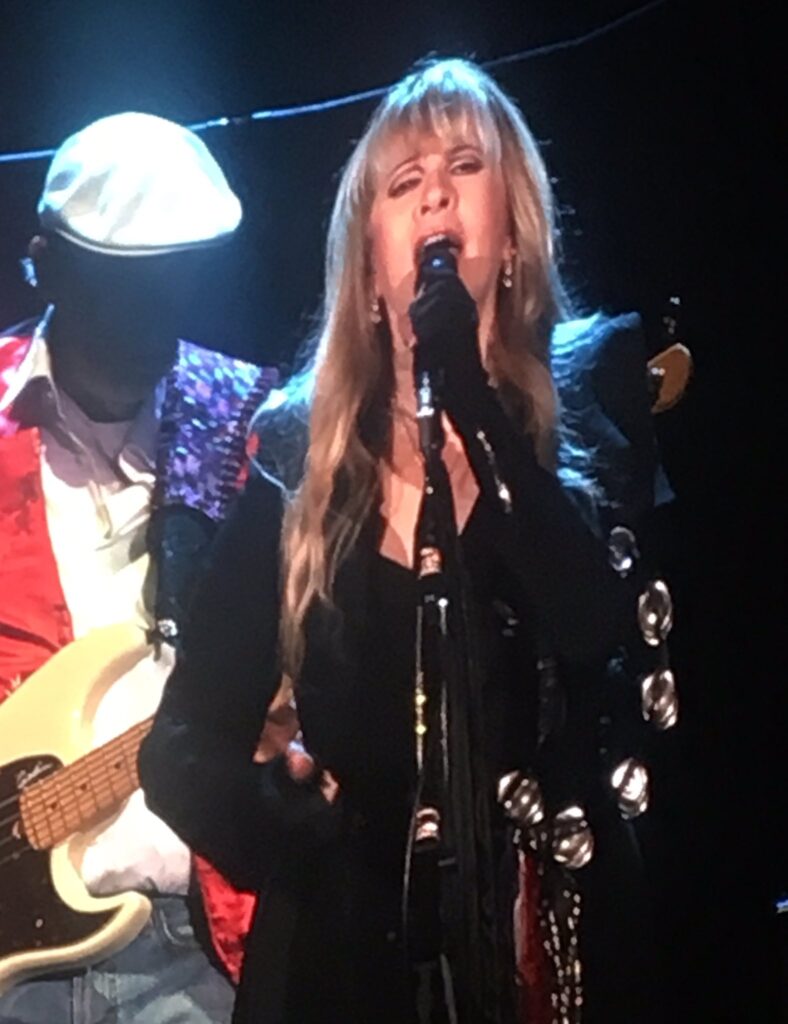
    Fleetwood Mac closed out The Classic East at Citifield on Sunday night, a repeat performance of The Classic West, two weeks earlier at Dodger Stadium in Los Angeles.

    Fleetwood Mac started their set at 9:00 p.m. local time, following Earth, Wind & Fire and Journey. Once again, due to the curfew, the band performed a shorter version of the On With The Show set, performing for exactly two hours. Concert goers were treated to a great firework show during “Don’t Stop,” the set closer.

    Fleetwood Mac, The Classic East, Citifield, New York, July 30 2017
    (The Classic)
    Fleetwood Mac, The Classic East, Citifield, New York, July 30 2017
    (DaveStewart‏NYC)
    Fleetwood Mac, The Classic East, Citifield, New York, July 30 2017
    (David J. Criblez)
    Fleetwood Mac, The Classic East, Citifield, New York, July 30 2017
    (Marc Urselli‏)
    Fleetwood Mac, The Classic East, Citifield, New York, July 30 2017
    (Marc Urselli‏)
    Fleetwood Mac, The Classic East, Citifield, New York, July 30 2017
    (Ranubris)
    Fleetwood Mac, The Classic East, Citifield, New York, July 30 2017
    (Kaitlyn Deere)
    Fleetwood Mac, The Classic East, Citifield, New York, July 30 2017
    (Sean Blankenship)

    Twitter was abuzz with celebrities sightings — particularly for One Direction alum Harry Styles, who has been spotted often over the weekend enjoying the festival. Fashion models Camille Rowe and Alexa Chung were also part of Harry’s encourage.

    https://twitter.com/laynemontgomery/status/891847420786638850

    Fleetwood Mac, The Classic East, Citifield, New York, July 30 2017
    (1D-istractions)

    Videos

    Much love and gratitude to alk61695, ani270674, ErinBrown1978, Mike Fitzsimmons, Stephen Hurtes, Megan McCarthy, richeye, Chuck Siegel, speechino, and Maryanne Roberto Fine for sharing these videos!

    The Chain (Stephen Hurtes)

    https://youtu.be/0F953bYEo8c?t=15s

    You Make Loving Fun (Stephen Hurtes)

    https://www.youtube.com/watch?v=ItS4yHBx4cI

    Dreams (speechino)

    Second Hand News (alk61695)

    Rhiannon (Stephen Hurtes)

    https://www.youtube.com/watch?v=OFAT4pjCO04

    Everywhere (coming soon!)

    Bleed to Love Her (ani270674)

    Bleed to Love Her (ErinBrown1978)

    Tusk – end (richeye)

    Sara (Chuck Siegel)

    Say You Love Me (coming soon!)

    Big Love (coming soon!)

    Landslide / Never Going Back Again (Maryanne Roberto Fine)

    [jwplayer mediaid=”380310″]

    Never Going Back Again (Megan McCarthy)

    Think About Me (ErinBrown1978)

    Gypsy (Stephen Hurtes)

    https://www.youtube.com/watch?v=4fwlm6YC8HY

    I’m So Afraid (coming soon!)

    Go Your Own Way (Dennis Farrell)

    Don’t Stop (Maryanne Roberto Fine)

    [jwplayer mediaid=”380305″]

    Don’t Stop – fireworks (Mike Fitzsimmons)

    [jwplayer mediaid=”380316″]

    Set List

    1. The Chain
    2. You Make Loving Fun
    3. Dreams
    4. Second Hand News
    5. Rhiannon
    6. Everywhere
    7. Bleed to Love Her
    8. Tusk
    9. Sara
    10. Say You Love Me
    11. Big Love
    12. Landslide
    13. Never Going Back Again
    14. Think About Me
    15. Gypsy
    16. Little Lies
    17. Gold Dust Woman
    18. I’m So Afraid
    19. Go Your Own Way
    20. Don’t Stop

    Reviews

    https://twitter.com/KaitlynDeere_24/status/891855521208303616

    https://twitter.com/DaveStewartNYC/status/891841441072386048

    https://twitter.com/mheido03/status/891836863081832449

    https://twitter.com/Pfro/status/891834123546918912

    https://twitter.com/worstseembetter/status/891834118195073024

    https://twitter.com/annarfitz/status/891833992600793088

    https://twitter.com/DaveStewartNYC/status/891832294650019840

    https://twitter.com/mandyapolis/status/891828337638875144

    https://twitter.com/JimSaxtonActor/status/891822104903122946

    https://twitter.com/destinyrulesx/status/891432267586973698

    https://twitter.com/hestylaugh/status/891821546960031744

  • Fleetwood Mac closes out The Classic West

    Fleetwood Mac closes out The Classic West

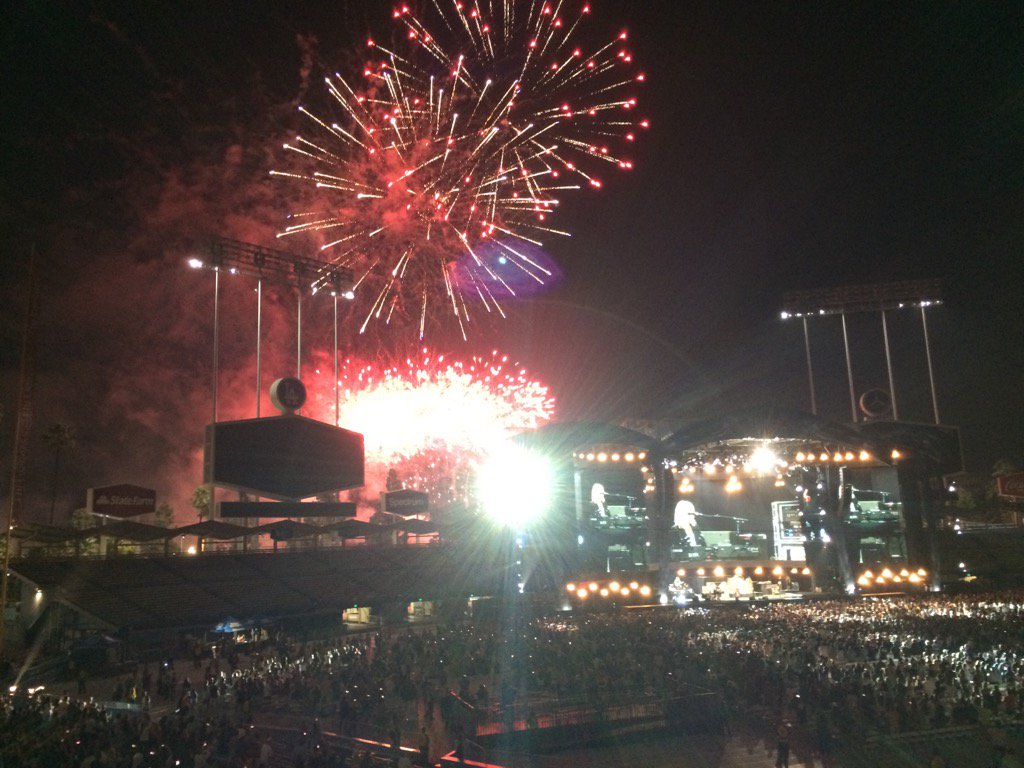
    Fleetwood Mac closed out The Classic West on a balmy Sunday evening at Dodger Stadium in Los Angeles. Fleetwood Mac hit the stage at around 9:00 p.m. local time, following Earth, Wind & Fire and Journey, who had kicked off the Sunday night lineup.

    Stevie dedicated “Landslide” to late Eagles’ band member Glenn Frey and his son Deacon Frey, who had stepped in to perform some his father’s songs on Saturday night during The Eagles’ emotional set.

    At the end of “Don’t Stop,” the set closer, concert goers were treated to a huge fireworks display, which was appropriate for the celebratory closer.

    Fleetwood Mac will repeat their performance at The Classic East next Sunday, July 30, at Citifield in New York.

    Fleetwood Mac, The Classic West, Dodger Stadium, July 16 2017
    (Jason Minnix)
    Fleetwood Mac, The Classic West, Dodger Stadium, July 16 2017
    (Carla Manacop)
    Fleetwood Mac, The Classic West, Dodger Stadium, July 16 2017
    (Laurie Flamholtz)
    Fleetwood Mac, The Classic West, Dodger Stadium, July 16 2017
    (JC Bliss)
    Fleetwood Mac, The Classic West, Dodger Stadium, July 16 2017
    (Chrissy Eldred)
    Fleetwood Mac, The Classic West, Dodger Stadium, July 16 2017
    (Heath Hudson)
    Fleetwood Mac, The Classic West, Dodger Stadium, July 16 2017
    (KLOS FM)

    Set List

    1. The Chain
    2. You Make Loving Fun
    3. Dreams
    4. Second Hand News
    5. Rhiannon
    6. Everywhere
    7. Bleed to Love Her
    8. Tusk
    9. Sara
    10. Say You Love Me
    11. Big Love
    12. Landslide
    13. Never Going Back Again
    14. Think About Me
    15. Gypsy
    16. Little Lies
    17. Gold Dust Woman
    18. I’m So Afraid
    19. Go Your Own Way
    20. Don’t Stop

    Videos

    Much love and thanks to Dustin Blair, SoCal Music, and Whistlerskiboy for sharing these videos!

    The Chain (Whistlerskiboy)

    https://www.youtube.com/watch?v=0n4fX68Z1NQ

    The Chain (SoCal Music)

    You Make Loving Fun (Dustin Blair)

    [jwplayer mediaid=”380119″]

    You Make Loving Fun (SoCal Music)

    Dreams (Dustin Blair)

    [jwplayer mediaid=”380130″]

    Dreams (SoCal Music)

    Rhiannon (Whistlerskiboy)

    https://www.youtube.com/watch?v=UJYC2rPyGoI

    Tusk (SoCal Music)

    Landslide (SoCal Music)

    Gypsy (SoCal Music)

    Gold Dust Woman (SoCal Music)

    Go You Own Way (Whistlerskiboy)

    https://www.youtube.com/watch?v=z9CL7mUO1OU

    Don’t Stop (Tanner Stauss)

    Twitter Feed

    https://twitter.com/MartinjDuran/status/886826501844328448

    https://twitter.com/bainofyrexstnce/status/886809792311959552

    https://twitter.com/dimond_andrea/status/886808555805827072

    https://twitter.com/thenamescliff/status/886807852764905473

    https://twitter.com/alracwashere/status/886807583725559809

    https://twitter.com/castro_alli/status/886807310634409984

    https://twitter.com/stringertiffany/status/886807213020291074

    https://twitter.com/BritRick09/status/886805054849662976

    https://twitter.com/misslbf/status/886804617379446784

    https://twitter.com/RayMartinez/status/886802169453608960

    https://twitter.com/Stenomama11/status/886801210581196801

    https://twitter.com/oliiviiaa__/status/886799603672072192

    https://twitter.com/VanessaWood_/status/886790432801280000

    https://twitter.com/alequiaa/status/886789050950066176

    https://twitter.com/itscarinae/status/886787044730519552

  • VIDEOS: Fleetwood Mac Live @1982 US Festival

    VIDEOS: Fleetwood Mac Live @1982 US Festival

    Watch newly reissued footage of Fleetwood Mac performing at the 1982 US Festival. The footage comes from the tentatively titled The US Festival 1982 – A Feature-Length Documentary, currently being produced. A Kickstarter campaign has helped fund the independent project.

    Don’t Stop (released on FleetwoodMacVEVO July 10, 2017)

    Dreams (released on FleetwoodMacVEVO June 19, 2017)

    Gypsy (released on FleetwoodMacVEVO June 20, 2017)

  • Classic Rumours Five plan global tour for 2018

    Fleetwood Mac will be reuniting with Stevie for a global tour, according to a new report. The most famous band lineup will begin rehearsing next March, with tentative plans to be on the road by June 2018.

  • REVIEW: Fleetwood Mac – Tango in the Night [Deluxe Edition]

    REVIEW: Fleetwood Mac – Tango in the Night [Deluxe Edition]

    Fleetwood Mac, Tango in the Night, Neal Preston
    (Neal Preston)

    FLEETWOOD MAC
    TANGO IN THE NIGHT
    Warner Brothers (3-CD, LP, DVD Box Set)

    **** (4 stars out of 5)

    Five years on from their last album, Mirage and 10 years after Rumours, Fleetwood Mac were more-or-less in tatters when they re-emerged in 1987. Lindsey Buckingham was in the throes of a new solo album, Stevie Nicks in the grip of all manner of personal problems, Mick Fleetwood and the McVies were living their own lives. If Tango in the Night was not a contractual obligation that they had no choice but to fulfill, then it’s hard to imagine why they even thought they could make a record.

    Actually, the answer to that is simple — Christine McVie did a TV program, Fleetwood and Buckingham joined her for the occasion and between them they hatched what was simultaneously one of the most anticipated albums of the age and, once past the admittedly sizable fan club, one of the most unnecessary. 1987 was the year of hair metal et al. Who cared about Fleetwood Mac?

    Even today, Tango is viewed less as the final installment of that imperious succession of monsters that this latest incarnation of the band had released, and more as the first in the run of “who cares?” sets that wound down the band’s original career (Behind the Mask and do-you-even-remember Time followed it up.)

    And yet… song for song, performance for performance, Tango in the Night is one of the strongest albums in the band’s entire canon. Be honest — even Fleetwood Mac (1975) and Rumours have the songs you skip on the occasions you play them; Tusk is only perfect if you weed out one-third of its bodyweight; and Mirage… well, it’s Mirage, isn’t it.

    Tango, though, defiantly boasts just two truly deplorable songs, and as they are both the work of Ms. Nicks (“Welcome to the Room… Sara” and the positively wretched “When I See You Again”), we will accept that she maybe wasn’t in the best place for the sessions… and, according to the liners, wasn’t even in the room for more than a couple of weeks.

    Even the love grunts that punctuate “Big Love” were recorded by Lindsey and Christine, and then sped up to a Nicksian pitch, and on the subject of “Big Love,” it’s peculiar the way history has written it off as little more than a barrage of snorting, to which a half-written song has been painfully grafted. Because, listened to again, it’s great and, if you can overlook the retching, it’s a nigh-on perfect locomotive rocker, and second only to the title track in terms of intensity.
    Tango in the Night itself is phenomenal, an anguished guitar work-out that harks back to the Peter Green-era “Green Manalishi” in terms of deliverance and release, and makes you wish that this was the side of Fleetwood Mac that snagged the headlines… add “I’m So Afraid,” “The Chain” and “Tusk” to the line-up and there’s barely another band on earth can touch Mac for that earthy, emotional ooomph.

    Christine McVie, too, seems more than usually inspired; the songs on which she takes at least a co-credit (the hits “Everywhere” and “Little Lies,” and three tracks written with Buckingham) include some of her finest ever Mac contributions, with “Mystified” maybe her best of all time. And, while the production (very ’80s, as you’d expect) might well have painted over a lot of the cracks that had obviously splintered the quintet, a second disc of demos and alternates (and a couple of B-sides) reinforces the strength of both songs and players. The “full version” of album closer “You and I, Part II,” now sensibly subtitled “Part 1 and 2,” is consummate Fleetwood Mac; a song that effectively incorporates everything that had made them so magical for the past 12 years. What better way could there have been to conclude this phase of the group’s existence?

    The remainder of the deluxe box set, in comparison to those that preceded it, feels sparse but really, it isn’t. One disc rounds up the various 12-inch mixes that accompanied the album’s five singles; another serves up the promo videos and a lush 5.1 mix of the album; and finally, the original LP is present on vinyl, and a lovely job they made of it.

    Yes, the liners could have been more expansive, delving deeper into the triumphs and tragedies that we know accompanied the sessions… and for heaven’s sake, how many times did the author need to refer to the band’s career as a dance? Across a touch over two pages, Tango becomes “the last dance,” “a graceful turn in the extended dance,” “a complex moment” in a “complicated dance” and, of course, we are still being moved by the band’s “dance with history.” Which makes you wonder which of their albums is next for the beautifully boxed, deluxe-o-rama treatment? Well, it probably won’t be Time. The one after that, on the other hand…

    Dave Thompson / Goldmine / June 2017 (p34)

  • Happy Record Store Day!

    Happy Record Store Day!

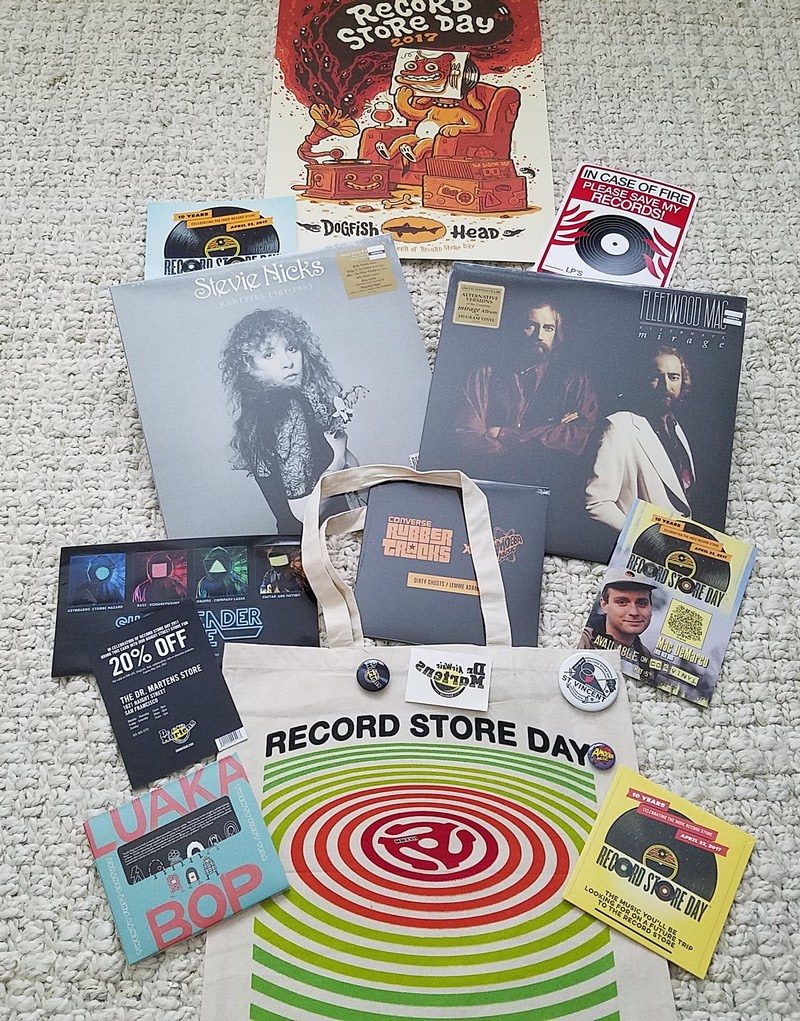
    April 22 is Record Store Day! Special vinyl editions of Stevie Nicks’ and Fleetwood Mac’s recent catalog reissues have been released for the special occasion.

    Stevie Nicks Rarities features six tracks from the deluxe editions of Bella Donna and The Wild Heart; while Fleetwood Mac’s  Alternate Mirage compiles 12 different studio takes from the 2016 deluxe edition of Mirage. Record Store Day initially reported that Rarities would be pressed on 10″ vinyl, but both releases turned out to be issued on standard 12″ vinyl.

    Rarities will be limited to 5000 copies and Alternate Mirage, 6500 copies. Get both releases from participating stores or independent sellers on eBay.

    Stevie Nicks, Rarities, Fleetwood Mac, Alternate Mirage,, Record Store Day, April 21 2017

    Stevie Nicks, Rarities, Record Store Day, April 21 2017

    Fleetwood Mac, Alternate Mirage,, Record Store Day, April 21 2017

  • REVIEW: Fleetwood Mac Tango in the Night (Deluxe Edition)

    REVIEW: Fleetwood Mac Tango in the Night (Deluxe Edition)

    The music of Fleetwood Mac could fairly be said to define the 1970s – in all its style, tumult, and excess.  Where did that leave the union of Mick Fleetwood, John McVie, Christine McVie, Stevie Nicks, and Lindsey Buckingham once a new decade emerged?  1982’s Mirage found Fleetwood Mac trying to recapture the magic of 1977’s epochal Rumours, and succeeding in large part.  Yet Mirage felt as if it firmly had one foot planted in the previous decade.  With its belated follow-up, 1987’s Tango in the Night, the band embraced the 1980s and created an album for all time.  In true Mac fashion, the group was also dissolving in the process.  Now, Tango in the Night is the fourth of their albums to receive a multi-format reissue campaign from Warner Bros. Records and Rhino including a slipcased 3-CD/1-DVD/1-LP Deluxe Edition box set.

    The tango, is of course, a dance characterized in part by “stylized body positions” per Merriam-Webster – or an “interaction marked by a lack of straightforwardness.”  Both of those definitions have bearing on the Mac’s nocturnal dance, as producer-arranger Buckingham and longtime co-producer Richard Dashut crafted a stylish and beguiling set of textured, varied soundscapes that could hardly be called straightforward; note even the lurking, ominous eyes in the otherwise-tranquil, Henri Rousseau-inspired cover artwork.  The productions embraced the technological advances of the late 1980s and the prevailing, synthesized radio-friendly sound, while crucially never ignoring that Tango in the Night was a “band” record.  It may not be as conceptual as Rumours or as boldly experimental as Tusk, but Tango remains a potent collection nonetheless.

    Seven of the twelve songs on Tango were, in full or in part, penned by Lindsey – betraying its roots as a solo album.  The pulsating opener “Big Love” is quintessential Buckingham, with the band offering taut accompaniment to his vocals, guitar and Fairlight sampler.  Both utterly contemporary and appropriately edgy, with Buckingham providing the provocative male and female utterances that are a key part of the track’s rhythm, it became one of Tango‘s six (!) singles and made it all the way to the top five of the Hot 100.  “Caroline” is an impressionistic and mysterious ode to, or warning about, a captivating woman, driven by its thick, heavy and percussive drum sound.  Title track “Tango in the Night” captures Buckingham’s mastery at creating a sonic atmosphere as it shifts from calm to restive, a soft ‘n heavy mélange of rumination.  “Family Man” is a gentler composition with its simple lyric statement of “I am what I am/A family man…”

    Three tracks were co-written by Buckingham and McVie, who are currently preparing for the release of their first joint album, simply entitled Lindsey Buckingham Christine McVie.  Their swooning “Mystified” is a gentle, lightly tropical oasis on Tango, while the rocker “Isn’t it Midnight” (co-written with Eddy Quintela, McVie’s then-husband) is a cool depiction of a roguish figure.  The gleaming, uptempo “You and I (Part II)” has sweetness and longing in equal measure.  (Part I of the song was released on a non-LP single; while that edited version isn’t present on the Deluxe Edition, the combined full version of Parts I and II can be found on Disc Two.)

    In David Wild’s typically excellent liner notes to this reissue, Stevie Nicks notes that “Christine is the hit songwriter in Fleetwood Mac.”  Indeed, McVie penned the album’s two chart-topping and arguably most enduring hits: the shimmering romantic declaration “Everywhere” (No. 1 AC/No. 14 Pop) and the bittersweet, insistent “Little Lies” (No. 1 AC/No. 4 Pop).  The latter was also penned with Quintela.  Both songs proved undoubtedly that Fleetwood Mac, a decade post-Rumours, were still indisputably a force with which to be reckoned.

    Stevie Nicks’ three major contributions to Tango all showed different aspects of her strong personality despite the fact that she wasn’t closely involved with the album’s creation.  “Seven Wonders,” predominantly written by her friend Sandy Stewart, is a wistful reflection with a big hook, given a strong pop-rock sheen in Buckingham and Dashut’s production.  Nicks brought Gone with the Wind imagery to “Welcome to the Room…Sara,” a personal account of her stay at the Betty Ford Center.  Though the lyrics are typically enigmatic, the emotional underpinning shines brightly.  The tender “When I See You Again” boasts both gravitas and intimacy as a duet performed by famous ex-lovers Nicks and Buckingham.

    An entire disc of Demos, Alternates, and B-Sides is available as part of the Deluxe Edition or the 2-CD iteration, and as per usual in this series, these rarities are exceptional finds.  All of the tracks are previously unreleased other than the B-sides: Tango yielded four unique flipsides including Buckingham’s “Down Endless Street,” Buckingham and Nicks’ “Book of Miracles,” and Buckingham and McVie’s “You and I (Part I)” and “Ricky.”

    “Book of Miracles” is Lindsey’s instrumental arrangement of Stevie’s “Juliet,” which subsequently appeared in a different, full version with lyrics on her 1989 solo album The Other Side of the Mirror.  “Juliet” itself is heard in a raw, rocking run-through version, too, as well as a demo of Nicks’ “Ooh My Love,” which would also find its way to The Other Side.  Listen for Stevie’s effusive in-studio chatter following “Juliet” for an extra bit of fun.

    Of the alternate versions, an early take of “Seven Wonders” is compelling even in embryonic form, while two versions of “Mystified” – an instrumental, and a lo-fi vocal version – in tandem offer a window into the song’s creation.  The rather fully-produced demos included here are real treats, as well.  “Tango in the Night” is radically different than the completed version.  There are a couple of never-before-released songs, too.  Buckingham’s “Special Kind of Love” is a slice of buoyant pop, and his and McVie’s “Where We Belong” has an in-progress feel that leads one to wonder how it would have developed had the band continued refining it.  Nicks’ “Joan of Arc,” also mooted for Tango, is not among the still-generous array of selections here.

    The Deluxe box also boasts a third disc of fourteen 12-inch remixes sure to please completists.  These reinterpretations by Arthur Baker and John “Jellybean” Benitez of five Tango tracks (“Big Love,” “Seven Wonders,” “Little Lies,” “Family Man” and “Everywhere”) don’t supplant the originals, of course, but capture a particular time and place – that of the late-1980s dance/pop scene.  Their inclusion is mightily welcome on this set.  Unlike previous releases in this series, no live concert has been included, likely because Lindsey Buckingham departed the group before the tour supporting Tango.

    The Deluxe Edition’s DVD has the album’s five era-defining music videos, and a pristine 24/96 stereo version of the album. (No surround mix was available this time around.) For listeners with the capabilities to enjoy it, this high-resolution version is the preferred way to experience Tango in the Night.  A vinyl LP of the original album only rounds out the package.  A gatefold houses the LP as well as a slots for each of the discs in a unique sleeve.

    The various components of Tango in the Night have been optimally remastered by Dan Hersch, while the previously unreleased material has been lovingly mixed by Brian Kehew with Bill Inglot, who produced the set with Steve Woolard.  David Wild provides the essay in the 12-page LP-sized booklet, drawing on fresh and revealingly candid (and often humorous!) quotes from Stevie Nicks, Lindsey Buckingham, and Mick Fleetwood.  Mick marvels at the “strange but true” story of the band, but one thing is clear listening to this revitalized Tango in the Night – that these rock-and-roll survivors could put aside their differences to come together and create something vital.  This Tango is as mysterious and beguiling as ever.

    Joe Marchese / The Second Disc / April 18, 2017

  • REVIEW: Fleetwood Mac Tango in the Night

    REVIEW: Fleetwood Mac Tango in the Night

    If you were never much of a fan of the world-beating, Buckingham-Nicks version of Fleetwood Mac, Tango in the Night was the album that bore out all your reservations. Bland, self-indulgent, easy-listening, cold, clinical, calculating, mercenary: On the surface, especially in 1987, it was all of that where the band’s previous million-sellers hadn’t quite checked all the boxes.

    Time and trends have been kind, though. Tango in the Night’s hits never really left the radio, becoming nearly as ubiquitous as those from Rumours. And a lot of what was previously dismissed as overproduction now simply sounds modern. Lindsey Buckingham, the band’s grand marshal, has been given his rightful place among rock’s bonafide Creative Geniuses. The climate is ripe for critical reassessment.

    Fair enough, but let’s not get ahead of ourselves.

    From a cynical perspective, Tango in the Night is the sound of a band doing exactly what it had to do in order to reclaim lost sales (the preceding Mirage and Tusk had sold mere millions rather than tens of millions), please record company execs and radio programmers alike, and keep pace with then-current trends.

    The whole thing has a gauzy, digital coating that comes from a combination of cold professionalism and heavy reliance on technology. It’s all right there in the two most enduring radio hits, “Everywhere” and “Little Lies”. Both Christine McVie compositions, they are the very embodiment of adult-oriented, FM-radio easy listening. Where McVie’s previous unabashed love songs felt endearing and sweet, these feel slight and rote. McVie and her bandmates seem like mere vehicles that are necessary for the technology and production to flow through. To a cynic, “Everywhere” and “Little Lies” have stuck around for their utility. When there are no more FM radio stations or waiting rooms around not to offend anyone, they will finally go away.

    Those specific hits are emblematic of the album as a whole. The other tracks are either second-tier versions of them or toned-down versions of Buckingham’s whimsical indulgences.

    But it all works. Each track is so listenable, so much a ready-made, state-of-the-1987-art symbol of the Fleetwood Mac you know and love, that the whole collection takes on an additive power. Yes, this is Fleetwood-Mac-by-numbers, but it is the best Fleetwood-Mac-by-numbers you could possibly imagine. Which, even 30 years later, is preferable to a lot of other pap on the radio.

    The project that became Tango in the Night began as a Lindsey Buckingham solo album, which is its saving grace. His arranging skills and attention to detail make the even boilerplate material interesting. Take away the twinkling harp on “Everywhere”, the tinkling xylophone on “Mystified”, or the sneering backing vocals on “Little Lies”, and the songs hardly demand to be heard twice, much less a hundred times.

    Stevie Nicks did not have much involvement in Tango in the Night, as she was busy with her solo career and averse to recording in ex-lover Buckingham’s home studio. When she does show up, she sounds disheveled. This quality works to the band’s benefit on “If I See You Again”, one of those vulnerable Nicks ballads. When Buckingham takes the vocal at the end, it is easily the album’s most poignant moment for anyone familiar with the pair’s turbulent history.

    For his part, Buckingham picks up the slack and delivers a solid set of songs. “Caroline” remains one of the most fun, sing-along-inducing melodies he has written. The sultry title track, while not subtle, features some of his most scorching guitar work. It also lends the album some much-needed dynamics. “You and I, Part II” is breezy yet laced with regret. In hindsight, it is easy to hear Buckingham trying out techniques that would serve him very well in his subsequent solo work.

    This “30th Anniversary” edition of Tango in the Night has an excellent audio remaster to recommend it. It can’t remove some of the dated synth sounds, but it does get rid of a lot of that gauzy coating and add more dimension and definition. The second disc, with outtakes and demos, offers few revelations aside from a couple nice Buckingham/McVie tracks that were shelved. The Deluxe version adds 12” remixes from Arthur Baker, videos, hi-def audio, and vinyl.

    Yes, on the surface Tango in the Night confirms every troubling notion about the world-beating version of Fleetwood Mac. But this well-done reissue also reaffirms a surprising number of the strengths that got them to that position.

    Fleetwood MacFleetwood Mac
    Tango in the Night
    Warner Bros.
    US: 31 MAR 2017

    Rating: 7/10


    John Bergstrom / Pop Matters (UK) / 12 April 2017

  • REVIEW: Fleetwood Mac Tango in the Night (Deluxe Edition)

    REVIEW: Fleetwood Mac Tango in the Night (Deluxe Edition)

    Fleetwood Mac’s peak occurred between 1975 and 1977, when the band—reinvigorated by the addition of Lindsey Buckingham and Stevie Nicks—issued an eponymous album and Rumours. Many critics viewed the 1979 follow-up to the latter LP, Tusk, as a bit of a disappointment, and after that it was all supposedly downhill—way downhill.

    I’m not buying this party line, as I’ve noted in my reviews of deluxe reissues of Tusk and 1982’s Mirage. I think those albums were largely terrific, and I can say the same about 1987’s Tango in the Night. I’m probably not alone in rejecting the critical consensus about Tango, moreover, since the CD has sold more than 15 million copies and ranks as the second-bestselling album of the group’s career (after Rumours).

    The record, which started out as a Buckingham solo project and wound up being his last album with the group, has now joined the Fleetwood Mac reissue series. And, like its predecessors in that series, this repackaging lives up to its “deluxe” billing. Three CDs respectively deliver a 2017 remaster of the original album; 13 B-sides, demos, and early and alternate versions; and more than a dozen 12-inch mixes of five Tango tracks. There’s also a DVD that includes videos for five of the tunes and a high-resolution stereo mix of the LP; and, for those who miss the pre-digital era, a vinyl record that contains the 2017 remaster. If all that’s not enough to keep you busy, you can turn to the enclosed oversized booklet, which features an essay about the album, plus lyrics, photos, and credits.

    The rhythmic original LP, which sounds better than ever thanks to the remaster, is loaded with pleasures, not to mention hit singles. Among the highlights: Buckingham’s “Big Love,” which gives Donna Summer’s “Love to Love You Baby” a run for its money in the sensuality department; and such ear candy as “When I See You Again” and “Seven Wonders,” both with passionate Stevie Nicks vocals; and the sublime “Everywhere,” “Little Lies,” and “Mystified,” all sung by Christine McVie. Songs like these leave no doubt that Fleetwood Mac were masters of melody and production and that any one of its three vocalists would have been enough to make another band famous. A few tracks, such as “Family Man,” deliver more studio wizardry than emotion but the bulk of this material is the real deal.

    Disc two is stronger than you might expect. “Down Endless Street” is as catchy as anything on the original album and, while you can see why Tango’s versions improved on some of the outtakes and demos here, they’re virtually all interesting and well-executed.

    It’s difficult to be as enthusiastic about disc three, which dilutes everything that’s special about Fleetwood Mac by introducing disco beats and embellishments. If you’re nostalgic for Studio 54, this is the record for you. If not, you’ll likely prefer the songs on the original album.

    I have mixed feelings about the DVD. It’s good to see the videos—which feature “Big Love,” “Seven Wonders,” “Little Lies,” “Family Man,” and “Everywhere”—but it would have been better to have some concert material from the period; what we have here instead are pretty visuals accompanied by a lip-synching band. As for the high-resolution version of the album on the DVD, it sounds even better than the CD; but it would have sounded better still if it were a 5.1 surround mix.

    Happily, the album is being made available in several formats. Casual fans can opt for a single CD with the remastered album, though I’d recommend that listeners seriously consider a two-CD package that incorporates the disc of outtakes and other rarities. The everything-but-the-kitchen-sink edition described above is a somewhat more debatable (and, of course, pricier) purchase, but if you’re a big fan of the group, you might well be glad to have it.

    Jeff Burger / The Morton Report / April 3, 2017