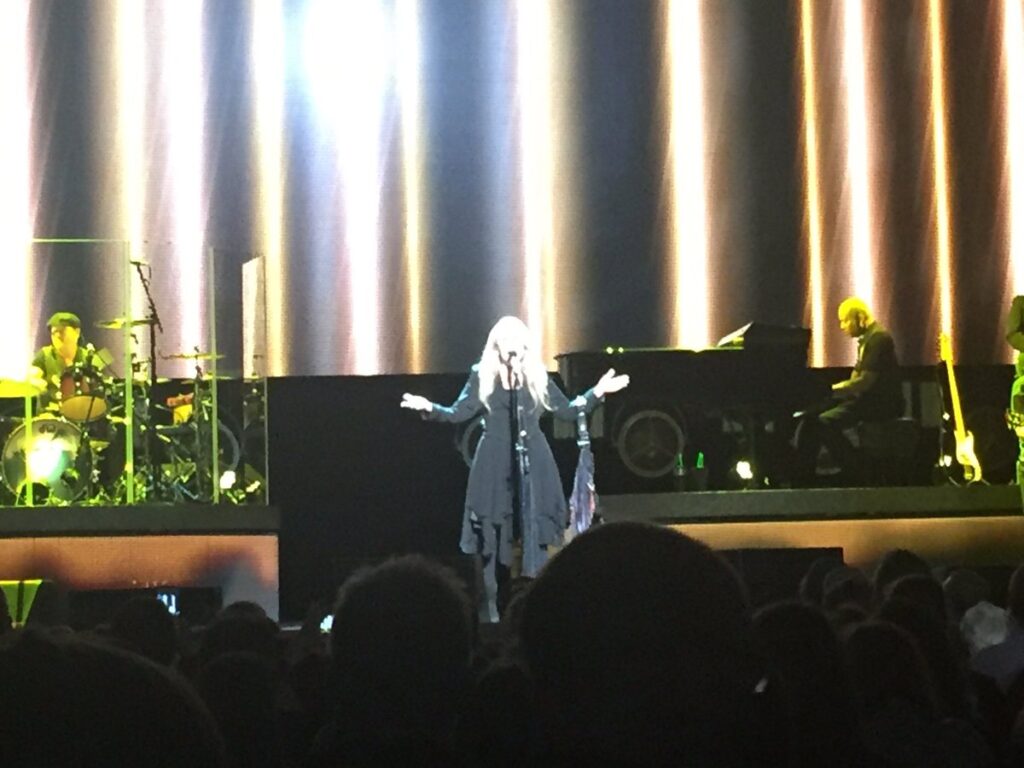
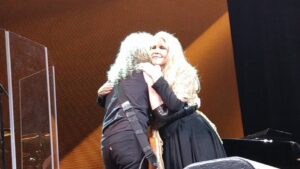
On Friday night, Stevie Nicks performed at the Mohegan Sun Arena in Uncasville, CT — the 16th show of the 24 Karat Gold Tour.
Videos
Much love and thanks to DewdRocks, Adam Kearns, and TheSkuncle for filming and sharing these wonderful videos!
Opening comments (TheSkuncle)
Stop Draggin’ My Heart Around feat. Chrissie Hynde (TheSkuncle)
Belle Fleur story
“You can’t bring your boyfriend with you because, if you don’t have a job up here, you don’t get to go. It’s not cool. Um, so, I had this picture in my mind of me in the very beginning when I was so like, so taken with the guy that I was driving around in a, in a Toyota…and now I’m driving in a big, long, black, fantastically beautiful limousine… So I would say to myself in, in my painting, walking down a path from the house, waving, kinda turning around, waving to my boyfriend, getting in the car, and knowing that the relationship is for all practical purposes over because you’re not coming home for six months, maybe a year. You can never actually tell somebody how long the tour’s gonna go so, anyway, it was my picture, my little painting, and it’s called ‘Belle Fleur.’”
Got a chance to rock out with my mom at @StevieNicks concert. Beautiful tribute to Prince. Celebrating love and thanksgiving ✨ pic.twitter.com/4D3ukGiw9N
Her generous songs provide an antidote to today’s often embattled pop music.
The cover of Bella Donna, Stevie Nicks’s first solo album, shows the artist looking slender and wide-eyed, wearing a white gown, a gold bracelet, and a pair of ruched, knee-high platform boots. One arm is bent at an improbable angle; a sizable cockatoo sits on her hand. Behind her, next to a small crystal ball, is a tambourine threaded with three long-stemmed white roses. Nicks did not invent this storefront-psychic aesthetic—it is indebted, in varying degrees, to Hans Christian Andersen’s Thumbelina, de Troyes’s Guinevere, and Cher—but, beginning in the mid-nineteen-seventies, she came to embody it. The image was girlish and delicate, yet inscrutable, as if Nicks were suggesting that the world might not know everything she’s capable of.
This intimation is newly germane: a vague but feminine mysticism is in. Lorde, Azealia Banks, FKA Twigs, chvrches, Grimes, and Beyoncé have all incorporated bits of pagan-influenced iconography into their music videos and performances. Young women are now embracing benign occult representations, reclaiming the rites and ceremonies that women were once chastised (or worse) for performing. On runways, on the streets, and in thriving Etsy shops, you can find an assortment of cloaks, crescent-moon pendants, flared chiffon skirts, and the occasional jewelled headdress.
While Nicks’s sartorial choices have been widely mimicked, it’s rare to hear echoes of her magnanimity in modern pop songs, which are frequently defensive and embattled, preaching self-sufficiency at any cost. It’s difficult to imagine Nicks singing a lyric like “Middle fingers up, put them hands high / Wave it in his face, tell him, boy, bye,” as Beyoncé does in “Sorry,” a song from her newest album, Lemonade. Nicks’s default response to betrayal is more introspective than aggressive. Her music has long been considered a balm for certain stubborn strains of heartache; her songs are unsparing regarding the brutality of loss, yet they are buoyed by a kind of subtle optimism. It’s as if, by the time Nicks got around to singing about something, she already knew that she would survive it.
This month, Bella Donna, from 1981, and Nicks’s second solo album, The Wild Heart, from 1983, are being reissued. Nicks was thirty-three when Bella Donna was released. Though its cover might not suggest an excess of reason, in its songs she is a sagacious and measured presence. Her acknowledgment of the heart’s capriciousness is gentle, if not grandmotherly. There’s surely no kinder summation of love’s petulance than the chorus of “Think About It,” a jangling folk song about taking a breath before hurling yourself off a metaphorical cliff. “And the heart says, ‘Danger!’ ” Nicks sings. She pauses briefly. “And the heart says, ‘Whatever.’ ” For anyone busy self-flagellating over an error in judgment, this can feel like a rope ladder thrown from above—an invitation to scramble up and out of despair. It is generous and knowing, and offers a clear-eyed conclusion: some things can’t be helped.
In 2012, Tavi Gevinson, the young founder of Rookie, an online magazine concerned chiefly with the complexities of teen-age girlhood, ended a tedx talk with some blunt advice: “Just be Stevie Nicks. That’s all you have to do.” What does it mean to be Stevie Nicks? To understand loss and longing as being merely the cost of doing business? To acknowledge the bottomless nature of certain aches, yet to know, in some instinctive way, that you’ll keep going? Nicks evokes Byron, in spirit and in certitude: “The heart will break, but broken live on.”
Nicks was born in 1948, in Phoenix. Her paternal grandfather, A. J. Nicks, Sr., was a struggling country musician, and he taught Nicks how to sing when she was four years old. She was given an acoustic guitar for her sixteenth birthday, and immediately wrote a song called “I’ve Loved and I’ve Lost and I’m Sad but Not Blue.” The title is a surprisingly succinct encapsulation of Nicks’s lyrical alchemy: a combination of acceptance (I am hurting) and perspective (I will not hurt forever).
In 1966, when Nicks was in her senior year of high school and living in Atherton, California—her father, an executive at a meatpacking company, had been relocated there—she met the guitarist Lindsey Buckingham at a party. He was sitting cross-legged on the floor—bearded, curly-haired, and strumming the Mamas and the Papas’ “California Dreamin’.” Uninvited, she joined him in harmony. (“How brazen!” she later said.) Buckingham asked Nicks to join his band, Fritz. By 1971, the two were romantically involved. They eventually took off for Los Angeles, where they tried to make it as a duo, called Buckingham Nicks, releasing one album, in 1973, to very little acclaim. Not long afterward, Buckingham was asked to join Fleetwood Mac, a British blues band featuring the singer and keyboard player Christine McVie, the bassist John McVie, and the drummer Mick Fleetwood; the group was being rebooted as an American soft-rock act. Buckingham insisted that Nicks be invited, too. She ended up writing two of the band’s biggest early hits, “Landslide” and “Rhiannon.”
Extraordinary success often leads to spiritual dissolution, and Fleetwood Mac had its share of psychic turmoil. In 1975, Fleetwood divorced his wife, the model Jenny Boyd, after she had an affair with one of his former bandmates. Nicks and Buckingham broke up the following year. Around the same time, John and Christine McVie’s marriage collapsed. There was an ungodly amount of brandy and cocaine on hand to help nullify the despair. Still, in 1977, Fleetwood Mac—now five wild-eyed, newly single people—released Rumours, a collection of yearning songs about love and devotion. The record spent thirty-one weeks at the top of the charts, and is one of the best-selling albums in American history.
(Norman Seef)
Tusk, which the group released two years later, was a bombastic double LP that cost a million dollars to produce. The critic Stephen Holden, in his review of the album for Rolling Stone, suggested that Nicks sounded “more than ever like a West Coast Patti Smith.” Superficially, at least, Nicks and Smith aren’t obvious analogues. Nicks is hyperfeminine, intuitive, and bohemian; Smith is androgynous, cerebral, and gritty. But both are unusually perceptive chroniclers of their time and place.
If Smith is obliged to the Lower East Side of Manhattan—and the punk scene that included the Ramones, Television, and Suicide—Nicks’s debt is to Laurel Canyon, and to the sentimental, silky-voiced artists who emerged from L.A. in the late sixties and early seventies. Some of those acts—James Taylor, the Eagles—are now considered, fairly or not, irrelevant to the Zeitgeist: too mellow, too affluent, too sexless, too white. Candles and incense and macramé plant hangers; wistful thoughts about weather. Nicks’s lyrics often worry over domestic or earthly concerns—gardens, mountains, flowers, the seasons—and how they might affect the whims of her heart. “It makes no difference at all / ’Cause I wear boots all summer long,” she sings in “Nightbird.” When compared with the dissonant and provocative music coming out of downtown New York, the California sound could seem limp. But the scene in Laurel Canyon was tumultuous. Many of its artists—including, at various times, Nicks—were wrecked by drug addiction. Nicks’s voice, a strange, quivering contralto, gives her songs unexpected weight. Its tone reminds me of the gloaming—that lambent, transitional moment between night and day.
Jimmy Iovine and Stevie Nicks, 1981 (Chris Walter)
Bella Donna was produced by Jimmy Iovine, a Brooklyn-born audio engineer who worked on Bruce Springsteen’s Born to Run and produced the Patti Smith Group’s Easter and Tom Petty and the Heartbreakers’ Damn the Torpedoes. Iovine spent time in California, but his sensibility was tougher and more plainly that of the East Coast. He later became a co-founder of Interscope Records, where he helped to establish the career of the rapper Tupac Shakur, and, for a period, he oversaw the hip-hop label Death Row Records. Iovine was aware of concerns that Nicks was too coddled and immature to make a solo record as good as the records she’d made with Fleetwood Mac. Regardless, there was romantic chemistry. “This record was our love story unfolding,” she has said.
Bella Donna reached No. 1 on the Billboard chart, and produced four hit singles: “Stop Draggin’ My Heart Around,” a duet with Petty; “Leather and Lace,” with Don Henley; “Edge of Seventeen”; and “After the Glitter Fades.” The last, a country song about the travails of stardom—Nicks wrote it just after she and Buckingham moved to Los Angeles, long before she had a record deal, showing either hubris or prescience—contains organ, pedal steel, and reassurances. “The dream keeps coming even when you forget to feel,” she sings.
Nicks, like most artists, culls inspiration from disparate sources. She is prone to saying things like “ ‘Edge of Seventeen’ was about Tom Petty and his wife, Jane, my uncle dying, and the assassination of John Lennon.” But her personal life—a tangle of love affairs, often with her collaborators—informs her work in explicit ways. “Heartbreak of the moment isn’t endless,” she sings, in “Think About It.” This might seem like a billowy platitude, but if you are someone who does not think that every flubbed decision is fodder for personal growth, it is comforting to hear someone assert that nearly all mistakes can be neutralized, if not conquered. If Bella Donna contains a single directive, it’s to love freely, love fully, and hang on.
(David Montgomery)
In 1981, Iovine flew with Nicks to the Château d’Hérouville, in northern France, where Fleetwood Mac was recording its next album, Mirage. Iovine left almost immediately, to escape the interpersonal conflicts that roiled the band. Iovine and Nicks’s relationship foundered. The following fall, while Fleetwood Mac was on tour, Nicks’s childhood friend Robin Anderson died, of leukemia, at the age of thirty-three. “What was left over was just a big, horrible, empty world,” Nicks has said. Days before her death, Anderson had prematurely given birth to a son. Nicks, operating under the savage logic of grief, married her friend’s widower, Kim Anderson, thinking that she would help raise the child. They divorced three months later.
By 1983, Nicks was ready to make another record. Her relationship with Iovine was strained, but Nicks asked him to produce the record anyway. The Wild Heart is inspired in part by the unravelling of that relationship, and in part by her mourning for Anderson. Nicks frequently cites as a guiding influence for the recording sessions the 1939 film adaptation of Emily Brontë’s Wuthering Heights, which depicts an undying, almost fiendish love. Mostly, the songs are about bucking against the circumstances that separate us from the people we need.
(Herbert W. Worthington, III)
The artist Justin Vernon, of the band Bon Iver, uses a brief sample of “Wild Heart” (a track from The Wild Heart) on the group’s new album, “22, A Million.” Nicks’s voice is sped up, pitch-altered, and barely discernible as human—just a high, grousing “wah-wah,” deployed intermittently. Vernon pinched it from a popular YouTube video of Nicks, in which she sits on a stool having her makeup done, wearing a white dress with spaghetti straps. She begins to sing. Soon, someone is messing with a piano; one of her backup singers joins in with a harmony. The makeup artist gamely tries to continue with her work, before giving up. While the studio recording of “Wild Heart” is saturated, almost wet, this version is all air, all joy.
What affects me most about the video is how profoundly Nicks appears to love singing. Her voice has an undulating, galloping quality. It is as if, once it’s started up, there’s no slowing down, no stopping; the car is careering down a mountain, with no brakes. You can see on her face how good it feels just to let go.
“Stand Back,” the first single from The Wild Heart, was inspired by Prince’s “Little Red Corvette,” which Nicks heard on the radio while driving with Kim Anderson to San Ysidro Ranch, in Santa Barbara, for their honeymoon. (Prince played keyboards on the track, though he’s not credited in the album’s liner notes.) The song was produced in accordance with the style of the era, with lots of synthesizer and rubbery, overdubbed percussion. The lyrics describe a deliberate seduction followed by an acute betrayal. “First he took my heart, then he ran,” Nicks sings. The chorus is appropriately punchy: “Stand back, stand back,” she warns. Nicks is capable of going fully feral before a microphone, perhaps most famously at the end of “Silver Springs,” a song intended for Rumours and one of several that she wrote about Buckingham. (It ends with Nicks hollering, “Was I just a fool?”) On “Stand Back,” she erupts briefly, on the middle verses, but for the rest of the song she is more characteristically sanguine. “It’s all right, it’s all right,” she concedes. “I did not hear from you, it’s all right.”
Nicks went on to make six more solo albums, and three more with Fleetwood Mac. Following her divorce from Kim Anderson, she never married again, or had any children, though a rich maternal instinct runs through all her songs. This, more than anything else, may be the reason that Nicks’s work has endured—why listeners turn to her for consolation, especially now, when many feel wounded and the radio remains rife with confrontational whoops. To be Stevie Nicks is to offer shelter. ♦
Amanda Petrusich / The New Yorker / November 28, 2016
Amanda Petrusich is a contributing writer for newyorker.com, and the author of “Do Not Sell at Any Price: The Wild, Obsessive Hunt for the World’s Rarest 78rpm Records.” MORE
This article appears in other versions of the November 28, 2016, issue, with the headline “What the Heart Says.”
Scroll down for photos, videos, reviews, fan reaction, and the revised set list!
On Saturday night, Stevie Nicks performed at the Sands Event Center in Bethlehem, PA — the lucky 13th show of the 24 Karat Gold Tour.
Stevie has been telling audiences how important it is to do one wants, especially at her age. She stayed true to that advice by dropping “Dreams,” Fleetwood Mac’s only number single in the U.S, from Saturday night’s set list. The perennial favorite has been included in every major solo or Fleetwood Mac tour set list since its release in 1977. Stevie also dropped the related Bella Donna track “Outside the Rain,” another song often included in her set lists. But to the delight of the crowd, she replaced the two songs with Fleetwood Mac’s classic 1982 hit single “Gypsy.” She used the same black-and-white, projection-screen visuals featured in Fleetwood Mac’s 2014-2015’s On with the Show Tour.
During “Stand Back,” Stevie posed with the 1973 Buckingham Nicks record, which a fan had brought for Stevie to sign. (It had already been signed by guitarist Lindsey Buckingham.) A similar moment occurred during Fleetwood Mac’s On with the Show Tour, where a fan presented the album for both Lindsey and Stevie to sign.
During “Edge of Seventeen,” two fans in the front row (Vikki Carlucci and Roseanne Mughetto) gave Stevie a rose-decorated crown, which Stevie graciously accepted and wore on stage (see more photos below).
(Alexa Marie / Jasmine Leslie)
The following slideshow photos by Chris Shipley / The Morning Call
[slideshow_deploy id=’375510′]
The following slideshow photos by Matt Smith / Lehigh Valley Live
[slideshow_deploy id=’375545′](Alexa Marie / Jasmine Leslie)(Alexa Marie / Jasmine Leslie)(Alexa Marie / Jasmine Leslie)(Alyssa)(Robbie Lopez)(Alyssa)
The following photos are courtesy of Vikki Carlucci:
LOS ANGELES – Stevie Nicks has gone solo for the “24 Karat Gold Tour” playing more than two dozen arena dates in North America before the end of the year. The tour launched in Phoenix on Oct. 25 and concludes at the Forum in Los Angeles on Dec. 18. Production designer Paul Guthrie of Toss Film & Design Inc. in Minneapolis chose 88 Claypaky Mythos fixtures for the lighting rig and a grandMA2 console for show control.
Nicks’s latest tour, in support of her album, 24 Karat Gold – Songs from the Vault, launched in Phoenix and will wrap in Los Angeles. While the iconic singer/songwriter appears as a solo artist, she tapped the Pretenders to open for her – delivering a powerhouse show for ticketholders.
A veteran of Nicks’s tours, Guthrie endeavored to “create something new and a bit more modern” for her new show. “Stevie enjoys using video content so the tour features a lot of video on an LED video wall backdrop and L-shaped scenic pieces,” he explains. “Our overwhelming lighting edict is always no smoke. So we defer to lighting the band and adding in layers of light to create new looks.”
The versatility of Mythos offers myriad options to Guthrie. “It’s fun to have one light that can produce a multitude of different effects in the same head,” he says. “Mythos is basically the workhorse light in the rig.” He notes that the tour’s complement of 100-120 moving lights “is now considered a medium-size rig for an arena tour. It used to be that 16 were considered to be a lot! We’ve come a long way.” PRG’s Las Vegas office supplied the fixtures.
Eighty Mythos are mounted in the overhead lighting trusses where they form “solid lines of Mythos,” Guthrie reports. “On the downstage and mid-stage trusses they provide stage wash and beam effects. Those on the most upstage of the trusses, upstage of the video wall, create layers to add depth.”
Eight more Mythos are positioned on the floor upstage of the band “to set fire” to their dynamic performance.
Tom Wagstaff, the lighting director for the Pretenders deploys about 60 Mythos, on the downstage and mid-stage trusses, and repositions the complement on the floor, says Guthrie.
Two grandMA2 full-size consoles, one active and one back up, and two NPUs are on hand to “literally run everything that’s moving and changing on stage that’s not the actual band,” he notes. “We control all the lights, the video, the hoists and the scenic movement from the board.”
Guthrie and Chris Lose jointly programmed the show. “I had the show file from Stevie’s last solo tour and Chris had the show file from the last Fleetwood Mac tour he did. So we combined them to start then built out the file over two weeks of rehearsals at Sony in LA.”
Guthrie likes the grandMA2 for its “reliability and feature set. I’m extremely fortunate to work with a lot of very clever MA users so I’m constantly learning new tricks,” he adds.
“The ability for Chris and me to be on the board and programming was a huge advantage. In a lot of rehearsals, I was making adjustments to the file as he was running the show. I could program content while he programmed lights. That’s a massive advantage.”
For the “24 Karat Gold Tour” Thomas Mayer is the lighting crew chief and Cecil Nelson, Matt Schiller and Scott Naef are the lighting crew.
A.C.T Lighting, Inc. is the exclusive North American distributor of both Claypaky fixtures and MA Lighting products. Guthrie previously deployed Mythos on tours for Miranda Lambert and Macklemore and Lewis.
Scroll down for photos, videos, set list, reviews, and fan reaction!
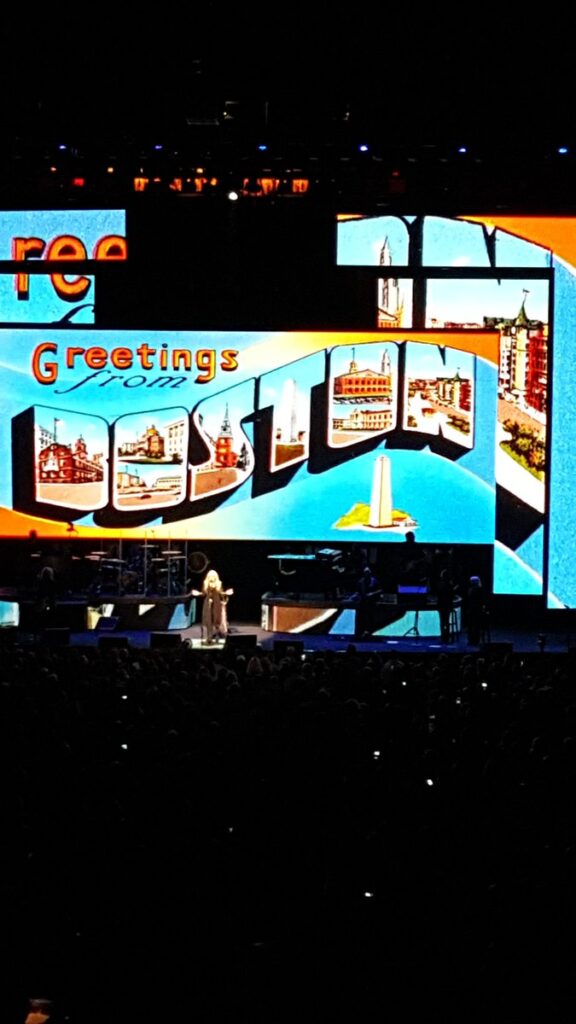
On Tuesday night, Stevie Nicks performed at TD Garden in Boston — the 12th show of the 24 Karat Gold Tour. Despite the poor weather conditions outside (heavy wind and rain), the show went on as planned.
Slideshow photos by John Wilcox / Boston Herald [slideshow_deploy id=’375471′]
Much thanks and love to Damani Barboza, Carrie C, kcarton, Matthew Creen, Michal Korpalski, Lisa Samataro, Jason Trevino, and Wide awake for sharing these wonderful videos!
Gold and Braid (Damani Barboza)
If Anyone Falls (kcarton)
Stop Draggin’ My Heart Around feat. Chrissie Hyde (kcarton)
Stop Draggin’ My Heart Around feat. Chrissie Hyde (Jason Trevino)
“This tour has made me really believe that, you know, we all really should do what we want to do. Sometimes people tell you what you should do and, where they want you to go — whether it’s your parents or your friends or your boyfriend, the girlfriends, whatever, and people have a whole lot to say about what it is that you do. And I just want to remind you that the person that knows what you should do for you the best IS YOU. And that is what I have learned in my very long life that — in my very long life — is that time passes, things pass, problems pass away, and what you are left with is you and your dreams. So take care of your dreams and make them work for you and be happy amongst your dreams and the things that you love because that’s really…when you get to be my age… I mean, I don’t feel old, even though I totally am. I don’t feel that way. I feel like I’m still wrapped in my dreams, and you should too.”
“So I love you all! You are a magnificent, magnificent city, and yes, I think I’m absolutely gonna get one of those beautiful apartments on Beacon Street. So I’ll see you there, walkin’ up and down the street. Thank you, Boston! You’ve been awesome!”
Set List
Gold and Braid
If Anyone Falls
Stop Draggin’ My Heart Around (with Chrissie Hynde & Waddy Wachtel)
Her signature style and that voice! @StevieNicks said she saw beautiful Beacon Hill from plane, thinks she should move here. Us too Stevie. pic.twitter.com/m2l6YcC9u5
When you’re a writer, you have to be very careful. We all know, especially after the last couples of years, what words do. You can’t just say shit, sorry. I know, I’m so grounded! I’m grounding myself.
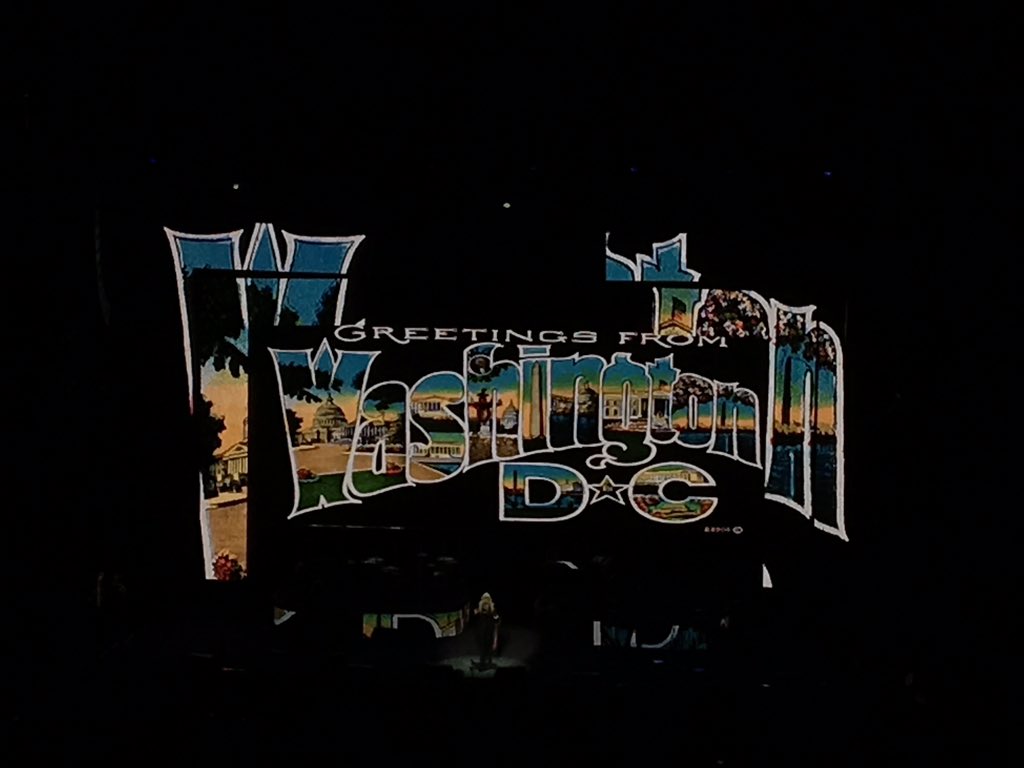
On Monday night, Stevie Nicks performed at Verizon Center in the nation’s capital, Washington DC — the 11th show of the 24 Karat Gold Tour.
Stevie has been having a lot of fun on the tour, even letting an expletive unexpectedly roll off her tongue at the DC show. While telling the story of ‘Crying in Night,’ Stevie accidentally dropped the F-bomb, saying “Why in the f*ck not?” Shocked by what she had just said, Stevie instantly covered her mouth, walked away from the mic, and paced around the stage for a few moments before returning to the center to apologize to the crowd. She told them “I never swear onstage — ever!” But the crowd didn’t seem to mind in the slightest and found Stevie’s blooper moment to be quite human and amusing. They laughed and shouted out in support ‘We love you, Stevie!’” Even guitar Waddy Wachtel walked over, with a big grin on his face, and put his arm around the clearly mortified Stevie. She managed to compose herself and continue telling the story. (See the full clip below).
Much thanks and love to Paige Collyer, Enjoy Life with Me, Nadine Hughes, Sandy Mac, Dianne King-McGavin, and Stevie Nicks concert videos for sharing these wonderful videos!
Wild Heart / Bella Donna (Sandy Mac)
Enchanted (Stevie Nicks concert videos)
https://www.youtube.com/watch?v=bK6nygIG4zI
Moonlight (A Vampire’s Dream) (Enjoy Life with Me)
Crying in the Night – ‘Why in the f*ck not?’ (Dianne King-McGavin)
“…other people won’t like it. So maybe we shouldn’t do it. And finally, we’re like, ‘Why in the fuck not?’ Lynn Fleetwood, I know you’re out there. Do not tell anybody that you heard that. I do not swear onstage — ever. I swear in my regular life, but I do not ever swear onstage so I am…let me apologize for that.
Anyway, I did say basically that. So we just decided, OK, let’s do it, why not? Without using the expletive. So anyway, it’s uh a very, it’s cool song. I have no idea what in the world at 21, 22-years old what the hell these uh…that’s not a swear word. That’s just, you know, a place. Um, I think that it’s uh I can’t figure out what in the world I wrote it. I must have seen a movie or something that I wrote it about because it’s very interesting…intriguing words. So anyway, here it is, ‘Crying in the Night.’”
Edge of Seventeen (Paige Collyer)
https://www.youtube.com/watch?v=uDy8VzoqAIc
Leather and Lace (Nadine Hughes)
Set List
Gold and Braid
If Anyone Falls
Stop Draggin’ My Heart Around (with Chrissie Hynde & Waddy Wachtel)
Much love and thanks to Childfree diANe, Elaine Cooper, Denny Henson, S Martin, Music Madness, Greg Perry, and rhiannon1119 for sharing these wonderful videos!
Gold and Braid (Music Madness)
Stop Draggin’ My Heart Around feat. Chrissie Hynde (Music Madness)
“This next song was written song by Tom Petty, and uh, he let me have this song for the first single of the Bella Donna record and had he not given me this song, I have to say, we might not even be standing here tonight. So every time I hear this song, I feel like, ‘Thank you, God. Thank you, God, for Tom Petty.’ So… So thank you, God, for Tom Petty!”
Chrissie Hynde after the song: “She would SO be here without Tom Petty!”
Belle Fleur (Music Madness)
“Next song is about, um, was written probably in around, around mid-1979 and it was… I had just been in Fleetwood Mac long enough to understand that I was pretty famous and I had a good job and, um, I went on tour a lot and if you happen to have a boyfriend, um, you had to leave. So most relationships in those days ended when tours began because you had no choice and you couldn’t certainly take your boyfriend with you. This is what they say on the road: ‘If you don’t have a job, you can’t come,’ especially if you’re a guy coming with a girl singer. So that’s not gonna work. So anyway, this song was kind of written about, in my little, you know, metaphorical mind, of me walking out down the path to the giant long limousine, which I loved from the very beginning, um, and say goodbye. Turning around and waving and saying goodbye and knowing that you’re not gonna come back for a really long time and probably when you do, the relationship is gonna be over. However, you’re going on tour so it’s such a good thing. So anyway, this song’s called ‘Belle Fleur.’ That means beautiful flower…fleur, fleur, fleur.”
Dreams – partial (S Martin)
Wild Heart / Bella Donna (Music Madness)
Wild Heart / Bella Donna (rhiannon1119)
Enchanted (Greg Perry)
New Orleans – intro (Music Madness)
Starshine (Music Madness)
Moonlight – intro (Music Madness)
Stand Back (Greg Perry)
Stand Back story (Music Madness)
Crying in the Night (Greg Perry)
“When Lindsey and I first came to Los Angeles, it was like 1971, and we kind of arrived here with 12 songs that became the Buckingham Nicks songs. The first thing we did was move in with our producer Keith Olsen, much to his like, ‘Oh, great,’ and met Waddy Wachtel. So Waddy started talking to us with our music and we finished this amazing record called Buckingham Nicks. And there was song on it that was gonna be like the single. We’re not sure if anyone even heard this song. We’re actually not even sure if anybody on the West Coast ever heard the record. But he’s been saying to me for many years, ‘Stevie, we should do the song.’ And I’m like, ‘Well, I don’t know, you know. It is on Buckingham Nicks and maybe Lindsey wouldn’t like it.’ And so we never did, and finally this time, ‘Let’s do it. Why not?’ So anyway, this is it. And it’s very old, and when the songs over, I’m gonna tell you actually like how old it is. It’s called ‘Crying in the Night.’”
Crying in the Night (rhiannon1119)
If You Were My Love (Music Madness)
Band Introductions (Music Madness)
Edge of Seventeen (Childfree diANe)
“Hey, what song did you take out…!” (Music Madness)
Rhiannon (Elaine Cooper)
Rhiannon (Childfree diANe)
https://www.youtube.com/watch?v=PQdASSjoczE
Leather and Lace (Music Madness)
Leather and Lace (rhiannon1119)
Final comments (Denny Henson)
Set List
Gold and Braid
If Anyone Falls
Stop Draggin’ My Heart Around (with Chrissie Hynde & Waddy Wachtel)
Belle Fleur
Outside the Rain/Dreams
Wild Heart/Bella Donna
Enchanted
New Orleans
Starshine
Moonlight (A Vampire’s Dream)
Stand Back
Crying in the Night
If You Were My Love Band introductions
Gold Dust Woman
Edge of Seventeen Encores
Rhiannon
Leather and Lace
STEVIE NICKS PLAYED THE BEST SHOW IVE EVER WITNESSED.
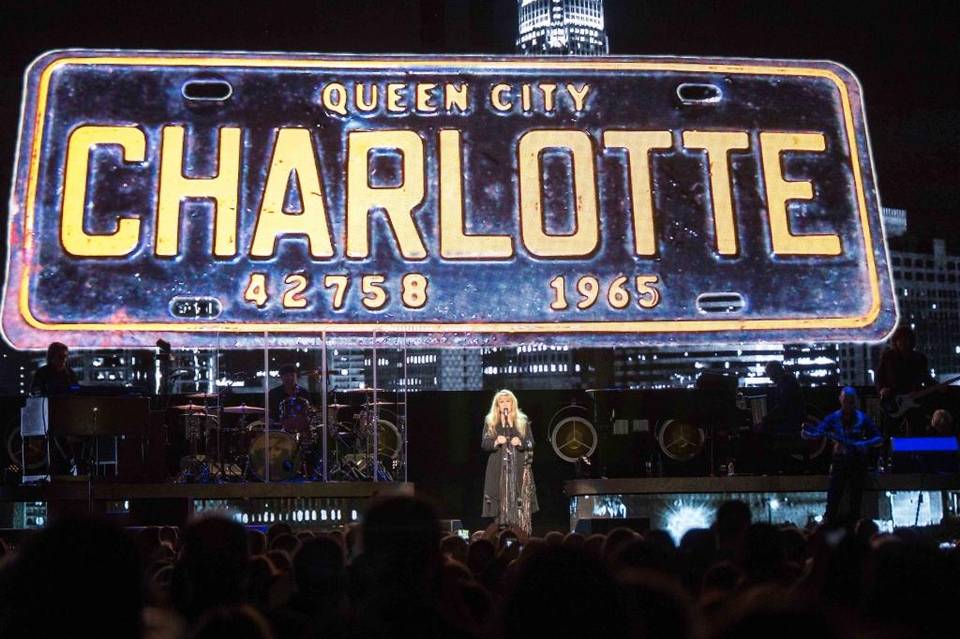
On Thursday, Stevie Nicks performed at the Spectrum Center (formerly Time Warner Cable Arena) in Charlotte, North Carolina — the ninth show of the 24 Karat Gold Tour.
(Benjamin Robson / Charlotte Observer)(Benjamin Robson / Charlotte Observer)(Benjamin Robson / Charlotte Observer)(Benjamin Robson / Charlotte Observer)(Lisa Barnes)(Liz Pfeffer)(Scoop Charlotte)
Videos
Much love and thanks to CLT ure, Goalisoul, Bobby Padgett, and PochaHiness8 for filming and sharing these videos!
If Anyone Falls / Stop Draggin’ My Heart Around feat. Chrissie Hynde (Goalisoul)
“Welcome, Everybody! Take a deep breath, this is a place of happiness…and love. And we’re gonna rock! Let’s go!”
Gold Dust Woman (Bobby Padgett)
Edge of Seventeen (PochaHiness8)
Edge of Seventeen [Prince tribute] – short clip (CLT ure)
Rhiannon (Bobby Padgett)
Rhiannon (Goalisoul)
Rhiannon (PochaHiness8)
Leather and Lace (PochaHiness8)
Leather and Lace (Goalisoul)
Set List
Gold and Braid
If Anyone Falls
Stop Draggin’ My Heart Around (with Chrissie Hynde & Waddy Wachtel)




 The cover of Bella Donna, Stevie Nicks’s first solo album, shows the artist looking slender and wide-eyed, wearing a white gown, a gold bracelet, and a pair of ruched, knee-high platform boots. One arm is bent at an improbable angle; a sizable cockatoo sits on her hand. Behind her, next to a small crystal ball, is a tambourine threaded with three long-stemmed white roses. Nicks did not invent this storefront-psychic aesthetic—it is indebted, in varying degrees, to Hans Christian Andersen’s Thumbelina, de Troyes’s Guinevere, and Cher—but, beginning in the mid-nineteen-seventies, she came to embody it. The image was girlish and delicate, yet inscrutable, as if Nicks were suggesting that the world might not know everything she’s capable of.
 This month, Bella Donna, from 1981, and Nicks’s second solo album, The Wild Heart, from 1983, are being reissued. Nicks was thirty-three when Bella Donna was released. Though its cover might not suggest an excess of reason, in its songs she is a sagacious and measured presence. Her acknowledgment of the heart’s capriciousness is gentle, if not grandmotherly. There’s surely no kinder summation of love’s petulance than the chorus of “Think About It,” a jangling folk song about taking a breath before hurling yourself off a metaphorical cliff. “And the heart says, ‘Danger!’ ” Nicks sings. She pauses briefly. “And the heart says, ‘Whatever.’ ” For anyone busy self-flagellating over an error in judgment, this can feel like a rope ladder thrown from above—an invitation to scramble up and out of despair. It is generous and knowing, and offers a clear-eyed conclusion: some things can’t be helped.
 In 2012, Tavi Gevinson, the young founder of Rookie, an online magazine concerned chiefly with the complexities of teen-age girlhood, ended a tedx talk with some blunt advice: “Just be Stevie Nicks. That’s all you have to do.” What does it mean to be Stevie Nicks? To understand loss and longing as being merely the cost of doing business? To acknowledge the bottomless nature of certain aches, yet to know, in some instinctive way, that you’ll keep going? Nicks evokes Byron, in spirit and in certitude: “The heart will break, but broken live on.”
 In 1966, when Nicks was in her senior year of high school and living in Atherton, California—her father, an executive at a meatpacking company, had been relocated there—she met the guitarist Lindsey Buckingham at a party. He was sitting cross-legged on the floor—bearded, curly-haired, and strumming the Mamas and the Papas’ “California Dreamin’.” Uninvited, she joined him in harmony. (“How brazen!” she later said.) Buckingham asked Nicks to join his band, Fritz. By 1971, the two were romantically involved. They eventually took off for Los Angeles, where they tried to make it as a duo, called Buckingham Nicks, releasing one album, in 1973, to very little acclaim. Not long afterward, Buckingham was asked to join Fleetwood Mac, a British blues band featuring the singer and keyboard player Christine McVie, the bassist John McVie, and the drummer Mick Fleetwood; the group was being rebooted as an American soft-rock act. Buckingham insisted that Nicks be invited, too. She ended up writing two of the band’s biggest early hits, “Landslide” and “Rhiannon.”
 Extraordinary success often leads to spiritual dissolution, and Fleetwood Mac had its share of psychic turmoil. In 1975, Fleetwood divorced his wife, the model Jenny Boyd, after she had an affair with one of his former bandmates. Nicks and Buckingham broke up the following year. Around the same time, John and Christine McVie’s marriage collapsed. There was an ungodly amount of brandy and cocaine on hand to help nullify the despair. Still, in 1977, Fleetwood Mac—now five wild-eyed, newly single people—released Rumours, a collection of yearning songs about love and devotion. The record spent thirty-one weeks at the top of the charts, and is one of the best-selling albums in American history.


 “Stand Back,” the first single from The Wild Heart, was inspired by Prince’s “Little Red Corvette,” which Nicks heard on the radio while driving with Kim Anderson to San Ysidro Ranch, in Santa Barbara, for their honeymoon. (Prince played keyboards on the track, though he’s not credited in the album’s liner notes.) The song was produced in accordance with the style of the era, with lots of synthesizer and rubbery, overdubbed percussion. The lyrics describe a deliberate seduction followed by an acute betrayal. “First he took my heart, then he ran,” Nicks sings. The chorus is appropriately punchy: “Stand back, stand back,” she warns. Nicks is capable of going fully feral before a microphone, perhaps most famously at the end of “Silver Springs,” a song intended for Rumours and one of several that she wrote about Buckingham. (It ends with Nicks hollering, “Was I just a fool?”) On “Stand Back,” she erupts briefly, on the middle verses, but for the rest of the song she is more characteristically sanguine. “It’s all right, it’s all right,” she concedes. “I did not hear from you, it’s all right.”