“Outside the Rain” is Track 9 on Bella Donna, Stevie Nicks’ first solo album. It follows “Leather and Lace” and preceding “The Highwayman” in the album track order.
About the Song
Stevie has never publicly shared the story behind “Outside the Rain,” but it appears to be about her relationship with drummer Mick Fleetwood. The strongest clue of this came from her concert performances of the song, during which she modified the lyric “Well, it’s just one more link in the chain” to “Well, Mick said, ‘Stevie, it’s just one more link in the chain. Baby, don’t break it.”
Stevie wrote several songs about her romantic relationship with Mick Fleetwood around this time. These songs include “Angel,” “Beauty and the Beast,” “Storms,” and “Watch Chain.”
Considered a deep-cut in Stevie’s vast catalog, “Outside the Rain,” has started Stevie’s live shows on several concert tours. It has often segued into the Rumours track “Dreams.”
Lyrics
Outside the rain And the heart skips a beat So you’re lonely Creature of the night It’s been almost a week Can you love me only
Look at me, for a very long time Long enough to know Love is a word – I’ve been trying to find Words don’t matter They don’t matter at all
Maybe it’s only a dream I don’t want to feel that Well it’s one more link – in the chain I don’t believe that
So you’re still lonely You say that it’s been forever Maybe you never knew me Maybe you thought that I’d never change but You know I’m changing You’re wrong
And it’s been like dying No love’s that hard to find And I’m tired of I’m tired of trying Outside the rain And the heart skips a beat So you’re lonely
Look in my eyes Touch my face Baby, there’s no one That can take my place
Look in my eyes, touch my face Baby there’s no one that Can ever replace that heartache Take away that heartache
Love is a word that some entertain If you find it You have won the game
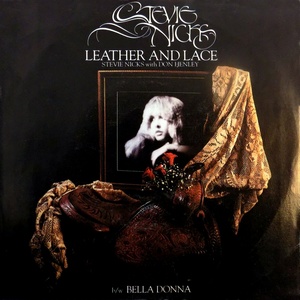
“Leather and Lace” is Track 8 on Bella Donna, Stevie Nicks’ first solo album. It is duet with Eagles drummer Don Henley. It follows “How Still My Love” and precedes “Outside the Rain” in the album track order. It was the album’s second single, reaching No. 5 on the Billboard Hot 100.
About the Song
“I wrote ‘Leather and Lace’ for Waylon (Jennings) because he called and asked me to write a song called ‘Leather and Lace.’And I had never written a song for somebody especially for somebody that had given me a title. Well, I wrote the chorus, and I called him and said, “I’ve written the chorus,” and we’ve sent it to him. And he called back and said, “Finish it!” So I was under a lot of pressure to finish this song whereas in…usually if I don’t want to finish something, I don’t finish it.
“I was going out with Don Henley at the time. And I would play it for Don. And he would say, ‘That’s terrible! Start over.’ And I would say, ‘Oh, I can’t believe you said that,’ and I would start over. Not that he ever jumped up and down about it, but there did come a time when said ‘Okay, it’s acceptable’ and we recorded it. We made a demo of it that is so similar to the record that a lot people don’t even notice it if I put the demo on. It’s that similar. And I was playing guitar, (sarcastically) sterling guitar, and he was singing. I mean, we were singing, you know, (singing) ‘Sometimes I’m a strong man‘ exactly, exactly the same.
“And so when I started to do this album, we called him, and I said ‘Don, I can’t do this song without you. So if Waylon doesn’t do it and you don’t do it, it doesn’t get done ’cause I wrote this song for a man and a woman in the music business that are trying to work out their problems together. You know, your spirit and my spirit is greatly in it, as is Waylon’s and Jessi’s. In fact, much more ’cause I don’t know them. And so will you please come down and listen to the track and see what you think.’
“And he came down, and I was working on another song and I guess he must have been pleased because he sang on the record. And he’s a hard one to get to, even for me. And he would do anything for me, but he wouldn’t do it if he didn’t think it was good. So that was probably the greatest compliment of all that he is even on this record because he wouldn’t have put his voice on this record if he didn’t think it was up to his standards.”
Lyrics
Is love so fragile And the heart so hollow Shatter with words Impossible to follow You’re saying I’m fragile I try not to be I search only for something I can’t see
I have my own life and I am stronger Than you know But I carry this feeling When you walked into my house That you won’t be walking out the door Still I carry this feeling When you walked into my house That you won’t be walking out the door
Lovers forever face to face My city your mountains Stay with me stay I need you to love me I need you today Give to me your leather Take from me my lace
You in the moonlight With your sleepy eyes Could you ever love a man like me And you were right When I walked into your house I knew I’d never want to leave Sometimes I’m a strong man Sometimes cold and scared And sometimes I cry But that time I saw you I knew with you to light my nights Somehow I’d get by First time I saw you I knew with you to light my nights Somehow I would get by
Lovers forever face to face My city your mountains Stay with me stay I need you to love me I need you today Give to me your leather Take from me my lace
Lovers forever face to face My city your mountains Stay with me stay I need you to love me I need you to stay Give to me your leather Take from me my lace Take from me my lace Take from me my lace
Released on October 6, 1981, “Leather and Lace” was the second single from Bella Donna. Issued as a 3:27 single edit, the song peaked at No. 6 (3 weeks) on the Billboard Pop Singles chart. In the U.S. “Bella Donna” was the b-side track. In the UK, “Outside the Rain” was the b-side.
“How Still My Love” is Track 7 on Bella Donna (1981), Stevie Nicks’ first solo album. It follows “Edge of Seventeen” and precedes “Leather and Lace” in the album track order.
About the Song
“‘Still of the Night’ was really probably one of my most romantic songs. I really wrote that about…I was feeling really romantic at the time. It’s my sexiest song. I love to sit and play it. It’s the vibe-iest song. It’s the one song I said had to be on the album, and it was the one that went in and out and in and out and off and on and off and on the album in the last four months, incredibly, until finally I knew that it would come around to people realizing it’s really such a neat song even if it’s for yourself to enjoy it” (Nicks, 1981).
“I really don’t write extremely sexual songs, never have. I’m always going to write about the bouquets and the flowers [laughs]. But ‘How Still My Love’ really is a sexy song, and being that it’s one of my few sexy songs, when we do it onstage it’s fun. It’s kind of woozy and it’s slow, but it’s got a really great beat — kind of a strip-tease, a little burlesque, a little Dita Von Teese-y.
“The title actually came from two different books I saw in some hotel, one was called How Still My Love and one was called In the Still of the Night, and I used both, but I never even opened up the books [laughs], so I have no idea what they were about. Whenever I come into a room with a library, in a hotel or whatever, I pull them all down and just sit — I get a lot of ideas that way” (Greenblatt, 2009).
Lyrics
Still the same old story What price glory You make it easy In the still of the night In the still of the night How still my love In the still of the night How still my
Doing all you can for me They say you’re not the man for me Don’t make it easy In the still of the night In the still of the night How still my love In the still of the night How still my love
Standing in the doorway Watching out to sea Calling out to me You go your way Go on go on But you don’t forget me Oh no you don’t forget me Oh no my lonely one You’re doing all you can for me They say you’re not the man for me Don’t I make it easy In the still of the night It’s me talking to you
How still my love In the still of the night How still my love In the still of the night It’s me that’s talkin’ to you In the still of the night
“Edge of Seventeen” is Track 6 on Bella Donna, Stevie Nicks’ first solo album. Coupled with a live version of the song, “Edge of Seventeen (Just Like the White Winged Dove)” was the third single from the album, reaching No. 11 on Billboard Pop Singles.
“Edge of Seventeen” is Stevie’s signature concert setlist closer.
About the Song
“Edge of Seventeen” was inspired by the sudden deaths of John Lennon and William “Bill” Jonathon Nicks (Stevie’s paternal uncle).
“The place where it came from when it was written was sad because it came out of my frustration in not knowing exactly how to accept the death of John Lennon or the death of an uncle that I had that died in the same time period of cancer. And that’s what the white winged dove is. The white winged dove is the spirit going, and the nightbird at the end is the one that is taking. It was a period of time that I just didn’t know what to do, so I just sat down and wrote about it. I spent a lot of time thinking about how I would write this song, and I spent a little bit of time with my uncle as he was dying and I knew a lot of people that knew John Lennon, and I felt their pain for him and my own pain as losing him too and the “Edge of Seventeen” just was born out of that.”
Recording
“Recording it was the most exciting thing I’ve ever done because everybody felt that there was an electrical charge going through this white winged dove, all the way through that song, and for the three days we worked on recording the track of it. We had the lady singers and myself and all 10 of the guys out in one room recording. Most of this album was done completely recorded with everybody in the room, very few overdubs, very few toppings on the cake. It’s pretty much exactly how it was. The vocals too, the vocals bled right into the drums, you know, and the guitar amps, and everything. So it was like whatever we did out there had to be pretty on because it was gonna show up somewhere, and we weren’t going to be able to get rid of it without taking off an initial instrument. So everything that we did had to be, you know, it was like we were doing a concert. I mean, the girls got dressed up, we spent a lot of time getting ready every day, and we would go into the studio with them. They would note that we didn’t come down there looking like little grubettes off the street, you know. And so they were impressed and pleased that we cared so much. And so what that did was turned it right around and they cared that much. And a lot of the times they were doing other sessions in the daytime and they would come straight from there to me at 7 at night and we would get them for like three days from 7 until 2. And so we had precious little time to waste.
“Edge of Seventeen” U.S. 7″ vinyl single cover
Timespace liner notes
“I had lived up in the hills with Jimmy [Iovine] for almost six months. He was coming to the end of Tom Petty’s album…it seemed I had waited a long time, and so since no one really knew where I was, I was starting to get very edgy to do something. I was also starting to feel very unimportant and very sorry for myself. I was ready to begin Bella Donna, and it seemed like it would just never happen. Jimmy had told me many times about his incredible friendship with John Lennon; how John had taken Jimmy in and taught him how to record. He was his teacher…and I was entranced because I could not imagine these two together. Anyway, it was a real life fairy tale, and I believed it. Then one grey day, the fairy tale ended…Jimmy’s friend was dead. But Jimmy’s love for John did not die. A terrible sadness set in over the house, there was simply nothing I could do to help and nothing I could say. So I went home…Jimmy would have to go this one alone.
“I went home to Phoenix and went to visit my uncle, who was very sick (with cancer), not knowing that no one but his son, John, was there…and I sat on his bedside, while John sat on the floor besides him, and we stayed there. My father did not come, nor my mother, nor my aunt…so I sat there and held his hand, and sometime right about sunset, he slightly turned his head to John, and then to me, and his hand slowly let go of mine. I did run out into the hallway, but no one was there…and the white winged dove took flight…
Well I hear you, in the morning… And I hear you, at nightfall… But sometimes, to be near you… Is to be unable…to hear you…
“Goodbye to you both, I said… There was nothing else left to say”
The title of “Edge of Seventeen” originates from a story that Tom Petty’s ex-wife Jane Benyo shared with Stevie. Jane described meeting Tom at the age of 17, but Stevie heard “edge” instead of “age” because of Benyo’s distinct Southern accent.
“Jane told me once that she met Tom when she was 17. But Jane has the most incredible Southern accent that you have ever heard, and she said (impersonating Jane’s accent), ‘I met Tom at the age of 17.’ She said “age” and I thought she said “edge” and I said, “Jane, I’m writing a song called ‘Edge of Seventeen.’ She didn’t believe me. She called a couple of days ago and said, ‘You did! Wow, I love it!’”
White-Winged Dove of the Southwest
The white-winged dove refers to the bird native to parts of the southern western United States (and Mexico), particularly Arizona, where Nicks was born and lived for many years. The dove is known for making a “hoo-hoo” sound and a drawn-out cooing call to warn others about the presence of a predator. After reading about the dove, Stevie decided to reference it in the song.
Lyrics
Just like the white winged dove Sings a song Sounds like she’s singing Ooh ooh ooh Just like the white winged dove Sings a song Sounds like she’s singing Ooh baby ooh said ooh
And the days go by Like a strand in the wind In the web that is my own I begin again Said to my friend, baby Nothin’ else mattered
He was no more than a baby then Well he seemed broken hearted Something within him But the moment that I first laid Eyes on him all alone On the edge of seventeen
Just like the white winged dove Sings a song Sounds like she’s singing Ooh baby ooh said ooh Just like the white winged dove Sings a song Sounds like she’s singing Ooh baby ooh said ooh
I went today maybe I will go again Tomorrow And the music there it was hauntingly Familiar When I see you doing What I try to do for me With the words from a poet And the voice from a choir And a melody nothing else mattered
Just like the white winged dove Sings a song Sounds like she’s singing Ooh baby ooh said ooh Just like the white winged dove Sings a song Sounds like she’s singing Ooh baby ooh said ooh
The clouds never expect it When it rains But the sea changes colors But the sea Does not change And so with the slow graceful flow Of age I went forth with an age old Desire to please On the edge of seventeen
Just like the white winged dove Sings a song Sounds like she’s singing Ooh baby ooh said ooh Just like the white winged dove Sings a song Sounds like she’s singing Ooh baby ooh said ooh
Well then suddenly There was no one left standing In the hall yeah yeah In a flood of tears That no one really ever heard fall at all I went searchin’ for an answer, Up the stairs and down the hall Not to find an answer Just to hear the call Of a nightbird singing Come away come away
Just like the white winged dove Sings a song Sounds like she’s singing Ooh baby ooh said ooh Just like the white winged dove Sings a song Sounds like she’s singing Ooh baby ooh said ooh
Well I hear you in the morning And I hear you At nightfall Sometime to be near you Is to be unable to hear you My love I’m a few years older than you
Just like the white winged dove Sings a song Sounds like she’s singing Ooh baby ooh said ooh
“After the Glitter Fades” is Track 5 on Bella Donna (1981), Stevie Nicks’ first solo album. It follows “Think About It” and precedes “Edge of Seventeen” in the album track order.
About the Song
“‘After the Glitter Fades’ was written in 1972 [although] it was copyrighted in 1975. Which is a strange sort of premonition to have in 1972 because that was two years before Fleetwood Mac. And I mean that was when the Buckingham Nicks album had been dropped so we were going nowhere fast. And I seemed to have some idea what was going to happen, that I was really gonna face some really serious glitter and see some serious glitter fade.”
Stevie had country singer Dolly Parton in mind when she wrote the song. “I wanted [Dolly Parton] to do ‘After the Glitter Fades’ ’cause I really thought it would be perfect for her. And it got sent to her and I don’t think Dolly ever really got it. I think if she’d ever got the song, she would have wanted to do it.”
Stevie has performed “After the Glitter Fades” live in concert on the Bella Donna (1981) and Enchanted (1998) tours.
Lyrics
Well I never thought I’d make it Here in Hollywood I never thought I’d ever Want to stay What I seem to touch these days Has turned to gold What I seem to want Well you know I’ll find a way
For me it’s the only life That I’ve ever known And love is only one Fine star away Even though the living Is sometimes laced with lies It’s alright The feeling remains Even after the glitter fades
The loneliness of a one night stand Is hard to take We all chase something And maybe this is a dream The timeless face of a rock and roll Woman while her heart breaks Oh you know the dream keeps coming Even when you forget to feel
For me it’s the only life That I’ve ever known And love is only one fine star away Even though the living Is sometimes laced with lies It’s alright The feeling remains Even after the glitter fades
For me it’s the only life That I’ve ever known And love is only one fine star away Even though the living Is sometimes laced with lies It’s alright The feeling remains Even after the glitter fades Oh you know the feeling remains Even after the glitter fades Oh the feeling remains Even after the glitter fades
“After the Glitter Fades” was the fourth and final single from Bella Donna. Coupled with “Think About It,” the genre-crossing single reached No. 32 on Billboard Pop Singles and also charted on Adult Contemporary and Country.
Billboard Charts
Pop Singles: 32 Adult Contemporary: 36 Country: 70
Reference
Nicks, S. (1981). Interview with Stevie Nicks. Denis McNamara, interviewer, WLIR 92.7 FM.
Nicks, S. (1981). Interview with Stevie Nicks. WMMR 93.3 FM.
Nicks, S. (1981). Interview with Stevie Nicks. WIOQ 102.1 FM.
“Think About It” is Track 4 on Bella Donna, Stevie Nicks’ first solo album. It follows “Stop Draggin’ My Heart Around” and precedes “After the Glitter Fades” in the album track order.
About the Song
“I wrote ‘Think About It’ in 1975 for Chris (McVie) and for myself too. I wrote for her because I needed to write it for somebody else. She was going through her divorce with John (McVie) and in those days, there were no wardrobe mistresses or speech therapists or anything. There was just me and Chris. And so all she really had was me. And so I really had to be her friend and really be strong beside her at that point because she was really going to leave. And I had my own problems with Lindsey, and I was really going to leave. And so this was just a song to remind her and remind me at the same time that we were giving up a lot if we left and that it was really something that should be taken to, taken to the heart and thought about heavily before we walked out.”
Lyrics
Step into the velvet of the morning Let yourself lay back within your dreams Take on the situation but not the torment Now you know its not as bad as it seems
Well I know you’d like to come away But baby you can’t come Your fortune is your life’s love Oh and anytime you think about leaving Think about what you know Well think about it Think about it before you go
Even when you feel like your life is fading I know that you’ll go on forever You’re that good Heartbreak of the moment is not endless Now your fortune is your life’s love Well honey I know you’d like to come away But baby you can’t come Your fortune is your life’s love Whoa and anytime you think about leaving Think about what you know Well think about it Think about it before you go
And the heart says danger And the heart says whatever It is… that you want from me I am just one small part Of forever Falling star star Catcher
Even when you feel like your life is fading I know that you’ll go on forever You’re that good Heartbreak of the moment is not endless Your fortune is your life’s love Well honey I know you’d like to come away But baby you can’t come Your fortune is your life’s love Anytime you think about leaving Think about what you know Well think about it Think about it before you go Well think about it Think about it before you go And the heart says danger The heart says whatever Think about it Think about it before you go
“Stop Draggin’ My Heart Around” is Track 3 on Bella Donna, Stevie Nicks’ first solo album. It is a duet with Tom Petty & The Heartbreakers. It follows “Kind of Woman” and precedes “Think About It” in the album track order.
About the Song
Stevie provided harmony vocals on Tom Petty’s “Insider,” a track that he had written for her. But after recording the song together, Tom was so impressed by how it turned out that he decided to include the track on his 1981 album Hard Promises. Feeling guilty about the turnaround, Tom gave Stevie “Stop Draggin’ My Heart Around” instead.
What Tom Petty Said
“It’s funny, you get such preconceived ideas about artists. I knew Stevie, but not real well, and she’d been asking me for a long time for a song. I thought that ‘The Insider’ would be the thing for her, because it’s acoustic, it has that kind of feel. She really liked the song, so we went to do the vocal and she started to sing harmony every time. Because my track was playing in her headphones as a guide. So she said, ‘Just let me sing the harmony one time.’ So she did, and when it was over, I just sat there, in awe. She walked back in and said, ‘How was it?’ I said, ‘It’s a-mazing.’ She said, ‘I can tell by the look on your face, you don’t wanna give me this song. I’m giving it back to you right now.’ I really thought a lot of her for that.
“Then I went through this terrible guilt. Jimmy (Iovine) and I thought, we can’t take it back, because we promised it to her. So we went to her and said, ‘Stevie, what if we trade you another song for ‘Insider’? She said, play it for me, and we played her ‘Stop Draggin’ My Heart Around.’ She says, “Wow! That’s why I wanted YOU to write me a song — it’s rock ‘n’ rock, that what you do. ‘The Insider’ sounds like what I do.’ And I thought, how dumb of me to think that she’d want me to write like her. We’ve got some videotapes of those sessions that are very funny” (Marsh, 1981).
Lyrics
Baby, you’ll come knocking on my front door Same old line you used to use before I said, yeah, well, what am I supposed to do I didn’t know what I was getting into
So you’ve had a little trouble in town Now you’re keeping some demons down
Stop draggin’ my Stop draggin’ my Stop draggin’ my heart around
It’s hard to think about what you’ve wanted It’s hard to think about what you’ve lost This doesn’t have to be the big get even This doesn’t have to be anything at all
I know you really want to tell me good-bye I know you really want to be your own girl
Baby, you could never look me in the eye Yeah, you buckle with the weight of the words
There’s people running ’round loose in the world Ain’t got nothing better to do Than make a meal of some bright eyed kid You need someone looking after you
I know you really want to tell me goodbye I know you really want to be your own girl
Baby, you could never look me in the eye Yeah, you buckle with the weight of the words
Stop draggin’ my heart around Stop draggin’ my heart around Stop draggin’ my heart around
On July 8, 1981, Modern Records released “Stop Draggin’ My Heart Around” as the lead single from Bella Donna. Coupled with “Kind of Woman” in the U.S., the single become a big hit, peaking at No. 3 (for 6 weeks) on the Billboard Pop Singles chart. The song’s accompanying music video was among the first music videos that aired on the MTV network in the summer of 1981.
Cover for U.S. 12″ promo vinyl single
Chart Performance
“Stop Draggin’ My Heart Around” raced to No. 3 on the Billboard Hot 100 chart, boosting Bella Donna to No. 1 on the Billboard Top 200 Albums. The track remains Stevie’s highest charting solo single to date on the Billboard Hot 100.
“Stop Draggin’ My Heart Around” remains Stevie’s highest Billboard-charting single as a solo artist.
“Kind of Woman” is Track 2 on Bella Donna, Stevie Nicks’ first solo album. It follows “Bella Donna” and precedes “Stop Draggin’ My Heart Around” in the album track order.
About the Song
Stevie wrote “Kind of Woman” in Aspen, Colorado in 1973. She also wrote “Landslide” at this time.
“‘Kind of Woman’ I wrote about Lindsey (Buckingham) when he went on the road with the Everly Brothers, and I was sure he was gonna meet somebody because it says, “Temptation falls in your path / No hesitation why you ask / You have another waiting at home / And yes she matters to you.” That was me, right? And then I thought… It says, “You didn’t mean to meet her you cry.” Right, right. “Oh, but the sun goes down every night / She came to you and you were alone / And yes she matters to you / It’s the kind of woman that’ll haunt you.” So it’s like, which is the kind of woman? Was it me or was it the woman that he would meet? I didn’t know. And then I’d never been on the road or I had no idea. I mean I had the same thoughts that probably every little girl in the world thinks when a rock and roll band comes into town. As Joni Mitchell would say, “Don’t count on your plans with a rock and roll man.”
Lyrics
Temptation falls in your path No hesitation why you ask You have another waiting at home And yet she matters to you
Kind of woman that’ll haunt you She matters to you She’s kind of woman that’ll haunt you She matters to you
You didn’t mean to meet her you cried Oh, but the sun goes down every night She came to you and you were alone So yes, does she matters to you
Kind of woman that’ll haunt you Oh, kind of woman that’ll haunt you She matters to you
Promised myself a long time ago No, it would be difficult to let you go Oh, if not at least within The touch of my fingers It’s close she keeps in heaven
Kind of woman that’ll haunt you Heaven Kind of woman that’ll haunt you Is to be in heaven
Kind of woman that’ll haunt you Is to be in heaven I know, I know Kind of woman that’ll haunt you
“Bella Donna” is Track 1 on Bella Donna (1981), Stevie Nicks’ first solo album. It precedes “Kind of Woman” in the album track order.
About the Song
“Bella Donna was my idea for the name of this album before I even wrote the song “Bella Donna.” I always loved the sound of the words bella donna and that’s really how I get my ideas for songs. You know, “Rhiannon” was a sound before it was a song to me.
When I came off the road with Fleetwood Mac last year after our year tour — the year-Tusk Tour — I really had decided that it was time for me to make some decisions and some changes in my life, one of them being that I wanted to make sure I could still exist alone without Fleetwood Mac and without the entourage and without everything that went along with being in a very big rock and roll band. After six or seven years of that, you don’t really know anymore until you actually try to do something alone.
So I saw some time coming up that I was going to be free enough to be able to actually pick out the songs and do it and I did it to prove to myself that I could still exist alone. And if you listen to the words to “Bella Donna” you will realize I am not writing about a beautiful woman — I’m writing about the possibility of any woman not being beautiful anymore and just turning into an old, used-up woman. And if you listen once again to the words and you hear me say, “No speed limit / This is the fast lane / That’s just the way that it is here,” that is the way that is it there. “And the woman becomes tired and the woman disappears / And you never thought that your face would become thin,” but it did and it scared me and I didn’t like it and I decided that I had to go out and do something alone without the rest of everybody that had surrounded me for a long time.
And “Bella Donna” is really the symbol of that and why when you turn over the album it says “come in out of the darkness.” It was telling myself to come in out of the darkness and also offering the same question to everybody else. And it was a decision whether or not to remain in the darkness or not.”
Lyrics
You can ride high atop your pony I know you won’t fall ’cause the whole thing’s phony
You can fly swingin’ from your trapeze Scaring all the people But you never scare me
Ooh, my bella donna And we fight for the northern star
No speed limit This is the fast lane It’s just the way that it is here And you say I never thought it could
Bella donna And we fight for the northern star
And the lady’s feeling Just like the moon that she loves Don’t you know that the stars are A part of us Oh, and the lady’s feeling Just like the moon that she loves
And you say But I never thought it could
My bella donna Come in out of the darkness
You are in love with And I’m ready to sail It’s just a feeling Ooh, oh…
Sort of captures your soul Bella donna
And the woman may be awestruck And the woman may truly care But the woman is so tired Oh… So the woman disappears
Oh, come in out of the darkness Ooh, Bella donna, my soul
Don’t change Baby, please don’t change And you say And your face becomes thin And it you never thought it could
Ooh, come in out of the darkness Oh, bella donna Ooh, ooh…
You are in love with And I’m ready to sail It’s just a feeling
On November 4, 2016, Rhino Records reissued Bella Donna as an expanded edition (CD, vinyl) with remastered sound. It includes the original remastered album with two additional discs of demos, early takes, and alternate versions and Stevie’s concert at Fox Wilshire Theatre on December 13, 1981.
In the late 1970s, Stevie Nicks launched Modern Records with record executives Danny Goldberg and Paul Fishkin as a vehicle for the backlog of unrecorded material that Stevie had amassed over the years. With help of producer Jimmy Iovine and high-profile acts, such as Tom Petty & The Heartbreakers and Eagles member Don Henley, Bella Donna became a critical and commercial success. Stevie later earned a Grammy Award nomination for Best Female Rock Performance for “Edge of Seventeen.”
Release
Modern Records released Bella Donna on Monday, July 27, 1981. It reached No. 1 on the Billboard Hot 200 Albums chart and produced the Top 40 singles “Stop Draggin’ My Heart Around,” “Leather and Lace,” “Edge of Seventeen,” and “After the Glitter Fades.”
In 2004, the RIAA certified the album 5X platinum for the shipment of five million units to retailers. Bella Donna remains Stevie Nicks’ best selling album to date.
Charts
Stop Draggin’ My Heart Around (Duet with Tom Petty & The Heartbreakers)
Billboard Chart
Peak
Pop Singles
3
Album Rock Tracks
2
Leather and Lace (Duet with Don Henley)
Billboard Chart
Peak
Pop Singles
5
Adult Contemporary
10
Edge of Seventeen (Just Like the White Winged Dove)
Billboard Chart
Peak
Pop Singles
11
Album Rock Tracks
4
After the Glitter Fades
Billboard Chart
Peak
Pop Singles
32
Adult Contemporary
36
Country
70
Promotional Videos
Stop Draggin’ My Heart Around
Leather and Lace
Edge of Seventeen
After the Glitter Fades
Production Credits
Produced by: Jimmy Iovine
Engineered by: Shelly Yakus
Additional Engineering: Don Smith, Thom Panunzio
Assistant Engineers: Dana Latham, James Ball, Niko Bolas, Tori Swenson
Mixing Engineers: Don Smith, Shelly Yakus
Mastered by: Stephen Marcussen
Lacquer Cut by: SM
Management: Front Line Management, Irving Azoff
Design Concept: Christopher Nicks, Herbert Worthington III, Stevie Nicks
Art Direction, Photography, and Design: Herbert W. Worthington III
BELLA DONNA (1981)July 27, 1981–Bella Donna is Stevie Nicks’ 1981 solo recording debut. It features the singles “Stop Draggin’ My Heart Around,” “Leather and… More
Bella DonnaJuly 27, 1981–“Bella Donna” is Track 1 on Bella Donna (1981), Stevie Nicks’ first solo album. It precedes “Kind of Woman” in… More
Kind of WomanJuly 27, 1981–“Kind of Woman” is Track 2 on Bella Donna, Stevie Nicks’ first solo album. It follows “Bella Donna” and precedes… More
Stop Draggin’ My Heart AroundJuly 27, 1981–“Stop Draggin’ My Heart Around” is Track 3 on Bella Donna, Stevie Nicks’ first solo album. It is a duet… More
Think About ItJuly 27, 1981–“Think About It” is Track 4 on Bella Donna, Stevie Nicks’ first solo album. It follows “Stop Draggin’ My Heart… More
After the Glitter FadesJuly 27, 1981–“After the Glitter Fades” is Track 5 on Bella Donna (1981), Stevie Nicks’ first solo album. It follows “Think About… More
Edge of SeventeenJuly 27, 1981–“Edge of Seventeen” is Track 6 on Bella Donna, Stevie Nicks’ first solo album. Coupled with a live version of… More