Category: Enchanted (1998)

  • A storm called Stevie

    A storm called Stevie

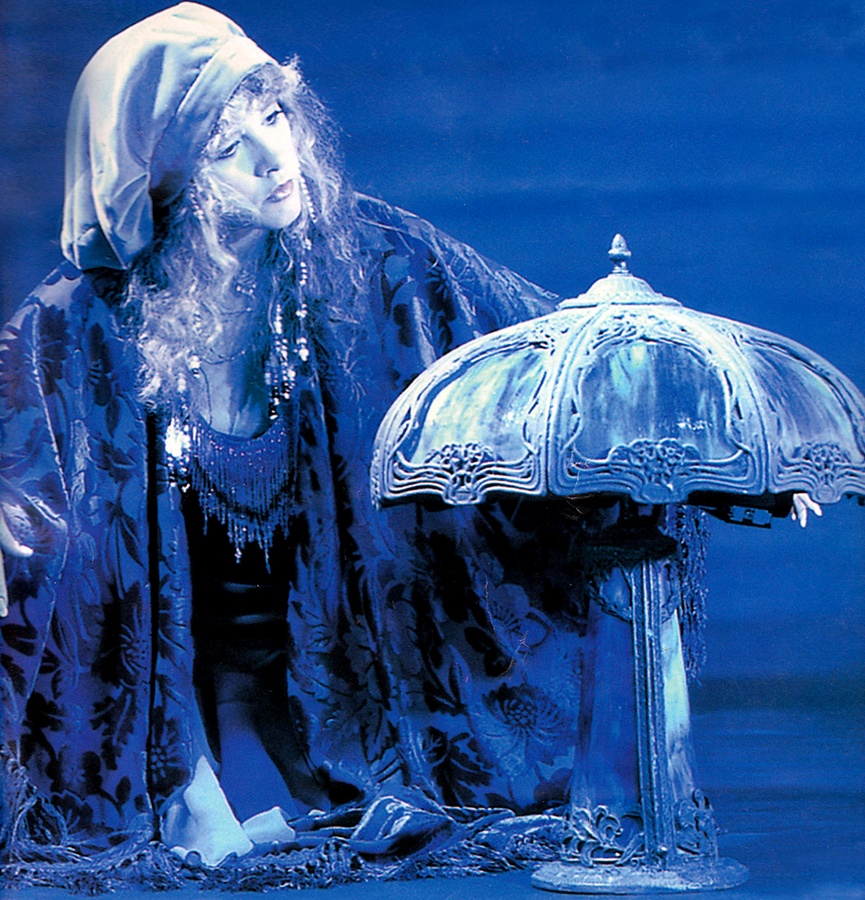
    With her swirling robes, angel-witch presence, and glorious, mellifluous voice, Stevie Nicks emerged as the most unabashedly ethereal and feminine embodiment of the post-hippie era. A quarter-century and many upheavals later, she’s striking as big a chord as ever with new audiences who crave the spiritual deliverance her music seems to promise. She’s even inspired an adulatory drag event, the Night of a Thousand Stevies. As they say, imitation is the sincerest form of flattery.

    Straddling the spirit world and the rock-‘n’-roll world, Stevie Nicks has cast her spell wide over generations of listeners and musicmakers. Her influence, as the bewitching force of Fleetwood Mac and one of rock’s preeminent solo vocalists, continues to be as all-encompassing as her trademark shawls — ask new friends Billy Corgan of Smashing Pumpkins and Courtney Love. Even Madonna’s been doing a Stevie Nicks lately: her black flowing robe in the “Frozen” video is clearly an homage to Nicks’s gypsy persona.

    Of Fleetwood Mac’s three main songwriters, Nicks is hardly the resident musical genius — that tag belongs to Lindsey Buckingham, who shaped many of Nicks’s songs. Nor is she the most natural “pop” writer; it was Christine McVie who wrote the band’s more lightweight, commercial hits, such as “Say You Love Me” and the Clinton election tune, “Don’t Stop.” But Nicks was responsible for the numbers, singles and album tracks alike, that captured our imaginations: “Dreams,” “Gold Dust Woman,” “Gypsy,” “Landslide,” and countless other Mac and solo hits. In that dusky voice of hers, a voice that still evokes burning incense and hints at the possibilities of the night, Nicks sang of deep personal traumas and entangled loves – and of transcending it all “like a bird in flight,” to quote her classic “Rhiannon.”

    Her songs suggest the aura of one who’s lived several past lives, which in a sense she has during her turbulent voyage with and without the legendary West Coast group since 1975. Following the release of last year’s Mac comeback album, The Dance (Reprise), she took a look back over her solo career with this spring’s retrospective box set, Enchanted (Modern/Atlantic). We checked in with her in May, just before she turned fifty and embarked on a forty-date solo tour.

    RAY ROGERS: The reaction to The Dance clearly shows how much people have missed you. Tell me about the Mac reunion tour last year. Would you say it’s still magic when you guys come together?

    STEVIE NICKS: Yes. The tour was very magic. You could be in a really bad mood, but when you walked up to the side of the ramp and heard that applause and saw how happy everybody was, you’d just have to get in a good mood. I mean, how could you possibly not be in a good mood when you’re in a room playing for people who love your music? The shows were so noisy and loud and boisterous and electric, they reminded me of our ’70s shows.

    RR: And they really affected people, even those who saw you only on TV. I have a friend whose more was beaten nearly to death about eighteen years ago. It was a miracle that she survived.’ And ever since that moment, my friend had been unable to cry. But watching you sing “Landslide” on the reunion concert on TV freed something in him, and he wept for the first time in eighteen years.

    SN: Wow. Well, I’m glad. He needed to cry. Hearing a story like that gives you the most worthwhile feeling you can have as a songwriter and entertainer: to know that you’ve really touched people, that you’ve made a difference in their lives. As far as I’m concerned, that’s the only reason to do this.

    RR: What was it like, this time, to be up there onstage singing those very personal songs about the people you’re playing with? Does it get easier over the years, or is it still a very loaded situation?

    SN: Both. It was, I think, very cathartic for us this time. We’ve had a long time to stop and look and listen and think about what happened. And nobody’s angry anymore. But it’s always intense. There’s nothing about Fleetwood Mac that is blase. We were never a band that went onstage and was bored.

    RR: Is it ever a burden to sing some of the more emotional songs?

    SN: Every once in a while something will hit me, and I’ll almost burst into tears. It doesn’t happen too often. It happened once on the last Fleetwood Mac tour, at a certain part in “Sweet Girl.” [singing] “Go through the . . . traffic, it goes through the fog/The sun is burning me, and you come walking out in the rain with me” – something like that. I just started thinking about how Christine [McVie] didn’t want to go back out on the road, and it upset me. I was thinking of her as Sweet Girl! She was standing right there, next to me. I have to be careful because I’m real emotional and I could go that way every night if I let myself. I don’t, because it’s not going to do me any good to burst into tears in the middle of “Silver Springs” or something. So I keep the emotion at a certain level.

    RR: Did putting all your solo work together on the Enchanted box set unleash a lot of emotion?

    SN: It was like looking over a great book report of my life, good and bad. Each song tells me exactly who was in my life when I wrote it, where I lived, what I was doing, who was important, who wasn’t important.

    RR: How did Fleetwood Mac react when you first began your solo career in the first place? Were they supportive?

    SN: Supportive is a pretty big word. They were not supportive. When I first went to do Bella Donna (1981), they questioned my reasons, and once they realized that I was simply looking for an outlet for my songs — because three songs for Fleetwood Mac every two years just wasn’t enough — they understood I wasn’t trying to leave the band. Then it just became something else I did.

    RR: Tell me about the new record you’re working on.

    SN: The title song, which I wrote during the O.J. Simpson trial, is about that sixteen-million-to-one person who makes it to the top of their field and then has trouble handling Shangri-la. And it’s not just about me. In fact, it’s not that much about me at all — it’s about a lot of other people that I see and hear about. You say to yourself, “God, I made it. I’m at the top of my field. I’m a beloved artist of some kind.” And then, “I can’t handle it.” And how sad is it that all your dreams come true and you just can’t keep yourself together?

    RR: And what can we expect musically?

    SN: I’m going to stay very simple on this record. I want to play piano on a lot of it. Because when I play, it’s different than when anybody else plays. It’s not that I play that well — I don’t. But I have a certain timing thing that makes it different if I’m playing alone. The reason I want to do this is so my songs stay a little bit closer to the way I wrote them. If you listen to the version of “Rhiannon” on Enchanted, that’s how I wrote it and first showed it to Lindsey [Buckingham].

    RR: That’s a fantastic version of that song.

    SN: Thank you. I’m really proud of it. I held out to get it on this record because I felt it was really important for people to have “Rhiannon” the way she was originally written.

    RR: There’s a real intensity to it. There’s an intensity to the Fleetwood Mac version, too, but this one has a different quality about it that’s almost shocking.

    SN: Right. That’s my intensity I put into it, whereas the intensity of the Fleetwood Mac “Rhiannon” is all five of us. This is just mine, and that’s what makes it different. And I think that might be an interesting way for me to go about this next record.

    RR: You’ve taken a lot of inspiration from things that fly in your work – lots of birds and angels and wings and stuff – and when you lift your arms up in your shawl, it looks like you’re about to take flight yourself. What’s drawn you to that kind of imagery over the years?

    SN: That whole winged thing I do comes out of modern jazz and all the weird dancing I took. And it’s just me. I’ve always been fascinated by flight, ballet, high jumps, big movements, big, big hand gestures. I’m just a person who likes to go onstage and entertain people.

    RR: There seems to be a return to mysticism among female pop musicians. I’m thinking of people like Tori Amos, Sarah McLachlan, Erykah Badu, even Madonna now. It’s always been in your work In one way or another. Why do you think others are tapping Into that spirit at the moment?

    SN: Because having a little bit of the spiritual is ultimately better than having none. For me, the whole idea of twirling around in chiffon onstage is a whole lot more fun than standing there in a straight dress that doesn’t move. A long, long time ago I decided I was going to have a kind of mystical presence, so I made my clothes, my boots, my hair, and my whole being go with that. But it wasn’t something I just made up at that point. It’s the way I’ve always been. I’ve always believed in good witches — not bad witches — and fairies and angels.

    RR: Did you know that you are a sort of drag Icon?

    SN: Well, I’ve heard that. Is it true?

    RR: Definitely.

    SN: It cracks me up — I love it. I saw a six-foot-five guy dressed like me in the front row at one of the recent Fleetwood Mac shows. He had a veil thing on, and a full-on dress. I could hardly get through the song — it just made me die laughing. I wanted to jump offstage and run down and look at him. [laughs] I’ve heard about the Night of a Thousand Stevies in New York, which of course I’m going to go to, as soon as I can manage to be on that side of the country when it happens.

    RR: I understand you’ve gotten to know Billy Corgan and Courtney Love recently. How do you relate to them?

    SN: Well, you know, they made an effort to meet me, which is so great because I probably wouldn’t have made the effort. They’re really nice and they do what I do, which makes them different from other people. I don’t know very many people who stand center stage and do what I do. I just hope we’ll become good friends and that it will last.

    RR: Do you like their music?

    SN: Um . . . I like some of their music. And they know that. Some of it’s too loud for me, some of it I don’t understand. I really like Billy’s poetry.

    RR: Courtney’s someone who’s led a lot of her life in public. What advice would you have given her during her various crises?

    SN: Save yourself. Don’t let this be the end of you — it’s not that important. I’m glad I didn’t know her back then because what happened to her would have really broken my heart.

    RR: Fleetwood Mac’s excessive drug use In the ’70s and ’80s is legendary. You’ve been very public about overcoming your cocaine addiction In the ’80s. Is there anything from those years you regret missing out on because of your drug use?

    SN: I think a lot of cool things may have happened that I probably don’t even remember. I didn’t miss out on doing anything because I did everything I wanted to do. It’s just, you know, who remembers? So, who cares?

    RR: How do you feel about turning fifty this year?

    SN: I have been preparing myself for it for a year. I began telling everybody I was fifty the day I turned forty-nine. I’ve been going, “Oh no, I’m really fifty,” so that I wouldn’t be shocked. As much as I think that age is a state of mind and a state of your heart and energy, at the same time the word fifty sounds really old to me. I’m not crazy about turning fifty. I’ll just go straight to fifty-one. [laughs] But I don’t feel like I’m old. I feel there’s still a lot more time.

    RR: How does being a diva in the ’90s differ from being one in the ’70s?

    SN: I never really considered myself a diva.

    RR: But a lot of people do.

    SN: That’s very far-out. But I don’t know how to answer the question because, you know, I just get through everything. It’s like, I’m still here. I’m still standing after all these years.

    RR: How do you think you’ve made it through?

    SN: I think there is definitely a God. I think there was definitely an angel with me all the way through the bad times. Somebody keeping me safe. I feel very spiritual now. I really believe that God makes my music good and makes me able to deliver it and makes me able to not look or feel fifty. I mean, there has to be some outside help — this can’t all be happening on its own. I feel like my life is pretty damn good right now.

    Ray Rogers / Interview / July 1998

  • High Priestess

    High Priestess

    Shedding drugs, weight and breast implants, Stevie Nicks whirls back

    ENTHRONED UPON HER FOUR-poster bed, incense and candles burning as the clock nears midnight, Stevie Nicks nestles into a stack of pillows and tries to remember the last 10 years of her life. It doesn’t come easy: Nicks, the hottest femme in pop’s pre-Madonna firmament of the 1970s, degenerated into a bloated, drugged-out cliché of the era’s rock-and-roll excess. “I know how serious things were, and it scares me to death,” she says. Her nightmarish fall began with a cocaine habit that consumed millions of dollars and burned a hole through the cartilage of her nose. But as the Fleetwood Mac singer reveals for the first time, in a bedroom interview in her sprawling, adobe-style Phoenix home, cocaine was just the start of her long slide into darkness. It seems late in the day to meet the press, but for Nicks the bewitching hour is the right time to conjure up her ghosts: “This is when my life gets going.”

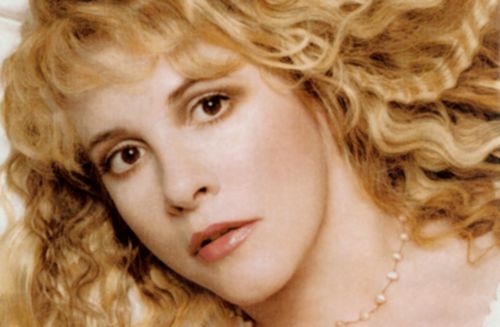
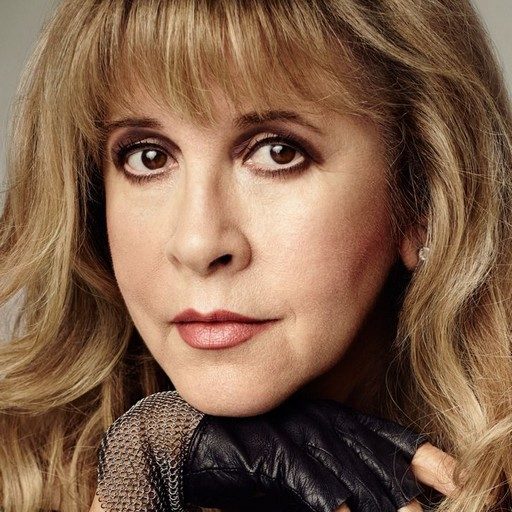
    In more ways than one. Nicks, now 49, slimmed-down, drug-free and in her best health in years, has executed a turnaround worthy of her heyday as Fleetwood Mac’s doe-eyed dervish. Enjoying a rebirth of interest in her music and even her over-the-top look—designers Isaac Mizrahi and Anna Sui aped her slit maxis and sky-high platforms in their recent collections—Nicks has been riding a new career high since last May. That’s when her old band regrouped after a seven-year recording hiatus to cut a No. 1 album, Dance, and launch a three-month, sold-out tour. This week, Nicks’s once contentious, newly copacetic Mac mates—her former flame, guitarist Lindsey Buckingham, 50, drummer Mick Fleetwood, 50, bassist John McVie, 52, and his ex-wife, keyboardist Christine McVie, 54—are to be inducted into the Rock and Roll Hall of Fame during ceremonies in New York City. For Nicks the event will be especially sweet. “Stevie bridges the gap between the powerful rock singers of the ’60s, like Janis Joplin and Grace Slick, and what’s going on today,” says alternative diva Sheryl Crow, echoing a chorus of surprising fans that includes the Smashing Pumpkins’ Billy Corgan and Courtney Love. Adds Crow, who will deliver the induction speech: “She is the woman all young girls wanted to be and all men wanted to be with.”

    That proved too heavy a burden for Nicks, who grew up in Northern California as the daughter of a well-traveled executive, Jesse Seth Nicks, and his homemaker wife, Barbara (they now live near Stevie in Phoenix). In 1974, Nicks and Buckingham, her former high school classmate, joined Fleetwood’s struggling blues band, helping to transform it into one of the most successful groups in pop history.

    But like others who made the leap to stardom in the 1970s, Nicks fell for cocaine’s allure. Recalls Fleetwood: “Sometimes I worried myself sick about whether she would survive.” His own addiction, he adds, landed him in that “same dark place.” While she remained a member of the band, Nicks launched a solo career with her hit Bella Donna album in ’81. Meanwhile she continued to snort so much coke that in 1986 a plastic surgeon told her, “If you want your nose to remain on your face, stop right now.”

    Nicks took his advice, completing a 28-day stint at the Betty Ford Center in Rancho Mirage, Calif., that year. “But after I quit cocaine,” she says, “things got even worse.” She continued to gain weight and looked constantly fatigued. In 1987 friends who feared she would relapse on cocaine persuaded her to see a psychiatrist, who prescribed Klonopin, a powerful tranquilizer to which she became addicted. “The drug changed me from a tormented, productive artist to an indifferent woman,” says Nicks, who became so zonked-out that she barely remembers an entire solo tour in 1989. “I vegetated into my own little world.” While hosting a bridal shower for a friend in late 1993, Nicks crashed into a fireplace and gashed her head but didn’t feel a thing. That scare gave her the courage to face a brutal, 45-day detox. “It would have been so easy for me to call a limo from rehab, go to another hospital and ask for Demerol because I was in so much pain,” she says. “Instead I stood on the edge of the cliff and said, ‘I need to live.’ ”

    Back home and drug-free in 1994, Nicks embarked on a six-month solo tour despite weighing 175 pounds and still feeling tired. Described by one critic as “twirling toward oblivion,” Nicks recalls walking off the stage at tour’s end and vowing “I would never sing in front of people again. Singing is the love of my life, but I was ready to give it all up because I couldn’t handle people talking about how fat I was.”

    While her growing lethargy had been diagnosed as the effects of Epstein-Barr virus, which causes constant fatigue, Nicks and her mother suspected it might be related to silicone breast implants that she had received in 1976. “Like cocaine, the whole world was getting them back then, and everyone was told they were safe,” Nicks says. “But I’m living proof that they aren’t safe.” Indeed, several doctors advised that removing her implants would be painful and unnecessary, but Nicks had the surgery anyway in 1994. “It turned out they were totally broken,” she says.

    With her health restored, Nicks also decided to slim down, and in 1995 she lost 30 pounds on a high-protein, low-carbohydrate diet. When her band-mates called last April suggesting a reunion, Nicks was game. A highlight of the ensuing tour was her performance of her previously unreleased 1977 tune “Silver Springs,” which chronicled the breakups of Nicks and Buckingham’s relationship and the McVies’ marriage. “There was such a multilayered story being told,” drummer Fleetwood says of the song. “It was our moment of high passion. It floored me every night Stevie sang it.”

    No old romances were rekindled during the tour, says Nicks, who has remained single since a brief 1983 marriage to Kim Anderson, the grieving husband of her best friend, Robin Stucker, who had died that year of leukemia. Though she has also been involved with rockers Don Henley, Joe Walsh and producer Jimmy Iovine, Nicks says she doesn’t mind being single. “I’m free,” she says. “So when someone starts telling me what to do, it’s like, ‘See ya!’ ” Nicks appears to have cast off her troubles with equal assurance. “I’m so far away from that now, it’s almost like another person,” she says of her stoned past. “I don’t want to be her ever again.”

    Steve Dougherty & Todd Gold / People, Vol. 49 No. 2 / January 19, 1998

  • Q & A with Stevie Nicks

    Q & A with Stevie Nicks

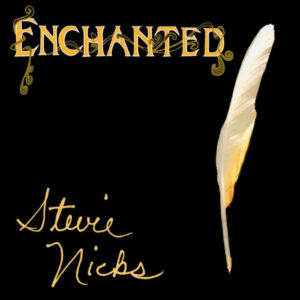
    Enchanted box set cover

    Stevie Nicks talks about compiling first retrospective box set, new solo album, and the future of Fleetwood Mac

    Anyone who was paying attention during Fleetwood Mac’s reunion tour last fall could tell that Stevie Nicks, 49, was still the star of the show. Trim and healthy, she got the biggest cheers and entranced the audience just as she had two decades before when the Mac was riding high on the mega-million-selling success of the album Rumours. Now, with Fleetwood Mac taking a breather, Nicks is going her own way once again, with her most prodigious display of wares since she began her first solo career in 1981. On Tuesday she releases Enchanted, a three-CD box set that contains her solo hits, choice album cuts and a bunch of rarities including soundtrack songs, collaborations with Kenny Loggins and John Stewart, outtakes and a haunting, spare piano version of “Rhiannon.”

    She begins a tour May 27 in Connecticut, with Boz Scaggs opening. When that wraps up in early August, she plans to finish her first solo album in four years — and her first release for her new label, Warner-Reprise.

    Q: This is quite a productive period for you.

    A: It’s almost like I didn’t ask for any of this; it just happened. I was truly started on a record of my own when the whole world changed, upside down.

    Q: You had started on your next album when the reunion popped up?

    A: Yes. All of a sudden this thing about Fleetwood Mac happened, and as the days went by there was more talk and then somebody from Warner Bros. actually came up and said (Lindsey Buckingham) really is going to put his record on the shelf to do this. I said, “Well, I don’t believe that,” because he said that a million times before. So I called him and I said, “Lindsey, I need you to tell me what’s happening because if we really are going to do this I’m not even going to start my record.” And he said, “I’m going to do it.” I said, “You’re sure? You promise?” He said, “Yes.” And then when I got home from the Fleetwood Mac thing I was told Atlantic felt this was a good time to do the box set, since I was going to Warner-Reprise. So all of these things just sort of happened, to my surprise.

    Q: You were so clearly the fan favorite during the tour. How does the rest of the band deal with that?

    A: I think probably it’s fine and fairly easy for everybody in the band except Lindsey. I think it’s hard for Lindsey because we started out together. I think he goes, like, “When did you do all this? Why do you get this kind of reaction?” And I think that is hard for him. So I don’t talk to him a lot about it. I don’t want to make Lindsey unhappy. I care about him and want him to be happy.

    Q: Do you foresee another Fleetwood Mac project?

    A: I feel that what we did this last year, it was great. Everybody had a great time. It was a little hard on Christine (McVie), but I think she will change her mind and she will get bored and say, “Oh, I want to do this one more time.” There’s no way this band won’t play again. I just know that when the time is right it’ll come back together. It’ll probably be in two years, two and a half years.

    Q: What was it like compiling Enchanted?

    A: It was like going through the photo album that went along with all those records, that went along with my life. Those songs are the photo album of my life because each one of them really was about something pretty heavy, for me to write a song about it. And when you put them all together it’s a pretty tumultuous bunch of songs.

    Q: Will this tour be different from your others?

    A: It’s going to be a great set, and it’s not going to be like any other set. On a regular tour basically you just go back and get the tour you did last time and change it around a little and add two new songs off of whatever new record you’re going out with. This tour is going to be a story. Because it’s the box-set tour, it’s OK for me to pick songs that people aren’t familiar with. This will be kind of a special show, I think.

    Q: What’s the next album going to be like?

    A: The title song is written — “Trouble in Shangri-La.” It’s like Bella Donna; it’s a definite concept album. It’s about achieving Shangri-la and not being able to handle it.

    Q: Sounds like a true story.

    A: (laughs) Oh, yes. I understand it all pretty well. Going through all these songs (for Enchanted) made me take a walk back through my life and made me think about things I’d forgotten, and think about experiences that were pretty strong and really touched and changed my life. I look back on all that now and really see what were the good things and what were the bad things — just wisdom, you know? I think I’m really smarter than I used to be, and I don’t take anything for granted now.

    Q: Any regrets?

    A: No, because the things that I’ve wanted to do and haven’t done, I will do. I want to do a children’s cartoon movie. And I want to do a Rhiannon record with just the songs of Rhiannon — because there’s “Rhiannon,” but there are also nine other songs I did right in that period of two years, when I was reading the books of Rhiannon.

    Q: You once talked about adopting a child. Is that still an ambition?

    A: I don’t really need children. I have a niece who’s 6, who certainly fills my life up as far as a child goes. I’m going to just work on my work. I don’t think the world is going to have that much of a problem with me not being married or having a family. I don’t think that’s why I came here. I have something that’s really important to do, and I don’t think I’ve done that yet.

    Gary Graff (Special to The Chronicle) / San Francisco Chronicle Datebook / April 26, 1998

  • Atlantic honors Stevie Nicks with lavish 3-CD ‘Enchanted’ anthology

    Atlantic honors Stevie Nicks with lavish 3-CD ‘Enchanted’ anthology

    A quarter-century ago, Stevie Nicks penned a tune about embracing a paradox, its music an upward spiral that predicted a corresponding descent, its lyrics contemplating the change that only comes from awareness of the unchangeable. The song ultimately celebrates the victory that arrives by agreeing to allow others to triumph.

    On the eve of the release of “Enchanted” (Atlantic, due April 28) the engaging three-CD, 46 track retrospective – with eight unreleased cuts – of Nicks’ lengthy solo career, it seems the soon-to-be 50-year old sing/songwriter, who wrote the lovely “Long Distance Winner” as half of an early – ’70’s duo Buckingham-Nicks, has finally found the wisdom to learn from the intuition of her 25-year-old self.

    “Back then, ‘Long Distance Winner’ was very much about dealing with Lindsey,” says Nicks, referring to Lindsey Buckingham, her artistic and emotional partner in the interval before their act merged with a subsequently revitalized Fleetwood Mac. “How else can I say it?” she wonders aloud, quoting a passage of the “Enchanted” track resurrected from the long out of print “Buckingham-Nicks” album: “I bring the water down to you/But you’re too hot to touch.”

    “What the song is really all about,” Nicks confides, “is a difficult artist, saying ‘I adore you, but you’re difficult. And I’ll stay here with you, but you are still difficult” And the line ‘Sunflowers and your face fascinates me’ means that your beauty fascinates me, but I still have trouble dealing with you – and I still stay. So it’s really just the age old story, you know?” Meaning the inability to live with someone and the inability to live without them.

    According to Nicks, who starts a 40-date US solo concert trek May 27 in Hartford, Conn., Buckingham’s stubborn but admirable streak lay in his unwillingness to compromise his composing to play in clubs, playing four sets a night in a steakhouse, whereas I was much more able to be practical.” That was then, and this is now, an era in which Nicks and the tempestuous Fleetwood Mac were able to set aside their collective differences, focus on teamwork, and reunite for the hugely fruitful “The Dance” live record and tour.

    Stevie is quick to assert that the Mac now “plays way better than we did in the beginning” and readily agrees that the material selected for ‘The Dance’ boasts even better arrangements than the vintage renditions. Yet she admits her own personal and artistic intransigence of old: ‘Gold and Braid’, another song on ‘Enchanted’ is an unreleased track from my (1981) Bella Donna’ (solo debut) sessions, and it’s about Lindsey wanting more from me in our relationship. But wanting to know everything about someone, which goes hand in hand with being in love, was never something I’ve ever wanted to share with anybody. Professionally, everybody always wanted me to be their idea of what I should be. I’d flat-out look at people and say, “you know I’m not gonna do what you want, so why do you bother?”

    “I’ve learned from mistakes,” she adds. “I got fat, and on the Dr. Atkins diet I had to lose 30 pounds I had been trying to lose for four or five years. But people have come into my career and wrongly told me, “Change your music, reinvent yourself! I just stayed what I am.”

    Which is a real rock’n’roll character; a true one-of-a-kind piece of work. “Thank you!” she responds, erupting into giggles edged with her trademark throaty rasp. “People used to laugh at my musical style or my black handkerchiefy stage clothes, which make me look like an orphan out of ‘A Tale of Two Cities,’ and say ‘Oh, that’s very Stevie Nicks.’But now people in the fashion industry (like designers Anna Sui and Isaac Mizrachi) are giving me these accolades. If you believe in something and stick it out, it’ll come around, and you’ll win in the end.”

    Other familiar criticism of Nicks center on her devotion in both composing and common-day activities to a heavily mystical life view. Possibly the single most recurrent image in her material, as illustrated by the “Sleeping Angel” cut that “Enchanted” retrieves from the 1982 “Fast Times at Ridgemont High” soundtrack, is a supporting cast of heavenly spirits. “I am religious,” Nicks explains. I wasn’t raised in any religion, because we were always moving when I was a kid and didn’t get involved in any church. But I believe there’ve been angels with me constantly through these last 20 years, or I wouldn’t be alive. I pray a lot. In the last few years I’ve asked for things from God, and he’s given them to me. And there were things I thought were going to kill me, and he fixed them. I felt that because I was fat I wasn’t talented anymore; I was destroying this gift God gave me and asked for help. Now I’m happy, even outside my music, and enjoying my life.

    Find out how Prince was involved in ‘Thousand Days’

    Stephanie Nicks was born May 26, 1948, the daughter of General Brewing president Jess Nicks and the former Barbara Meeks. “My mother’s mom and dad were divorced very early,” says Stevie, “and her stepfather worked in a coal mine in Ajo, Arizona, and died of tuberculosis. She had a hard life, was very poor, was 19 when she got married, had me at 20. My dad went after a big job in a big company, got it, did very well, and liked to move around and travel a lot. My mom got used to it and had a lot of fun, but she’s much more practical, frugal – she still sniffs her nose at my dad’s and my experience tastes – and she wanted more than anything else for her daughter and son (Christopher) to be independent and self assured.”

    “I didn’t want to be married or have children,” Nicks confesses, “because then I couldn’t have worked as hard on all this. I would have split the whole thing down the middle, and I wouldn’t have been a good mother, or a good song writer either. If I got a call from the love of my life and a call from Fleetwood Mac saying you have to be here in 20 minutes, I’d still probably go to Fleetwood Mac. And that’s sad, but it’s true.”

    Over the years Nicks has overcome substance abuse, serious eye surgery, the Epstein-Barr virus, and a host of detractors eager to diminish her musical contributions. Yet “Enchanted” documents a resilience and a wry candor – “I’m no enchantress!” she pointedly exclaims on the albums “Blue Lamp” – as well as a parallel path to her Big Mac experience, characterized by productivity and solo success equaling or exceeding that of her talented bandmates. Nick’s work is un-apologetically feminine in the face of the boys’ club that is rock. Consistently tuneful and sure in its spell-weaving , Nicks’ music also has surprising staying power, as show by “If Anyone Falls,” one of the best and sexiest pop/rock singles of the ’80s, and Enchanted’s” frank “Thousand Days,” which could close the ’90s on a similar note.

    “‘Thousand Days’ was written about my non-relationship with Prince,” says Nicks, who had earlier composed “Stand Back” with him – although she notes he’s never called her back “to set up his payment on 50%” of the latter. “Days” recounts an abortive, all-night ’80s recording session with him at his Minneapolis home during a Fleetwood Mac tour, climaxing with Nicks “smoking my pot – he didn’t agree with my lifestyle – and going to sleep on Prince’s floor in his kitchen. I like him, but we were just so different there was no possible meeting ground.”

    https://www.youtube.com/watch?v=9BYa603KYa8

    With current colleagues/collaborators does she most admire?

    “Alanis Morissette, Joan Osborne, Sheryl Crow (who co-authored “Somebody Stand By Me” on “Enchanted”), and Fiona Apple, who’s very young and angry. I care about her and hope she’s OK. Fame is dangerous ground when you are young. You have gotta pace yourself.”

    Music to My Ears / Timothy White / Billboard / April 18, 1998