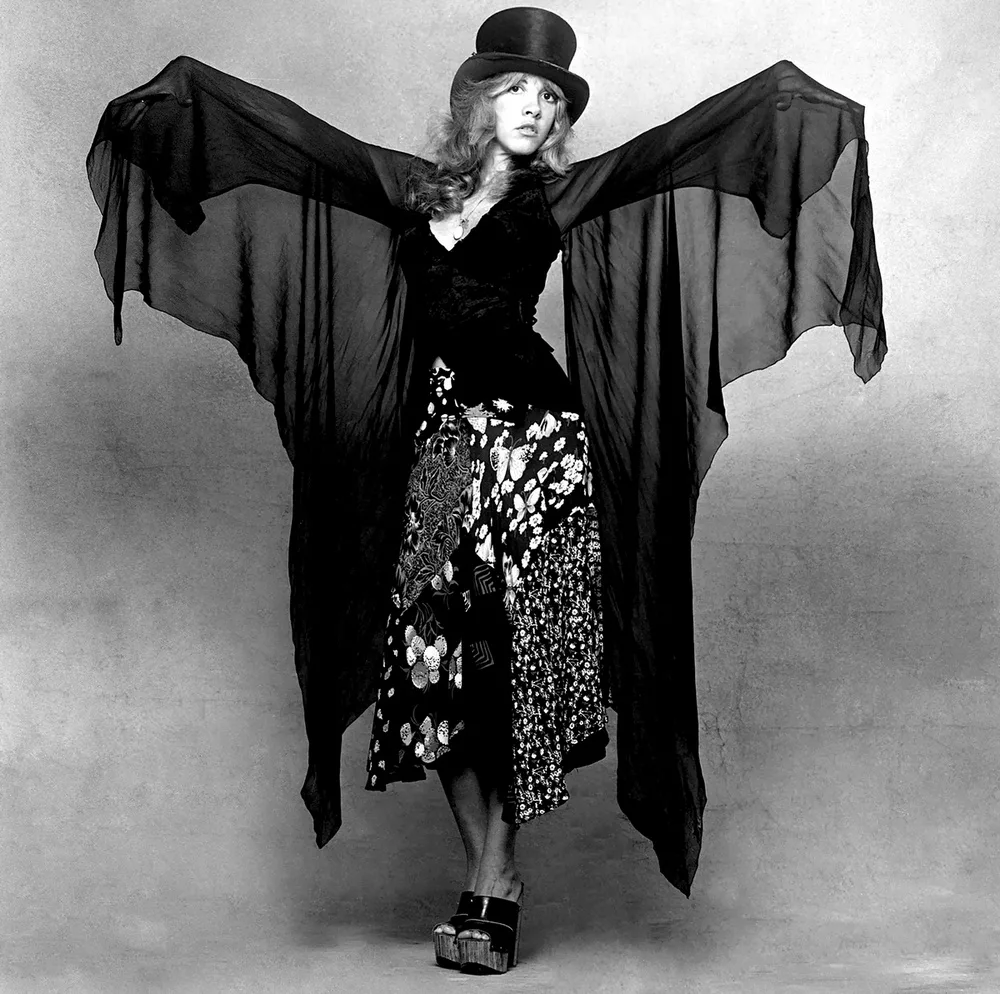
Rhiannon is a character in the 1973 science fiction novel Triad by Mary Leader. Stevie liked the name so much that she wrote the song that became the classic “Rhiannon.”
Years later, Stevie learned that Rhiannon was a Welsh deity in Celtic mythology. The striking similarities between the song “Rhiannon” and Rhiannon of the Welsh stories inspired Stevie to write several more songs about Rhiannon, the Welsh horse goddess. Most of these songs remain unreleased. “[Rhiannon] sounded so free, with personality traits of my own, about a woman who is into her own trip.” (Tower, 1977).
Stevie hopes to produce a musical based on her unreleased “Rhiannon” songs someday.
“Sara” is mainly about Stevie’s three-month affair with Mick Fleetwood during the Rumours Tour in 1977. But, like many of Stevie’s songs, “Sara” alludes to different things happening in her life, as the original version contains many unreleased verses. “It’s about myself, and what all of us in Fleetwood Mac were going through at that time. The true version of that song is 16 minutes long. It’s a saga with many verses people haven’t heard.” (Us, 1994)
“A great dark wing…”
The first half of the song is about Stevie and Mick’s romance. The following verse specifically refers to Mick:
And he was just like A great dark wing Within the wings of a storm I think I had met my match He was singing And undoing… And undoing… The laces… Undoing the laces
Said Sara…you’re the poet in my heart ~
The song’s title was inspired by Stevie’s good friend Sara Fleetwood. “I used her name because I love the name so much.” (EW, 2009). Stevie confirmed in the liner notes of the Tusk reissue (2015) that the Sara referenced in the song was, indeed, Sara Fleetwood, who assisted her during the recording of the song. “My friend Sara was there when I wrote it. She kept the coffee going and kept the cassettes coming and made sure we didn’t run out of batteries, and it was a long, long night recording that demo. She was a great songwriter helper. Sara was the poet in my heart. She likes to think it was all written about her, but it really wasn’t. She’s in there, for sure, but it’s written about a lot of other things, too.”
When you build your house ~
The Eagles drummer Don Henley believed that the lyric “when you build your house, call me” was about him. “I was building my house at the time,” Don said, “and there’s a line in the song that says, ‘And when you build your house, call me.’” (GQ, 1991). Stevie confirmed Don as the inspiration for the actual lyric, telling Ryan Murphy in 1994, “That is true.”
But the lyric’s actual meaning seems to be broader. “‘When you build your house’ was about when you get your act together,” Stevie wrote in the 2015 Tusk reissue liner notes. “Then let me know, because until you get your act together, I really can’t be around you.” Stevie hinted that line could actually be about The Eagles songwriter J.D. Souther. “Mick was the “great dark wing within the wings of a storm,” but when I was going with Mick, I was hanging out with J.D. Souther and he kept saying, ‘You do know this relationship with Mick is never going to work, don’t you?’ And I said, ‘Well, when I get out of it, I’ll let you know.” And so there’s bits and pieces of him there talking to me.”
There’s a heartbeat and it never really died ~
For many years, it was rumored that Stevie had become pregnant with Don Henley’s child. “I believe, to the best of my knowledge, [that Stevie] became pregnant by me,” Don told GQ in 1991. “And she named the kid Sara, and she had an abortion – and then wrote the song of the same name to the spirit of the aborted baby.”
Stevie addressed the pregnancy and subsequent abortion in a 1994 radio interview. “He blew it on the fact that I had an abortion. He told a big magazine that… I would never have told the world that. 92 phone calls from Don and 800 apologies later, well, that story’s out now.”
In 2014, Stevie expanded on the pregnancy to Billboard. “Had I married Don and had that baby and had she been a girl, I would have named her Sara. But there was another woman in my life named Sara, who shortly after that became Mick’s wife, Sara Fleetwood” (Tannenbaum, 2014).
https://www.youtube.com/watch?v=ScSsOA4UVr8
Reference
Tannenbaum, R. (2014, September 26). Stevie Nicks admits past pregnancy with Don Henley and more about her wild history. Billboard.
In “Gypsy,” Stevie reflects on her young-adult life in the 1960s and early 1970s. She describes it as a wish or a search for the life she knew before Fleetwood Mac.
So I’m back to the Velvet Underground ~
The first verse of the song includes the lyric “So I’m back to the Velvet Underground,” which refers to visiting a San Francisco clothing store called The Velvet Underground, where all the female rock stars of the time allegedly shopped. The store, located in the Haight/Ashbury district of San Francisco, no longer exists.
“That’s the words: ‘So I’m back to the velvet underground’ — which is a clothing store in downtown San Francisco, where Janis Joplin got her clothes, and Grace Slick from Jefferson Airplane, it was this little hole in the wall, amazing, beautiful stuff — ‘back to the floor that I love, to a room with some lace and paper flowers, back to the gypsy that I was.’ So that’s what “Gypsy” means: it’s just a search for before this all happened.” (EW, 2009)
“In the old days, before Fleetwood Mac, Lindsey (Buckingham) and I had no money, so we had a king-size mattress, but we just had it on the floor. I had old vintage coverlets on it, and even though we had no money it was still really pretty… Just that and a lamp on the floor, and that was it—there was a certain calmness about it. To this day, when I’m feeling cluttered, I will take my mattress off of my beautiful bed, wherever that may be, and put it outside my bedroom, with a table and a little lamp.”
Lightning strikes maybe once maybe twice ~ I still see your bright eyes ~
The lyrics “Lightning strikes maybe once maybe twice” and “I still see your bright eyes” are associated with Stevie’s childhood friend Robin Snyder Anderson, whom Stevie met at Arcadia High School in the mid-1960s. Sadly, Robin passed away after battling leukemia in 1982. “I tacked on a line for my friend Robin, my best friend, who died of leukemia: ‘I still see your bright eyes.’ But then, Robin wasn’t sick yet. She got cancer, and died within a year” (EW, 2009). Stevie later reflected on Robin’s death in the song “Nightbird” from Stevie’s 1983 album The Wild Heart.
For Stevie’s 16th birthday, her parents gave her a Goya guitar. She wrote “I’ve Loved and I’ve Lost,” a song about a boy whom she was interested in but ended up dating her best friend instead.