Category: Rumours Expanded & Deluxe (2013)

  • Music review: Fleetwood Mac Rumours

    Music review: Fleetwood Mac Rumours

    Fleetwood Mac Rumours

    ROCK
    Fleetwood Mac Rumours (Warner Bros.)

    In 1977 they were everyone’s favorite rock ‘n’ roll soap opera, this band of ex-spouses and ended lovers, and it’s often been said that genuine raw emotion played a key role in the artistic and commercial success of Rumours and the initial Buckingham-Nicks version of Fleetwood Mac.

    “The truth about Rumours,” says singer-songwriter Stevie Nicks in the liner notes of the superb 35th-anniversary reissue of the album, “is that Rumours was the truth.”

    Singer-singwriter-guitarist Lindsey Buckingham and Nicks had broken off a longtime relationship. Founder-bassist John McVie and singer-songwriter-keyboardist Christine McVie’s marriage ended in divorce. Founder-drummer Mick Fleetwood and Nicks were “rumoured” to be sleeping together. And so on.

    But miraculously, they all stuck together musically. Indelible songs like “Go Your Own Way,” “Gold Dust Woman,” “Don’t Stop” and “Dreams” resulted.

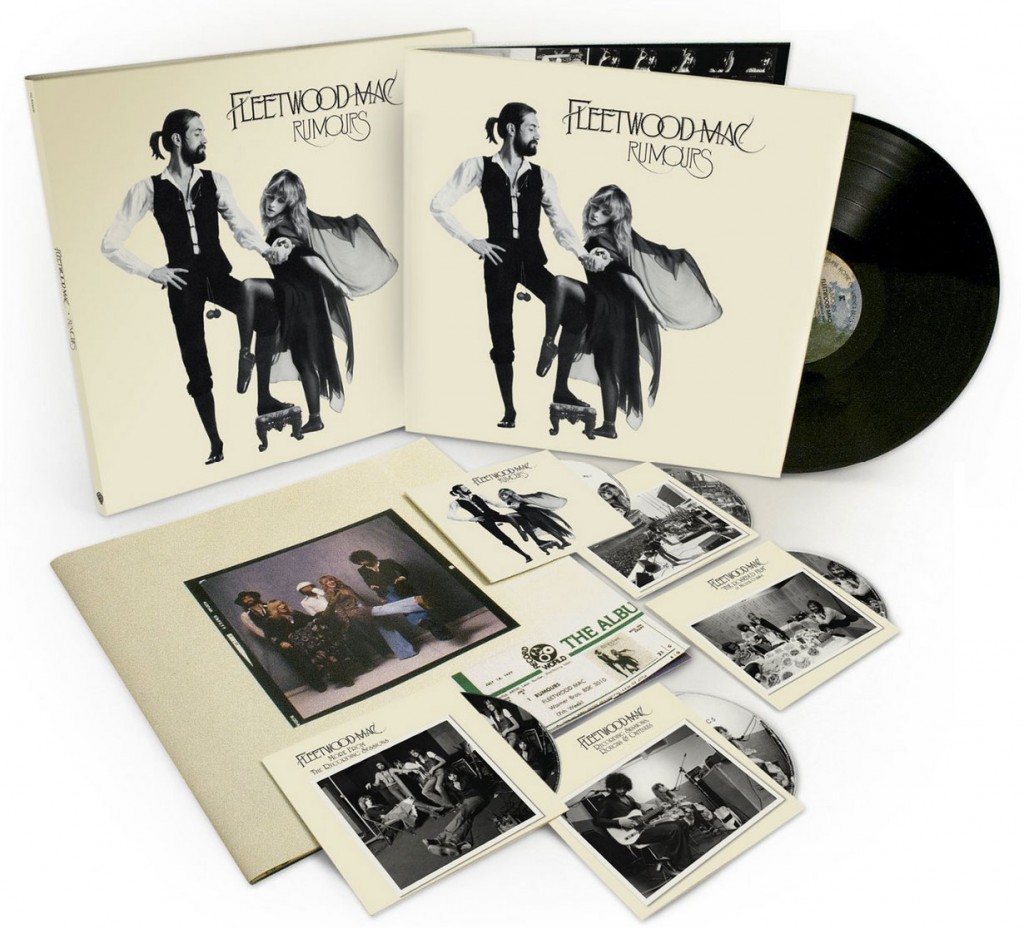
    The three-disc expanded edition includes a live disc recorded at ’77 dates in Oklahoma City and Tulsa (Buckingham can be heard noodling the chords to “Tusk,” which was yet to be born) and a third disc has alternate takes, the outtake “Planets of the Universe” and demos from the “Rumours” studio sessions. The pricey deluxe edition includes all this plus an additional outtakes disc, a DVD and a vinyl version of the album.

    Gene Triplett / OKC / Friday, February 8, 2013

  • Listening post: Fleetwood Mac Rumours

    Listening post: Fleetwood Mac Rumours

    2013-0129 Rumours Deluxe Edition

    Pop

    Fleetwood Mac, Rumours: Deluxe Anniversary Edition (Warner Bros., three discs). It’s certainly not news that Fleetwood Mac’s Rumours is a pop masterpiece, a high-water mark in the annals of ’70s California-based rock and pop. Very few self-respecting record collectors or rock historians would consider their collection complete without it. We all know the story of its creation – how the songs reflected the romantic turmoil within the band, as various relationships crumbled, principally the very torrid one between singer Stevie Nicks and guitarist/songwriter Lindsey Buckingham. What we may not know is what a fantastic live ensemble this particular lineup of Fleetwood Mac was. This new anniversary edition gives us a beautifully remastered version of the original album, with the inclusion of the revered outtake “Silver Springs” tacked on, and a whole disc’s worth of alternate versions and outtakes, too. But the grand prize is the full live concert from the 1977 Rumours world tour, which takes up a full disc. This is the holy grail for Mac fans, and makes the anniversary edition a must-have. 4 stars

    Jeff Miers / The Buffalo News / Friday, February 8, 2013

  • Fleetwood Mac Rumours

    Fleetwood Mac Rumours

    2013-0129 Rumours Deluxe Edition

    10/10 – BEST NEW REISSUE
    Fleetwood Mac Rumours
    Rhino / Warner Bros.; 1977/2013

    Fleetwood Mac’s Rumours would never be just an album. Upon its release in 1977, it became the fastest-selling LP of all time, moving 800,000 copies per week at its height, and its success made Fleetwood Mac a cultural phenomenon. The million-dollar record that took a year and untold grams to complete became a totem of 1970s excess, rock’n’roll at its most gloriously indulgent. It was also a bellwether of glimmering Californian possibility, the permissiveness and entitlement of the 70s done up in heavy harmonies. By the time it was made, the personal freedoms endowed by the social upheaval of the 60s had unspooled into unfettered hedonism. As such, it plays like a reaping: a finely polished post-hippie fallout, unaware that the twilight hour of the free love era was fixing and there would be no going back. In 1976, there was no knowledge of AIDS, Reagan had just left the governor’s manse, and people still thought of cocaine as non-addictive and strictly recreational. Rumours is a product of that moment and it serves as a yardstick by which we measure just how 70s the 70s were.

    And then there’s the album’s influence. Though it was seen as punk’s very inverse, Rumours has enjoyed a long trickle-down of influence starting from the alt-rock-era embrace via Billy Corgan and Courtney Love to the harmonies and choogling of Bonnie “Prince” Billy and the earthier end of Beach House. Rumours set a template for pop with a gleaming surface that has something complicated, desperate, and dark resonating underneath.

    Setting aside the weight of history, listening to Rumours is an easy pleasure. Records with singles that never go away tend to evoke nostalgia for the time when the music soundtracked your life; in this case, you could’ve never owned a copy of it and still know almost every song. When you make an album this big, your craft is, by default, accessibility. But this wasn’t generic pabulum. It was personal. Anyone could find a piece of themselves within these songs of love and loss.

    Two years prior to recording Rumours, though, Fleetwood Mac was approximately nowhere. In order to re-establish the group’s flagging stateside reputation, in early 1974 Fleetwood Mac’s drummer and band patriarch, Mick Fleetwood, keyboardist/singer Christine McVie, and her husband, bassist John McVie, moved from England to Los Angeles. The quartet was then helmed by their fifth and least-dazzling guitarist, the American Bob Welch. Not long after the band’s British faction had relocated, Welch quit the band. Around the same time Mick Fleetwood was introduced to the work of local duo, Buckingham Nicks, who’d just been dropped by Polydor. The drummer was enchanted by Lindsey Buckingham’s guitar work and Nicks’ complete package, and when Welch quit, he offered them a spot in the band outright.

    The group, essentially a new band under an old name, quickly cut 1975’s self-titled Fleetwood Mac, an assemblage of Christine McVie’s songs and tracks Buckingham and Nicks had intended for their second album, including the eventual smash “Rhiannon.” It was a huge seller in its own right and they were now a priority act given considerable resources. But by the time they booked two months at Record Plant in Sausalito to record the follow-up, the band’s personal bonds were frayed, there was serious resentment and constant drama. Nicks had just broken up with Buckingham after six years of domestic and creative partnership. Fleetwood’s wife was divorcing him, and the McVies were separated and no longer speaking.

    While Fleetwood Mac was a bit of a mash-up of existing work, Lindsey Buckingham effectively commandeered the band for Rumours, giving their sound a radio-ready facelift. He redirected John McVie and Fleetwood’s playing from blues past towards the pop now. Fleetwood Mac wanted hits and gave the wheel to Buckingham, a deft craftsman with a vision for what the album had to become.

    He opens the record with the libidinous “Second Hand News,” inspired by the redemption Buckingham was finding in new women, post-Stevie. It was the album’s first single and also perhaps the most euphoric ode to rebound chicks ever written. Buckingham’s “bow-bow-bow-doot-doo-diddley-doot” is corny, but it works along with the percussion track (Buckingham played the seat of an office chair after Fleetwood was unable to properly replicate a beat a la the Bee Gees’ “Jive Talkin’”). Like “Second Hand News,” Buckingham’s “Go Your Own Way” is upbeat but totally fuck-you. He croons “shackin’ up is all you wanna do,”—accusing an ex-lover of being a wanton slut on a song where his ex-lover harmonizes on the hook. Save for “Never Going Back Again,” (a vintage Buckingham Nicks composition brought in to replace Stevie’s too-long “Silver Springs”) Buckingham’s songs are turnabout as fairplay with lithe guitar glissando on top.

    “Second Hand News” is followed by a twist-of-the-knife Stevie-showpiece, “Dreams,” a gauzy ballad about what she’d had and what she’d lost with Buckingham. It was written during one of the days where Nicks wasn’t needed for tracking. She wrote the song in a few minutes, recorded it onto a cassette, and returned to the studio and demanded the band listen to it. It was a simple ballad that would be finessed into the album’s jewel; the quiet vamp laced with laconic Leslie-speaker vibrato and spooky warmth allow Nicks to draw an exquisite sketch of loneliness. “Dreams” would become Fleetwood Mac’s only #1 hit.

    Though Fleetwood Mac was always the sum of its parts, Nicks was something special both in terms of the band and in rock history. She helped establish a feminine vernacular that was (still) in league with the cock rock of the 70s but didn’t present as a diametric vulnerability; it was not innocent. While Janis Joplin and Grace Slick had been rock’s most iconic heroines at the tail-end of the 60s, they were very much trying to keep up with boys in their world; Nicks was creating a new space. And Fleetwood Mac was still very much an anomaly, unique in being a rock band fronted by two women who were writing their own material, with Nicks presenting as the girliest bad girl rock’n’roll had seen since Ronnie Spector. She took the stage baring a tambourine festooned with lengths of lavender ribbon; people said she was a witch.

    Like her male rock’n’roll peers, Nicks sang songs about the intractable power of a woman (her first hit, “Rhiannon”) and used women as a metaphor (“Gold Dust Woman”), but her approach was different. At the time of Rumours’ release, she maintained that the latter song was about groupies who would scowl at her and Christine but light up when the guys appeared. She later confessed that it was about cocaine getting the best of her. In 1976, coke was the mise of the scene—to admit you were growing weary would have been gauche. Nicks’ husky voice made it sound like she’d lived and her lyrics—of pathos, independence, and getting played—certainly backed it up. She seemed like a real woman—easy to identify with, but with mystery and a natural glamour worth aspiring to.

    It’s almost easy to miss Christine McVie for all of Nicks’ mystique. McVie had been in the band for years, but never at the helm. Her songs “You Make Lovin’ Fun” and “Don’t Stop” are pure pep. “Songbird” starts as a plaintive ode of fealty and how total her devotion—until the sad tell of “And I wish you all the love in the world/ But most of all I wish it from myself,” (an especially heart-wrenching line given that McVie’s not quite ex-husband was dragging a rebound model chick to the sessions and Christine was sneaking around with a member of the crew). She didn’t hate her husband, she adored him, she wished it could work but after years of being in the Mac together, she knew better. Throughout, McVie’s songwriting is pure and direct, irrepressibly sweet. “Oh Daddy,” a song she wrote about Mick Fleetwood’s pending divorce is melancholy but ultimately maintains its dignity. McVie, with typical British reserve, confessed she preferred to leave the bleakness and poesy to her dear friend Stevie.

    As much feminine energy as Rumours wields, the album’s magic is in its balance: male and female, British blues versus American rock’n’roll, lightness and dark, love and disgust, sorrow and elation, ballads and anthems, McVie’s sweetness against Nicks’ grit. They were a democratic band where each player raised the stakes of the whole. The addition of Buckingham and Nicks and McVie’s new prominence kicked John McVie’s bass playing loose from its blues mooring and forced him towards simpler, more buoyant pop. Fleetwood’s playing itself is just godhead, with effortless little fills, light but thunderous, and his placement impeccable throughout. The ominous, insistent kick on the first half on “The Chain”, for example, colors the song as much as the quiver of disgust in Buckingham’s voice when he spits “never.”

    In the liner notes to the deluxe Rumours 4xCD/DVD/LP box set, Buckingham describes the album-making process as “organic.” Rumours is anything but, and that is part of its genius—it’s so flawless it feels far from nature. It is more like a peak human feat of Olympic-level studio craft. It was made better by its myopia and brutal circumstances: the wounded pride of a recently dumped Buckingham, the new hit of “Rhiannon”, goading Nicks to fight for inclusion of her own songs, Christine McVie attempting to salve her heart with “Songbird.” That Fleetwood Mac had become the biggest record Warner Bros. had ever released while the band was making Rumours allowed for an impossibly long tether for them to dick around and correct the next album until it was immaculate.

    Given the standalone nature of Rumours, it’s difficult to argue that any other part of the box set is necessary. The live recordings of the Rumours tour are fine, lively even (perhaps owing to Fleetwood rationing a Heineken cap of coke to each band member to power performances). Only a handful of tracks on the two discs of the sessions outtakes lend any greater understanding of the process behind it. One is “Dreams (Take 2)”, which is just Nicks voice, some burbling organ, and rough rhythm guitar gives an appreciation of her fundamental talent as well as Buckingham’s ability to transform it; it makes the case for how much they needed each other. Another is “Second Hand News (Early Take),” which features Buckingham mumbling lyrics so as not to incense Nicks. The alternate mixes and takes (more phaser! Less Dobro! Take 22!), by the time you make it to disc four, just underscore the fact that Rumours did not hatch as a pristine whole. One does not need three variously funky articulations of Christine’s burning “Keep Me There” to comprehend this.

    Nevertheless, it is difficult not to buy into the mythology of Rumours both as an album and pop culture artifact: a flawless record pulled from the wreckage of real lives. As one of classic rock’s foundational albums, it holds up better than any other commercial smash of that ilk (Hotel California, certainly). We can now use it as a kind of nostalgic benchmark—that they don’t make groups like that anymore, that there is no rock band so palatable that it could be the best-selling album in the U.S. for 31 weeks. Things work differently now. Examined from that angle, Rumours was not exactly a game changer, it was merely perfect.

    Jessica Hopper / Pitchfork / Friday, February 8, 2013

  • Fleetwood Mac: Rumours (Expanded Edition)

    Fleetwood Mac: Rumours (Expanded Edition)

    Rumours Expanded Edition (2013)
    Rumours Expanded Edition (2013)

    It seems fitting in a way that a big reason for the existence of this “Expanded Edition” of Rumours is also a big reason why the original album had such magical appeal. That is, the always-dynamic, often turbulent relationship between Lindsey Buckingham and Stevie Nicks.

    In 2012, Buckingham and Fleetwood Mac’s namesake rhythm section of Mick Fleetwood and John McVie held sessions to record tracks for a new album. Nicks, meanwhile, was on an extended solo tour in support of her latest solo album. According to Buckingham, when Nicks returned she was none too interested in contributing to a new Fleetwood Mac album. She was, however, keen on reviving Buckingham Nicks, the name under which the two singer-songwriters had recorded before fate brought them to Fleetwood Mac. Nicks claimed she had a “long lost” song she wanted to do for a long-awaited CD issue of Buckingham Nicks (1973). Buckingham claimed it was a Fleetwood Mac song all along.

    Oh, these rock ‘n’ roll kids …

    Thing was, Fleetwood Mac were set to do a tour in 2013. In lieu of a new album to promote, Warner Brothers decided on a “35th Anniversary” re-issue of Rumours. Rumours was originally released in February 1977. You do the math.

    Oh, these rock ‘n’ roll record companies …

    The story of Rumours has been told many, many times. It has been told, through its songs, to anyone who has listened to the album. As far as the album itself, well, if you cannot recognize Rumours as one of the most complete, satisfying, musically-accomplished, memorable, hummable, which is to say, best, albums of the rock’n’roll era, you need to figure out what it is that is holding you back. If you are one of those people who believe it’s “too soft,” “too clean,” “too SoCal” … you need to get over yourself. Because, musically, what you have here is one of the most powerful rhythm sections in all of rock, meshing with a prodigiously-talented guitarist and arranger, in service of some impeccable songwriting and some unwieldy sex appeal.

    Oh, Rumours

    If there is any “new” perspective to be gleaned, maybe it’s a bit of old perspective. As with all such massive cultural achievements, it’s nearly impossible now to imagine Rumours in its original context. The juggernaut that Fleetwood Mac became after its release now seems inevitable, so much so that you imagine Fleetwood Mac the juggernaut creating the album in the first place. But, of course, that was not the case. Rumours was, basically, a “difficult second album”. The band had had unexpectedly huge success with their first Buckingham-Nicks-assisted album, Fleetwood Mac (1975), but that success had come gradually, eventually reaching a peak at the top of the charts. Who knew if the band could sustain it? Not Warner Brothers, who were putting the pressure on for a follow-up. Not the band themselves, who were, well, you know the story …

    Really, then, you might want to go back and marvel at the supreme level of confidence these songs project. It’s there in every drum crash on “Dreams”, every three-part vocal on “The Chain”, every twinkle of Buckingham’s guitar on “Never Going Back Again”. Yes, the band consisted of all experienced professionals. But they were also at a crucial career point, in complete personal and emotional turmoil, and having cocaine for breakfast, lunch, and dinner. Go back and stand in amazement at how Rumours reaps all the possible benefits of that scenario without suffering any of the potential pitfalls. Every song is an open-and-shut case, a tightly-sealed, end-of-story work of pop-rock perfection.

    Which means items like discs of live material and outtakes are superfluous at best. Then there is this matter. Rumours was in 2004 reissued in remastered form and with a disc of outtakes. This package should have satisfied those fans who were curious about the band’s creative process and wanted to hear some works-in-progress. There is really no justification for this 2013-model, three-disc “Expanded Edition”, other than a financial one. Buckingham has said that, while the band had to approve the tracklist, he could have done without the release.

    It’s easy to agree, and that is why this package does not get the perfect score the original album deserves. Disc One reprises the 2004 remastering, the audio quality of which is always a subjective issue. To these ears, though, it sounds fine. Disc Two tosses in some live performances from the Rumours tour. They show that, despite the multiple overdubbing and laboring over the studio versions, the band could replicate them and play them well. “Dreams” and “Rhiannon” are too fast. The cocaine, maybe? A perfectly enjoyable but hardly essential listen.

    Disc Three has a bunch of outtakes that were not used for the 2004 release. That means they are outtakes that were not deemed fit for an outtakes album. They are mostly rough, and reveal little except that the coda from “The Chain” came from an unused Christine McVie song. A couple tracks are worth hearing more than once, due to the inherent appeal and strength of Nicks’ voice. An early “Dreams” take is minimal and almost ghostly. An early “The Chain” has nothing more than a few lyrics in common with the album version. An acoustic Nicks ballad, it finds her emoting more than on the finished product, in the process revealing why hardly a warm-blooded male in the Western Hemisphere could have resisted her.

    The three-disc package is priced reasonably, surely targeting old fans who will, psychologically at least, get a kick out of buying “new Fleetwood Mac” product. Meanwhile, many other Fleetwood Mac albums languish in the CD dark ages, and a new Fleetwood Mac album sits in the studio, in need of some female vocals.

    Oh, Fleetwood Mac …

    Rating: 7/10

    John Bergstrom  / PopMatters / Friday, February 8, 2013


    John Bergstrom has been writing various reviews and features for PopMatters since 2004. He has been a music fanatic at least since he and a couple friends put together The Rock Group Dictionary in third grade (although he now admits that giving Pat Benatar the title of “first good female rocker” was probably a mistake). He has done freelance writing for Trouser Pressonline, Milwaukee’s Shepherd Express, and the late Milk magazine and website. He currently resides in Madison, Wisconsin with his wife and two kids, both of whom are very good dancers.

  • Fleetwood Mac’s legendary Rumours album turns 36

    Fleetwood Mac’s legendary Rumours album turns 36

    Fleetwood Mac Rumours

    Whenever a music publication makes a list of top rock albums, Fleetwood Mac’s Rumours is there. While the album actually came out 36 years ago, the band is celebrating with what’s being called a 35th anniversary expanded edition.

    Members of Fleetwood Mac, from left, Lindsey Buckingham, Stevie Nicks, Christine McVie, Mick Fleetwood and John McVie, pose with their Grammys for “Rumours” in 1978.

    “We’ve been waiting a long time to put this out,” Stevie Nicks told Rolling Stone. “If you were a Fleetwood Mac fan, you get to hear the songs turn into the songs without a lot of overdubbing. It’s very simple.”

    Rumours is the kind of album that transcends its origins and reputation, entering the realm of legend,” writes Stephen Thomas Erlewine of AllMusic.com. “It’s an album that simply exists outside of criticism and outside of its time, even if it thoroughly captures its era.”

    The album is noteworthy of course for such songs as “Go Your Own Way,” “Don’t Stop,” and “You Make Lovin’ Fun,” but also for the band’s own romantic turmoil as the album was being made, which bleeds through into the music.

    “That really was a lot of the appeal of Rumours,” Lindsey Buckingham admitted in the same Rolling Stone interview. “The music was wonderful, but the music was also authentic because it was two couples breaking up and writing dialogue to each other.”

    The band recently added more dates to their upcoming tour, which begins April 4 in Columbus, Ohio, and which will include many songs from “Rumours.”

    Christine McVie will not be a part of the tour. In 2012, when the tour was announced, Nicks told Rolling Stone, “(McVie) went to England and she has never been back since 1998, so it’s not really feasible, as much as we would all like to think that she’ll just change her mind one day. I don’t think it’ll happen. We love her, so we had to let her go.”

    The band’s 1975 song “Landslide” appeared in Sunday’s Budweiser Super Bowl commercial, one of the most popular ads of the night.

    Gael Fashingbauer Cooper / NBC News / Monday, February 4, 2013

  • 35 Years of Rumours: A Retrospective on Fleetwood Mac's iconic album

    35 Years of Rumours: A Retrospective on Fleetwood Mac's iconic album

    Fleetwood Mac Rumours

    I’m fourteen years old and I have two albums sitting on my bedroom floor. It’s winter, maybe late February. There’s a heavy snow falling, enough snow to send most fourteen year olds outside to do stupid things like attach themselves to car bumpers so they can slide down the slick streets.  Not me. I’ve opted to stay in and study. Not schoolwork. I was never the kind to study for school on a Friday night. I’m studying music.

    On my right side is Led Zeppelin’s The Song Remains the Same, an album I’d been listening to non-stop since Christmas. On my left is Fleetwood Mac’s Rumours, an album I’ve yet to put on my turntable. It was a gift from my grandfather, who knew someone who knew someone at a record label who gave it to him to “give to that granddaughter of yours that likes music.”  That’s me.

    I’m into rock and roll. I’m into deep lyrics about stairways to heaven and hobbits. I’m into noisy guitars and the high pitched wails of Robert Plant. I’m not into whatever this Fleetwood Mac group is selling me.  That’s for people who like pop music. Not for rockers like me.

    But something compels me to give it a try. What can it hurt? No one is around. None of my friends will know that I’m sitting here listening to what is ostensibly a top 40 album while I’m supposed to be rocking the hell out.

    So I drop the album on the turntable. Lower the needle. I get through the first side unscathed, hardly taken in by the pop sensibilities and jangly beats. I’m about to give up and turn back to Jimmy Page and my air guitar when I decide to flip the album and keep trying. “The Chain” starts up.

    I’m mesmerized.

    There’s something about the song that reveals all the layers beneath the surface of what I thought was just another radio friendly album by a band I’d never admit to liking.  I listen to “The Chain” three more times before going back to the first side. I start the album over and listen with a better understanding of what I’m actually listening to.

    I think about all those articles about Fleetwood Mac in Creem magazine and all those other rock rags I read. I dig through stacks of saved magazines and look for pieces on the band. I want to know their history. I want to know their lives.

    After five listens of Rumours, it seems I do know their lives. They are lives of complications, of heartbreak and pessimism but of love and optimism. So many complex feelings, so many things that at fourteen I’m struggling to understand yet so many feelings that are vaguely familiar, having seen adults in my own life go through breakups and reconciliations.

    And my god, that bass line on ‘The Chain.” Even beyond the words, those precious few notes speak to me of a  certain darkness. The last minute and fifteen seconds of the song encompass everything the members of Fleetwood Mac were trying to tell me about life and love and loss and misery.

    Trust no one. Everything is a lie.

    The stories unfolding in front of me while listening to Rumours are far removed from hobbits and heaven. There’s a level of profundity that’s a startling revelation to a fourteen year old.  Music nowhere near the simplistic pop I thought I would find on the album? Another revelation. Rumours is  just a different version of rock and roll, I think.  A more complex, intricate and even intimate version.

    It wasn’t until many years later that I fully understood the process behind the making of Rumours and everything that led up to it. The breakups, the drugs, the romantic entanglements and estrangements, they all served a purpose in creating what is truly one of the greatest albums ever made.

    35 years later (it’s really 36 years, but it’s their anniversary so we’ll let them call it 35) with the stories all public knowledge, the background of Rumours only adds to the mystique of the album and the band.

    The just released 35th anniversary reissue contains three discs encompassing the original album, twelve unreleased tracks and B-sides, acoustics, demos and instrumentals. Very few albums in history are worth this kind of attention 35 years after their inception.  If such lavish attention all these years later keeps Rumours alive, so be it. Let every generation discover and ingest what I took in at fourteen, with the benefit of having the whole story at hand.

    Does an album that’s already had a celebratory reissue deserve another one? When that album is Fleetwood Mac’s Rumours, the answer – my personal one – is yes.

    By Michele Catalano, Contributor / Forbes / Saturday, February 2, 2013

  • Album Review: Fleetwood Mac Rumours [reissue]

    Album Review: Fleetwood Mac Rumours [reissue]

    2013-0129 Rumours Deluxe Edition

    Album Review: Fleetwood Mac – Rumours [Reissue]

    I’ll admit: I’ve made love while Rumours spun on the turntable beside my bed. It was beautiful and sentimental, an unforgettable experience (that I probably shouldn’t be divulging in an album review). But there’s no record that better soundtracks sex than this one. Hell, if you’re between the ages of 25 and 36, there’s a decent chance that you were conceived to these songs. They’re romantic — tales of love and lust, love making and love breaking — infused with universal emotions that nearly everybody can relate to and understand. The critics gave it rave reviews, the general public bought 40 million copies, and the Grammy association crowned it Album of the Year in 1977. Rumours was a rare, ubiquitous success.

    How? Heartbreak. The five musicians who wrote these songs were a complete mess at the time. Let’s take inventory: Drummer Mick Fleetwood’s wife cheated on him with his best friend; on-and-off couple Lindsey Buckingham and Stevie Nicks finally split prior to these recording sessions; and longtime Fleetwood Mac members Bob John McVie and wife Christine were going through a divorce. Shit was fucked up.

    Yet, despite all these tumultuous relationships, the music survived. The McVies bickered and fought in social situations, but worked symbiotically while writing songs. Same goes for Nicks and Buckingham. The record label wanted an album, and Fleetwood Mac delivered. The band took that “fucked up shit” and turned it onto itself, crafting 12 songs about the age-old strife of Boy vs. Girl.

    Buckingham picked up his acoustic guitar and composed the sparse folk number “Never Going Back Again.” And why would he want to return to a relationship that left him teased and tortured? Nicks was (and remains) a beautiful woman — one helluva vocalist and songwriter. Clearly, their breakup affected him. He also countered with “Go Your Own Way,” an FM staple and a pointed piece of advice. “Loving you isn’t the right thing to do / How can I ever change things that I feel?” He sings it reluctantly.

    Nicks was equally transparent with her lyricism. “Dreams” — the band’s only No. 1 single — is literally a direct reply to Buckinghams’ songs: “Now here you go again / You want your freedom.” The dialogue that runs throughout Rumours gives it unity. Rarely do multiple songwriters compile a set of songs that work so well together.

    Christine McVie is the odd one out. At first listen, her songs don’t appear to fit the back-and-forth narrative outlined by Nicks and Buckingham. While they sing of post-separation angst, McVie waxes optimistic on “You Make Loving Fun,” clinging to the best parts of her marriage as it begins to crumble. “Don’t break the spell / It would be different and you know it will” — despite the song’s misleading title, you can tell by the longing in her voice that she’s aware of the distance growing between her and Bob John. Her words are tinged with denial, but she knows their spell is being broken. He made loving fun. Now, things are different.

    Rumours is quietly distraught, but it sounds so pleasant. On nearly every track, Nicks, McVie, and Buckingham bounce their voices off one another; their harmonies glisten, so cooperative and unified — in utter defiance of the estrangement depicted in the lyrics. Buckingham’s chiming guitar work sticks to the major key and gives these songs the accessibility that made them hits. Christine McVie’s keyboards are an underrated sonic element. She achieves a warm tonality that’s largely responsible for the record’s sexy mood. The sounds are passionate, the words are fragile. And what makes Rumours so remarkable and relevant is that it remains fragile and passionate 35 years later.

    The folks at Rhino Records realized this, celebrating the album’s 35th anniversary with all-encompassing box set containing an LP, four CDs, a documentary, and nearly 50 live cuts, demos, and outtakes. In practicality, it’s excessive and overwhelming. Nobody needs three unfinished versions of “Songbird.” But from a historical, archival standpoint, this package is extremely valuable, as Rhino left in the studio banter and rough cuts from the recording sessions; you get to overhear Fleetwood Mac as they make the record.

    Earlier this week, NPR blogger Bob Boilen published a dissenting piece called “Why I’ve Never Liked Fleetwood Mac’s Rumours.” He complains of “planned and orderly” production, “goofy lyrics,” and a record stained with the “taint of the past.” The first two points are just opinions, and to each his own. But I adamantly disagree with his closing statement. Just because a record is released in 1977, it’s tainted by the past? No. Aesthetically, Rumours sounds like an older record; however, the songs (and the emotions contained within them) hit with as much poignancy as they did three decades ago. As a 22-year-old in 2013, I can play this album and feel and emote and project my own sappy thoughts onto those of Buckingham, Nicks, and McVie. Or I can play it when I have a girl over and let it set the mood. I can’t help but think that the twentysomethings of the past shared a similar relationship with Rumours. And that’s why, after 35 years, it endures.

    Essential Tracks: “Dreams,” “Never Going Back Again,” and “You Make Loving Fun”

    Jon Hadusek / February 1, 2013

  • Looking back on Fleetwood Mac’s Rumours more than 35 years later

    Looking back on Fleetwood Mac’s Rumours more than 35 years later

    2013-0129 Rumours Deluxe Edition

    A new deluxe set drills deep on the classic album

    Fleetwood Mac’s Rumours came out in 1977, before the internet and tabloid TV. Instead, all we had to do was listen to the lyrics to get all the drama. The album, which celebrates its 35th anniversary (one year late) with today’s release of a four-CD deluxe edition, chronicled the break-ups of three relationships: singer Stevie Nicks and guitarist Lindsey Buckingham were splitting after seven years together, keyboardist/singer Christine McVie and hubby/bassist John McVie had just divorced. Drummer Mick Fleetwood’s marriage to wife Jenny, who was not in the band, was unraveling, in part because she was having an affair with his best friend.

    To be sure there were break-up albums before theirs: Bob Dylan’s “Blood on the Tracks” comes to mind, and ones after, Bruce Springsteen’s “Tunnel Of Love,” but no album has ever been quite so public a bloodletting as the life drains out of the various relationships.

    The quintet took a year to record Rumours in Sausalito, Calif. at the Record Plant. While they were in the studio, their self-titled 10th album (and the first to feature Buckingham and Nicks) was gaining traction and was a clear sign that moving from the blues-based sound of the previous efforts to a pop-oriented sound was the right move commercially. That was only confirmed with Rumours, which spent 31 non-consecutive weeks at No. 1 on the Billboard 200.

    Most of the songs for Rumours were written was done on the spot, with the songwriters bringing their not-so-fully fleshed ideas into the studio for the others to noodle on. Often, as in the case of “Second Hand News,” Buckingham withheld revealing the lyrics until the last moment since he knew they weren’t likely to go down well with Nicks.

    I got a copy of the deluxe set a few weeks ago and for the first time in years listened to the Rumours, as it was originally released 36 years ago, from start to finish.

    How does it hold up? Remarkably well. It’s like visiting an old friend. The songs easily move into the next and weave everyone’s stories together. Even more fascinating is revisiting how the couples are talking to each other through the songs. For example on “The Chain,” (the one song co-written by all five) Buckingham sings, “And if you don’t love me now/You will never love me again/I can still hear you saying you would never break the chain.”  On “Oh Daddy,” which Christine McVie wrote from Jenny’s perspective, she laments “Why are you right when I’m so wrong/I’m so weak but you’re so strong.” On “You Make Loving Fun,” Christine McVie is singing about her new love, the band’s lighting director (much to John’s dismay). Despite all the cocaine and alcohol that fueled the sessions, or maybe because of them, the overall effect is a voyeuristic look at three break-ups that are raw and complex, and despite their specificity, have a universal appeal for anyone who has found him or herself similarly entangled. The raw immediacy of the tracks still remains.

    All the songs individually have held up as well, especially “Second Hand News,” “Dreams,” “Go Your Own Way,” and “I Don’t Want To Know.” The quintet created music that was not of the day—there’s no ‘70s equivalent of a dubstep drop or a hint of electroclash. Instead the production still sounds fresh and clean and not dated. Buckingham’s guitar playing is crisp, with John McVie and Fleetwood Mac’s rhythm section propulsive when need be and totally in retreat when a gentler touch is demanded.

    Of course, the big mistake with Rumours, one due to time limitations on the vinyl and internecine fighting, is that Nicks’ delicate, searing “Silver Springs” was left off the album. That was corrected in 2001 on a DVD-Audio version and subsequent pressings have included “Silver Springs.”

    The other three discs are fun, but not essential unless you’re a big fan. Disc 2 includes live versions of much of the album from 1977, as well as other hits, including “Rhiannon” and “Monday Morning.” The other two discs feature outtakes, alternate versions of songs, and demos from the recording sessions, including two songs that didn’t make the album, “Planets of the Universe” and a lovely duet, “Doesn’t Anything Last.” The last disc, originally issued in 2004, also includes rough takes and outtakes. It’s very fun an instructive to hear how the songs morphed and were constructed. For example, the demo of “The Chain” is slow and acoustic, but no less haunting.

    A super-expanded version also contains “The Rosebud Film,” a 1977 doc looking at the making of Rumours and the original album on vinyl.

    The current band, which does not include Christine McVie, will start a tour April 4 in Columbus, Ohio.

    Melinda Newman / Hit Fix (Inside the Music) /Tuesday, Jan 29, 2013

  • Fleetwood Mac: Rumours 35th anniversary reissue

    Fleetwood Mac: Rumours 35th anniversary reissue

    Rumours Expanded Edition (2013)
    Rumours Expanded Edition (2013)

    Besides squeezing out endless cash wads from the wallets of music buyers (an ever-diminishing breed), what’s the point of a fancy-ass remastered deluxe box-set reissue? In the case of Fleetwood Mac’s 1977 pop masterstroke Rumours, it’s a question especially worth asking.

    It’s almost impossible to improve, sonically, on one of the warmest, richest recordings in the history of pop music. As a studio document — in terms of engineering, production and performance — Rumours is in the elite company of Dark Side of the Moon and Aja: albums with fidelity as high-class as the songs themselves. This new remaster gives each instrument a more crisp, modern definition, particularly on headphones: Check out Mick Fleetwood’s punchy hi-hat and snare on “Second Hand News,” Lindsey Buckingham’s punchier acoustic strums in the left channel of “Dreams,” the more prominent vocal echo during “Go Your Own Way.” But are these “improvements” necessary? Probably not.

    This 35th anniversary package (It’s actually been 36 years) is stuffed to the brim with extras, most of which already showed up on the 2004 double-disc reissue. But they’re still marvelous: Stevie Nicks ballad “Silver Springs” is the most transcendent b-side ever recorded; Fleetwood Mac were so on fire during this fertile stretch that they didn’t even bother tacking it on to the actual album. The early run-throughs and demos are illuminating—proof that some of the greatest pop songs start off as silly doodles with gibberish melodies: On “Second Hand News,” Buckingham mumbles his way through about 20 percent of the lyrics (“Let me do my stuff” was the focal point, even in this unfinished version), as the band pitter-patters unobtrusively behind him. On an early version of “I Don’t Want to Know,” Buckingham and company are figuring out the track in real time, with Buckingham giving transitional cues (“Verse!”).

    The most revelatory moment is the “acoustic duet” version of “Never Going Back Again,” which is hardly a “duet” since it features brushed drums, congas, piano, a delayed lead guitar figure and three-part vocal harmonies. It’s the maximalist flip-side to the original’s stripped-down simplicity. On the other side of the “essential” coin is “Mic the Screecher,” in which Fleetwood conjures nails-on-chalkboard screeches over aimless piano chords.

    Live tracks from the ‘77 Rumours World Tour are worth seeking out for dedicated fans (especially a ripping take on “Monday Morning,” which harnesses more primal energy in its folky strut), even if none approach the quality of their studio counterparts: “Dreams” is played far too fast, losing its sexy, mystical voodoo; Buckingham’s blaring, out-of-tune guitar on “The Chain” is a distracting deal-breaker. A better live document is the “Rosebud Film,” a previously unreleased mixture of concert footage and chatty interviews. It captures the band in all their late ’70s glory: Buckingham, the afro-glam prince; Nicks, the witchy heartthrob; McVie, the elegant shadow-lurker; Fleetwood, the bearded class clown; McVie, the groove monster in awkwardly short jean-shorts.

    In one particularly great scene, Nicks describes the band’s hodge-podge fashion: “I know sometimes we look like—you know, Lindsey’s all Chinese’d-out in his kimona, and I look like I’m going to a Halloween party, and Christine looks like she’s going to be confirmed in the Catholic church, and Mick looks like he’s going to a Renaissance fair, and John looks like he’s going to the beach.”

    That unique blend of heavy and playful, mystical and muscular—it was never as potent as it was on Rumours. If there’s ever been an album that deserves the lavish, borderline-unnecessary reissue treatment, it’s this pop behemoth.

    ©  Ryan Reed / Paste Magazine / January 29, 2013

  • Stevie Nicks recalls Rumours sessions as 35th anniversary reissue hits stores

    Stevie Nicks recalls Rumours sessions as 35th anniversary reissue hits stores

    2013-0129 Rumours Deluxe Edition

    The 35th anniversary reissues of Fleetwood Mac’s Rumours hit stores today. The band’s historic 1977 album is available as a six-disc Deluxe Edition and a three-CD Expanded Edition. The deluxe package offers a remastered version of the original record plus the B-side “Silver Springs,” along with a variety of demos and outtakes, a CD of a ’77 concert performances, a DVD boasting a making-of documentary and a high-quality vinyl LP.

    As fans familiar with the history of Fleetwood Mac know, at the time Rumours was being recorded, all five members of the band were going through major personal turmoil. Stevie Nicks and Lindsey Buckingham, who were a couple when they joined the group in 1975, were in the process of breaking up. In addition, John McVie and Christine McVie had just divorced, while Mick Fleetwood‘s own marriage was on the rocks. This upheaval was reflected in, and inspired, many of the tunes that wound up on the album, including such hits as “Dreams,” “Go Your Own Way” and “Don’t Stop.”

    Speaking with ABC News Radio about the Rumours sessions, Nicks admitted that as hard as that time may have been emotionally for the band members, it also was a very positive period for the group, in part because of the quality of the music being made.

    “We were all writing little movies around what was really happening and we were digging it,” she explained. “We were having a lot of fun recording those songs, even though we were falling apart…If anything was keeping us from falling apart it was going into the studio every day. And we were totally having a great time.”

    The singer also maintains that although she and her band mates may have been experiencing a lot of hurt with regard to the state of their relationships, on the whole, they had little to complain about.

    “We were rich. We were young,” said Nicks. “We were falling out of love with each other but, hey, there was a lot of other…men and women in the world. [And] we were all movin’ on and we had these great jobs. So, as bad as it was, it was still great.”

    Following its release in February 1977, Rumours went on to top the Billboard 200 chart en route to winning the Grammy for Album of the Year. It has sold more than 19 million copies in the U.S. alone, making it the ninth-best-selling album ever released in the States. Fleetwood Mac fans can expect to hear plenty of tunes from the record if they check out a show on the band’s upcoming North American tour, which kicks off April 4 in Columbus, Ohio.

    ABC News Radio  / Tuesday, January 29, 2013

    Copyright 2013 ABC News Radio