All the best rock stars have their trademark stage moves. Maroon 5 frontman Adam Levine and pop singer Christina Aguilera are certainly aware of the attention that these singular moves command, having sung about “Moves Like Jagger” in the summer of 2011. From Chuck Berry’s rhythmic “duck walk” to Roger Daltrey’s swinging mic routine to the late Michael Jackson’s gravity-defying moonwalk, the greatest performers know exactly what it takes to put on the most memorable stage shows. The Queen of Rock and Roll herself, Stevie Nicks, is no different on her mission to leave the crowd visually spellbound at each show.
Without further adieu, here are Stevie’s Top 10 Stage Moves over the years.
10. Air guitar, drums, keyboards… (video: Luana Barrett)
https://www.youtube.com/watch?v=ut_-_7RPBec
Who doesn’t want to play guitar, drums, or keyboards like a rock star? Granted, Stevie is already an established rock star who has nothing more to prove, so this spectacle is unnecessary. But a girl can still dream, like in this clip, in which Stevie’s gets so lost in air keyboards that she misses her vocal cue to start “Rhiannon.”
9. Shake those maracas! – “Sara” (video: Nicole Barker)
This is a relatively new stage move that Stevie introduced during the instrumental breaks in “Sara.” It’s kind of tribal at first glance, as Stevie raises her arms up high and shakes her hands like maracas. She even varied it in latter tours by walking backwards. At 65, that takes coordination!
8. Crouching Stevie, Hidden Dragon (video: Andy Leo)
There’s something imposing about this great stance, like some serious sh*t is about to go dowwwwn. Stevie digs in, assumes the position, and just lets loose, like in this unforgettable performance of “Rhiannon” from Fleetwood Mac’s 1982 Mirage tour.
7. “Say You Will” Lasso dance (video: evie1942)
The “Say You Will” lasso dance has arguably been Stevie’s most elaborate stage move because it involves so many steps. So here’s the breakdown, with lyrical cues in parentheses:
1) Face forward and start singing, “Say you will, say you will…,”
2) point your index finger up (“Give me one more chance…”),
3) open your hands, bend your arms and spread them to the side (“At least give me time…”),
4) shake your hands in disapproval (…to change your mind”),
5) place your arms to the side, raise them up, extend them to the center (“It always seem to heal the wounds if I can…”), and finally
6) put your left arm on your hip and wave an invisible lasso overhead with your right hand. (“…get you to dance.”)
Got it? It’s OK if you didn’t because, fortunately, we have a video tutorial. Front row fans realized that once they got the steps down, they could mimic the lasso dance at the shows. And they did just that!
Miley Cyrus may have popularized the move, but she’s got nothing on Stevie’s version of the hoedown throwdown, complete with happy feet. Adorable.
5. Graceful spinning – “Gypsy” (video: CroNix99)
She is dancing away from you now…and spinning! Stevie introduced this continuous spinning move during The Dance. It’s slower than another great spinning move that she’s known for (coming up!), but the speed is just right for the midtempo “Gypsy.” Donning a beautifully layered black dress with long, flowing sleeves, Stevie exudes elegance and grace with each turn.
Nothing captures Stevie’s mystical charm like the series of moves she has put together for “Gold Dust Woman.” There have been variations on this interpretive dance over the years, and every time we see it, we are simply entranced.
3. Marching high kick – “Gold and Braid” (video: Andy Leo)
Fans often pay homage to this memorable stage move at tribute parties. But most fans will turn to this familiar performance from the 1981 White Winged Dove Tour to rekindle fond memories of marching high kicks and flying tambourines. Unfortunately, Stevie no longer performs the move onstage, otherwise it would be higher on this list. But seeing the clip over again continues to make fans nostalgic.
2. “Stand Back” high kick (video: WMG)
Stevie performs the “Stand Back” high kick so fast that you could literally blink and miss it. But it is a sight to behold. Stevie has mentioned in interviews that she has always been incredibly limber, boasting that she can do the full splits in a heartbeat. While we’ve never seen Stevie throw down the full splits in performance, the “Stand Back” high kick is the next best thing. (To see Stevie doing a full split, watch the opening scene of the “Gypsy” video.) If you pumped your fist in pride when Daniel LaRusso of The Karate Kid (aka “Daniel-san”) performed the winning “Crane Technique,” against his formidable competitor, then you will be knocked out when Stevie does her stage-right “Stand Back” high kick.
1. “Stand Back” spinning (video: evie1942)
It’s probably no surprise that Stevie’s best stage moves happen in “Stand Back,” the pulsating highlight of Stevie’s live shows. The infectious beats and ominous synth notes just command energy and movement. Though her spinning velocity may vary from tour to tour, fans roar in approval whenever Stevie puts herself into circular motion. It’s a happy moment for everyone, bringing a smile to even the most jaded music fan.
After seeing Fleetwood Mac this week at the Staples Center in LA, I had to do a post on Stevie Nicks.
Stevie is one of the original bohemian rock and roll queens, and her style and look back in the ’70s was as distinctive and inspirational as it is for any bohemian look today. I found this article title calling her “Best Hippie-Queen Earth Mother,” and in it, Florence Welch of Florence and the Machine talks about the influence Stevie Nicks has had on her.
Here are some of my favorite images of Stevie Nicks and Fleetwood Mac (images have been removed).
Above is the back cover of Fleetwood Mac’s Rumors album. The cover is so great. I especially love the dress and scarf worn by Christine McVie here most of all… this came out in 1977, and Chrstine’s outfit still rocks in my book! Sorry Stevie… but in this case, Christine’s look is inspired!
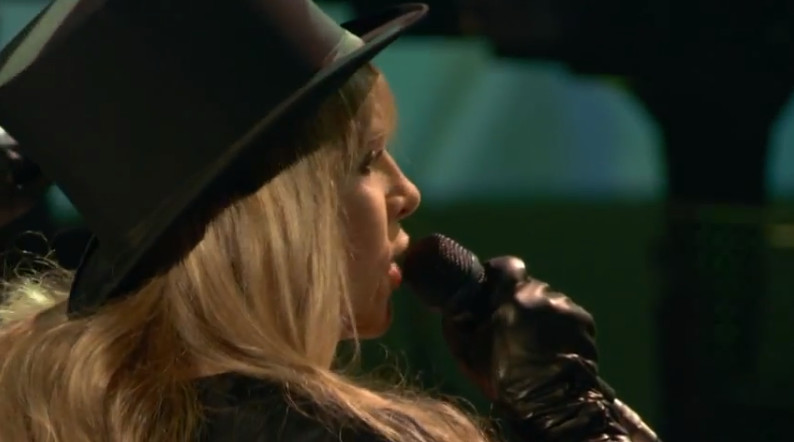
Stevie Nicks in top hat! When Stevie came out on stage at the show this week in one of her wardrobe changes wearing her trademark top hat, the crowd went nuts!
Other than fashion and long cool effortless looking hair, Stevie mostly kept her makeup simple, and it works for a bohemian look then and today as well. To create makeup look for yourself, begin with great skin. Having skin that is fresh and looks natural begins with skincare and then adding concealer where needed and foundation if you choose to use it. I have been using the Clarisonic cleansing brush and love the way it deep cleans my skin and gently exfoliates daily. Gentle exfoliation is a key to a great complexion. http://www.clarisonic.com
Next I suggest my facial serum Heir Atelier Ultimate Make Up Prep, which is a fantastic foundation primer that gives you a natural dewy finish that you can follow with foundation or if you prefer just add concealer where you need it.
Stevie looks like she may have only used Mascara in earlier years and then added eyeliner a little later. The image at the top of the post with the beret also looks like the inside rim line of her eyes is lined in either a flesh or white liner which makes the eyes appear larger.
Protip: That is a great makeup trick to try if you want to make your eyes look larger and be sure to use a flesh tone pencil for the most natural look.
Protip: If you are fair to medium like Stevie, use a dark brown Mascara and eyeliner that looks most natural. If you are darker in skintone or haircolor, you can wear black more easily and still look natural.
Follow the look with a lip gloss only to duplicate the look. Choose one that looks best for your skin tone and coloring to create your version of a Stevie Nicks bohemian-inspired look.
With more than 40 years of solid recording experience under her belt, Stevie Nicks is clearly a legend in her own right. She has paved the way for many singer-songwriters to succeed in today’s fickle music business and provided a few valuable lessons for aspiring artists in a similar quest for stardom. Here are five good ones:
1. Write your own songs. It pays off in the end, literally.
Sure, not everyone can write a classic like “Landslide.” But it took years before the mainstream took notice of this masterpiece. “Landslide” was always a favorite among fans, but it was never a single, so it languished in Fleetwood Mac’s back catalogue for years. But gradually a new generation of artists, such as the Smashing Pumpkins and Tori Amos, picked up on the reflective ballad, introducing the song to new audiences everywhere. When the Dixie Chicks covered the song in 2002, it became the most successful Adult Contemporary song of all-time. Since Stevie was the sole songwriter, she reaped huge dividends, and it filled her coffers—for a lifetime.
2. Less is more, really.
Stevie has racked up a ton of accolades for her songwriting, but you may be surprised to learn that she knows only a few basic chords, many of which she uses over and over again. Her endless poetry may hang on just three chords, but they are the right three chords. Maximize the skills you have, no matter how limited they are.
3. Keep a journal, and make it fabulous.
To quote the great songwriter herself, “memories fade like the wind” (from Rock a Little outtake “Mirror Mirror”), so it’s essential to jot down every important and not-so-important event that happens in your life. Your unique life experiences will be the greatest inspiration for your songs. Like Stevie’s fans, your future admirers will be dying to find out whom you wrote your breakup songs about. So be sure to include all the scandalous details in your notes. If you noticed Stevie’s journals in her recent documentary In Your Dreams, they are bound works of art, filled with poems, drawings, and illustrations. Inject your interests and personality onto the pages. It will inspire you to keep writing in them.
4. Learn how to harmonize
Despite pop music’s rich legacy of accomplished harmony singers (think The Everly Brothers, The Beatles, and Motown), few singers today even bother to work that hard. But this vocal technique will make you a more versatile singer and set you apart from the others. Take Stevie’s lead, she’s the harmony queen.
5. Don’t burn your bridges
Stevie’s fired people, broken up with countless boyfriends, and nearly split up Fleetwood Mac, among other dramas. For many, any of these incidents would be the bitter end to a great band or relationship. But in Stevie’s case, somehow the embattled parties (Lindsey Buckingham, Mick Fleetwood, Don Henley, to name just a few) remain her strongest allies today. How can that be possible? The reason is probably not too far from why most people love her in general. Stevie has a way of connecting with people, whether it’s in her enthralling stage presence, her inspiring songwriting, or her empathy for others less fortunate. I hear she writes the nicest letters (real ones, not email) to people too. The point is, keep your relationships intact because, as Stevie has demonstrated, they will last a lifetime and help you in unexpected moments.
Look to the shawls; let them show you the way. All night you’ve been anticipating their arrival on the Fleetwood Mac stage: the witchy moment when Stevie Nicks, that blonde chanteuse, abruptly disappears from view and, with a simple costume change she’s perfected over 35 years, reemerges a woman transformed, wrapped in fringed silk signaling a visitation by Rhiannon or Gold Dust Woman or the livid spurned lover of “Stand Back,” fine fabric unfurling from her delicate shoulders like the banner of an advancing army, heralding not just a song but the coming of an event. There may also be a wind machine, or perhaps you’re just imagining it. This was all to be expected, and somehow it still thrills. Twirling in the outstretched arms of Stevie Nicks, those shawls have magic in them.
No one rocks a shawl like Stevie Nicks. That much was evident at Madison Square Garden this spring, the third stop of a constantly extending, sold-out Fleetwood Mac world tour (coming to Jones Beach on June 22). Everywhere in the arena were homages to Stevie: top hats, feathers, flowing black fabric. And, of course, shawls. Fathers and daughters danced enthusiastically side by side, and the air was thick with the smell of furtive intergenerational pot smoking. Chances are, you or someone next to you was weeping during “Landslide,” with that chorus you might casually dismiss as cliché until you find yourself singing it in unison with 15,000 fans: “Time makes you bolder / Children get older / I’m getting older, too.”
Nicks’s 65th birthday was May 26, and she spent it twirling onstage at the MGM Grand in Las Vegas. Stevie Nicks, her generation’s great California girl sex symbol, who very publicly fought her way back from drug addiction and weight gain, now an aging rock star unafraid of the passage of time and, having long ago married her music, still an undefeated romantic searching for love. “She’s like your fairy princess godmother,” Courtney Love has said, “who’s gonna save you, and lives in a magical kingdom somewhere, and has, like, fabulous romances.”
Onstage, she’s still an aesthetic pioneer—her near-butt-length hair, fingerless gloves, knee-high black suede platform boots, and finely tailored dress in tatters all adding up to what she herself calls “the Stevie Nicks thing.” It’s a persona she’s said is drawn from the slinkiness of Grace Slick, the “humbleness” of Jimi Hendrix, and the attitude of Janis Joplin. Nicks had observed all three and opened for Hendrix and Joplin just out of high school in the late sixties as part of Fritz, her first musical partnership with Fleetwood Mac’s intense virtuoso guitarist Lindsey Buckingham. Buckingham is, with toweringly tall oddball drummer Mick Fleetwood, one of two ex-boyfriends Nicks performs with every night, a five-foot-one pixie singing with raspy conviction about her own heartbreak and resilience on the same stage as two men who’ve caused her pain. Or is it vice-versa?
Fleetwood Mac is, to fans, not just a band but a riveting 40-plus-year soap opera involving the loss of members to schizophrenia and a religious cult; the arrival in 1974 of gorgeous, drama-filled young couple Stevie and Lindsey; and the cocaine-and-alcohol-fueled divorces and affairs behind 1977’s Rumours, which became the then-fastest-selling album of all time. You don’t come to one of their shows just for the music; you come to watch them masochistically stare down their past before a live audience. You come to watch Stevie and Lindsey—who’ve known each other since high school—look into each other’s eyes and harmonize on the songs they wrote about each other, in anger, long ago: “Dreams” (by Stevie, “Now here you go again / You say you want your freedom / Well, who am I to keep you down?”), and “Go Your Own Way” and “Never Going Back Again” (by Lindsey, and meaner). You come to see Stevie dance in front of Mick’s drum kit, knowing full well she had an affair with him after her breakup with Lindsey, while Mick was married—as Lindsey wails away on guitar and looks on. You come because you feel for the quiet, steady man on bass, John McVie (the only guy in the band Stevie hasn’t slept with), who had to lay down the rhythm track on songs like “You Make Loving Fun,” written by his ex-wife, now-retired keyboardist and singer Christine McVie, about her affair with the band’s lighting director and how she’d never been so satisfied by a man before. You come because this is a band that has not tried to hide their genuinely fucked-up dynamic, which plays out deliciously onstage in banter about the state of “the war” and in the way Stevie always leaves to put on her shawls right in the middle of one of Lindsey’s blazing guitar solos. Has she just had enough of his ego? Or is she magnanimously ceding the floor, only to return moments later to show him how it’s really done? To see Fleetwood Mac play live, knowing what you and everyone knows about their turmoil, substance abuse, and brushes with death, is to see layers of meaning in every gesture and to marvel that they’ve survived long enough to make it to this very show.
“If your mother told you when you were 8 years old you’d be playing Madison Square Garden—this is it,” Nicks said that night, her voice cracking. “This is the dream. So everybody, we’re so glad you’re here. The party starts now!”
The first shawl I see up close is simple, black, and draped across Nicks’s nose and mouth as she slumps down in a dark Santa Monica editing room. It’s a few weeks before the start of the tour, and she’s extremely stressed tying up loose ends, one of which is approving the final cut of a documentary about the making of 2011’s In Your Dreams, her first solo album in ten years. An earlier cut of the movie with muddled sound had left her displeased when she’d seen it in Austin. “Oh, it’s so much better,” she says now. “After watching it in Texas, I was ready to slit my throat, get back on the airplane, and jump out.”
Nicks’s vibe is so outwardly mystical and New Age-y it verges on the ridiculous: In Your Dreams has two songs referencing vampires, including “Moonlight,” inspired by a tear-filled viewing of The Twilight Saga: New Moon, which reminded her of all the men she’s loved who’ve left her. (“We kept a photo of Bella and Edward on the soundboard when we recorded,” she said.) But as she intently watches the movie, as editors and sound mixers and producers all watch her watching herself, she comes across less rock star than anxious home cook, terrified the soufflé will collapse. Her hair is in a messy topknot, and she’s peering down saucer-like “super-prescription” rose-colored glasses. She’s so deep in concentration it takes at least ten minutes for her assistant of 25 years, Karen Johnston, to find the right opening to whisper in her ear that I’ve arrived. Nicks turns around, blows me a long, sorrowful kiss, and then returns to her slumping.
In the recording studio, 1975.
We look to our stars for otherworldliness and operatic scale, which Nicks delivers. But what sets her apart even among peers is her total Auntie Mame availability, how immediately she is right there with you. She’s as vividly present in the midst of a performance as she is when you meet her offstage: After that blown kiss, the next time she addresses me directly is to tell me I’m welcome to stay in the editing studio or to follow her. “I’m going to go to the bathroom,” she says. “Go anywhere you want.”
This is when I discover that no matter how much time I get to spend in the presence of Stevie Nicks, it will never feel complete. I miss half a story about how she wound up spontaneously touring with Tom Petty. “And I said, ‘Have you promised her diamonds or something? Buy her a fucking Porsche.’ And he goes, ‘She won’t go’ ”—she imitates Petty talking about his wife in a low, mopey voice. Nicks went in her place to keep Petty company and had a grand time, she says, until the Australian government discovered she was performing without a work permit and told her, “ ‘If you even walk on that stage and go ping!, you can never come back to Australia. Not on a vacation, not with Fleetwood Mac, not with friends.’ And that’s, like, a career-killer right there.’ ”
I learn how she came back from that trip, having accidentally pilfered a bunch of melodies written for Petty, and wrote a song to one of them and recorded it with Fleetwood Mac and kind of like an idiot played it for Petty over the phone: “All I can hear is Tom screaming.” And I learn that she’d initially balked at letting cameras into Tara, her six-bedroom L.A. mini-mansion, where she and Dave Stewart of the Eurythmics recorded the album, because “that’s a lot of work to get up every day for a year and get dressed and put on makeup.” And how she’d been reluctant to do another album at all because “the music business is dead.”
Before working with Stewart, she’d never written a song in real time with anyone else, she says; she usually has a producer like Buckingham or Jimmy Iovine (another ex-lover, who co-produced her debut solo album Bella Donna) build a track around a poem from one of her hundreds of leather-bound journals. Or she writes alone at the piano (she can’t read music and has never had lessons). Now she refers to the “sandbox” of creativity she had with Stewart as the best time of her life: “He makes you feel like Alice in Wonderland and he’s the Mad Hatter.” They wore Dickensian costumes and rented owls and a white horse to prance around her backyard. Occasionally, Nicks would tap-dance by her black Bösendorfer grand piano; it still has a bullet in its lid from getting caught in a freeway shooting while being moved from Los Angeles to her house in Phoenix, where she was born, because she’d had a dream that the piano had gotten destroyed in an L.A. earthquake and wanted to keep it safe.
Nicks turns to her film editors—she wants them to take out the part in the documentary where she says, “Take that fucking track off.” “I tried very hard not to swear in this film,” she says, “because that’s not the role model that I want to be.”
One rarely finds a role model who snorted so much cocaine she tore a permanent hole in her nose. Nicks has made no secret of her years on blow—complemented with alcohol and pot, and fostered by long hours, stage fright, stress over her relationship with Buckingham, sudden immense wealth, and fatigue from the Epstein-Barr virus she’d contracted following complications from leaking silicone breast implants—an addiction that she kicked at Betty Ford in 1986. Or of her eight years on Klonopin, the benzo she’d been prescribed to make sure she wouldn’t go back on coke, for which she checked herself into a hospital for 47 days in 1993.
“She’s had a life, a dramatic life, and she came out the other end,” says former Interview editor-in-chief Ingrid Sischy when I ask her to explain why Nicks has such an avid following to me, a non-devotee born too late to have witnessed the history. In other words, she survived when she probably shouldn’t have, in an era when many didn’t—not just the drugs but the Shakespearean love affairs, with Buckingham, Fleetwood, and Iovine, along with two members of the Eagles (Don Henley and Joe Walsh), Eagles songwriter J. D. Souther, and a you-go-girl list of countless others. “She hasn’t airbrushed her life at all,” Sischy says. “She gets out there, and she’s the weight she is, she’s the age she is, and she’s still got so much dignity and class and humor. Stevie Nicks is not about repentance; I always thought she was about consciousness. But to know there’s different chapters and different battles at different moments in your life that you have to make peace with so you can take on new battles is a pretty great thing for kids to see.”
Fellow 65-year-olds who turn into lighter-waving teenagers in her presence know Nicks as the breezy feminine antidote to the harder-edged women of rock: Patti Smith, Debbie Harry, Joan Jett. “She was like a feminine version of Mick Jagger,” says Sheryl Crow, a good friend and collaborator, who joins Beyoncé, Mary J. Blige, Florence Welch, Sandra Bernhard, and Taylor Swift on a long list of performers who see Nicks, with her singular, sexy-Gollum voice, as a musical superhero. (Lindsay Lohan has expressed interest in playing her in a biopic, to which Nicks has responded, “Over my dead body. She needs to stop doing drugs and get a grip.”) Nicks spent the months leading up to the tour gigging with Dave Grohl and considers herself an honorary member of Foo Fighters, Lady Antebellum, and Tom Petty and the Heartbreakers. Her look, created with her costumer Margi Kent, has influenced fashion designers from Anna Sui to somebody’s brother’s girlfriend who gave her an organically dyed silk poncho during tour rehearsals because Nicks had inspired her to go into fashion (“So attractive on somebody skinny and 18,” Nicks says of the poncho). A woman in the U.K. named Johanna Pieterman paints Celtic-style portraits of Nicks with your spirit animal of choice (usually an owl, wolf, stallion, or unicorn). And for 23 years, a collection of drag queens, costume enthusiasts, and Nicks fanatics whose lives she’s touched have been gathering at Night of a Thousand Stevies, a New York dance party and revue in which participants twirl to techno versions of “Sara” and “Edge of Seventeen” and shake tambourines adorned with ribbons rather than applaud. “I love being the reason that people gather and have a good time,” says Nicks, who’s been too scared to attend but did record a video message telling them to “sing your little wild hearts out” two years ago. “But I’m completely befuddled it’s still going on.” A creature from a bygone era of celebrity that is both pre-sarcasm and pre-confessional, Nicks will invite you in to feel her feelings with her, but wouldn’t dream of tweeting about the pint of ice cream she ate to get her through it.
Right now, Johnston is trying to wrench Nicks away: She’s got to get to rehearsal because she hasn’t been able to practice their closing song because the power went along the Pacific Coast Highway the night before and shrouded her apartment in darkness and bad energy from all those angry people stuck in their cars. “They’re gonna hate me,” Nicks says of her bandmates. “I’m going to be crucified.”
Her longtime publicist, Liz Rosenberg, just in from New York, comes up to say hello and, as she goes in for a hug, sniffles.
“You’re sick?!” asks Nicks, jumping back and throwing her shawl protectively across her face.
“I’m not touching you. But I’m here. No, we’re not gonna hold hands. We’re gonna love from a distance.”
“If I get sick again, I am, like, a dead woman. Just … back away.”
Stevie Nicks, Mick Fleetwood, and Lindsey Buckingham, 1977.
The reason Nicks is terrified of being sick again is standing outside a rehearsal space on the Warner Bros. lot in Culver City. Lindsey Buckingham is there, has been there for hours, and she has no idea how he’ll react to her tardiness. He spots her, scowls, and taps his wrist. Everyone takes a nervous breath. Then he smiles, and everyone laughs. Breathe out.
“We’re getting along,” Nicks tells me, tentatively. “It’s been a long, long, long, long, long, long time. Like, decades. We haven’t gotten along like this since I can remember, since maybe before we joined Fleetwood Mac, when it was just the two of us. And it really is really lovely.” Rock critics often simplistically pit Stevie and Lindsey against each other, citing how Stevie only joined Mick Fleetwood’s British blues-rock band because Mick wanted Lindsey as a guitarist and Lindsey insisted they take his girlfriend, too. But Nicks has been on a musical path since she was 4, tap-dancing on a bar and singing duets with her country-musician grandfather, and these days when the band wants to hit the road again, they wait for her. “Three years is really a perfect amount of time to be out of the spotlight,” Nicks says, having pushed this reunion back a year. “It’s a good idea to get out of the spotlight and let people miss you.”
On tour, Buckingham is the band’s musical director, and Nicks is happy to let him worry about lighting cues, videos, and which songs they play and when: “I just get to stand there and sing, which is easier than what he does,” she says. This time around, the boys are trying to be sensitive to Nicks’s vulnerable position as the band’s sole female since Christine McVie left in 1998 after suffering panic attacks and developing a fear of flying. “It’s not near as fun” without her buddy there, Nicks tells me. “Because it was girl power, you know?” “She’s our queen bee,” Fleetwood says of Nicks, “and she needs protecting.”
At rehearsal, Nicks and Buckingham’s banter lit up with hard-won playfulness as they tried to work out their positioning on the stage. After “Landslide”—which Stevie wrote about Lindsey, just before joining Fleetwood Mac, as she contemplated leaving music behind entirely when their duo, Buckingham Nicks, was dropped from its label—Lindsey remarked: “I feel weird standing behind her. I don’t want to stand too close.” Stevie fired back, teasingly: “I don’t know. I have stood next to you playing guitar for how many years?”
To perform “Gypsy,” Nicks suggested, “I’m just going to basically stand sideways because I know you can’t turn.”
Buckingham: You’re stalking me.
Nicks: I’m stalking you on this one.
Buckingham: All I can do is angle toward you. I gotta look at the neck.
Nicks: Just remember to look over at me every once in a while so I don’t look like an idiot.
Buckingham: I just need to eye the neck of the guitar and then look over at your neck. Go from neck to neck.
Nicks: My wrinkly neck.
Buckingham: Oh, stop it.
The set includes, at Nicks’s suggestion, a long-lost Buckingham Nicks demo, “Without You,” that she wrote about being hopelessly in love with Lindsey and considers the best poetry she’s ever written about him. And it ends with “Say Goodbye,” which Buckingham wrote just ten years ago, 27 years after their breakup, having married and had children, about trying to move on: “That was so long ago, yeah / Still I often think of you.”
“They’re still sending messages to each other,” says Fleetwood. “They are absolutely on a journey, and they have absolutely not given up. And it’s nothing to do with being in love. It’s to do with love itself and the premise of a huge underlying respect from whence they have come and from whence they started their journey together. And I think they truly advocate that: ‘We can end our days saying, We didn’t run away from this.’ ”
Stevie Nicks lives in the bow of a ship in the sky. At least that’s the feeling one gets from inside her condo along the Pacific Coast Highway, a glass-fronted, vertically stacked “penthouse.” If you walk to the outermost edge of her vast, open living room, with walls paneled in wood and beige furniture covered in white fur throws, the view is 180 degrees, from Palos Verdes to Pointe Dume, Malibu. On a clear day, you can see Catalina Island and, if you’re lucky, dolphins. Once, her housekeeper came running over to alert her to a gigantic hawk perched just outside her window; birds of prey live in the cliffs that abut the building. “I went, ‘Don’t even move!’ ” Nicks says, reenacting the moment with a crouch and a whisper. She got her camera and took his picture. “And I felt like something happened, like a connection was made,” she says. “He was never coming back. That was a once-in-a-lifetime thing.”
She takes me out onto that balcony. “When I moved in here, everybody said, ‘You’re paying a lot of money for one big room,’ but the architect said to me, ‘You should never worry about that because there are eight views like this in the world. Not Paris, not London, not Rome.’ ”
Another window looks back into the hills. From it, she can see Tara and the giant oak or sycamore—she’s not sure which—in the backyard she wrapped in Christmas lights years ago that she never took down. “I can wave at my friends!” she says. Nicks only stays at Tara on momentous occasions, like recording In Your Dreams or the five months she spent grieving over her mother’s sudden death at 84, in 2012. She often jokes about Tara being a bed-and-breakfast since she mainly uses it to house visitors (she also has a 39-year-old goddaughter who lives there permanently). She got the condo because four days after she moved into Tara, “I realized that I couldn’t really live there because I can’t hear the ocean from there.” At the height of Fleetwood Mac’s excess, Nicks was legendary for insisting her hotel rooms be painted pink and outfitted with a white piano. “One of Stevie’s almost comedic needs, Traveling Wilbury that she is,” says Fleetwood, “is what we call hotel-hopping, where we all check into a hotel and she goes, ‘Oh, I need to try another one,’ and just checks out. She should be a hotel critic.” The singer Vanessa Carlton, a close friend, calls it “gypsy culture”: “If you’re just not connecting to the space anymore, you just gotta move on down the road.”
Johnston once shared a place with Nicks but now has her own a mile away, so she can rush over, as she did the night the power went out. “I’ve been warning all you computer people that one day the whole city’s going to go down. For me it’ll just be like, ‘It’s all dark!’ All of you guys will be like, ‘Oh, no!’ ” says Nicks, who’s such a Luddite she communicates with her fans by handwritten letters that Johnston scans and uploads to the Internet. She hasn’t had a driver’s license since 1978 (“Where would I go by myself?”) and is only reachable by phone through landline or Johnston. I was with them once when Johnston’s cell phone rang; Nicks harmonized with the ringtone.
“I don’t think I’ll ever sell this place,” Nicks says. “I’m bored at the big house. I feel lonely at the big house. I feel depressed at the big house. I’m kind of going like, ‘Now I kind of wish I had a boyfriend!’ at the big house. I come over here and I walk through those doors and I feel like an international pop star.”
She takes me to her bedroom, which is largely undecorated, but for a “moon and stars” light machine her goddaughters—Fleetwood’s two youngest daughters—gave her and that she now buys for everyone she knows, and a large Buddha on the floor. There are Buddhas everywhere. She’s not a believer, she says, “but I probably will be someday.”
On her bed sits one of the beautiful journals in which she’s constantly scribbling poetry and drawings of fairies and mystical things—many of which bear a resemblance to the work of Sulamith Wülfing, the German fairy-tale artist after whom she named her dog, a fourteen-and-three-quarters-year-old Yorkshire terrier–Chinese crested mix. (Nicks often talks for Sulamith in a high-pitched squeal.) Beds, Nicks laments, are a constant bane; she’s bought ten in the past year. “This is another new bed, and it’s going back.” She can’t sleep flat because of a hiatal hernia and acid reflux, and she thought this Tempur-Pedic mattress would help, but she also uses her bed as an office, and every time she sits up she feels like she’s sinking into a hole. Nicks is a night owl. (“You ever wonder why her skin looks so good?” asks Carlton. “She never goes out in the sun; she’s a vampire.”) And, she says, don’t judge her for all the white fur everywhere; it’s mostly rabbit. “Listen, there’s an overpopulation of rabbits. There’s so many rabbits in Phoenix that they’re, like, gonna move the people out.”
Above her bathtub is a sign reading “DON’T PISS OFF THE FAIRIES”; she often lies there, doing her daily vocal exercises, and regrets her remodeling decisions. Adjoining the bathroom is a walk-in closet, an entire wardrobe of miniature shawls and Rhiannon sleeves custom-made for Sulamith, and drawers upon drawers filled with the insoles of just about every shoe she’s ever bought, in case they might fit other footwear. “I’m like a hoarder,” Nicks says. She keeps nearly everything that people give her—like that silk poncho she’ll never wear from the young designer. “I feel bad, you know? It’s like a piece of love. You have no idea. I have storage units full of … I could outfit everybody in Los Angeles in these things.”
My own trip to see Stevie in Los Angeles had begun in a pretty fragile state. I’d just broken off a yearlong thing with an unavailable man, my 35th birthday was a month away, my period had started that morning, and I couldn’t shake the words of my mother, another blonde adventuress and former Haight-Ashbury–ite who also turns 65 this year, when I told her about meeting this New Age oracle and rock feminist whose name she struggled to place. “She sounds like a very brave lady,” my mother said, confessing that, for all her youthful rebellion, not getting married had never occurred to her as an option and that she didn’t know who Stevie Nicks was because she’d tuned out most of pop culture around the time that Rumors came out. “I was busy,” she said, “having a baby.”
And here I was, 35 years later, in a closet with a 65-year-old rock star who was disobeying orders for vocal rest from her band and talking to me like we were 23 and high on romantic ambition; a woman who represented to me, in that moment, the uncompromised life my artist mother might have had, and a future, of unapologetic loves and losses past my still-fresh heartbreak, I might look forward to, too.
Nicks has been trying to feed me ever since I arrived but has almost no food to offer, because the only thing in her fridge are boring Weight Watchers–friendly packaged meals that a lady sends over every three days. “That’s how I stay on my perfect diet—I can come out here in the middle of the night crazed, and there just isn’t anything, so there’s no reason to even bother to come out here, because I’ll just be eating one of my meals that is supposed to be for tomorrow, and I don’t really want that, because it’s exactly what I just had today.” Which would be chicken, and more chicken, plus an ever-accumulating number of Jell-O cups and baby carrots; there are at least 25 baggies in her vegetable drawer. “How many carrots can you eat?!” she asks, cackling. “I eat one yogurt every single night right before I go to bed. It’s my, like, special time.”
The strongest substance in her house these days is coffee, but it’s nearly impossible to steer her away from the topic of drugs. “There wasn’t any ecstasy around when we were doing drugs, which I’m really happy about,” she says. “I’m very careful. Very careful. If I break my ankle and I need to take a pain pill, then I’m taking a pain pill. But I’m not going to take a pain pill if I don’t need it, ever. I’m past that, you know. I’m 65 years old. And I don’t drink. I quit smoking cigarettes. I don’t do any recreational drugs. And I’m really pretty happy. Sometimes I’m up onstage and I’m going, ‘I can’t really believe you are actually up here, sober as a judge, having a great time.’ ”
When I ask about regrets, she only mentions the eight years on Klonopin. She believes her psychiatrist was a rock groupie who just wanted to hear her stories, and she spent her late thirties and early forties lying on a couch, ballooning to 175 pounds, and doing the worst, most nonsensical writing of her life. “I talk about how I’m happy to not be married, I’m happy to not have children, and that’s all true,” Nicks says. “But the fact is that I don’t know what would have happened in that eight years. Maybe I would have met somebody. Maybe I would have had a baby. Who knows? So that is something that was really stolen from me.”
Imagine, she says, being single and Stevie Nicks. “Like, I’m gonna go to a bar? And hang out? I mean, where am I gonna meet somebody?” She and Sheryl Crow actually make up skits imagining the videos they’d record for a matchmaking service. “We who are famous, we laugh,” says Nicks, performing one for me: “Hi! My name is Stevie Nicks, and I’m looking for somebody that is no more than five years older than me. Please no health problems, no diabetes, no heart disease, no gout, please, no bipolar; if you’re on an antidepressant, not good.” Or: “Hi! You know, I’m in a band called Fleetwood Mac, and, you know, I’m looking for, like, a guy who’s, like, tall, and, like, you know, anywhere from … well, I don’t really date younger men, so, you know, anywhere, from, I guess I could go as young as 58. And as old as 68. Not 70. Just 68. And, um, I like to travel, but I have an assistant, and she always has to come with me because I really gave up packing a long time ago.”
“It is hard!” says Crow. “Relationships are hard enough, but to be a strong woman who’s also in front of a large audience of people who are trying to connect with you—it’s threatening.”
Nicks goes on. “When we were really young, it was a lot easier. Because we were crazy. I’m not crazy now. We moved fast and furiously in those days, and I had lots of boyfriends and lots of amazing relationships and lots and lots of fun. I had enough fun and enough relationships to last me for the rest of my life, really.” She pauses. “If that special man walked into my life, I’m the first one to say I would probably pack my bags and go with him. But it’s a very elusive thing.”
“She’s very amazing about making these major decisions about her life that a lot of people would just stumble along, and suddenly you’re 35 with three screaming kids and going, ‘Hey, how did I end up here?’ ” says Dave Stewart. “It’s this free-spirit thing: Don’t let people push you into a box that you don’t like.” Carlton, 32, remembers Nicks telling her that when Nicks joined Fleetwood Mac, she only saw one path for herself, and it didn’t involve childbearing. “She said, ‘I wanted to be respected by every single dude on that stage, and if I walked out and I’d made that choice, the dynamic would have been different.’ And she’s right,” Carlton says. “And now it’s a little bit different because of women like Stevie. And I think, God, I’m just so grateful to her. She’s a total badass.”
Carlton tells me that last year she asked Nicks to write out her “rules of engagement”—how to get what you want out of life and men. Nicks gave her a stack of hotel stationery with handwritten directives and the overall message that you shouldn’t compromise on having a wonderful, interesting life just because it can be a challenge for some men, but that you should also be aware that that lifestyle can be a burden. Carlton reads one aloud: “ ‘He must have a good job. He must be happy and satisfied with his own life. You are there to enhance his life, not take away from it, and he is there to enhance your life, not fuck it up.’ That’s my favorite one. Thank you, Stevie!”
Friends, including Fleetwood, have worried about Nicks’s loneliness. “Most women would not be happy being me,” Nicks says. “People say, ‘But you’re alone.’ But I don’t feel alone. I feel very un-alone. I feel very sparkly and excited about everything. I know women who are going, like, ‘I don’t want to grow old alone.’ And I’m like, ‘See, that doesn’t scare me.’ Because I’ll never be alone. I’ll always be surrounded by people. I’m like the crystal ball and these are all the rings of Saturn around me.”
“My generation fought very hard for feminism, and we fought very hard to not be labeled as you had to have a husband or you had to be in a relationship, or you were somehow not a cool chick,” she says. “And now I’m seeing that start to come around again, where people say to you, ‘Well, what do you mean you don’t have a boyfriend? You don’t want to have one? You don’t want to be married?’ And you’re like, ‘Well, no, I don’t, actually. I’m fine.’ And they find a lot of reasons why you’re not fine. But it just seems to be coming back. Being able to take care of myself is something that my mom really instilled in me,” she says. “I can remember her always saying, ‘If nothing else, I will teach you to be independent.’ ”
Johnston comes in—it’s time for Nicks to return to Sulamith, put on her hot-water bottle, set her hair into rollers, eat her yogurt, and have her special time. But I want more; the bottom is still nowhere in sight. “There is no more,” Nicks says, while promising we’ll talk again in six months, when the tour is more settled. Then, as I’m walking out, she shouts, “I didn’t even tell you that I twirl a magnificent baton!”—grabbing one and spinning it backward and forward, in her right hand and her left, and around her waist and back the other way around her head, because for reasons I will never know, the baton just happens to be in reach. “Mama,” she says softly. “My mother taught me that. All right, honey.” She shuts the door.
Her career has spanned more than four decades, from the Buckingham Nicks era all the way to the present, as she tours the world with a reunited Fleetwood Mac.
To celebrate all things Stevie, here are ten things you may not know about her.
1. Jimi Hendrix dedicated a performance to her.
When Stevie joined Lindsey Buckingham’s early band Fritz, the opportunity gave her a lot of high-profile slots opening for major musical acts – including Jimi Hendrix, who singled her out on stage one night and dedicated a song to her. (source)
2. She has never won a Grammy Award as a solo artist.
Chalk this one up to the erratic nature of the Grammys – Stevie has been nominated for an award eight times as a solo act, but has yet to take one home.
3. A Pokemon character *may* have been created in her likeness.
There’s a long-standing story floating around that the Japanese anime series/merchandising empire Pokemon created a character, Jynx, modeled after Stevie’s personality. This remains unconfirmed, but strong opinions on both sides continue to circulate. (source)
4. Stevie loved Destiny’s Child’s sample of ‘Edge of Seventeen.’
Destiny’s Child sampled Nicks’ solo hit “Edge of Seventeen” with their own mega-hit, “Bootylicious.” Despite drawing some ire from her fans, Stevie reportedly loved the sample – and even appeared in Destiny’s Child’s music video for the song.
5. Her 2011 single ‘Secret Love’ was originally written a long time ago.
The lead single to Nicks’ 2011 album In Your Dreams, “Secret Love” actually originated back in the 1970s – Stevie had written it and recorded a demo version for Rumours, but it didn’t end up making the cut.
6. It took her a while to nail the vocals on ‘Gold Dust Woman.’
According to Mick Fleetwood, Stevie struggled with laying down the vocal tracks for the song Gold Dust Woman. The scene, in his words, found Stevie “hunched over in a chair, alternately choosing from her supply of tissues, a Vicks inhaler, a box of lozenges for her sore throat and a bottle of mineral water.”
7. Nicks’ original version of ‘Sara’ was very long.
Though its final album cut ended up at more than six minutes long, Stevie’s original version of Sara ran much longer – sixteen minutes long, in fact.
8. The death of her godson inspired her Sound City collaboration with Dave Grohl.
In 2012, Stevie appeared on a song called “You Can’t Fix This,” which was featured on the soundtrack to Dave Grohl’s documentary Sound City. According to Stevie, the song’s somber lyrics related to the death of her godson, who died of a drug overdose.
9. ‘Landslide’ wasn’t released as a single.
Though it’s become one of Fleetwood Mac’s signature songs (and boasts some of Stevie’s most impressive work), “Landslide” wasn’t originally released as a single. It wasn’t until the Smashing Pumpkins’ 1990s cover amassed great success that Nicks and Fleetwood Mac thought about re-recording it for their 1997 live album The Dance. That version of the song hit the Billboard Hot 100.
10. ‘You May Be the One’ utilized the best talents of Nicks and Dave Stewart.
Stevie’s colleague and producer Dave Stewart (of the Eurythmics) brings a lot to the table and it was the combination of his impeccable guitar skills and her expansive book of poetry that joined forces to create the song “You May Be the One.” As Stevie put it, “He just says, ‘OK. Go,’ and I start reciting my poem. By the end of a half an hour, we had written a great song. I was completely amazed.”
Stevie Nicks has led a remarkable, iconic life – and as such there are countless other facts that didn’t make the cut. So, feel free to suggest any others in the comments below, and happy birthday, Stevie!
American singer-songstress, Stephanie Lynn “Stevie” Nicks, has been dubbed “The Reigning Queen of Rock and Roll” and one of the “100 Greatest Singers of All Time” (Rolling Stone, 1981). Inducted into the Rock and Roll Hall of Fame in 1998, Nicks has garnered over forty Top 50 hits, sold over 140 million albums, and received eight Grammy Award nominations as a solo artist, five as a member of Fleetwood Mac.
Fame and fortune aside, Nicks is much more than rock ‘n’ roll royalty; she is a Rock Star Auntie who “finds maternal fulfillment through her nieces, nephew, and godchildren” (The Age, 2006). Nicks resolved to never have children of her own “due to her demanding career and desire to follow her art wherever it should take her” (ABC Downtown Radio, 2001): “My mission maybe wasn’t to be a mom and a wife; maybe my particular mission was to write songs to make moms and wives feel better.” Intent on pursuing her passion and discovering her life’s purpose through music, Nicks was more than ready to relish the joys of aunthood (Rolling Stone, 1998):
“I don’t really need children. I have a niece who’s six, who certainly fills my life up as far as a child goes. I’m going to just work on my work. I don’t think the world is going to have that much of a problem with me not being married or having a family. I don’t think that’s why I came here. I have something that’s really important to do, and I don’t think I’ve done that yet.”
Choosing Life on the Road Over Life at Home
Although she once seriously considered adoption, hectic tour schedules made Nicks soon realize that the working mother’s life would not work for her (Daily News, 1997):
“I have a newfound respect for moms. When I’m at my house in Phoenix, I live with my 5 ½-year-old niece [Jessica] and my brother and sister-in-law. And I now really understand what an incredible commitment it is to have a child, and how difficult it is. I know I could not have done both. I’d have ended up having to stop doing my music, or pretty much letting someone else raise my child—which would have made me very unhappy […] I don’t want to bring children into a world of crazy rock ‘n’ roll. I mean, people have asked, ‘Are you going to take your dog on tour?’ No! I don’t want her to go out there and get sick and die. So, to drag a kid around on the road? I don’t think that’s right.”
Long after Nick’s breakup with Fleetwood Mac bandmate Lindsey Buckingham, and then later a divorce from a three-month union with close friend Kim Anderson, she remained determined to enjoy life as a rock artist, unfettered by marriage and motherhood. After one of her best friends, Sheryl Crow, adopted two boys, Nicks gave the following statement in an interview (The Guardian, 2011):
“It’s a decision I made, to not get married and have children. […] I want to have complete freedom. Sheryl does not have complete freedom now. She doesn’t! But that’s what she wanted. She wanted a baby. And I have a Yorkie Chinese crested dog. I’m happy with that.”
Staying Single With No Regrets
Last year, when asked if she ever regretted the decision to stay single, Nicks responded with a firm and resolute “No” (CBS This Morning, 2012):
“Once I joined [Fritz] in ‘68…I wanted to be a rock and roll star. I wanted to be a rock and roll singer, and there’s a song that my grandfather used to sing to me that goes: ‘I never will marry. I’ll be no man’s wife. I tend to stay single all the rest of my life.’ And my father always said, ‘She’ll never get married.’ I really kind of made that decision.
It is a solid decision that other aunts and godmothers have made—to stay single and happy while pursuing their lifelong dreams. For Rock Star Auntie Stevie Nicks, it was destiny:
I have lots of kids. It’s much more fun to be the crazy auntie than it is to be the mom, anyway. I couldn’t do what I’m doing if I had kids.”
“Personally, I think that sexy is keeping yourself mysterious” Stevie Nicks told Rolling Stone in 2002. “I’m really an old-fashioned girl, and I think I’m totally sexy.”
Well, there you have it. For over 40 years, Ms. Nicks has embodied bohemian mystique, fronting Fleetwood Mac and pursuing a solo career in billowing sleeves, Victorian lace and dark, draping stage costumes. The singer joined Fleetwood Mac at the end of 1974 and quickly became known for her Grammy award-winning raspy vocals. (Ever heard of a little album called “Rumours”?)
Nicks achieved her memorable aesthetic with the help of stylist Margi Kent, who designed most of her epic ensembles. The costumes are works of art in and of themselves and have been exhibited at The Metropolitan Museum of Art and DC’s National Museum of Women in the Arts, among others.
In honor of the Rock and Roll Hall of Fame inductee’s birthday today (May 26), we’re taking a look back at Nicks’ memorable — and sexy — style.
Click through the slideshow and tell us your favorites.
Stephanie Lynn “Stevie” Nicks turns 65 on Sunday. As the lead singer of Fleetwood Mac and as a solo artist she has written and sung some of the most indelible songs of the rock era.
The band has long since entered the pantheon of Rock Greatness as a “legacy act.” When your local classic-rock station plays “Go Your Own Way” and “Rhiannon” back-to-back on “Two for Tuesday,” do you drum along on your steering wheel? Of course you do! You’re only human!
And yet. While Stevie—I’m going to call her “Stevie” because, like all icons, she invites familiarity while retaining a core of mystery—has enough solo hits to avoid complete dismissal, there’s a troubling willingness among amateur and professional rock critics to explain away her success. They try to credit it to her looks, her mystical image, her boyfriends, her collaborators—anything and anyone except, you know, her.
Robert Cristagau’s “Consumer Guide” entry on 1979’s Tusk says the album reveals band mate (and one-time boyfriend) Lindsey Buckingham’s production genius—but “shows Stevie Nicks up for the mooncalf she’s always been.”
A 1997 profile of the band in Rolling Stone (a magazine that’s never interviewed a classic rocker it didn’t want to journalistically fellate) by Fred Schruers is dismissive of Nicks’ contributions:
It was Buckingham, of course, who left the gate open for the impostors with his repeated walkouts on the band, but he is also the creative linchpin of the fivesome. Nicks had her solo hits like “Edge of Seventeen” and a pair of great duets with Tom Petty… but Buckingham is the tormented genius you could lift out of ’70s rock and set down, with his fierce chops and raging vocals, anywhere you like.
Bart Bull — before he was Michelle Shocked’s husband — wrote this in Spin in 1987, while reviewing Tango in the Night:
Of course, Stevie Nicks is worse than ever in some ways, but there’s a pathetic aspect to her now that can’t help but suggest that she’s almost certainly human…. Stevie’s main distinction is that she’s a ditz, but she’s such a huge ditz that it’s impossible to parody her any more than she does herself. Lindsey Buckingham is at his least experimental here, but he never stops experimenting anyway. And Christine McVie is the exact counterbalance to Stevie, immersed in the craft of the popular song as Stevie is immersed in herself, and yet she’s just as recognizable, just as distinctive, and far harder to pin down and parody.
I don’t want to turn this into a Lindsey vs. Stevie prizefight. God knows they’ve done enough of that themselves. (Just count the number of times the word “win” and its permutations appear in their songs about each other.) It is not an either/or proposition. People can and do like both. Stevie is certainly the better lyricist, singer, and, I believe, all-around songwriter. Lindsey is a masterful guitarist and visionary producer.
But why is Lindsey forgiven his limitations, but Stevie not forgiven hers? Or perhaps the better question is: Why do Lindsey’s strengths carry more weight than Stevie’s? Why is Lindsey a genius and Stevie a ditz, a precocious naïf?
It’s not just Lindsey either. This happens with her other male collaborators, as well. Her record company insisted on the Tom Petty-Mike Campbell penned “Stop Dragging My Heart Around” as the first single from her debut solo album Bella Donna, rather than any of the record’s other 10 songs that she wrote or co-wrote herself, including “Edge of Seventeen,” “Leather & Lace,” and “After the Glitter Fades” — all of which eventually performed well as singles.
Paul Fishkin, the record executive who launched her solo career, explained it in her “Behind the Music” episode: “We really worked hard… to make sure we had a rock song or two as the first single. We knew that we had a lock on… the rock programmers from the rock stations. And we also knew that a lot of those guys, even though they liked the way she looked, didn’t quite take her seriously because of that witchy, airy-fairy image that had come out of Fleetwood Mac.”
So she needed Tom Petty to vouch for her to some fucking Member’s Only jacket-wearing DJs. Tom Petty lent legitimacy to Stevie, but not vice versa.
Why can’t the performer and writer of “Landslide,” “Sara,” “Rhiannon,” “Gypsy,” and “Stand Back,” not to mention Fleetwood Mac’s only U.S. number-one hit, “Dreams,” plus a shit-ton of other tremendous songs that are famous to her rabid “chiffon-head” fans, get the respect she deserves?
There are a lot of biases at play here, not all of which are entirely unearned. When you earnestly say things like, “My ballet teacher believes that my head was cut off in another life. I totally give with my body except for my neck,” well, you’re inviting a certain amount of eye rolling.
And it’s true she’s not an accomplished instrumentalist. As Lindsey Buckingham has correctly observed many times, her voice is her instrument. She can play piano and guitar well enough to write her songs, but she does need a producer/arranger to help turn her compositions into radio-ready records. So do lots of artists! And it’s not as if she’s uninvolved in the production. It’s not as if she doesn’t have ideas and opinions about how she wants things to sound!
And anyway, have you heard her demos? I have. They’re mysteriously good. The playing may be rudimentary and inexact, but her senses of melody, harmony, and phrasing carry them. They are no less wondrous for being simple.
But basically, the obvious answer is sexism. Sexism defines a sphere of life for women and then trivializes that sphere, or, alternatively, punishes women who don’t restrict themselves to that sphere. Because young Stevie was a pretty girl who sang about love, and Welsh witches, and crystal visions, and blue lamps, and styled herself like a glamorous-Dickensian-waif-cum-Californian-hippie, she was accepted yet trivialized. Because older Stevie had the nerve to age and gain weight and still dare to cast herself as a romantic heroine, she’s been punished: derided as a ridiculous crone stuck in a fantasy world.
What I wish these people would do is actually listen to her songs. Yes, there’s a certain amount of decoding that needs to happen to translate the “Stevieisms” into regular speak, but it’s possible. I can’t tell you how many times I’ve suddenly slapped my forehead and thought, “Oh! That’s what that means! That’s so true!”
Once I understand what she’s saying, I find myself relying on her phrases again and again. When I bungle something spectacularly and need to start over I think, “In the web that is my own, I begin again.” Whenever I feel ego suffocating a relationship I think, “Rulers make bad lovers—you better put your kingdom up for sale.” If I feel myself longing for something unreasonable, I admit, “Where is the reason? Don’t blame it on me—blame it on my wild heart.” And when I find myself bewitched by someone I want to throw my arms around them and say, “Sunflowers and your face fascinate me.” Her words stick, and that must be some kind of endorsement.
If they were to really listen, what these critics would understand is that her work has never really been about mysticism. That’s the window dressing, the envelope, the exquisite spun-sugar sculpture atop the cake. The real subject of her work is powerful women: the joy of professional triumph, the limitations of one’s power, the difficulties of finding and sustaining love.
What could be less flaky of a subject? I suppose she could sing her itemized tax deductions, but that wouldn’t have quite the same ring, would it.
A lot of people do get it, and Stevie has become something of a latter-day feminist icon to a generation of dreamy, artistic teens and twentysomethings. This is funny too, considering Stevie has never really embraced the term feminism.
During a radio interview in 1979 to promote Tusk, she was asked about being a pioneer in male-dominated rock-and-roll.
“I hope that Chris and I helped a little, for women. Because, I mean, I’m not any kind of… I’m non-political; I’m not a women’s liberation person. I don’t care about any of that because I’m fun; I have great friends, money, wonderful dogs; I don’t need to be a women’s liberationist. And I don’t need a man to take care of me, so I don’t have to fight it. I hope that we have opened some doors. Because it seems that there are a lot more women singers around now than there were when Chris and I started. I mean, to me, it’s like yesterday that Christine and I were brand new. We were the ones being talked about. And now we’re the old grandmothers of rock and roll. I’m going, ‘God! I’m just 15 and a half really! What is this?! I’m the biggest punk rocker of all!’ And suddenly, me and Christine are the mother lode, you know? It’s weird, very strange. But anyway, I hope we helped.”
Not exactly Gloria Steinem, is she? And yet, I don’t think the girls who idolize her are wrong. Because despite Stevie’s aversion to the F-word, she’s lived like a feminist, by which I mean that she lived the life she wanted.
She shacked up, unmarried, with Lindsey Buckingham for five years in the early ’70s when most “good girls” wouldn’t have done that. She had a lot of love affairs because she wanted to, okay? (Sidebar: Can you imagine the slut shaming she would get from the tabloids today? Taylor Swift certainly can.) She did a lot of drugs. She wrote songs about drugs, and anger, and love. At the height of her late 80s/early 90s tranquilizer addiction, some of them were appallingly bad. She figured out that drugs were stupid and she cleaned herself up. She chose her career, again and again, over men, over babies, over domesticity. A woman can certainly be a feminist and a wife and a mother and a homemaker, but the point is she didn’t want to be. She wanted to be who she is. She wanted to be a star.
So when people scoff at Stevie as a lightweight, I want you to set them straight. Do it for Stevie. No, fuck that, Stevie’s fine. Do it for your daughter, sister, mother, aunt, friend, girlfriend, wife. Do it for all the girls who long to rule their lives like a bird in flight.
Amy Mulvihill lives in Baltimore—on purpose! She tweets here.
By Heather Marrin The Luxe Life
Monday, April 15, 2013
When Tavi Gevinson of RookieMag ended her TEDTalk on Still Figuring it Out, she noted that the one lesson to take away from it all was “to just be Stevie Nicks. That’s all you have to do.” Gevinson credits her undying devotion to the rock icon to Nicks’ unapologetic attitude towards her flaws and unmatchable presence on stage and off. And Gevinson’s last words on the TED stage? “So yeah, please be Stevie Nicks.” If we would, we could. In the meantime we’ll be watching her preform tonight in all her rock-god glory and counting down the top ten things we love about Stevie Nicks.
Her eclectic fashion choices, period. Flowy-skirts, leather, and lace are just a few of the staple items we can thank Stevie Nicks for making mandatory when it comes to music-festival fashion must-haves.
Her songwriting. Nicks has penned some of the greatest songs in rock and roll history, including Rumours classics, “Dreams” and “Gold Dust Woman.”
She does her own thing. We aren’t the only ones that love her in Fleetwood Mac and love her just as much solo—her debut solo album Bella Donna has gone five-times platinum selling over five million copies.
Her unique start. Nicks got her start in the spotlight playing local gigs with her grandfather at the age of four.
Her extra-curricular high-school activities. While kids her age where playing on school sports teams and joining student councils, Nicks was falling for her future musical and romantic partner, Lindsey Buckingham—they would later join forces in a band called Fritz which opened for greats like Jimi Hendrix and Janis Joplin, and then together join Fleetwood Mac.
Her strength. After battling addiction during the 80’s and early 90’s, Stevie completely detoxed in ’93 and not too long after Fleetwood Mac hit the road again rocking for stadium-sized crowds.
Her big heart. She regularly visits soldiers who have been wounded at the National Naval Medical Center in Bethesda, Maryland. She has said, “I refuse to be pulled into the politics of war. But once these soldiers sign up, go to war and come back to a hospital, I will do whatever it takes to make them better.” She has also been a past supporter of a number of other charities including Music Rising, Big Brothers and Big Sisters, and Red Cross (to name a few).
Her bangs. From a Farah Fawcett flip to 80’s crimp to dead straight; Nicks has rocked bangs every which way and has never failed to pull it off.
Her top hat. Nicks has arguably made the black top hat just as famous as Abraham Lincoln.
Her voice. She’s got that thing that every female vocalist wants—that’s why she is number fourteen on VH1’s lists of 100 Greatest Women in Rock and Roll and has a spot in The Rock and Roll Hall of Fame.
Tags: Fleetwood Mac, People, Stevie Nicks, Tavi Gevinson, Ted Talk, The Girl, The Icon
Sex, drugs, and lots of fringe and lace from the Fleetwood Mac frontwoman
Stevie Nicks: gold dust woman, fringed free spirit, record-setting musician—there are nearly endless ways to describe the Fleetwood Mac frontwoman, but few come close to fully capturing what the blonde-haired icon was about. Indeed, there was an air of mystery that surrounded her, from her layers of velvet, crochet, and lace to her poetic lyrics in now-classics like “Rhiannon,” “Landslide,” and “Edge of Seventeen.”
No matter what she means to you, Nicks is undisputedly among the most influential style-setters of the past half-century; this is, after all, the woman who regularly donned a top hat and never looked like a fashion victim. You see echoes of her in everyone from Madonna to Florence Welch, and with today’s reissue of Fleetwood Mac’s classic album Rumours (the expanded, deluxe version comes with unreleased live recordings and outtakes from a 1977 documentary about the band), it’s just a reminder of how long-lasting her influence still is.
Experience it in-person when the band goes on a 34-date reunion tour this spring—but in the meantime, here’s how to bring a little bit of the gold dust woman into your own life.
Rebecca Willa Davis / Nylon Magazine / Tuesday, January 29, 2013