Category: Say You Will (2003)

  • Song of the Year: ‘Soldier’s Angel’

    Song of the Year: ‘Soldier’s Angel’

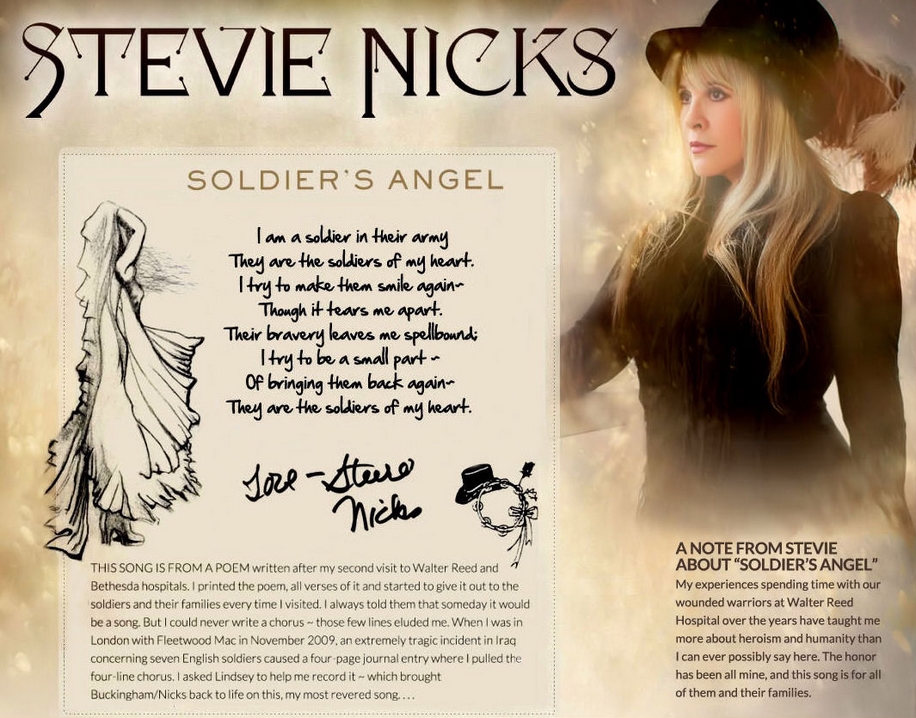
    Saluting Stevie Nicks’ “Soldier’s Angel”

    Years from now, 2011 may be remembered as the year postfeminism produced poster girls for the status quo. Female-fronted hits such as the movie Bridesmaids and the TV show New Girl were hailed as breakthroughs, despite their unremarkable content. (Bridesmaids even showed up on some confused critics’ year-end best lists.)

    Ironically, inordinate media attention turned this distaff escapist trend into a genuine threat to women’s cultural advancement. The “women in comedy” hype carries the suggestion that lucrative half-truths are the best female artists can hope to achieve; risking personal expression turns funny chicks into Debbie Downers.

    My choice for best pop song of last year, Stevie Nicks’ “Soldier’s Angel,” points the way out of hype. As if responding to Bridesmaids and New Girl, Nicks shows us how 21st-century pop artists can speak truth and navigate politics.

    In “Soldier’s Angel,” Nicks tells how her visits with wounded veterans at Walter Reed and Bethesda Naval Hospital unsettled her as a woman, citizen and icon. Lindsey Buckingham’s resonant guitar notes ensure that the song is threaded through with dread in the face of mortality. Against this stirring backdrop, Nicks’ voice—scarred and pitted by time and trouble—expresses a veteran artist’s perseverance for inspiration.

    Imagining how the soldiers to whom she ministers must see her, Nicks sings, “I am a soldier’s girlfriend as I look upon their faces/ They make me remember my first love/ Goin’ out to dances.” Buckingham’s presence as guitarist and background vocalist connects her romantic recollection to our collective Fleetwood Mac memories. As “smart” pop critics might say, Nicks “implicates the audience” in her healing mission.

    The refrain of “Solder’s Angel” speaks of the “war of words between worlds” within which Nicks’ mission is enmeshed. This must refer to the partisan scapegoating that has infected American political discourse. While Hollywood entertainment like Bridesmaids and New Girl promises escape from political conflict, Nicks elevates the discourse to a philosophical, even spiritual plane.

    “Soldier’s Angel” was a 2011 highlight, but it may resonate even more profoundly in this election year. As Nicks warns: “No one walks away from this battle.”

    Ben Kessler / City Arts / Tuesday, January 17, 2012

  • Going his own way

    Going his own way

    Lindsey Buckingham stakes his claim in the Fleetwood Mac legacy

    The man doesn’t need Perry Mason to argue his case. It’s clear from one spin through the recently-remastered mid-’70s Fleetwood Mac masterpieces (Fleetwood Mac, Rumours and 1979’s underrated Tusk) that guitarist/vocalist/arranger Lindsey Buckingham was, is and always will be the heart, soul and brains of this stadium-filling supergroup. After all, the band foundered when he went solo after ’97’s Tango in the Night, only to whirr back to life last year when he returned to oversee the Mac’s creative, well-kudoed comeback, Say You Will, as well as the spanking-new concert CD/DVD Live in Boston. A true renaissance man, the crafty Buckingham developed his own finger-pickings style as a rockabilly-obsessed Palo Alto teen, then settled on a particular guitar, as well — the customized, viola-shaped Tuner Model 1 that now provides that signature Mac-chimey sound. Is this unexpected reunion all that he hoped it would be? During a Los Angeles rehearsal, Buckingham weighed in on this and other issues.

    The Wave: Have your bandmates finally conceded that, yes, indeed, you are truly the Alpha Wolf?

    Lindsey Buckingam: Well, I dunno… I dunno if anyone would wanna define it quite that way. But when we regrouped, everyone had sorta gotten their shit together, so it was really great to see all these people and realize that there was still a lot of care, a lot of love and that the chemistry was certainly as good as ever. We were playing better than we ever did, so that alone made it worthwhile. And one of the things that happened was a male-bonding kinda-thing. It was interesting to watch Mick [Fleetwood, founding drummer] and John [McVie, bassist/co-founder] talk, for example. Because without Christine [McVie, founding keyboardist and ex-wife of John] there, John was able to be a little looser, with no baggage or buttons to be pushed. It was really neat to see some business get taken care of that might’ve been 30 years old. Same with Stevie Nicks and me, in some ways. There was a renewed appreciation.

    TW: But you’ve got to claim some credit, right?

    I was cynical about our success because I perceived the pitfalls. And I felt that I was pretty much holding it together on a musical level, and in a way wasn’t getting credit for it. But it wasn’t as if there was any kind of organized suppression — people gravitated to what was most obvious, and Stevie was almost immediately singled out in terms of her personage and the witchy image she’d put together. Maybe if I’d been the one who was singled out, I wouldn’t have been so cynical. But I had to fight for myself in the band, fight for what I thought was right without anybody’s help. To get to Tusk, I had to punch some holes in the status quo.

    TW: People probably forget the dramatic U-turn you took with Tusk. It wasn’t exactly what folks were expecting after Rumours.

    We came out with Rumours, which was certainly a beautiful album, musically and otherwise. But the musical soap opera aspect of that, I think, became more the focal point than the music. And then you’re in this spot: Where do you go from there? Well, you can make a Rumours 2 — certainly, the record company’s gonna ask you to make Rumours 2 for all the wrong reasons. But in the meantime music from England had come out — new wave and punk — and although it wasn’t anything that influenced me directly, it did give me the courage to say, “Hey, look, I wanna try some new things.” But I had a meeting with the band, and everyone was dead set against it and we had a fight about it. But somehow I managed to prevail and do it. And by the end of it, everyone was totally on the same page. But I mean, releasing “Tusk” as a first single, compared to “Go Your Own Way”? It took everyone by surprise, and that was part of the beauty of it for me. It confounded everyone’s expectations.

    TW: And now, of course, every marching band in the world has to learn “Tusk” by heart.

    Ha! I know, I know. It’s crazy. And at the time, everyone was happy with the album, until, of course, it didn’t sell 16 million records. Then there was a backlash again. So then you got Mirage, which is not a bad record, but it’s sorta drifting in hazy waters. Tango was better, but it’s still way under duress.

    TW: But Mac songs from that era still mean the world to people. You helped compose and conceive some all-time classics.

    And it’s hard to be as connected with that as one might think. You’re not necessarily in touch with the illusion it creates. Obviously, you figure if you’re selling 16 million albums, something is happening, but you’re just too insulated to be in touch with that collective effect.

    Tom Lanham / The Wave (Vol. 4, Issue 16) / July 28-August 10, 2004

  • Rumours Confirmed – Fleetwood Mac Set for Belfast

    By Jeff Magill
    IC Network
    Aug 27 2003

    ULSTER will be celebrating the return of the Mac this December when the legendary Fleetwood Mac play Belfast for the first time in almost 20 years.

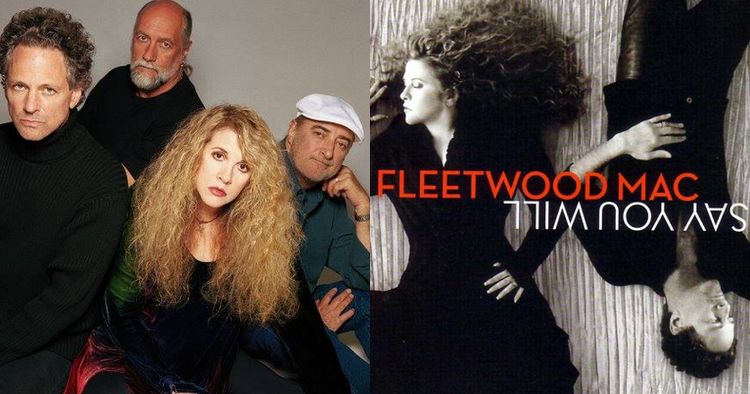
    Hot on the heels of their successful album Say You Will, current members Mick Fleetwood, Stevie Nicks, John McVie and Lindsey Buckingham have announced that they will play a one-off show in the Odyssey Arena, Belfast, on December 8.

    The show will be part of the band’s current world tour, the American leg of which has so far received rave reviews.

    As well as playing tracks from their new album, the band have been giving fans what they really want — live versions of their greatest hits.

    If “rumours” are to be believed, the classic tracks played on the US tour include Dreams, Say Goodbye, Tell Me Lies, Albatross, Go Your Own Way and Gypsy.

    Fleetwood Mac formed in 1967 and over the past 26 years have enjoyed multi-million album sales.

    The group fell apart in the early-1990s, with Stevie Nicks going on to achieve a successful solo career.

    Now back together, minus Peter Green and Jeremy Spencer, the band’s Belfast date is a must for their legion of Ulster fans.

    The band were originally due to play just two Dublin dates, on November 19 and 20, but these sold out within minutes.

    A similar demand is expected for the Belfast date when tickets go on sale at 9am on Saturday, September 6.

    Tickets for the concert cost �, � and �, and will be available from the Odyssey Box Office on 028 9073 9074 or Ticketmaster on 0870 243 4455.

    Tickets will also be available online from www.ticketmaster.ie

    j.******@***********co.uk

  • Fleetwood Mac: An epochal band in its twilight years

    Fleetwood Mac: An epochal band in its twilight years

    Fleetwood Mac Say You Will (2003)Just hours after the release date of the new Fleetwood Mac album was announced, I was summoned to London’s leading talk radio station, LBC, to comment on this important piece of breaking news. The presenters, both seasoned news reporters, made no effort to conceal their excitement. Was it true that the “classic” line-up was back together again? Did that mean the new album would sound like Rumours? Tell us again about the good-bad old days of the Mac — the feuds, the drugs, the squillions of records sold, the money squandered, the sheer, glorious, wanton excess of it all.

    We should all know better by now, and yet a part of me is just as eager as my radio show hosts were to discover what developments lie in store as the latest chapter in this unseemly, yet strangely gripping saga begins. If you have been able to follow the Byzantine twists and turns in the plots so far — the disappearances, sackings, resignations, bust-ups, stand-ins, solo albums, reconciliations and all the rest — you are probably something to do with the group. But it isn’t the blow-by-blow detail which matters now so much as finding out what happens next.

    People miss an important point when they dismiss old troopers like Fleetwood Mac as mere peddlers of nostalgia with no contemporary relevance. All great pop acts have a powerful narrative thread running through their activities and there are any number of them — from The Rolling Stones to Ozzy Ozbourne — whose scriptwriters are now tantalizingly close to revealing what happens in the end. Go and see Paul McCartney on his current tour and of course it’s a nostalgia trip, but you also get to find out what eventually happened to all those Beatles songs and, for that matter, what became of the teenagers who screamed themselves hoarse in the black and white newsreels of the 1960s. But beware; exposure to such knowledge at close quarters is not necessarily for the faint-hearted.

    Unseemly, yet strangely gripping

    Listen to Say You Will and you hear the sound of a group which 25 years after its finest hour, is still riven by dissent and disharmony while staffed by individuals who know that they will never make music apart to rival the music they can still, sometimes, make together. We know it too. Indeed, Say You Will, began life as the fourth Lindsey Buckingham solo album when the guitarist, singer, songwriter and producer was made painfully aware that his record company — like the rest of the world — had little interest in it as a solo offering.

    Having buried the hatchet with his former paramour Stevie Nicks and re-tooled the same songs as part of a Fleetwood Mac album, Buckingham finds himself playing a starring role in a different story. Nine of the 18 compositions are his, while the other nine (not that anyone’s counting, of course) are written and sung by Nicks. Glueing these elements together, over the course of a 76-minute marathon, is the redoubtable rhythm section of drummer Mick Fleetwood and bass player John McVie.

    The velvet-voiced Christine McVie has “finally” dropped out of the picture, so it is not in fact the “classic” line-up, despite a lot of group and record company spin to suggest that it is. Even so, Say You Will, represents something of a renaissance in the band’s artistic fortunes, if not quite the return to Rumours-era form that has been suggested.

    Fleetwood Mac Say You Will
    (Neil Preston)

    Buckingham, ever the most experimental member of the outfit, takes his brief to new extremes on several strange and surprisingly powerful excursions into heavy, prog-rock territory. “Murrow Turning over in His Grave” is a fire and brimstone protest song: “Would you feel the ooze as your brain drains out/From the pneumatic drills and sharpened knives?/Blood in the sky/Are you dead or alive?” And on a gothic-rock extravaganza called “Come” he piles into a long, squealing guitar solo while Fleetwood Mac’s snare drum explodes like a fusillade of cannon shots.

    But however far out on a limb Buckingham takes them, Nicks is always on hand to guide the group gently but firmly back to it core, soft-rock sound. Her willowly, siren voice rises above the acoustic riffing of “Illume” — a dark if predictably vague response to 9/11 — and brings a worldly-wisdom to bear on the bittersweet lovers’ tale of “Thrown Down.” “I am older now, but I still remember,” she sings on “Smile at You,” her weathered tone soaring over a wall of ghostly, wailing harmonies.

    The album ends with two farewell songs — first Buckingham’s “Say Goodbye” and then Nicks’s “Goodbye Baby,” the eternal rivals divvying up the honours as meticulously as children claiming their fair share of going-home gifts at the end of the party. “There’s blood and guts and disagreements still to this day,” Fleetwood said recently, “But that’s what makes it mean a shit.” And so another of rock’s epochal groups enters its twilight years with a renewed mixture of pragmatism and passion which may come as a surprise to even their most ardent fans.

    David Sinclair / Word (Issue 4) / June 2003

  • Fleetwood Mac: Over 100 million served

    By C. Bottomley & Jim Macnie
    VH1.com
    Thursday, May 29, 2003

    The Big Mac is back, and Lindsey Buckingham explains how the pop stalwarts pieced together the very impressive Say You Will.

    Never say never. In 1987, Lindsey Buckingham bid farewell to Fleetwood Mac, and it was a big change for the band. With partner Stevie Nicks in tow, the lanky singer/guitarist/songwriter joined the ever-morphing Brit ensemble in 1975; during this 12-year stint he helped transform the group from respected also-rans to the epitome of platinum-selling rock stars. Inspired by Buckingham’s romantic turmoil with Nicks (as well as the disintegration of John and Christine McVie’s marriage), 1977’s Rumours sold 17 million copies. It was full of irresistible soft-rock and passionate hard pop. Ultimately, it even spawned Bill Clinton’s campaign theme, “Don’t Stop.”

    He issued a string of gorgeous solo discs, but retirement didn’t agree with Buckingham. Something was missing. Maybe it was Nicks’ witchy mysticism and gentle soul. Perhaps it was Christine McVie’s perky pop-craft and honeyed harmonies, or Mick Fleetwood and John McVie’s rhythmic backbone. Either way, with 1997’s The Dance, Buckingham was back in the fold, and the band began working on a stockpile of his songs.

    Younger groups might still look to Rumours as their template, but Say You Will, the Mac’s first album in eight years, beguiles, bewilders, and rewards. Buckingham’s guitar takes center stage, with fertile freak-outs and up-to-the-minute atmospherics that dazzle with their daring. McVie sat this album out, so songs like “Peacekeeper” bristle with Buckingham-Nicks’ethereal harmonies and chug-along pop beats. There’s even the odd diversion into political commentary. The band that made Say You Will is an inclusive and broad-reaching entity. Unlike many groups their age – 36 years if you’re counting – the Mac still have their teeth. Or should that be tusks?

    On the eve of their American tour, Buckingham spoke to VH1 about reinventing the Mac, painting in the studio, and which of the band’s songs could get him out of bed.

    VH1: Is getting back into action and starting a new tour second nature at this point?

    Lindsey Buckingham: The challenge of getting into that mold is more about how you present it. People like The Eagles tour all the time without having an album. For us, it’s how you dignify having made a very fresh album which is basically a reinvention of the name Fleetwood Mac, and present it in a way that is still familiar – not too challenging!

    VH1: Say You Will is a very progressive album, though. Some parts border on being experimental.

    LB: I would say so, too. I remember when Rumours came out, it got some crappy reviews. But in a year’s time, a lot of people were revising their opinion of it. But yeah, this album is a sort of marriage between the best of Rumours and the best of Tusk. And yet, it is breaking new ground.

    VH1: How did the album come about after such a long lay-off?

    LB: It was an epic effort. It started off as a solo album of mine. Most of the songs that ended up on Say You Will were cut with Mick before we did the Dance tour. After Mick and I had gone into the studio and John [McVie] came in to play some bass, some people thought, “This is interesting.” There was this intervention happening, where people said we needed to do a live album and tour. When the tour was done, I went back into my garage and finished all those songs pretty much in the state that you hear them on the album. “Peacekeeper” and “What’s the World Coming To” were the only ones that were cut later.

    VH1: You like to play with the studio on your solo albums, and Say You Will is pretty thick with audio ideas and treatments.

    LB: It was gratifying for me, because during my time away from Fleetwood Mac, I felt like I got better at using the studio as an instrument. I consider the process that I use on my own to be a kind of “painting.” The studio is not only an extension of the guitar; it’s an extension of your imagination.

    VH1: How was the recording process this time around as a reformed group?

    LB: One of the things that we wanted to do was present something closer to the energy of what we do on stage. Some of that was suggested by the fact that when we played as a three-piece, we all had much more room to maneuver. In a way, we’ve done the best playing I’ve ever heard on a recording. So it was about reeling that out and not worrying about anything other than what we do best.

    VH1: How is it now that Christine has left?

    LB: Well, when I first joined the band, I had to adapt to fit in, because so much of the [musical] space was already taken. John is a fairly intricate bass player, and Christine’s keyboard sound took up a lot of space as well. Not in a bad way, just in terms of what was left over. We don’t see her absence as any kind of detriment. It’s just different. Stevie and I were able to broaden our own particular landscapes as writers. It was kind of a gift, and very much in the tradition of a band that has re-invented itself many times!

    VH1: Mick and John are an unbelievable rhythm section. Describe what it is that they do.

    LB: Mick is a diamond in the rough. He does what he does, and after all this time, he still doesn’t know quite how he does it. He doesn’t want to know! There’s a real Zen feel to that: he knows he has a feel. But he’s just the ultimate in “dumb” – in the best sense of the word! He values that: he values the idea of feeling loose and having a groove that sits appropriately behind the beat. John is sort of an enigma. He’s a strange combination of [Charles] Mingus and [Paul] McCartney. He doesn’t talk about it, but he’s extremely smart and extremely melodic with what he does. It’s very easy to underestimate what he does – until you really listen to it. Through all the incarnations of the band, those two guys have been the thread.

    VH1: Which of Stevie’s new tunes touches you the most, as a fan of hers?

    LB: I like “Illume” a lot. I like “Thrown Down” a lot, too, sort of for my own petty needs because I felt I helped [articulate that tune]. “Say You Will” is real catchy, and will probably be the next single.

    VH1: Is making a record all craft or do your ideas come to you from your subconscious?

    LB: Sometimes when you’re in the process of “painting,” you get yourself into some sort of a reverie, where the subconscious comes to the surface a bit. With me, the songs don’t come fully formed before they start being worked on. I tend to think the process of making the record is part of the writing process, in terms of being flexible about what comes in and what changes.

    VH1: What message would you want listeners to come away with after listening to “Murrow Turning Over in His Grave”?

    LB: Edward R. Murrow was around when there was some standard for reporting on television. When he retired, he gave this speech about how TV was being used to distract and amuse and not particularly educate anyone. He said if the people responsible for what was on TV didn’t strike a balance, “history would take its revenge.” I wrote that song during the OJ Simpson trial. In some ways, that was the beginning of a new low, with Court TV popping up out of the blue and all that stuff which pretends to be objective news reportage, [but] is completely opportunistic.

    VH1: In our house we often play “Think About Me” to start the day. If you were to play one Fleetwood Mac song in the morning, what would it be?

    LB: I guess you could always fall back on ‘’Don’t Stop.’’ It’s harder to respond to a question like that when it’s you who’s made the music. But that’s one that goes across the board as an uplifting message.

  • Fleetwood Mac revived

    Fleetwood Mac Say You Will (2003)AP ─ Seven years ago when guitarist Lindsey Buckingham began working on a solo album, he was confronted by a cold reality: his record company had no interest in a Lindsey Buckingham solo album.

    A Fleetwood Mac album, however, was a different story.

    The company got its wish. One of rock ‘n’ roll’s brand names – and longest-running soap operas ─ has been revived this spring with four-fifths of its most famous lineup.

    A new album, Say You Will, is the first project with all-new material for Buckingham, Stevie Nicks, drummer Mick Fleetwood and bass player John McVie since 1987. Missing is retired keyboard player Christine McVie, making this edition more muscular and guitar-oriented.

    “All of us in this band, every time it comes around and happens again, are surprised and delighted, because we never think it is going to happen again,” Nicks says.

    The classic lineup ─ with Christine McVie included ─ had reunited for a nostalgia tour and live album in the late 1990s. But becoming a creative unit again was another thing entirely.

    Even before the tour, Buckingham had invited the band’s old rhythm section to work with him on his solo album. But Buckingham’s solo work has never sold very well and Warner Bros. was disinterested. Realizing it was the only way to get the music out, and after years of work, the three men decided to invite Nicks to join them in the summer of 2001.

    She was just about to leave for a long concert tour to support her own solo album. So she sent a disc of 17 songs she had written over several years ─ but never released ─ to Buckingham, Fleetwood and John McVie, who were working in a California studio.

    Buckingham, the band’s producer, saw Nicks’ gift as a test. And the Fleetwood Mac soap opera began a new installment.

    “Her involvement emotionally came in stages,” he says. “She had sent stuff over, but I don’t think she had a lot invested in what she sent over.”

    Not so, Nicks says.

    “I didn’t feel like I was dipping in my toe,” she says.

    “I had to go on this tour because Warner Bros had just released my record. … I gave them the CD and said, ‘I’ll be back as soon as I can.”‘

    Buckingham and Nicks with different interpretations of the same event?

    There’s a shock. Even cursory fans know their history: The couple’s romantic breakup fueled the mega-selling album Rumours, and they’ve danced delicately around each other’s psyches ever since.

    “All of that is never going to be behind us,” says Nicks, as she gazes at the ocean from her California home. “Our destinies are so entwined. We fight a lot. We have a lot of arguments. But in the long run, we’ve worked it all out.”

    Buckingham is now a married father of two. Nicks is single, and has spoken candidly about how hard it is to mix relationships and her career; the new song “Silver Girl” is a big-sisterly ode to friend Sheryl Crow, who is confronting the same issues.

    David Bauder / AP (press release) / Friday, May 9, 2003

  • Filter Albums: Fleetwood Mac – Say You Will

    Filter Albums: Fleetwood Mac – Say You Will

    Fleetwood Mac Say You Will (2003)Their first new material since 1987’s Tango in the Night. Sheryl Crow guests.

    **** (Four stars)

    With the pomp of Dallas, the longevity of Coronation Street, and the incestuous bent of EastEnders, Fleetwood Mac remain rock’s greatest soap opera. This latest instalment is something of a Buckingham-Nicks spin-off, the departure of Christine McVie meaning fewer keyboards and far more guitars.

    In terms of man-hours spent, it’s predominately Lindsey Buckingham’s baby, his protracted studio beavering going back at least six years, and now exhuming a number of songs originally slated for a solo album. When factors too complex to probe here made the Mac viable again, Buckingham, Mick Fleetwood and John McVie then began working on old and new songs of Stevie Nicks‘, and Stevie sang on Lindsey’s stuff. Reprise staff dreamt of Christmas bonuses, and the Mac’s various managers thrashed out the percentages. One suspects that the precision of Nicks and Buckingham’s nine songs apiece tally is not a mere happenstance.

    Enough already with the cynicism, though, because Say You Will is anything but a half-baked cash-in. Digesting its 18 tracks might be a python-swallows-gazelle task, but having done so, you’ll recognise a meticulously-honed blend of strong pop songs and Buckingham-led envelope-pushing. The title track, “Steal Your Heart Away and “What the World Coming To” are harmony-rich gems which sound chart-bound, while Nicks’ 9/11 response, “Illume,” and Buckingham’s US media critique, “Murrow Turning Over in His Grave,” lend edge and weight. Nicks’ lyrics and phrasing on the former are particularly strong, transforming what might otherwise have been a decent groove track into something special.

    Nicks has said, incidentally, that “Thrown Down” is about former beau Lindsey Buckingham, and it’s probably no accident that several other lyrics on SYW could be interpreted as further musings on the pair’s tempestuous, long-since-over romance. A crafty way of boosting this soap opera’s ratings, perhaps, but the music speaks for itself.

    Stevie Nicks and Lindsey Buckingham talk to James McNair. Separately.

    Can you and Lindsey talk about your relationship more openly now?

    SN: “You want the truth? We don’t talk a lot about our past. It’s like: do we need to go there? It’s just upsetting for both of us. I think we try to live above that and realise it was a long time ago and there’s nothing we can do to fix it. And it hasn’t turned out so bad, has it? We have really good, balanced lives now, and we’re still able to make music together. Apart from being married and having our own family, what more could Lindsey and I have asked for?”

    Do fans still tend to assume that relationship-dissecting lyrics you’ve written are about Stevie?

    LB: “Probably. And some of Stevie’s may be about me. Why ‘may be’? Because it’s not for me to say, even if I suspect some of them are. There are songs Stevie has written all throughout our relationship which I assumed were about me, then discovered that they weren’t, or that they were hybrids [laughs]. I can be as confused about that stuff as the fans, believe me.”

    James McNair / MOJO (Issue 114) / May 2003

  • Say You Will says Fleetwood Mac's on again

    Pop’s longest-running soap opera has been renewed for another season. Harmonious negotiations, a revised cast and a fusion of two scripts yielded Fleetwood Mac’s long-awaited studio reunion, Say You Will, which enters Billboard at No. 3 after selling 218,000 copies its first week.

    Singer/songwriters Stevie Nicks and Lindsey Buckingham, former lovers whose Rumours-era split left a bitter wake, each contribute nine songs, some originally destined for their solo albums. Drummer Mick Fleetwood and bassist John McVie, founding members of the storied band, returned to the fold, while keyboardist Christine McVie opted to retire.

    Sturdy musical roots and fragile emotional ties make Mac both a reliable and unpredictable commodity in rock. Fans embraced the band’s lucrative comeback in 1997, yet the players retreated into uncertainty. Buckingham resumed work on a solo album, but when a Warner Bros. executive disparaged it, he shelved it in anticipation of a leadership change at the label.

    “It was a lame-duck situation, so I played a waiting game,” he says. “I said to Mick, ‘Let’s cut some tracks with Stevie.’ If there was no interest in my solo album from the new regime, I figured it could morph into something else.”

    Incoming chief Tom Whalley did fancy Buckingham’s songs, but it was a moot point, since a Mac homecoming was in full swing. Before Nicks left on a solo tour in July 2001, she handed Buckingham a 17-track demo containing songs dating back to 1976. On New Year’s Eve, she listened to the tracks Buckingham had polished while producing the record.

    “I realized I needed to add new material,” Nicks says. “I told Lindsey, ‘I know you’ve already been waiting for me for six months, but I need 30 days.’ I told my brother, ‘Fire up the 12-track Akai,’ I got all my journals and went to work.”

    She delivered four songs in four weeks. Smooth sailing? Not quite. Sparks flew when Buckingham’s desire for a two-CD set was overruled, despite his willingness to absorb any financial loss entailed in a configuration that yields less profit per track than a single disc.

    “Some things conspired to force me to rethink that: politics in the band, certain things that were said,” Buckingham says. “Then we had a confrontational experience in getting a running order everyone was all right with.”

    Now he’s fretting over the set list for a tour starting May 7 in Columbus, Ohio, and heading east. The tour swings to the South and Midwest in June and hits the West Coast in July.

    “It’s more daunting than ever,” he says. “The new album needs to be dignified, but people with a bottom-line mentality say you can’t do too many new songs. How do you do a show that’s not too much of one thing? I’m losing sleep.”

    Nicks says creative tension and her uneasy dance with Buckingham are the least of her worries.

    “Mick and John could fire us and start over,” she says.

    Edna Gundersen / USA Today / Sunday, April 27, 2003

  • INTERVIEW: Fleetwood Mac's Stevie Nicks

    INTERVIEW: Fleetwood Mac's Stevie Nicks

    Stevie Nicks
    Nicks, who calls herself a “nervous nellie” tells US, “Now, instead of Prozac, I watch the Fine Living Network. That calms me down.”

    Fleetwood Mac Is Back!

    Twenty-six years after the release of their smash album Rumours, Mac delivers Say You Will, their first studio effort since 1995. Though much has changed (the once-hard-partying band is now drug-free), Mac’s wistful sound is still the same-thanks in large part to trendsetting singer Stevie Nicks. The single 54-year-old, who splits her time between Phoenix and Southern California, chats with US.

    You’ve toured for the better part of 30 years. Learn anything?

    That you have to take care of yourself. In the old days, we’d go straight to the bar after a concert. Well, we don’t do that anymore because we can’t!

    But you still enjoy some rock-star perks, right?

    We have a 738 private jet. It’s like our own party!

    The peasant look is in. Your style finally caught on!

    It feels terrific to know I had an effect on style, but I think those designers should send me money!

    What kind of guy scores a date with Stevie Nicks?

    Someone who is not jealous of what I do and who digs my lifestyle. My life is fun, and for the right man, it would be a gas! But I’m never home, and it’s hard for a man to be left behind. So I never look for Mr. Right, but I know he can always walk into my life. I like that.

    Is it strange sharing the stage with your ex, Lindsey Buckingham?

    Sometimes he takes me back to 1971; he’s still thin and pretty gorgeous. Often, I think we live in a parallel universe, where we’re not sure if it is 1973 or 2003.

    Shirley Halperin / US Magazine / Monday, April 21, 2003

  • Return of the Mac

    Fleetwood Mac, the zillion-selling adult-rock stars of the Seventies are back. And no, it’s not just for the money. JAMES MCNAIR talks to the band about their soap-opera-like past and hopes for the future

    As settings for a Fleetwood Mac interview go, Culver City Studios seems suitably grandiose. Its exterior facade is a white colonial mansion that featured in Gone with the Wind. Orson Welles filmed Citizen Kane here, and in 1933, this is where King Kong fell for Fay Wray. Today, though, Fleetwood Mac are here, just outside Los Angeles, to rehearse for an upcoming US tour in support of their new album, Say You Will. Eleven years after their White House gig in honour of President Clinton’s inauguration, it’s still location, location, location.

    The Mac are, of course, best known for their zillion-selling 1977 colossus, Rumours. And the story behind that AOR classic is almost as famous as the music itself. Fuelled by most of California’s cocaine – the drummer, Mick Fleetwood, reportedly considered a sleeve-note dedication to his dealer – Rumours featured “Dreams” , “Go Your Own Way” and “Don’t Stop” , songs that commented on Stevie Nicks’ messy break-up with the guitarist, Lindsey Buckingham, and Christine McVie’s split from the bassist, John McVie. Nicks went on to have a brief affair with Fleetwood, whose first marriage was on the rocks, while Christine McVie started seeing the band’s lighting director, Curry Grant. Even an Eastenders scriptwriter, I put it to Fleetwood, might have baulked at such close-knit dating.

    “It was all part of the ongoing saga that makes the band unique”, grins the lanky 55 year-old. “Unique even to this day, let me tell you. I went to Hawaii recently with my wife Lynn and our kids, and Stevie rented a house just down the road. My wife is a soulmate, but Stevie is a soulmate, too, and Lynn knows that. There’s so much you can enjoy with that dynamic.”

    Say You Will marks the departure of the keyboardist/songwriter, Christine McVie. More important, perhaps, it sees the return of Buckingham for what many consider the first proper Mac studio album since 1987’s Tango in the Night. The new record has garnered some excellent reviews, and with Christine gone, Stevie and Lindsey share the songwriting credits much as they did in their pre-Fleetwood Mac duo, Buckingham-Nicks. Talking to Buckingham, however, one senses Say You Will’s precise, nine songs apiece tally is not mere happenstance.

    “There were some problems with the track-listing near the end”, confides the guitarist, now 53. “Stevie was in Hawaii on vacation while I was in Los Angeles trying to master the album, and we got into some over-the-phone conflicts. It’s been hard for Stevie to feel good about what we’ve accomplished, and I really hope she will at some point. She’s yet to say ‘Good work on my songs, Lindsey.’ ”

    Managed by the man Buckingham calls “Big, bad Howard” (Kaufman), Nicks clearly holds a strong negotiating hand. Her solo albums – witness 2001’s Trouble in Shangri La – have consistently sold far more than those of Buckingham, and as many of the Lindsey songs on Say You Will were originally slated for solo release, you could argue that the Fleetwood Mac brand is something he’s falling back on – and not for the first time. What’s unquestionable, however, is that Buckingham’s presence has usually served to enliven Fleetwood Mac. Indeed, without his diligent production skills and sussed, sometimes feral-sounding musicality, the post Peter Green Mac have often sounded rather bland.

    This time, Buckingham’s edge and grit fire his US media critque, “Murrow Turning Over in His Grave” (named after the noted critic of McCarthyism, Edward J. Murrow), and the deliciously barbed “Come” (Think of me, sweet darlin’/ Every time you don’t come”). Some have alleged that he wrote the latter about Anne Heche, a former lover who went on the have a lesbian relationship with her fellow actress Ellen Degeneres. “That surprised me as much as it did everybody else,” says Buckingham, but as he’s now happily married with two young children, it’s perhaps understandable that he declines to comment further. Asked whether people still tend to assume that his and Nicks’ lyrics are about each other, however, he’s more forthcoming.

    “Yeah, they probably do,” he laughs. “And in Stevie’s case, at least some of them may be. Why ‘may be ‘? Because it’s not for me to say if they’re about me. I suspect some of them are, but then Stevie has written songs all through our relationship that I assumed were about me, then discovered that they weren’t, or that they were hybrids. I can be as confused about that as the general listener.”

    Stevie Nicks is almost 55 now. Her hair is still pleasingly big and blond. With her Yorkshire terrier Sulamith asleep in her lap, she tells me that she misses Christine McVie and her “crazy English humour” every day. “It used to be like that TV show Charmed, where they go: ‘The power of three!’ ” she says, reminding me that she publishes her songs through Welsh Witch Music. “Chris and I had the power of two.”

    Nicks is now single. Her relationship with Buckingham, she said in 1997, “was as close to being married as I ever will be again.” Listening to songs such as “Destiny Rules” and “Thrown Down” – “He fell for her again/She watched it happen,” runs the opening of the latter – it’s hard to decide whether she stills holds a candle for the guitarist or is simply exploiting a highly marketable aspect of rock’s greatest soap opera. She may be doing both.

    ” ‘Thrown Down’ is about Lindsey,” Nicks admits, “but I wrote that around the time of the Dance tour in 1997. Let’s just say he continues to be a well of inspiration, which is terrific.”

    Right. But can she and Lindsey talk about their relationship more openly now? “You want the truth?” , she says. “We don’t talk a lot about our past. We never have. It’s like ‘Do we need to go there?’ And it hasn’t turned out so bad, has it? Each of us has good, balanced lives now, and we’re still able to make music together. So apart from being married and having our own family, what more could Lindsey and I have asked for?”

    And her affair with Fleetwood? How does she view that these days? “That was a long, long time ago,” she whispers. “It was like a little dream. What has lived, though, is that Mick and I still have a great love and respect for each other. Our relationship was so short that it didn’t have time to build up animosities and jealousies. Mick will tell you -and I will tell you – that a lot of the reason it didn’t continue was because we knew it would be the end of Fleetwood Mac. So we were very mature about that; we made the right decision.”

    One new Nicks song that certainly isn’t about Buckingham – or Fleetwood, for that matter – is “Illume (9/11)”. Nicks was in New York when the twin towers were attacked, and “Illume” documents her feelings at the time. “My Rochester show was canceled because of an act of war,” she says,” and at one point we had a military escort on our wing. That whole period nearly drove me into a mental home.”

    “I read Stevie’s poetry for that song before she came in with the music,” says Fleetwood. “She was very unsettled by 9/11, as we all were. The groove for “Illume” is incredibly simple, and she was like : ‘Is this any good? Is it doing enough?’ I said, ‘In my opinion, Stevie, this is all about you; this is your modern-day “Gold Dust Woman.”‘ It has that Edith Piaf element coming through; that thing where the singer’s relationship with the lyric is incredibly personal and powerful.”

    Fleetwood, one soon realises, is the Mac’s most fervent flag-waver. He’s done everything in his power to keep this band alive, and his close friendships with Nicks and Buckingham have left him well placed as diplomatic go-between. Toward the end of my chat with him, I can’t resist playing devil’s advocate. What would he say to those who claim the Mac have reconvened for the cash? “Fleetwood Mac has morphed its way back,” he says. “You might say that this album is the result of eight years of people slowly getting to know each other again, so if somebody wants to be cynical and say that this is a money-making exercise, they’d be hard pushed to make a case. I don’t know how we get stuff done sometimes, because we’re a semi-dysfunctional family with four different managers, and it’s a nightmare, really. The truth is that I hope we make a load of cash. But how we’ve come to this point has been in the lap of the Gods.”

    James McNair / Independent Review (UK) / Friday, April 18, 2003