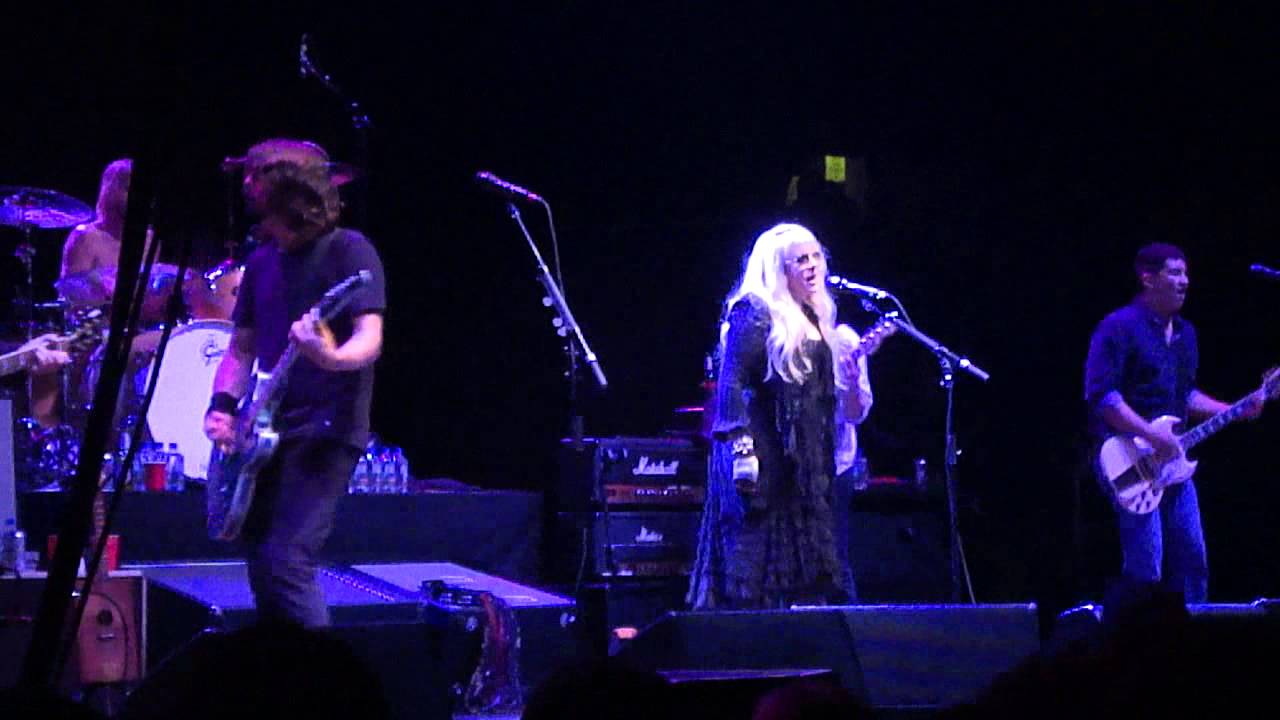
In a packed-to-the-rafters venue on Park City’s snowy Main Street, Dave Grohl is kicking off the 2013 Sundance Film Festival in ambitious, history-making style. Here to prornote his directorial debut Sound City, a documentary chronicling the hallowed LA studio where Nirvana recorded Nevermind, Grohl has assembled a roll call of its famous tenants to play their greatest hits and songs from the film’s accompanying album, Real To Reel.
It may be cold outside (freezing in fact), but inside the temperatures fuelled by the unique chemistry of the shape-shitting supergroup – anchored throughout by ringmaster Grohl (switching between guitar and drums) and his infectious, childlike enthusiasm. During the course of the three-hour-plus show, we’re treated to lively vocals from Alain Johannes, Rick Springfield, Corey Taylor, and Stevie Nicks, supported by the likes of Trent Reznor, Taylor Hawkins and Krist Novoselic. It’s a who’s who of rock’s finest, and it’s exhilarating to see them on stage together.
There’s barely room to breathe between baton passes, and the constantly rotating line-up keeps the excitable audience on its toes. Both Springfield’s “Jessie’s Girl” and John Fogerty’s Creedence hit “Proud Mary” are greeted with roof-raising mass singalongs. However, it’s the ethereal Nicks who alters the night’s real highlight, teaming up with Grohl for an emotional, acoustic version at Fleetwood Mac’s “Landslide” – a goosebump-inducing close to what been a superbly surreal evening.
AUSTIN, Texas — Dave Grohl has been a busy man in Austin.
He has been promoting Sound City: Real to Reel, the documentary he produced about the recording studio in southern California, which has had several showings during the South by Southwest Music Fest here.
Thursday morning, he delivered the festival’s keynote speech. And Thursday night, he and several of his fellow Foo Fighters were the house band for the Sound City Players, an ensemble of performers who have recorded at Sound City and who gathered for a performance before a full house at Stubbs.
The three-hour plus show featured several high-proflle artists, such as Stevie Nicks, John Fogerty, Rick Nielsen of Cheap Trick and Rick Springfield, plus Lee Ving of the punk band Fear. During a set by Chris Goss of Masters of Reality, Brad Wilk of Rage Against the Machine and now Black Sabbath sat in on drums,
After an opening set by Alain Johannes, a Queens of the Stone Age collaborator, Nicks took the stage.
She and Grohl launched into “Stop Dragging My Heart Around,” with Grohl taking Tom Petty’s vocal parts. After that, Nicks introduced a new song she’d written, “You Can’t Fix This,” a dour ballad that temporarily lost the crowd of about 3,000.
She got it back immediately with a few of her best-known songs: “Dreams”; “Landslide,” which featured Grohl on 12-string acoustic guitar and which prompted a heartwarming sing-along throughout the huge venue; and “Gold Dust Woman.”
That one ended with a long, raucous instrumental that brought out the beasts in Grohl and Foo Fighter drummer Taylor Hawkins.
Ving followed Goss’ set, growling through several high-speed hardcore punk songs in what seemed like a minute or less for each. Springfield would follow Ving with some of his Top 40 bromides, a sign of how diverse a setlist Grohl and his band had to learn and the breadth of artists who recorded beloved albums at Sound City.
By Sharon Chapman and Charles Ealy American-Statesman Wednesday, March 13, 2013
SXSW Music Thursday highlights
Check sxsw.com for updates or changes in the schedule.
Dave Grohl keynote. His “Sound City” documentary played Wednesday night during SXSW Film, and Thursday, Grohl delivers the 2013 Music keynote at 11 a.m. in Ballroom D of the Austin Convention Center. It’s open to badgeholders but will be streamed live at sxsw.com and npr.org. Grohl and his “Sound City” players, including Stevie Nicks, John Fogerty, Rick Springfield, Rick Nielsen, Krist Novoselic, Lee Ving, Corey Taylor, Brad Wilk, Taylor Hawkins, Nate Mendel, Pat Smear and Chris Shiflett play at 8 p.m. Thursday at Stubb’s.
Macklemore and Ryan Lewis signing. The rap duo, who are at everything this SXSW, are signing autographs. It’s in the Music Gear Expo Lounge 1:30 p.m. at the convention center and is free and open to the public.
MTVU Woodie Awards/Festival. During the day, it’s a music festival. At night, the MTVU awards are handed out. Scheduled performers include the aforementioned Macklemore and Ryan Lewis, Jake Bugg, Alt-J, among many more. 1:30 p.m. to 10 p.m. Thursday in a parking lot at East First and Red River streets. Free and open to the public, based on capactiy. Information: woodies.mtv.com.
Flatstock. The poster show opens in Exhibit Hall 4 at the Austin Convention Center. It’s free and open to the public from 2-6 p.m.
SXSW Interview: Clive Davis. The record producer and music mogul who recently released a tell-all book will talk with Bill Werde of Billboard Magazine. 2 p.m. Room 18ABC in the Convention Center.
SXSW Interview: Kendrick Lamar. One of the breakouts of SXSW 2012 will talk with Elliott Wilson of Rap Radar. 3:30 p.m. Room 16AB in the Convention Center.
SXSW Interview: Stevie Nicks. The Fleetwood Mac chanteuse is everywhere this year. She’s in her own documentary, “In Your Dreams,” and in Grohl’s “Sound City.” She’ll talk Thursday with NPR’s Ann Powers. 5 p.m. in Room 18ABC in the Convention Center.
Auditorium Shores. The free public shows on the shores of Lady Bird Lake start 5 p.m. Thursday, with Jovanotti, Bajofondo, Molotov and Cafe Tacvba.
SXSW Film Thursday highlights
Co-directors Stevie Nicks and Dave Stewart walk the red carpet “In Your Dreams,” a new documentary about Nicks’ latest album. 2 p.m. Paramount.
“Before You Know It,” directed by Austinite PJ Raval, explores the lives of older lesbian, gay and bisexual Americans. 3:45 p.m. Violet Crown.
“Bayou Maharajah: The Tragic Genius of James Booker,” documentary explores the life and times of the piano legend. 4 p.m. Topfer Theatre at Zach.
“All the Labor,” a documentary about the Austin cult band the Gourds. 4:15 p.m. Alamo Village.
Snoop Lion and director Andy Capper walk the red carpet for the new documentary “Reincarnated.” 4:30 p.m. Paramount.
“Finding the Funk,” a road trip documentary, looks at the James Brown bands of 1960s and Sly & the Family Stone. 7 p.m. Alamo Village.
“A Band Called Death” looks at the Detroit punk band. 7:15 p.m. Vimeo.
With the wild-eyed exuberance of a teenaged obsessive, Dave Grohl continues his quest for the ultimate Rock Supergroup, and along the way, tells the remarkably intimate tale of a legendary recording sanctum and its sacred totem – the Neve 8028 console. And oh yeah, Stevie Nicks stops by to sit a spell.
So, this happened: Stevie Nicks, microphone in hand, accompanied by Dave Grohl on acoustic guitar, performs “Landslide” to a packed house in Park City, Utah, while snow banks pile up against the building’s outward-facing walls, as if stretching to see inside, only to wither into water at Nicks’ heart-melting voice.
In honor of his Sound City documentary on the Van Nuys, California recording studio of the same name, first-time director, former Nirvana drummer, and full-time Foo Fighter Dave Grohl had called forth, on this brisk night, his incredibly star-studded new band the Sound City Players — including everyone from Stevie Nicks to Rick Springfield to Slipknot’s Corey Taylor. In honor of the Sundance Film Festival, they played for three-and-a-half hours straight, with Grohl onstage the entire time, usually backed by the Foos.
“Can you imagine?” gushes Grohl the next morning in the guts of the Park City Library, where his film is presently screening. “Never in my wildest dreams did I think that in one evening I’d play Creedence Clearwater Revival’s ‘Proud Mary’ with John Fogerty, Fear’s ‘Beef Bologna’ with Lee Ving, and Masters of Reality’s ‘Blue Garden’ with Chris Goss. It was like my ultimate mixtape.” Pause. “Live.” Pause, now quickly: “And I’m in the band.”
In most cases, the concept of “living the dream” has been reduced to a garishly tawdry, ubiquitous vision — a Cribs episode, a Mötley Crüe memoir, a sex tape. But Grohl’s dream is still flush with the cheek fat of youth, imbued with the bong water of a thousand high-school rips while others were doing homework, light on excess (sex, drugs), heavy on awesome (loud music), and built around a music geek’s teenage bucket list. It’s basically a rock’n’roll fantasy camp.
“I love to play,” he says, shifting his six-foot frame on the small couch like he hasn’t figured out what to do with this man-body. “And fortunately, I don’t know a lot of musicians that suck. I know a bunch of really good ones and they’re always up for playing.”
But Grohl is clearly the only reason that the smoky voice of Fleetwood Mac and the guy who refined the SoCal desert rock sound are sharing a Sundance stage. What’s more, his ability to pull off such a strange feat has everything to do with his impossible enthusiasm, which is always saying “Yes! Yes! Yes!” to whatever comes along, regardless of possible payout. Dave Grohl is as Dave Grohl does.
All of this began when he discovered that Sound City was closing up shop. Having recorded Nevermind there in 1991, he not only felt nostalgic for the funky old place, but knew of its most beguiling charm: the Neve 8028 console, a rare and powerful sound board that had offered its warmth to Neil Young’s After the Gold Rush, Fleetwood Mac’s self-titled album, six Tom Petty albums, Ronnie James Dio’s Holy Diver, Rage Against the Machine’s self-titled debut, Tool’s Undertow, Weezer’s Pinkerton, etc. Grohl asked after the gear and won the bid.
He got the idea to make a short clip documenting the Neve’s journey from its original home to his own Los Angeles-area Studio 606, so he called his pal Jim Rota, a producer who helped manage workloads for the Narnia films, and Rota pulled together a skeleton crew to get the job done. And they did. When Rota got home, he says he received a text from Dave: “I think we need to interview some of the people who recorded on this thing.” By the next morning, Grohl had outlined a feature-length documentary in a sketchbook.
“He didn’t just write one e-mail and BCC everyone,” says Rota by phone. “He wrote each person individually explaining his vision for the movie and asking them to do an interview. Every single person wrote back saying they were in. Over the course of a couple of weeks, the e-mails would come in, and he’d be like, ‘Holy shit! Neil just said yes! Eddie Vedder is in! Holy shit! Rick Springfield!’“
The more they dug, the more stories they discovered: Mick Fleetwood first met Nicks and Lindsey Buckingham at the studio; Springfield met his wife working behind the front desk; the first Heartbreakers jam happened there. Those who recorded at Sound City loved the place for both its quality sound and unsound qualities. In the film, musician after musician describes it as a dump, a shithole, an ashtray, a piss pot. At one point, producer/exec Jimmy Iovine is seen telling Petty, “Somebody should firebomb the place.”
The first 60 minutes of Sound City lovingly chronicles the unlikely hit-making haven, in part as an allegory about the demise of analog methods and person-to-person music-making. But rather than dive too deep into the shallow end of the authenticity pool — per his 2012 Grammys EDM rant — Grohl uses the final 30 minutes to show rather than tell. He has several of the film’s subjects over to his studio where he plays Lord of the Jam, demonstrating the might of skilled humans doing things in a small room with other skilled humans.
The Nicks session is impressive and the Trent Reznor-Josh Homme-Grohl mindmeld is transcendent, but the crown jewel, as everyone knows, is the part where Nirvana’s surviving members — Grohl, bassist Krist Novoselic, and touring guitarist Pat Smear — reunite with Paul McCartney at the helm and grind out some “Helter Skelter” gnarl, which becomes the song “Cut Me Some Slack.” (All of this is available on the Sound City — Real to Reel album.) There’s a great bit toward the end where Grohl says, “Why can’t it always be this easy?” and McCartney quips, “It is.”
“You can do no wrong when you’re making music with that guy, because anything goes,” says Grohl. “What I find in jamming with people from that generation is that they’re a lot more loose when it comes to vibe. They appreciate the energy of something chaotic. You look at Paul and think, ‘Wow, well, he’s obviously brilliant and he’s a master of melody and has made some incredibly delicate music.’ But he’ll strap on that Cigfiddle guitar through a tiny distorted amp and do a raging slide solo that sounds like a jet airliner.”
But it didn’t end there. While the so-dubbed “Sirvana” went on to play the 12-12-12 concert for Hurricane Sandy relief and Saturday Night Live to boot, the star-studded Sound City Players took shape, debuting in Park City, hitting up L.A. and New York, with plans to play London, Berlin, Sydney, and possibly Austin. Grohl knows he’s asking a lot of everyone involved, but “yes” is apparently contagious.
(Photo by Nathaniel Wood)
Asked what he likes about Grohl, Sound City’s producer Rota unwittingly explains what everybody likes about his friend: “In high school, there’s the guy who gets excited over sports and then there’s that dude who when you’re listening to ‘Achilles Last Stand’ by Led Zeppelin air drums the fills perfectly. That’s Dave. He’ll stop mid-conversation, slap you on the arm and then drum, to perfection, whatever is playing. That’s a certain kind of dude. Plus, he likes to drink beer and listen to music really loud. People horde together by their passions. If yours is giving a shit what amp somebody used on an album, you hang out with Dave.”
“Are we getting that shirt?” says a shrill voice not once, but twice. “Are we getting that shirt?” The red carpet for Sound City’s Sundance premiere is a tented, bifurcated runway of chaotic bustle with the stars passing through at their leisure while the other half of the makeshift reception hall is a roiling bolus of reporters with their cameras and microphones and stupid hats vying for attention. My tiny recorder captures the fibrillations of two such people all too faithfully.
“Is that Stevie Nicks?” says one. “Oh my God, I’m gonna die,” says the other one. “My mother-in-law is going to too-tahl-leee fuhh-reeek out.” Like the following night’s concert, we witness a veritable smörgåsbord of radness and unlikelihoods. To wit, here’s Nicks, in a fur coat with sunglasses: “I never want to be a movie star; it’s not in my veins. But this is all very fun.” Fear frontman “Lee Fucking Ving” (as indicated by a strip of masking tape on his jacket lapel) speaks eloquently on the “heart and soul” that went into the production. Rick Springfield mistily recalls some studio memories, his wife standing a few paces behind him. Corey Taylor from Slipknot is a bundle of charisma, hopping from mic to mic to talk about his experiences with ghosts (he’s writing a book). Chris Goss simply looms like the desert-rock ghoul that he is.
Then, in comes Novoselic. “I get a call from Dave: ‘Krist, do you want to play with Paul McCartney?’ And I live in Washington, so I’m like, ‘Dude, I’d walk there.’ Paul shows up and he starts doing this badass slide guitar, so I did this old grunge bass trick where I tuned the E string down to a D to get that rattly sound. Dave is on the drums, Pat is playing and we’re making all kinds of sounds and then we had a song! It was magical how it came together.” He repeats proudly, “We had a new song.”
Would he hit the studio with the old gang again? “I might be open. I’m always willing to play. I want to make a lot more music this year.” Smear has arrived too and also seems happy to be anywhere. Does he object to the words “Nirvana reunion,” asks one reporter. “Nah, I don’t care what you call it. I’d do it either way.” He’s soft-spoken, smiley and looks like one of Fred Armisen’s middle-aged Portlandia peaceniks. “So if Dave calls, you’re there?” asks the reporter. “Yeah!” Nearvana attained?
His rock’n’roll justice league assembled, Grohl appears just in time to be ushered through the swarm by a Sundance official. But the grinning grand poobah leaves himself enough time to drop Sound City’s thesis, reimagined as a call to arms: “Buy a fucking guitar at a garage sale and start a band with your neighbor and if everybody is as passionate as I am about this, there will be a wave of radical garage bands!”
Amen, Brother Dave.
“I think it really started with Queens of the Stone Age,” says Grohl, back in L.A., far from the blinding white snow, surrounded by manly hues. The office of his movie company, Roswell Films, is stocked with hides and leather furniture, plus lined with classic Sound City LPs and the aroma of coffee. I’d asked him when, exactly, it was that he became the Supergroup Guy. Circa 2002’s Songs for the Deaf, he guesses. Makes sense he’d return to the desert for QOTSA’s new one.
“The musicians that move in and out of that band are all really inspiring. We’re conditioned to think that bands are a specific combination of people and that you can’t deviate from that. The Beatles or U2 or whatever. Simon and Garfunkel.” Beat. “But that’s not as much fun as it is to be a total musical whore and jam with everyone… Nick Oliveri is one of the best bass players I’ve played with in my entire life, solid as a rock. Josh Homme is a creative mastermind with a wicked sense of improvisation. [Mark] Lanegan is just… Lanegan. That record let me stretch my wings and do stuff I had never done before. Nirvana was such a meat-and-potatoes band that I was basically playing disco drums. A lot of the drum fills I did I took from Cameo and the Gap Band. I’m not kidding.”
He lifts his elbows and air-drums a fill like Rota said he would, mouthing “crack-uhn-crack-uhn-crack-uhn-crack.” Unsurprisingly, he also says collaboing with QOTSA reminds him of the older kids he looked up to as a Virginia youth — high school burnouts who lived in 420-friendly communal jam dens stocked with shitty drums, basses, and guitars. At Friday’s show, he relayed a familiar anecdote about how for his 13th summer, he and his sister moved in with family in Illinois, and he discovered his raison d’être.
“My cousin came down the stairs and she was suddenly punk rock,” he told the audience. “She played me a record, The Record, by Fear, and that changed my life. It made me want to be a musician.” Now it occurs to him that one of his biggest influences was a music documentary — L.A. punk paean The Decline of Western Civilization — which not only featured Ving, but made music-making less daunting and fueled Grohl’s zeal for the spirit of collaboration.
After his staggering performance on the Queens record (not to slight Tenacious D’s debut LP) reminded the ear-having world that, oh yeah, dude is still a monster drummer, the calls came in. Killing Joke. Nine Inch Nails. Garbage. And when he realized what he was capable of, Grohl made the Probot record (2004), wrangling his favorite metal singers (Lemmy, Wino, Snake, Cronos) from his salad days as a teenage hesher.
Plus, with the Foo Fighters…wait, how have we not mentioned the Foo Fighters? Oh, because you can talk to Grohl all day about all manner of projects and forget that he’s not only the puppet-master-slash-pulse-pounding beat-keeper to a dozen concurrently active rhythms, but that he also has a highly functioning full-time group who’ve made a respectable seven albums in 18 years and have done strange things like record with Norah Jones.
(Photo by Nathaniel Wood)
“I’m the luckiest person in the world because everybody in the band is so talented and ready to go,” he says. “So when I call and say, ‘Hey, I know that we’re taking a break right now, but we need to learn 50 songs in the next 10 days and we’re gonna do shows all over the world,’ they just go, ‘Okaaaaay.’“
Oh, and Them Crooked Vultures. Yeah, that too. 2009. Dave Grohl. Josh Homme. Led Zeppelin’s John Paul Jones. We’re out of breath. Please, Dave, say something.
“What am I trying to prove?” That’ll do. “Why am I doing this to myself? I think my wife [Jordyn Blum] has asked me that question a million times. I don’t know. My mother was a public school teacher for 35 years and she got up at five in the morning and went to sleep at fucking 11 at night her entire life and didn’t complain once.”
In each of our two talks, Grohl references a shitty job that he doesn’t have to do anymore. In Utah, it’s “pushing a wheelbarrow around to build someone’s patio that they’re just going to walk on and never going to think about.” In L.A., it’s working “at that furniture warehouse.” He’d rather produce an EP for Swedish metal enigmas Ghost or direct a Soundgarden video (“By Crooked Steps”) any day of the week, and the reason he can do all this owes, in no small part, to the studio that gave birth to Nevermind.
Grohl’s is the first voice you hear in the film:
“We were just kids with nothing to lose and nowhere to call home. But we had these songs, and we had these dreams, so we threw it all in the back of an old van and started driving. Our destination? Sound City.”
He doesn’t need to say who “we” are. We know. Dave Grohl. Krist Novoselic. Kurt Cobain. Like, Nirvana. For his next bit of narration, he transforms our nostalgia for a thing we never witnessed, but whose reverberations we so wholly felt, into a reminder of not just how fleeting the innocence of youth can be, but also how fickle fame and fortune and favor and, yes, life itself so often are.
“When you’re young, you’re not afraid of what comes next. You’re excited by it. We were driving a van that could break down any moment, going on tours that could be cancelled at any moment, and playing music with people who could disappear at any moment. We had no idea that the next 16 days were gonna change everything.”
I ask him what he’d tell that young Dave who didn’t yet know anything about the everything that was to come.
“Oh God, I don’t know,” he smiles. “I wouldn’t change a fucking thing. There are certain obvious things that I regret, of course.” He pauses. “I regret that we didn’t take any fucking pictures of the making of that album. I think we had three photos and we used all of them in the movie. Nobody cared. You know, when I was young and in Nirvana, before we made the album and after it came out, I wasn’t very relaxed. I was super hyperactive.”
Ahem.
“I know,” he laughs. “I’m happy that I have my family, and I’m happy that I had Virginia, where I grew up, to retreat to any time I felt overwhelmed. Whenever there were times when I felt like the rug was being pulled out from under me and I was floating in this crazy space, I would stop and go back to that neighborhood and realize nothing’s changed, really. The world hasn’t changed and I’m the same person, I think. But I don’t know.”
But he is older now — 44 as of January 14. He’s married with two daughters: Harper Willow, 4, and Violet May, 7. He spent the previous Sunday with Violet eating pizza and watching Lord of the Rings films, which he enjoyed immensely. He’s aware of his legacy and the wider world that he’s a part of — otherwise Sound City couldn’t exist — and if Novoselic and Smear seemed a little bit moony on the red carpet, they weren’t alone.
“You know, as people, as friends,” says Grohl, “our history together is pretty deep. We’ve been to weddings together, we’ve been to funerals together. We’ve been through incredible highs and incredible lows. That comes out when you pick up an instrument and play with each other. Your personal history is a part of what happens with your hands and your head as you play music. So when I look up at Krist bouncing around the stage and I’m beating the shit out of my drums, it’s hard not to remember and reminisce. You look up and smile, like, ‘Oh my God, first of all, we survived, but also we’re still playing.’ It’s like getting back together with an old girlfriend, but minus the drama. It’s fucking great.”
There are easier ways to tell a coupla friends that you miss them than bringing in a guest Beatle, closing out a massive benefit concert, booking SNL, and flying them to some of the world’s most historic cities. But Grohl’s got his living dream to uphold — you wouldn’t expect him to send a card, would you?
“To be honest, it sounds so stupid, but this is one of my greatest insecurities,” he admits. “I try to keep my head above water because I’m afraid if I stop, I’ll sink. I start to think, ‘Oh no, I’m in everybody’s face too much, I gotta go away!’ And then, ‘No, don’t go away! They’ll forget who you are!’ It doesn’t make any sense, because at the end of the day, if it all stopped now, I would be completely happy. I’d still have to play, but if this were it, then fuck it, that was great.”
But that’s not it, of course. He rattles off his upcoming commitments: reviewing the video content for the L.A. concert; hosting Chelsea Lately for a week in which he’ll interview both Nas and Elton John; holding a Reddit AMA as if he hasn’t faced enough questions from a double-barrel of music and film press; bringing his Sound City Players to New York the following week; and delivering the keynote address at the SXSW conference in March, where he also hopes to throw another show.
“I’m just trying to get there,” he says, feigning an exhausted eye-roll. But he loves it and I know it because he hasn’t actually finished his sentence yet and it’s going to end like this: “…because I’m already getting inspired to make the next Foo Fighters record.” Now he does pause, like an exuberant high-schooler who’s just realized that he’s shared too much, tipped his hand too far to maintain cool, so he does the next best thing — he owns it. Dave Grohl shrugs and then says, “I’m a spazz, man.”
Chris Martins / Spin / Wednesday, February 20, 2013
Stevie Nicks leads Dave Grohl and the Sound City Players on ‘You Can’t Fix This,’ a song inspired by the death of the Fleetwood Mac singer’s godson. The group recently performed a slower, bluesier version of the track from the Sound City soundtrack on ‘The Late Show with David Letterman.’ It’s best experienced live.
The studio version ultimately relies on Nicks, who is not quite the gifted vocalist she once was. Only when one knows the context in which she penned the lyrics is it effective. Lost in the studio mix is the swirling guitar licks that set the mood for this dark quasi-anti-drug message. “We were careful in our own way / We walk through the darkness / We made a pact not to dance with the devil / Even when the devil seemed to have a heart,” she sings before the first chorus.
That chorus is an unimpressive, slogging arrangement that fails to grab one’s attention. “You can’t fix this / You lost a friend / Hearts breaking / Right and left / Friendships break like glass / And the devil pours another glass,” Nicks sings. Later a pair of backing vocalists freshen-up the lyrics. It’s a necessary addition, as the finished cut comes in at a lumbering six minutes.
“We never allowed the devil to come to the party,” Nicks sings multiple times. Presumably the “devil” is the drugs, which she did let come to the party during points in her life. Her godson overdosed, and Nicks has talked about him before. (Editor’s note: Stevie’s godson is her former manager Glen Parrish’s son.)
Lyrically, the message is meaningful but not brilliant prose. Clumsy rhymes aren’t softened by a magical arrangement of guitars and drums. Instead they’re left as the focus of a song that just sounds flat on the record. The slowed down live version they performed on late night television adds another dimension to the single, but ultimately it’s not going to be one fans remember forever.
Stevie and the Sound City Players gave a riveting performance of “You Can’t Fix This” on the Late Show with David Letterman last night. Before the band played, Letterman interviewed Dave Grohl about the new documentary. He also talked briefly to Stevie after the performance.
You can watch the full episode on the official Late Show with David Letterman web site or view the embedded clip of Stevie and the Sound City Players below. (Thanks to IdolXfactor3 for posting the clip of the performance)
The Sound City Players will fly to London in the coming days to perform a sold-out concert at the Forum on Tuesday, February 19. The forthcoming Sound City: Real to Reel motion picture soundtrack will be available on Tuesday, March 12.
“It’s going to be a long fucking night,” Dave Grohl said one song into his marathon Sound City concert at New York’s Hammerstein Ballroom.
Over the course of a few hours, he and his Foo Fighters bandmates performed alongside a stacked bill of rock ‘n’ roll luminaries, all of whom recorded at the late Sound City studios in Los Angeles and participated in Grohl’s documentary on it. From the get-go, Dave was more than happy to play bandleader and let his guests be the center of attention, save for a few times he took lead vocals on someone else’s song.
The evening kicked off with a segment from the “Sound City” film and segued into a set by Alain Johannes, whom Grohl said was the most talented musician to play with Them Crooked Vultures, the supergroup featuring Queens of the Stone Age’s Josh Homme and Led Zeppelin’s John Paul Jones. They started out loud, performing a track off the film’s soundtrack called “A Trick With No Sleeve” and throwing in “Hanging Tree” by QOTSA. Masters of Reality’s Chris Goss followed, with Rage Against the Machine’s Brad Wilk taking over drum duties for a set that included another new “Sound City” called “Time Slowing Down.”
Grohl’s enthusiasm kicked up a notch for the next guest, Lee Ving, the frontman of punk band Fear. “When people ask, ‘What’s it like to play with Paul McCartney, Stevie Nicks and John Fogerty,’ I say it’s like playing with Lee Ving,” Grohl told the crowd. Ving, for his part, was determined to encourage the beer drinkers of the crowd (“that’s everybody!”) to make some noise. Among the Fear-filled six-song set was “Your Wife Is Calling,” another soundtrack cut that made me wonder why more punk bands don’t incorporate some harmonica into their music. Seriously!
Foos drummer Taylor Hawkins got to live out his “rock ‘n’ roll fantasy camp” dream during the next segment, taking over lead vocals on Cheap Trick covers alongside the band’s guitarist Rick Nielsen. Grohl took over on drums with Nirvana bandmates Krist Novoselic and Pat Smear getting in on the action. At one point, Hawkins — who was pretty much the most excited person in the venue at this point — started whipping Smear’s ass with a towel, adding to the youthful “I can’t believe we’re actually doing this” vibe of the evening. Of course, they ended with “Surrender,” bringing the house down.
Up next was Rick Springfield, and I’ll admit that my knowledge of him is pretty limited to “Jessie’s Girl” and the fact that he recently admitted to being a sex addict. Therefore, I’m not sure how his songs originally sounded, but I will say that Dave and co. made Rick heavier than I ever thought he could sound. After four songs, including another one off the soundtrack, Grohl made light of Springfield’s one-hit wonder status. “It’s time for the next performer, unless you have one more song,” he said to Rick. With the crowd obviously in on the joke, Grohl said, “The fucking man wrote a song that everyone knows from the first fucking notes. Teach me your knowledge, Yoda!” That naturally led into the heaviest version of “Jessie’s Girl” I’ve ever heard. Kudos to you, Rick!
Clips from the documentary featuring the performers were shown between all the sets, and John Fogerty’s seemed to really resonate with the audience. The former Creedence frontman talked about how sad he was to hear that younger bands relied on digital trickery to record their songs instead of actually just playing well. And on that note, Fogerty came out for a set of classics: “Travelin’ Band,” “Born on the Bayou,” “Centerfield” (with that baseball guitar), “Keep on Chooglin’,” “Bad Moon Rising,” “Proud Mary” and “Fortunate Son,” with Grohl occasionally sharing vocal duties. It was at this point that I noticed my eardrums were taking a beating, but watching Fogerty and the Foos blast out those songs erased any pain or complaints I had.
Then came the final act to join the Sound City Players: Stevie Nicks. After duetting with Grohl on “Stop Draggin’ My Heart Around,” the Fleetwood Mac singer told a story about how her godson fatally overdosed at a frat party, and she started writing a poem to cope with her grief. (Editor’s note: Stevie’s godson is her former manager Glen Parrish’s son.) Grohl called her up a few days later to ask her to be a part of the movie, and the poem ended up becoming the song “You Can’t Fix This” once they hit the studio together. It was an emotional moment amidst such a light-hearted night, and a great reminder of how many of these songs could help people through their pain.
Following “Dreams,” the rest of the band stayed back as Grohl picked up a 12-string acoustic to perform “Landslide” alone with Nicks. As if he needed to get in some more of the heaviness following that beautiful rendition, Grohl returned to his electric axe and led the band in a feedback frenzy to kick into a shattering version of “Gold Dust Woman” to close out the show. Sadly, there was no all-star encore jam, but who could complain about that?
In the end, it was obvious that Grohl put this all together to live out a rock fan’s dream. Sure, he’s been in two of the biggest bands of the last 20 years, played on the biggest stages around the world and made boatloads of money doing it, but he hasn’t lost that joy of being a kid with an instrument and ambition. Few will ever be as fortunate as him, but it’s heartening to see a rock star like Grohl not just keep that passion alive, but to try to share it with all of us through his movie and these concerts. The music world is lucky to have Dave Grohl.
Dan Reilly / Spinner / Thursday, February 14, 2013
Many of the best music documentaries start with great performances, filmed and edited to explode on the screen. Dave Grohl, the first-time director of Sound City, has done something backwards, obvious and miraculous. He has turned his movie – a two-hour love song to the essential magic of musicians playing together in one room, framed by the story of a once-successful, now-fabled and shuttered recording studio in Van Nuys, California – into a real-life big-rock show, featuring a motley posse of stars who made some of their most important and successful records there.
For the New York stop by his Sound City Players, at Hammerstein Ballroom on February 13th, Grohl – the ex-Nirvana drummer and Foo Fighters boss – emphasized the classic rock deep in his bones, stacking the top end of the three-hour concert with mini-sets featuring Stevie Nicks of Fleetwood Mac, John Fogerty, Cheap Trick guitarist Rick Nielsen and Eighties heartthrob Rick Springfield, all backed by the Foos’ industrial-guitar roar. Sound City’s part in the Nineties’ alternative-rock revolt was duly noted in guest shots by singer-guitarist Alain Johannes – a Grohl confederate in Them Crooked Vultures – and singer-guitarist Chris Goss of the lysergic-metal band Masters of Reality and a producer-player on Sound City records by Kyuss and Queens of the Stone Age.
Absent and presumably unavailable: Neil Young, who made his 1970 album, After the Gold Rush, at Sound City and makes some of the most pungent comments about technology and studio communion in Grohl’s movie; and Tom Petty, whose 100-plus takes of “Refugee” at Sound City for 1979’s Damn the Torpedoes are obsessive legend. Grohl’s own first visit to Sound City – in 1991 to make Nevermind with Nirvana – was marked by an opening clip from the film, about the band’s long van ride to the studio from Seattle and the gangly exuberance of bassist Krist Novoselic, who handled low-end duties during the Cheap Trick segment.
Hardcore Fun and Stiff Competition
Grunge was still something you scraped off your shoe when the Los Angeles hardcore band Fear cut its signature album, The Record (Slash), at Sound City in late 1981. Singer Lee Ving actually opened his segment at Hammerstein blowing lonesome-train harmonica – the intro to “Your Wife Is Calling,” his featured track on the soundtrack album, Sound City: Real to Reel (Roswell/RCA). Ving, who is older than he looks and acts, started as a musician in electric-blues bands in Philadelphia in the late Sixties; he played that harp lick with plaintive, piercing authenticity.
Then the blink-and-you-missed-it fun kicked in, with the Foos’ Pat Smear, once of Fear labelmates the Germs, topping the blitz with nostalgic staccato guitar. Ving counted off every song twice as fast as the Foos played it, but the rush was impressive and consistent. “I Love Livin’ in the City,” “Beef Bologna” and “Foreign Policy,” all from the Record, were short and furious, sung by Ving in a pinched, corrosive bleat that sounded undiminished and appropriate for an unrepentant punk of 62.
Rick Nielsen has a couple of years on Ving but still plays and carries on like he’s not a day over 1978’s Heaven Tonight, which Cheap Trick recorded at Sound City. The Foos rocked tight and hard behind every one of the Sound City Players, but their combination of pop tang and metal surge was especially right for Cheap Trick’s original nervy blend of the two in “Stiff Competition” and “Surrender,” right down to Grohl’s spell in the back, as Bun E. Carlos, and Foos drummer Taylor Hawkins’ turn up front, playing Nielsen’s usual vocal foil, Robin Zander. Hawkins had the right shredded bawl for “Hello” and the blond hair. The shirtless look and baggy technicolor shorts were closer to Iggy Pop-goes-surfing, but Hawkins’ obvious delight – “Is this fantasy camp shit or what?” he declared, laughing before “I Want You to Want Me” – easily trumped his dress code.
Power Pop, Swamp Metal and a Beautiful “Landslide”
It says something about Grohl’s gift for collaboration that the best song in Springfield’s set was the first, “The Man That Never Was” from the Sound City soundtrack. It was hardly the biggest: Springfield played his MTV-era hits – including “Love Is Alright Tonite,” “Jessie’s Girl” and “I’ve Done Everything for You” (the last, weirdly, written by Sammy Hagar) – with cheerful exaggeration, punctuating the Foos’ hard-boy bluster with Pete Townshend-style guitar antics. But Springfield sang “The Man That Never Was,” a fast, dark jolt that could have come off the last Foos album or a late-period Hüsker Dü platter, like a guy interested in more serious resurrection, with a band of believers at his back.
Fogerty appears in the Sound City film, but every one of the Creedence Clearwater Revival classics he played with Grohl and the Foos was recorded elsewhere. Still, if Fogerty’s connection to this troupe was tenuous, his pleasure at ramping up the metallic treble lurking in his swamp rock was plain. Fogerty jubilantly traded verses and guitar breaks with Grohl on “Travellin’ Band” and “Born on the Bayou” and often jumped into the air when Hawkins hit one of his gun-shot snare accents, as if a joy grenade had gone off under Fogerty’s boots. He mentioned, before “Fortunate Son,” that he has recorded a new version of the song with the Foos (it appears on Fogerty’s imminent set of collaborations, Wrote a Song for Everyone), so this could be a friendship with legs.
The most remarkable thing about Stevie Nicks’ closing set was the sudden silence around her during the Fleetwood Mac delicacy “Landslide.” Most of the song was just Nicks and Grohl on 12-string acoustic guitar, a late shock in a night otherwise dense with fuzz and flayed-harmony choruses. Grohl is, by nature and charm, a rock dude, but his film gives the right time to the quieter, reflective pop Nicks and others made at Sound City, including her 1973 rarity, Buckingham Nicks, and 1976’s Fleetwood Mac. There could have been more of it in this show.
And Nicks’ husky alto deserved a greater boost in the PA during the harder stuff, especially her Sound City album feature “You Can’t Fix This.” But Nicks’ inner Janis Joplin-in-sorceress’-lace came out strong, undenied, in the evening’s finale, a “Gold Dust Woman” soaked in crying feedback at the start, with Nicks driven by the Foos to a howling, shouted anguish at the end.
“It’s not the technology,” Fogerty said, of making music and records, in one of the excerpts from Sound City shown during the night. “It’s the people.” See the film – it is good stories and great fun about a vanished prime. But Grohl did not take his movie on the road. He just brought the players. They did the rest.
David Fricke / Rolling Stone / Thursday, February 14, 2013
NEW YORK — Dave Grohl and the Foo Fighters played house band for Stevie Nicks, John Fogerty, Rick Springfield and others at a sold-out concert.
Grohl held an all-star, three-hour-plus show with those rock icons, who performed at the Sound City Studios in Van Nuys, Calif., in the late 1960s through the early ‘90s, and are the subjects of Grohl’s just-released directorial debut, the documentary “Sound City.”
Grohl kicked things off with Alain Johannes, yelling after the first song: “It’s going to be a long (expletive) night. You know that, right?”
It was, and the crowd at the Hammerstein Ballroom roared as Lee Ving of Fear, Rick Nielsen of Cheap Trick, Brad Wilk of Rage Against the Machine and others took the stage.
Grohl played the guitar during most sets, sang background — sometimes lead — and also worked as drummer.
When Nicks, the last of the special guests (or “Sound City Players”) hit the stage, she emerged in all black and in glasses. Her raspy vocals were matched by Grohl on “Stop Draggin’ My Heart Around.” He stared at her while she sang; she put her hands in the air.
Each act performed for nearly 25 minutes, and clips of the “Sound City” film played in between their sets. The film explores the then-rusty Sound City Studios where classic albums by Guns ‘n Roses, Fleetwood Mac, Tom Petty, Neil Young, Van Halen, Nirvana, REO Speedwagon and others were created.
Wednesday night’s performers are part of the line-up for the film’s soundtrack, “Sound City: Real to Reel,” due out March 12.
“The thing Dave has put together — I’ve never seen anything like it,” Chris Goss yelled when performing with Wilk.
An excited and shirtless Foo Fighters drummer Taylor Hawkins played frontman with Nielsen and Nirvana bassist Krist Novoselic.
“I get to sing Cheap Trick songs with Rich Nielsen. What is going on with my life? I can’t believe this,” the petite rocker said happily as he jumped around onstage.
Springfield performed his classic “Jessie’s Girl,” and Fogerty’s voice sounded clear when he sang six songs, earning loud cheers throughout his set.
But Nicks slowed down the rowdy and rock-filled night with “Landslide.” As she finished the song — and paused — a fan yelled out the last word of the groove to laughs from the crowd.
“Thank you,” she said. “You saved me.”
By Mesfin Fekadu / Associated Press / Thursday, February 14, 2013
Stevie Nicks. John Fogerty. Fear’s Lee Ving. Cheap Trick’s Rick Nielsen. Rick Springfield. It’s hard to imagine those people having much of anything in common beyond a) being musicians of a certain age, b) having recorded at L.A.’s legendary, now-shuttered Sound City studio and c) being friends with Dave Grohl.
Elements “b” and “c” are what brought the above and several other musicians to stages in Park City, Utah and Los Angeles over the past month, and Wednesday night saw the unlikely gang of musicians take the stage at New York’s Hammerstein Ballroom. In his inimitable ringleader fashion, Grohl has used “Sound City: Real to Reel” — the documentary he recently released about the famously dumpy studio where dozens of classic albums, ranging from Fleetwood Mac’s “Rumours” to Nirvana’s “Nevermind,” were made — as a catalyst to continue an ongoing real-life Rock and Roll Fantasy Camp that has seen him performing with Paul McCartney, Jimmy Page, John Paul Jones and others over the past few years. He rallied several of the musicians he interviewed in the film, assembled the Foo Fighters and some auxiliary Queens of the Stone Age members to join him as the house band, and off they went on a jaunt through some far-flung corners of Grohl’s teenage record collection (and presumably that of this evening’s predominantly middle-aged crowd). It’s probably safe to say no other person on Earth could have united these musicians… or, at least, would have wanted to. Like the film is his tribute to the studio, these concerts are his self-financed tribute to them — there was very little Dave Grohl-written music in the show.
“It’s gonna be a long f—in’ night – you know that, right?” Grohl roared one song into the nearly three-and-a-half-hour long show, which occasionally featured clips from the film in the brief gaps between the 4-to-6-song sets. It’s a testament to his fans’ affection and trust that they enthusiastically waited a good 90 minutes before hearing a single song that most of them knew. While Grohl was onstage for the entire night, headbanging enthusiastically whether playing guitar, bass or (too briefly) drums, the first part of the show featured a brace of obscure songs (from the film, Queens of the Stone Age, Them Crooked Vultures and Masters of Reality) sung by QOTSA’s collaborators Alain Johannes and Chris Goss. Rage Against the Machine drummer Zack Wilk played drums for the latter part of the set; like a pumped-up high school teacher, Grohl explained to the crowd just how legendary these generally unknown musicians are.
A short set of songs by Fear — the legendary late ‘70s L.A. punk act beloved by John Belushi—bellowed by Ving followed. While the presence of Foo Fighter Pat Smear — who was asked to join Nirvana purely because he’d been in L.A. punk icons the Germs—brought some old-school authenticity to the songs, the band, who were completely on point for the rest of the night, just wasn’t right. Punk is rock at its most basic; Taylor Hawkins — a world-class rock drummer — brought too much flair, and three guitarists is way too many for that sound.
The Cheap Trick set brought a needed lift to the show. Grohl moved behind the drums, Krist Novoselic stepped in on bass, Hawkins took the mic, and Cheap Trick’s Rick Nielsen teamed with Grohl to power a bracing set of “Hello There,” “Stiff Competition,” “I Want You to Want Me,” “Ain’t That a Shame” and, of course, “Surrender.” Nielsen bounded from one end of the stage to the other; Grohl’s drumming was stellar throughout — he kicked off “Ain’t That a Shame” with a riveting tribal rhythm that was a highlight of the show. And while Hawkins was no Robin Zander (shirtless, he looked more like Brad Pitt in “True Romance”), he passed muster, and brought a nice tribute to “Surrender” by replacing the Kiss records mentioned in the lyric with Cheap Trick records.
Rick Springfield, the odd man out in this very odd lineup, was up next, finishing, inevitably, with “Jessie’s Girl.”
John Fogerty stepped onstage, backed by the Foo Fighters, and jolted the crowd back to life with a blazing version of the Creedence hit “Travelling Band.” They were well-rehearsed — the Foos backed him for a version of the song on his forthcoming album, “Wrote a Song for Everyone” — and unlike the Fear set, the band’s classic-rock approach fit his songs like a glove. They tore through “Born on the Bayou,” “Centerfield,” “Keep on Chooglin’”, “Bad Moon Rising” and “Proud Mary,” with Fogerty clearly having the time of his life. “I’m up here playin’ with the f—in’ Foo Fighters!” he yelled in the middle of the set. “I especially love playing with this guy, who’s having such a great time playing rock and roll. Dave Grohl, he’s like a little kid!”
Finally Stevie Nicks took the stage and the band kicked back into gear on a rousing “Stop Draggin’ My Heart Around,” with Grohl playing Tom Petty’s part. After the song ended, Nicks told a harrowing story about how her godson had died of an overdose. “I wrote a poem about it, because that’s what I do.” Days later, Grohl called her about the film and eventually asked if she wanted to do a song together. She sent him the poem and said, “’Knowing our history, do you want to go there with me?’ He said, ‘I’m with you, babe.’” The mid-tempo, intense song is called “You Can’t Fix This” and is featured on the “Sound City” 11-track companion album, out next month. (Editor’s note: Stevie’s godson is her former manager Glen Parrish’s son.)
The band eased into a fluid “Dreams” — complete with Nicks’ signature hand gestures and some horrifying hippie dancing from some women in the crowd — then a lovely version of “Landslide,” with Nicks recalling writing the song by herself in the house of a person she didn’t know in Colorado in 1973, accompanied here by Grohl on 12-string acoustic.
Squalling feedback morphed into a majestic, drawn-out version of “Gold Dust Woman,” and then the long night was through. There was no encore — which isn’t really a surprise when you try to imagine what songs that motley crew might have played together. In fact, it’s probably a good thing these shows are so far-flung. What might life on that tour bus be like?
By Jem Aswad / Billboard / Thursday, February 14, 2013


 RCA/Roswell