“I WANT TO look eighteen or younger, right?” says Christine McVie, aged 42. “I know — an impossible task!”
“Could you hold your head a bit lower?” asks Adrian Boot, photographer. “It’s better for the structure of your face.”
“My double chin you mean?”
“Precisely. Nicely put though, wasn’t it?”
The photo session and interview with McVie and Mick Fleetwood in their Mayfair Hotel suite passes off pleasantly. Fleetwood poses his six foot six inches with his usual good nature and improbable dandification: striped trousers and shirt, shiny waistcoat with fob-watch chain (curving across a hint of embonpoint), embroidered slippers, yellow and white socks and a matador’s hat. This is a man who, 25 years ago, used to drive a vintage Jaguar sports car to the dole queue and blow the giro on petrol rather than food.
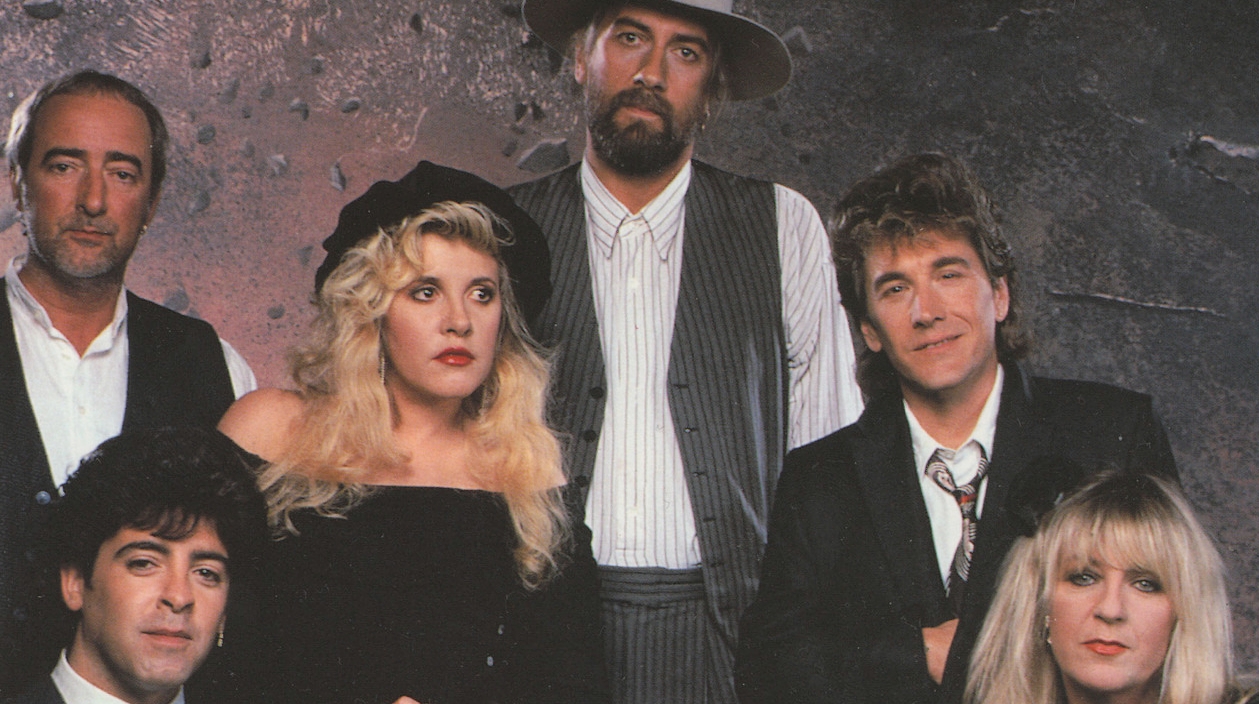
There is no sense of them carrying an exaggerated opinion of themselves. They still sound English, not Californian — Fleetwood slightly public school, McVie a trace of Brummie. But they do possess a comfortable awareness of status based with monumental solidity on Fleetwood Mac having sold the best part of 40 million albums around the world since 1975 and, in particular, on being one of the few bands who have written the soundtrack of a year, if not of an era. Rumours, released in February, 1977, stood at Number One in the US charts for 31 weeks, selling 20 million worldwide. It was the successor to Carole King’s Tapestry in the adult rock market. In Britain, if you couldn’t adjust to the Sex Pistols, you sang “Rhiannon” in the bath. It put a grateful record industry back on its feet.
So, of course, Fleetwood Mac are people for whom doors are opened. Before we can begin Fleetwood is caught up in making arrangements for that night’s Paul Simon concert and the “private” reception to follow. Very early that morning, when they flew in from California, he had immediately been offered seats for the Hagler-Leonard closed-circuit cinecast. he’d refused them, pleading jet lag with a reluctant nod at advancing years.
Journalistically this was a shame because Fleetwood Mac were just embarking on the same remarkable endeavour that Leonard had completed during the small hours — a successful comeback after five years out of the spotlight. Trying to remember all the old moves, keeping the chin out of the way.
Later that week a Sunday Mirror reporter tracked down Peter Green, the peerless guitarist who formed Fleetwood Mac in 1967, wandering around Richmond looking like a tramp. He is said to have a house in the area but he often sleeps on a bench at the railway station. The photographer tried to capture his filth, his obesity, caught him with a hand raised to show off his grotesquely long finger-nails. Children pull faces at him and call him “the werewolf”. He is a man on whom all doors are shut.
The name of the band used to be Peter Green’s Fleetwood Mac. Now the distance between them could hardly be greater. It’s not what anyone ever wanted. But it took Fleetwood Mac a very long time to learn how to keep pain out of their pursuit of happiness.
IT HAD STARTED so well. Fleetwood Mac’s drummer Mick Fleetwood, bassist John McVie and singer/keyboards player Christine Perfect were founder members of the British R&B boom. Whether they knew it or not, they were barnstorming around with the aristocracy of a rock generation. Green replaced Clapton in John Mayall’s Bluesbreakers and was succeeded by Mick Taylor — McVie on bass for all of them. Fleetwood played with Rod Stewart in Shotgun Express and had a month with Mayall before being fired for drunkenness. Christine was a member of Chicken Shack and went out with Spencer Davis.
Then in ‘67, seeking freedom from Mayall’s demanding ego, Green invited Fleetwood and McVie to join him from the Bluesbreakers crowd, adding the unknown Jeremy Spencer, a manic Elmore James impersonator. They recorded their debut album in three days and it stayed in the British charts for 13 months. Then Green began to roll out Mac’s single hits — “Need Your Love So Bad,” “Albatross,” “Man Of The World,” “Oh Well” and “The Green Manalishi” — a brilliant series of evolutionary moves away from the straightahead blues (in the middle of which they further excited their public by enlisting a third lead guitarist, Danny Kirwan). By 1969 they were one of the biggest live draws on the European circuit. Things could hardly have been sweeter.
What hadn’t struck any of the principals was that things fall apart. Or, more particularly, that people fall apart.
Suddenly Green announced that a Roundhouse gig in London’s Chalk Farm on May 24, 1970, would be his last with the band. All the stuff Fleetwood and McVie took in their stride he simply couldn’t stand any more. A turmoil of social, moral and religious ideals was whirling through his head and, if what he said about it was rarely coherent, it added up to guilt. Guilt about girls he’d casually screwed. Guilt about the children of Biafra whose bellies ballooned while he made a fortune playing guitar. He tried to assuage it. He read a New Testament Jeremy Spencer had given him. He gave thousands to famine relief charities. He began to study classical music, an antidote, one imagines, to the devil’s rock for which he’d become so prominent a disciple.
Nothing worked. Certainly not Fleetwood’s persuasions. “I always told Peter, I don’t see why on earth you feel guilty about being liked and by being liked being successful,” says the drummer sitting in the Mayfair 17 years on, still passionate about it, still grieved. “But he said it was all evil, he had to give everything away. He was…highly sensitive.”
Fleetwood still insists on viewing it as a crisis of personal ethics. Many others can’t accept such an upheaval as possible from the shrewd, ambitious Green they knew and can only go along with the story that he was spiked with a huge amount of LSD one night in Germany.
Green himself said at the time: “I was drawing away from music into just being a Christian person and it made me very happy, but it only lasted two or three weeks…” It seems that, although the conviction remained, the happiness never came back. One of the great rock guitarists has spent the last 17 years as gravedigger, barman, hospital orderly, petrol pump attendant, mental hospital patient, tramp and God knows what else, with only brief and abortive interludes as a musician.
Oddly enough, Jeremy Spencer had always seemed a far more likely candidate for a crack-up with a very obvious conflict between loony humour and inner seriousness. He would assure journalists his favourite reading was The Bible yet it was Spencer who managed to get Mac banned from The Marquee club by going on stage with a wooden dildo protruding from his unzipped fly. But it may be that it was the question of his musical identity that really screwed him up.
As a blues purist he was obsessed with perfecting his imitation of Elmore James while as a stage performer his party piece was an impression of Elvis Presley. This went down a storm with the punters at the time, but privately Spencer was agonising about his inability to write anything that amounted to more than “Dust My Broom” Part 243. The first hint of it came when he didn’t appear at all on Mac’s third album, Then Play On, despairing he had nothing original to offer.
His exit was even more dramatic and startling than Green’s. On the afternoon of a gig in Los Angeles, in February ‘71, he went AWOL, He walked out to buy a paper and he wasn’t seen for four days until he was tracked down to a nearby commune run by a pre-Born Again religious sect called The Children Of God. And that was that. He never came back.
At the time Fleetwood described a conversation with him in which Spencer had poured out his fears about the San Andreas Fault and the pall of “evil” hanging over L.A. which he felt was out to “get him”, as well as his worries about acquiring wealth, the band losing touch with the “real” blues and, on listening to an old tape featuring Green, his own inferiority as a guitarist. Quite a mess.
Naturally Mac were horrified at his fate, feeling that he had been caught at a low ebb and “brainwashed” by a sinister cult, snatched away not only from the band but from his wife and children. However, it has to be recorded that his family joined him immediately and stayed, and that ever since, when old friends have sighted him in Argentina, Brazil, Italy, Greece, he has been described as on an even keel and content with life.
SUCH WAS Fleetwood Mac’s first great period of crisis. Fleetwood and the McVies — Christine had joined as Green’s replacement — responded in the way that was to become familiar. Tin hat over the ears, heads down. A cross between a family and a platoon, they had bought a country house at Bordon, Hampshire, converted it into flats and lived together there.
They had a certain wildness, but also a feeling for security. Christine had twice earlier quit music for domesticity with John. She even refused a Top Of The Pops spot for a solo single to go on a planned summer holiday with him. She had been especially upset that Spencer dumped them in the middle of a tour. In front of a reporter she told her husband: “We could have lost a lot of money, lost this house, and that’s everything you’ve worked for for the last eight years.”
You might imagine that McVie didn’t know he’d been playing bass to buy a house, but he was a high-wire man who was always taking sneaky looks at the safety net. He began his working life as a trainee tax inspector, had been very reluctant to leave Mayall, and to this day has only been in two bands. For all the legendary boozing and tumbling through two decades he’s not exactly a fly-by-night.
Fleetwood does seem to have a more fundamental confidence in his own indestructability, probably encouraged by his family background. His father was a wing-commander in the RAF and he spent his boyhood in places like Egypt (at the time of Suez) and Norway. “So I feel comfortable anywhere on this planet,” he says. His Dad is probably the only wingco to have had a pop LP dedicated to him — Tusk.
Through the band’s dog days of the early ‘70s, the core trio took in talented American Bob Welch, lost Danny Kirwan to stage fright (even Green had described him as “neurotic”), signed up mediocre artisans Dave Walker (from Savoy Brown) and Bob Weston (from Long John Baldry’s band), and kept on recording albums that sold 250,000 in the States and 5,000 in Britain. They paid their bills but it was an inglorious business.
That was when their manager Clifford Davis tried to kill them off and inadvertently helped to make them superstars instead. And the band’s penchant for the traumatic shifted ground notably from the psychological to the romantic and the fiscal.
First Bob Weston, their least blessed substitution, had an affair with Fleetwood’s wife Jenny Boyd (sister of Patti Boyd/Harrison/Clapton). In the circumstances Fleetwood — for once looking a bit of an emotional softy in the light of subsequent events — couldn’t stand being on the road. In Lincoln, Nebraska, he called a halt to Mac’s umpteenth US tour and they flew home. Then, astonishingly, Davis formed a new band and, in February, ‘74, put it out on tour in America as Fleetwood Mac. Ill-advisedly, he told Rolling Stone that Fleetwood and McVie’s names were nothing to do with it: “This band is my band. I’ve always been sort of the leader.”
Audiences walked out. The real Mac slapped an injunction on the impostors, but were then grounded by Davis’s counter-suit. “That was the only time I really got panicky!” says Christine. “Because we couldn’t work, not until we’d proved he didn’t own the name.”
By the time they’d extricated themselves, Davis and Weston were out and Mick Fleetwood was managing the band. The LP Heroes Are Hard To Find, delayed by a Davis claim, had been released to the same mass indifference that had greeted most of Mac’s output post-Green. It was obvious they needed a shake-up. At Fleetwood’s instigation they agreed to move en bloc to California, although Christine in particular took some convincing. “I hated the idea,” she recalls. “It was a very scary proposition.”
In December ‘74, Bob Welch gave up the unequal struggle to drag Mac up by their bootstraps and went off to form his own band, Paris. So Fleetwood Mac were down to the eternal triangle — and no guitarist.
Meanwhile in England the bogus Mac rechristened themselves Stretch and put out a single called “Why Did You Do It?,” a whinge at Fleetwood for taking them to court — and the bastard was a hit.
HOWEVER, THE Fleetwood Mac principle of unorchestrated manoeuvres in the dark was about to achieve its greatest triumph. Just before Welch left, the eager new manager was scouting L.A.’s cheaper studios with the next Mac album in mind. At Sound City, to demonstrate their equipment they played him a tape by a duo called Buckingham-Nicks. By chance Buckingham was down the corridor and looked in. Short of a guitarist a couple of weeks later, Fleetwood remembered the encounter and asked the duo round. They hit it off and Buckingham-Nicks were invited to join Fleetwood Mac, on New Year’s Day ‘75, without so much as a 12-bar jam to confirm that their rapport extended into music.
This epiphany has become enshrined in rock lore as one of the moments that made an epoch. For Mac though it was only typical. It had been just the same when Spencer got religion. Welch was the first candidate they saw and he too was signed up without picking a note.
Buckingham-Nicks liked Fleetwood and the McVies well enough but they weren’t overexcited about the prospects of joining what had apparently become an irremediably Second Division outfit. Although they had been struggling in L.A. lately, their backgrounds had prepared them to anticipate success in life: Stevie’s Dad had been — simultaneously — Vice President of The Greyhound Bus Company and President of Armour Canned Meats; Lindsey’s father owned a coffee company. Still, they’d been in the music business for eight years with barely a sniff of a breakthrough, and had been living together for five years in steady descent down the ladder of poverty. They decided to give it a try. Stevie asked Mick if she could borrow all Fleetwood Mac’s albums off him because she didn’t have any of them and she couldn’t afford to buy them.
They went back into L.A.’s Sound City studios and, using material already written by the two separate units, knocked out the Fleetwood Mac LP in ten days. Then, as ever, they toured for six months solid. Initially they were supporting top league earners like The Eagles and Jefferson Starship, but then their product started to perform. Christine McVie’s “Over My Head” was Mac’s first big single hit in the States, and the album went up to 9, then fell away to 40 before taking a real run at it when “Rhiannon” became a monster and finally reaching Number 1 60 weeks after release (a record!).
At last, the dairy — except that the cream had curdled. The seemingly stolid old band which had somehow made a habit of wrecking individuals was about to start ruining relationships.
THE EMOTIONAL chaos began on the road and carried on during the recording of Rumours throughout ‘76. The McVies reckoned that their 24-hour-a-day life together had added up to 40 years of normal time and they’d had enough. For Buckingham and Nicks perhaps it was just their inevitable moment coinciding with Fleetwood Mac’s unforeseen apotheosis — they too split up.
Perhaps the most titillating aspect of the real life rumours we all so enjoyed was the implication that, even in extremis, the band’s play-it-close instincts were still dominant. It seemed that a sort of multiple extended-family incest was taking place. McVie turned up with one of Peter Green’s exes. He and Fleetwood were both said to have had a fling with Nicks. Christine settled in with the group’s lighting engineer, Currie Grant, for the next several years. Meanwhile, Fleetwood divorced his wife and remarried her just over a year later (though they were divorced a second time by ‘79), Buckingham characteristically kept a lower profile (though “meeting a lot of beautiful women”). He was sharing a house with Rumours co-producer Richard Dashut and concentrating, as only a Californian can, on “redefining my individuality.”
The only extra-familial relationships being noised abroad suggested that even stars can get starry-eyed: John McVie was said to have an unrequited crush on Linda Ronstadt (though he ended up marrying his secretary, Julie Ann Rubens, in ‘78) and Stevie Nicks conducted a long-distance phone romance with Don Henley of The Eagles which eventually got a little more cosy.
But nobody quit, though nobody outside the band could understand how or why. Looking back, Christine still asserts: “Everyone cared about everyone else. There might have been problems between me and John, but that didn’t mean we didn’t care about Mick, Stevie and Lindsey and vice versa. We’re friends. Very interwoven. And to let something that successful just all apart, to say, Sod the rest of you, I’m buggering off — there was a certain responsibility not just to the band but to the whole unit. There were a lot of people on the payroll. And then there was the fact that we knew we were good. Whatever happened that was the overriding factor.”
For Buckingham it was clearly a matter of self-control and damage limitation. On Mac’s British tour in ‘77 one journalist watched while John McVie drank himself out of affability and into aggression until he threw a glass of vodka into Buckingham’s face. Buckingham laughed it off and calmed him down.
WITH THE intimate areas of their lives in circus uproar, a bit of straightforward hedonism must have looked very appealing to Fleetwood Mac. Indeed they seem to have relished it royally. Stevie Nicks in her Blanche Dubois mood savoured the moments: “Stepping into the black limousine with the white scarves, the excitement — to me it’s the height of elegance, it’s what I always wanted if I was going to be in a rock band.”
They bought mansions and Rolls Royces. Their merest snacks were banquets, the leftovers a feast. Back-stage vintage champagne was delivered by the crate and cocaine was sometimes wittily arrayed in coke bottle tops. Once, on Christine’s birthday, she came home to find that her then lover, Beach Boy Dennis Wilson, had dug out the garden in the shape of a heart and filled it with roses — their friends stood around the edge holding candles. The band spent a million dollars recording the double album Tusk and a lot on solo albums of various merit and success.
Buckingham insists that the extravagant images are greatly exaggerated: “I don’t believe we were full bore into all that. Just having two women there made for a rather more refined and couth atmosphere I would say…though sure, there have been abuses.”
The great pleasure hunt ran its course. On the down-side of elegance Stevie found herself checking into hotels some nights because her house was full of people she’d never met before. Christine McVie, claiming to be “too set in my ways” to be able to accommodate children, elected to have herself sterilised. The unsinkable Fleetwood was afflicted for a time with a weird variant on diabetes, then went bankrupt to the tune of £2m owed to two Californian banks, his lawyer, and WEA. He explained that he had overextended himself investing in property and run out of readies. Back on his feet now, though the “poorest” member of Mac, he reflects: “It was an interesting process. People expect you to fall apart. But it didn’t destroy me. What I’m saying is you can’t put credence in…being able to go out and buy a nice car isn’t the be-all and end-all of you as a person.”
But they began to pick up the pieces. In January 1983, Stevie Nicks married Kim Anderson (the husband of her close friend, Robin, who’d died of leukaemia five months previously). The ceremony took place on the tennis court of her house in Marina Del Ray (they’re now divorced).
Indeed, the mood has changed so much that it’s even possible for Lindsey Buckingham to reflect on what he might have lost by joining the band. “Sometimes I speculate on what I had to give up in terms of my own pure style of playing and writing. What troubled me was that the phenomenon of Rumours, the sales, took over from what the Work was.” Buckingham has the habit of saying “Work” with an audible capital. “You’ve got to remain true to the Work. And that’s quite hard to do at this level. These years have been extremely…demanding, not only in the Work but emotionally. There are lots of ways of getting hurt. Though I’ve lost touch with a lot of what happened. I guess I blocked it out.”
The time had come for Fleetwood Mac to settle down.
 EVERYTHING ABOUT the recording of Tango In The Night was more pragmatic and practical than in their golden days. Although Fleetwood sticks to the party line about band independence free of record company molestation this is Buckingham’s story of the album:
“We hadn’t worked together for four years and we weren’t really used to seeing one another. When that happens there’s pressure from Warners of course and the people on the periphery, the lawyers and the management, start to move in to initiate an album. There was a group need to record but all our individual managers and lawyers had to talk because there was no one else to put the thing together on a logistics level — the band as such doesn’t have a manager since Mick stopped doing that. The meetings are a little chaotic. More people than I’ve ever seen. But…that’s show business.”
Fleetwood presents sincere pride in the new discipline with which they worked once they’d got through the paperwork to the music. Two to ten and then home to bed. A reformed character.
The album and single did much better than expected — the LP sold 1.5 million worldwide in six weeks — and they’ve made no secret of the fact that their attitude to success has undergone some modification over the last 20 years. Christine, 44 in July, married Eddy Quintela, a Portuguese musician (and co-writer of two tracks on the new LP) last autumn and is still based in Los Angeles. “You know when we got this success what I felt most was an immense sense of security. ‘Thank God I’ve got enough money so that whatever happens I can sort it out.’ My house, which I bought ten years ago, is the closest thing to the Cotswolds you could get. I tend to be very much of a home body. I love my home. I love looking after my roses. I’ve got a wonderful husband and three wonderful dogs…”
BUT THE raven’s still tapping at the window pane. Even after 17 years, the spectre of Peter Green still seems to haunt Mick Fleetwood and he’s remained determined to try and help him whenever he can.
For instance: Green seemed to touch bottom in ‘77 when he went round to Clifford Davis’s office with a gun and, in one of the most improbable rock business confrontations on record, demanded that the manager take back a £30,000 royalty cheque. Green was committed to mental hospital where, a few months later, Fleetwood phoned him inviting him to work on his solo African extravaganza, The Visitor, when he felt ready. “We had a really good time,” says Fleetwood. “He was objective, he was a lot better than I’d seen him for years. He spent some time with me and even got married at my house in L.A. (on January 4, 1978 to Jane Samuel). But all that went wrong and he seemed to slip back.”
Fleetwood the entrepreneur had been so hopeful that he lined Green up with a deal to relaunch his recording career but, to his mortification, when Green saw the contract he said it was “the devil’s work”. Back then, in his frustration, Fleetwood told a reporter: “I’ve totally given up with Peter. After a while it just wears me down.” Now he says: “I’ve got his phone number. I’ll check in with him before I leave. It’s just I get nervous because I don’t know whether he wants to talk or…It’s odd. He’s a stranger now really.”
Over in Richmond the Sunday Mirror man asked Peter Green whether he would ever play the guitar again. “I had one a while ago,” he said, “but it broke.”
© Phil Sutcliffe / Q / July 1987