Category: Trouble in Shangri-La (2001)

  • Stevie Nicks: Gold Dust Woman Returns

    Rock’s fairy godmother hooks up with Sheryl, gets compliments from Lindsey, and invites us into her Shangri-La.

    Stevie Nicks has always considered herself a songwriter first, performer second, but try telling that to the acolytes who flock to New York’s “Night of 1000 Stevies” to honor the woman, her wondrous voice, and last but definitely not least, her wardrobe. One of the most charismatic figures of rock ‘n’ roll, Nicks has enchanted audiences for more than 25 years with her unique ability to convey both power and vulnerability. As a solo artist and as part of Fleetwood Mac, she writes songs that elevate the feminine to a sacred place without alienating the male contingent; everyone feels honored to share her secrets and spells. In the words of friend and collaborator Sheryl Crow, Nicks is “the woman men want to be with and women want to be.” Listening to Fleetwood Mac’s Rumours at the age of 11, I too was enchanted by her silvery tones and languid phrasing, and spent hours poring over the photos of this tousled blond beauty in flowing chiffon and platform boots. She was, quite simply, the coolest chick I’d ever seen.

    Now 52, Nicks is as vital an artist as ever, and her recent collaborations with Sheryl Crow, Macy Gray, Sarah McLachlan, and Natalie Maines are a testament to her continued cool. Trouble in Shangri-La, Nicks’ first solo record since 1994’s Street Angel, represents a huge leap for the singer. A concept record that asks the question “what is paradise?” Shangri-La features songs from as far back as 1970, as recent as this year. From the title track to the driving “Sorcerer,” Nicks has added a bluesy depth to her vocal repertoire. The five songs produced by Sheryl Crow introduce looped drums and a light country twang. The record also includes a guest appearance from Nicks’ former lover, bandmate, and sometime-nemesis Lindsey Buckingham, which is a good sign for all the Fleetwood Mac fans who’ve been wondering about a reunion.

    Speaking to VH1.com from her California home, Nicks discusses the process behind what is easily one of her best solo albums, her determination to overcome stage fright, and the creative bond she still shares with her Fleetwood Mac cohorts.

    VH1.com: The new record is great, congratulations. Billboard said you’re in your finest musical form since Bella Donna.

    Stevie Nicks: Really? Well, I am actually in my finest form since Bella Donna. Bella Donna was made up of all the songs that didn’t go on the Fleetwood Mac records between 1975 and 1980 — which was many — because when you’re in a group with three writers you only get two or three songs per album. It’s the same with Trouble in Shangri-La: I started writing these songs in 1995 right after the big earthquake in California [in 1994]. And the other three were from the mid-’70s.

    In your bio you mention that you needed to replenish the creative well — go out and live your life for a while to get some new ideas.

    After the earthquake, in 1995 I went to Phoenix, and I never thought it was gonna take five years [to make an album]. So what happened is exactly what you said: In order to write the nine new songs on this record I had to really live. I can’t just make up songs, I can’t just make up poetry. I don’t write a poem unless something catches my eye and I go home very inspired or I meet somebody that really impresses me in some way. I would love to have written these songs during the first year and put this record out and be on to my second record by now, but I couldn’t. I wrote “Love Is” at the end of 1995 and I wrote “Trouble in Shangri-La” at the end of 1996, so it took one year to write those two songs. And I had to fit the three old songs and the new songs that I would come to write in between those two, because I wanted to stick to the concept of “trouble in Shangri-La.”

    How do you define Shangri-La? Was that your time with Fleetwood Mac?

    Pretty much, yeah. You know, if you live in a huge house and have a fabulous car and lots of money for 20 or 30 years, pretty soon paradise becomes your world. And it’s nothing special. And that’s the saddest part of all. I think you must always have trouble in Shangri-La to keep yourself from becoming complacent. If you stop searching you’ll get lost. Once you’ve attained paradise, people say, “Well, you don’t have to write any more songs. You’ve got lots of money.” It’s like, but does that mean I’m finished? So you can never feel that your work is done. You can never say, “That was the best song I ever wrote,” because hopefully you’ll write an even better song.

    Did you do a lot of reckoning with the past while making this record?

    I had just done the Fleetwood Mac reunion, which I loved, and then I did my Enchanted box set. With Trouble in Shangri-La, I really felt that I was making a step away from the past. The box set really was all about the past, and the Fleetwood Mac reunion was all about the Rumours songs. I really felt a necessity to go into the future. Because when you’re in a great old band that still exists, you can always live on that … you can always be that. Or you can go ahead and do your own thing along with doing that.

    It seems like you’ve really embraced the role of rock ‘n’ roll matriarch, inspiring and collaborating with a younger generation of female artists.

    It’s awesome for me, it really is.

    There’s some very interesting production on the record, and you delve into country and reggae a little bit as well. Were a lot of your new sounds inspired by working with Sheryl Crow and Macy Gray and Sarah McLachlan?

    Actually, for the five songs I did with Sheryl Crow [as producer] we used her people. And so yes, she was very responsible for the instrumentation of those songs. “Candlebright” was written in 1970; it was one of the demos Lindsey and I moved to L.A. with, and so I have an incredible demo of just me and Lindsey. And it’s exactly like what’s on the record except that it’s me and Sheryl! Singing with Sheryl is very much like singing with Lindsey: She’s a real great duet singer and so we had a great jumping-off point from the beginning. I went in, it was her band and a couple of extra people that she brought in for different sounds — violins, Chamberlin, all her little visions. I pretty much let her run with it. I said, “Here’s the demo, now you put your magic on it. All you have to do is make it so that we both think it’s better than the demo.” And we did.

    How did it feel to have Sheryl Crow write “It’s Only Love” for you and about you?

    Well, she came up the stairs carrying her guitar and she just sat down and played it for me. And she told me, “I went home and I just was really thinking about all your stories and all the stuff you’ve been through” – because now that we’ve been friends for four years I’ve just about told her all the great stories, she knows them all – and that’s really what she wrote the song about, all my different relationships and the men that I was with and the men that I’m still good friends with and really care about. They’re all still out there and around me, and she finds that pretty amazing. I think that’s what inspired her to write the song – you know, “sometimes lonely is not only a face that I have known.” And she sees my life: I am not married, I don’t have children, and I made that choice. I knew if I had children I would have to take care of them and I couldn’t hand them over to a bunch of nannies. So I knew if I had a baby I would stop making music and I would start being a mom. And I decided in my life, that my mission was to make people happy. It was more important. I only just got a dog two years ago, and trained her myself. And that’s the motherliest thing I’ve ever done.

    How did the Natalie Maines duet, “Too Far From Texas,” come about?

    That was a song that a friend of mine sent me a couple years ago, and when I first heard the Dixie Chicks I marked it in my brain that this was a song that I could probably sing with this girl Natalie Maines. I didn’t know her; I wrote it in my journal, turned the page down, put a little star by it, and never thought about it again. In the studio I told Sheryl about it and that thought it would be incredible [to cut it] with the girl from the Dixie Chicks. We recorded it live.

    Do you have a personal favorite song?

    My personal favorite is “Bombay Sapphire.” When it says, “I can see past you to the white sand,” that sentence right there is the whole reason for “Bombay Sapphire.” It means that I’m really trying to get over something, and though I’m freaked out about it I’m looking to the green ocean and can see past all of these problems to the incredibly beautiful white sand and the ocean beyond it. I’m gonna be OK because I am movin’ past you. And when “Bombay Sapphire” almost got pulled off the record because it wasn’t recorded right, I was horrified that one line was not gonna be on the record. It’s really important for me to tell people that if they’re in an unhappy situation they should not stay forever and be miserable.

    How was it producing the song yourself and singing with Macy Gray?

    It was easy, because it was exactly what I wanted to do. It was done in one night. I really did have a vision for that song, and [on earlier attempts to record it] nobody else saw my vision. The first time it was too R&B, the second time it was too Wagner, dirge-like. The third time it was back to its little funky reggae self. I’m managed by the same people who manage Macy, and in the spur of the moment I just said, “You know, I bet Macy could sing the high part on that chorus.” Two days later she was in the studio. So none of this was very thought out. It was all perfect accidents.

    You used seven producers on this record. Was it your intention to work with so many people?

    Well, I couldn’t really find one producer who could do the whole record. The whole idea of the concept record is pretty much gone, and I really wanted to keep my concept going even though there were different producers. When I recorded, say, “Fall From Grace” with John Shanks, Sheryl Crow was there that night at the studio. So it was like, all the producers kind of blended a little bit and became friends because they all really cared about this record and they all really wanted it to be great. I told Chris Lord-Alge, who mixed it, “You have to be the master seamstress here, because I don’t want the mood to be changed.” So he really worked hard on that.

    Sheryl Crow has said, “There’s always a male producer who wants to make [Stevie] into something that is maybe not as intimate as what she sees her music as being.”

    Sometimes people want to change things just for the sake of change. Not because they need changing. That’s a problem that I have. It’s like, we’re all in the studio rockin’ out, everybody loving the track, and then [after a break] I come back in and the drumbeat has been changed. What is that? You have to be very tough with these producers or it will be their record. I decided that there was not gonna be a song on this record that I did not love. There were two that didn’t come out right; I pulled them and gave them to Lindsey. We’re gonna put ’em on a Fleetwood Mac record, probably next year.

    Could you talk a little about that?

    Sure. Lindsey and Mick were here two weeks ago. I went back through the song vaults and I pulled 17 songs from a hundred years ago all the way up to now. We listened to Shangri-La, and we listened to the 17 demos, and Lindsey was knocked out. He really hadn’t heard all these songs; I guess I just never really played them for him. He had no idea that I was going to present him with 17 songs; he thought maybe we were gonna work on a song. So he called me the next day and said, “I’m driving up the coast and I’m taking notes and I’m very happy with all these songs.” So that’s about the nicest thing he ever said to me, really. “I’m very happy with all this music” was like, “Oh my God, I can’t believe he said that!”

    So you know, I will follow my Trouble in Shangri-La through as long as it goes, and Lindsey and Mick will work on [the new Fleetwood Mac songs] when I’m gone and I’ll come back and we’ll go in the studio and polish it all up. And hopefully a Fleetwood Mac album should be out by the end of next summer. It’s very easy to sit down and plan this all out because you never know what’s gonna happen. But in the perfect plan that’s what I would like.

    What about the song “Sorcerer”? Although it was written many years ago it feels like it comes from the perspective of a wise woman.

    “Sorcerer” was written in 1974, a year before we joined Fleetwood Mac. It was really about the city of Hollywood and how strange it was to us. It was all about models and rock ‘n’ roll and drugs and scary people. I was a very, very prudish little girl from San Francisco who had strict parents, I had not had a lot of freedom, and coming into this town was freaky. “All around the black ink darkness, and who found the lady from the mountains.” The lady from the mountains was me. I did a [nude] photo session for the Buckingham Nicks album and I was horrified about that cover. I did not want to do that and I was really made to feel like, “Don’t be a child, don’t be a baby, this is art, this is your future.” And I did do it and I never forgot that. It was the one time in my life that I did something that I felt was not morally right for me to do.

    Do you think it was inevitable that you and Lindsey would make up or did it involve a lot of work and effort on both your parts?

    It involved a lot of work and effort on both of our parts. And now we are good. We are actually friends. He has two children, a little girl and a little boy. Needless to say, going from a selfish rock ‘n’ roll god to having two babies, it’s very much changed his life. He can’t be selfish anymore. And he is thrilled with these little kids; they are precious. He never thought he was gonna have children, so he is surprised every day. He is a much softer, sweeter man and I love that, because I knew that softer man a long time ago. So I’m seeing my old friend back again.

    Christine McVie is not going to be part of this reunion?

    She can’t do it. She has moved back to England and she is really happy. Chris is 57, she has the rest of her life to live, and she doesn’t want to do this anymore. There’s really nothing that can be said to her to make her change her mind. She wants her life to be in England and she wants to be with her family and all her friends. She sold her house, her car, and her piano and went to England three years ago. And I haven’t seen her since! And it’s OK because I understand that she really cannot do this. So I’m not gonna ever ask her again. And she wants us to play. Just because she’s not there, she didn’t die. She’s living a fabulous life. She has a castle with 20 acres of gardens, she has an apartment in London, she knows everybody. And if you went over there and saw her life you’d say, “OK, I understand.” It’s very lonely on the road. It’s especially lonely for the girls. As Christine has said to me many times, “Stevie, this is your passion. It is not my passion.”

    Do you think you’ll always feel like a gypsy or do you find yourself being more inclined to stay in one place?

    I don’t think the gypsy part will ever go away. When I was little we moved every two years, so that kind of nomadic life is just what I was used to. I have a house in Phoenix, I rent a house here in Los Angeles, and I go to a hotel sometimes just because I like to move. I don’t think that part of me will ever change. If I’m in a bad mood I’ll get up and go somewhere, because I can always get out of that if I just change my environment. So where other people would turn to a really strong, straight glass of vodka, I get in the car and go somewhere.

    Are you looking forward to going out on the road this summer?

    Right now I’m very nervous about the experience, because I get very bad stage fright. I get terrible butterflies and it’s not pleasant. It has always happened to me. Once I walk out onstage it’s fine; all the nerves go away. But the six hours leading up to the shows are very hard for me.

    And that’s consistent throughout the tour?

    That’s consistent since the fourth grade; that’s consistent since the first time I twirled my baton in a talent show. My mother reminds me of this: “This is not new, Stevie. This has been happening since you were in the fourth grade and did your first performance in front of people. You were sick all day; you were sweating.”

    Steffie Nelson / VH1 / April 1, 2001
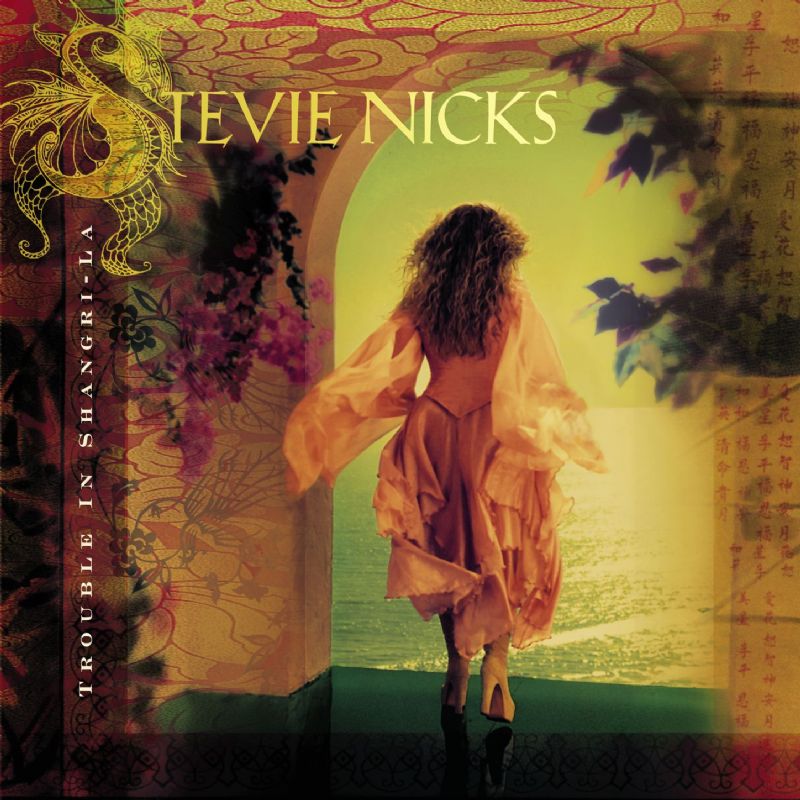
  • In the News: Stevie Nicks

    In the News: Stevie Nicks

    In 1994, STEVIE NICKS was watching the O.J. SIMPSON trial when she came up with the title of her next album: Trouble in Shangri-La. “It’s the whole idea of achieving paradise,” says Nicks, “and how difficult it is to handle it. Trouble in Shangri-La is about a lot of people, including myself.” Nearly eight years later, on May 1st, the album will hit stores. Says Nicks, “I love these songs, and I’m so excited to share them with the world.”

    Shangri-La was mostly written by Nicks but also features a variety of guest stars. Sheryl Crow plays some guitar and co-produced five of the album’s thirteen tracks, Macy Gray sings on “Bombay Sapphire,” and Dixie Chick Natalie Maines duets with Nicks on “Too Far From Texas.” “I’m really a harmony singer, so I love to sing with other lead singers,” says Nicks, who, in addition to her work with Fleetwood Mac, has topped the charts duetting with both Tom Petty and Don Henley. Another guest is Fleetwood Mac’s Lindsey Buckingham, who plays guitar on a song called “I Miss You.” Is the song about her former lover? “Well, it’s not,” says Nicks. “But a lot of these songs are about Lindsey.”

    Expect Nicks to hit the road this summer. And, if she has anything to say about it, another Fleetwood Mac album remains a possibility. “I would love to see us do one more record,” she says. “I’ll be doing my Trouble in Shangri-La thing for however long, and next year we could be on our way to a Fleetwood Mac album. Life is short. Why wait?”

    Rolling Stone / March 29, 2001

  • Stevie Nicks: Biography

    Stevie Nicks: Biography

    WEA Records International
    March 5, 2001

    “My music often unfolds like the book of my life,” declares legendary rock poet Stevie Nicks. And that’s precisely the way she wants it to be. “I believe in telling the truth…actually, it’s only way that I can exist as a writer.”

    It’s to that end that Nicks created the sterling, often confessional Trouble in Shangri-La, her first solo collection since 1994’s Street Angel. She says the project has been slowly evolving for several years, “taking different shapes and forms. But it never seemed quite right until recently. I needed to live my life. I need to replenish my well of life experiences.”

    And she certainly has. Easily one of her most powerful recordings to date, Trouble in Shangri-La is brimming with the rich prose and vibrant imagery that has inspired a veritable army of disciples. “Every step along the path of my life, I’ve been writing it all down, taking incredibly detailed notes,” Stevie explains. “Instead of partying, I run back to my room, open my journal, and pour out my heart onto paper. It can take minutes, or it can take all night. But it’s always deep. And it’s always real.”

    For Stevie, getting back in touch with the part of her self that was confident about her song writing skills was a crucial element in the creation of Trouble in Shangri-La.

    “I’d been hearing about how I should write with this person, or record that person’s material, and it started to wear me down,” the artist reveals, adding that it took longtime pal Tom Petty to remind her that she’s a top-flight songwriter in her own right. “I remember asking [him] to work with me on some songs. I wasn’t feeling my best; I was unsure about a lot of things. And he said, ‘No…you don’t need anyone to help you with your songs. Do it yourself.’“

    At first, Stevie was crushed. “But it was the jolt I needed,” she shares, adding that the album gem “That Made Me Stronger” was borne out of their fateful conversation. “It was a pivotal moment for me. The clouds cleared, and things started to naturally flow again.”

    ‘Naturally flow’ is an understatement. The songs started to come on like a tidal wave. And while Stevie notes that her songs rae “sometimes a continuation of one another,” with common lyrical threads and theme, the songs that comprise Trouble in Shangri-La also show the artist at her most experimental and varied. Classic Stevie tunes like the acoustic-based “Candlebright” and the gentle “I Miss You” are tempered by refreshingly inventive compositions like “Bombay Sapphires,” with it’s delicate undertow of Caribbean rhythms and its atmospheric keyboards, and “Love Changes,” which is seasoned with a splash of funk percussion.

    “To not grow is to die,” Stevie asserts. “Of course, you want to work within a framework that best suits your talent and style. But you also want to continually shake things up.”

    For Stevie, shaking things up included inviting an array of new friends and musicians to participate in Trouble of Shangri-La. Macy Gray vamps with seductive soul on “Bombay Sapphires,” while Sarah McLachlan harmonizes on the stately, piano-driven ballad “Love Is.” Also, Dixie Chick Natalie Maines is a complementary presence on the country-spiced rocker “Too Far From Texas.” Stevie recalls that every collaborator came to the project at times when “the songs seemed to be calling out their names. These are strong, wonderful women with incredible musical talent. To have them on this album is a such a special gift.”

    Stevie recalls her first meeting with Gray as being particularly memorable. “Her vibe is so wild, so intense. She walks into the room and it’s like everything starts to move.” She’s like a walking tornado. She’s a total blast. We had a great time working on the song. Our voices blended so well together.”

    Ultimately, the greatest gift to Trouble in Shangri-La is the kinetic creative union forged by Stevie with Sheryl Crow. “We’d been circling the idea of working on this album for quite a while,” Stevie says. “But we could never quite make it happen because of scheduling conflicts. So, we just went forward with our respective business, but we stayed in close touch. Suddenly, things cleared up and we wound up in the studio together.”

    Nicks and Crow eventually worked on five of the set’s thirteen tunes. As Stevie explains “Our connection is deep…deeper than I can even put into mere words.”

    Crow, who has long cited Nicks as a primary musical influence, wholeheartedly returns Stevie’s ardor. “To even be in the same room as Stevie was a dream come true for me. To work with her was beyond description. It was extraordinary.”

    Both agree that the key to their successful collaboration was mutual trust and respect. “From the moment in the studio, it was clearly a safe environment,” Stevie says. “And that opened up the lines of communication and allowed us to try new ideas out.”

    Among the more satisfying results of their experimentation is “Sorcerer,” on which Nicks scales to a rich falsetto during the song’s verses. “She was completely open and in-the-moment while we were working,” Crow notes. “She never stops working or striving to be a better artist.”

    Stevie also never stops fighting for the lyrical integrity of her songs. She recalls being the studio with co-producer John Shanks (The Corrs, BB Mak), who helmed a number of songs on Trouble in Shangri-La, and playfully tangling with him while cutting the anthemic “Fall from Grace.”

    “The original version of the song had all of these verses…too many, in John’s opinion,” Stevie recalls. “So, we set out to edit the song to fit a workable structure, and it was just breaking my heart to let some of the words slip away.”

    Nicks remembers one particular session when pals Laura Dern and Rosanna Arquette were hanging out in the studio, and they caught a glimpse of the original draft of the song. “And they were like, you can’t cut all these words,” she remembers. “Poor, John, they were yelling at him and giving him a hard time. It was all done in fun and good spirit, but it convinced me that I had to fight for my words. Before the night was done, we got every syllable in. And it’s become one of my favorite songs on the album.”

    In fact, “Fall from Grace” is among the songs that Stevie plans to add to her concert set when she hits the road for a tour this summer. “It’s the perfect balance to ‘Edge of Seventeen,’” in terms of energy. It’s great a song to rock out to. I love just cutting loose to that one.”

    Actually, Stevie says there isn’t a song on Trouble in Shangri-La that she wouldn’t love performing onstage. “I’m so incredibly proud of this album,” she adds. “These songs have been such a big part of my life. I’m so pleased and excited to get them out there for the world to hear. There’s usually a period when an artist is nervous about how people will react to their new material. I’ve been there. But there’s something about this set of songs. I have such a great, positive feeling about it. I’m more itchy for people to finally hear them than anything else. That’s a pretty good sign, isn’t it?”

  • Reprise’s Stevie Nicks returns with Crow in tow

    Reprise’s Stevie Nicks returns with Crow in tow

    Stevie Nicks is ready for ‘Trouble’

    Stevie Nicks is enjoying a rare moment of quiet. It’s a comfortably warm February afternoon in her Los Angeles home, and she is taking a brief breather before diving into what she describes as the “happy madness” of promoting Trouble In Shangri-La (Reprise, May 1), her first solo collection since 1994’s Street Angel.

    “Even after all of these years, this is the hard part — living through that period of time between the day you finish a record and the day the world gets to hear it,” Nicks says, her voice brightening as she adds, “but I’m so content with these songs. I’m more itchy for people to finally hear them than anything else.”

    And with good reason. Trouble In Shangri-La shows the sometime Fleetwood Mac siren in her finest musical form since her 1981 solo breakout, Bella Donna.

    “In many ways, this album brings me full circle,” Nicks notes. “There are a couple of songs I’ve been holding on to since that era, waiting for the right context to bring them out. Also, there was an accumulation of time and life experiences — and songs — reminiscent of that period.”

    Despite a diverse roster of producers — including Sheryl Crow, John Shanks, and Pierre Marchand — Trouble In Shangri-La boasts cohesion in style and structure as it strikes a balance between Nicks’ signature rock poetry and concise, radio-conscious pop hooks. The artist credits a renewed confidence in her songwriting as the driving force in the album’s direction.

    “I remember asking my dear friend Tom Petty to work with me on some songs,” Nicks says. “I wasn’t feeling my best; I was unsure about a lot of things. He said, ‘No. You’re a premier songwriter. You don’t need anyone to help you with your songs. Do it yourself.’ It was the jolt I needed.”

    Petty isn’t the only musical figure with such high regard for Nicks. Trouble In Shangri-La is brimming with high-profile guests. Dixie Chicks belter Natalie Maines harmonizes on the twangy midtempo rocker “Too Far From Texas,” while Macy Gray weaves her distinctive purr into the atmospheric shuffler “Bombay Sapphires.” Sarah McLachlan lends her voice to the lilting, set-closing ballad, “Love Is.” The common denominator among such seemingly disparate guests? Each cites Nicks as a prime musical influence — something that tickles her.

    “OK, so now I’m ‘Mama Rockstar,’” Nicks says with a giggle. “It’s cool. Actually, it’s great. I take pride in knowing that people have benefited from the road I’ve traveled. We’ve had a wonderful time bonding.”

    No recent bond has been deeper or stronger than the one Nicks has forged with Crow. The pair has been gradually developing a friendship for several years, but Nicks says the ties have become “unbreakable” since the two collaborated on five Shangri-La songs.

    “First, Sheryl’s brilliant,” Nicks says. “She’s an amazing songwriter, singer, and musician. But she’s also someone who gets it. She understands the life of a woman in rock’n’roll. There’s no room for playing games with her or saying, ‘You don’t understand what I’m going through.’ She understands, and that’s brought us closer than I can explain.”

    For Crow, connecting with Nicks is something she tries not to “get too deep into my head about,” she says. “She represents such a huge chunk of my life that it’s almost unreal to be in the same room with her.”

    Still, Crow notes that there was an instant ease in their relationship — both in and out of the studio. “Stevie’s just so real, so completely open as a person,” she says. “And as an artist, she continues to work hard. Sometimes you meet your heroes, and you discover they’ve stopped growing or have gone past caring about what they do. Stevie’s still so vital. She’s still looking to try new things.”

    Nicks and Crow both point at the “Shangri-La” highlight “Sorcerer” — a song the pair co-wrote and on which Crow lends guest vocals and guitars — as an example of their successful experimentation.

    “Sheryl challenged me to explore different areas of my voice,” Nicks recalls, noting the soulful falsetto that she reaches during the song’s initial verses. “It was fun to do, and it wound up working so well within the song’s arrangement.”

    Adds Crow, “Stevie’s an incredible singer. She approaches music in a such a unique manner. It would be easy for her to just stick to the same old thing, but she’s clearly not content to do that.”

    In addition to “Sorcerer,” Nicks notes the Crow composition “It’s Only Love” as a personal favorite. “It’s a song that I love to sing,” she says. “I’m hoping that it will be part of the set for the tour.”

    Touring is a key component of the Shangri-La marketing strategy. But don’t expect Nicks to drench the set with songs from the new album. “I learned an important lesson back during the first Rumours tour with Fleetwood Mac,” she says. “You can’t shove new songs down your audience’s throat. You can do three or four at the most.

    “On that Rumours tour,” Nicks adds, “we did most of that album, and people didn’t want any part of it. They want familiarity. They want the comfort of songs that feel like old friends. You can’t exploit your fans by forcing them to embrace songs they don’t know yet.”

    Nicks may offer a blend of classics and new material on her U.S. tour planned to run from mid-June through September. But in a “fair trade-off,” she is planning to perform much of Shangri-La during a showcase in Los Angeles shortly before the set’s release.

    “This record is clearly from the heart — and it shows her as a fresh, vital artist,” Reprise executive VP Rich Fitzgerald says. “It’s the record her die-hard fans waited for, but it has the potential to draw new admirers.”

    The label will begin working two singles from the project at radio in early April. Triple-A, mainstream rock, and classic-rock formats will be served the guitar-charged “Planets of the Universe,” while pop and modern AC will be offered the sweet, string-laden “Every Day.” A video clip for the latter cut is being planned for production in March.

    Nicks’ Web site, nicksfix.com, will offer streaming samples of “Every Day” in late February/early March. Guest appearances on The Late Show With David Letterman and The Rosie O’Donnell Show are confirmed to air around the album’s release, while other shows — along with several special tie-ins with VH1 — are soon to be locked in.

    Label enthusiasm seems to be running high, but Nicks admits that she isn’t the most competitive artist. “I’m not willing to kick and scratch to win,” she says. “That doesn’t mean that I don’t want to reach the largest possible audience. I’m one of the hardest-working people you’ll meet, but I’m just not driven by commerce. I make music and want people to hear it. It’s that simple.”

    Nicks — who is managed by Sheryl Louis at the Howard Kaufman Agency and whose songs are published by Welsh Witch/Sony Songs (BMI) — is philosophical about releasing an album at a time when the music business continues to be dominated by teens.

    “If you’re in it for real, then that’s what counts,” she says.

    Here is the track listing of Stevie Nicks’ Trouble In Shangri-la:

    “Trouble In Shangri-la”
    Produced by John Shanks and Stevie Nicks
    Written by Stevie Nicks

    “Candlebright”
    Produced by Sheryl Crow and Stevie Nicks
    Written by Stevie Nicks

    “Sorcerer”
    Produced by Sheryl Crow and Stevie Nicks
    Written by Stevie Nicks

    “Planets of the Universe”
    Produced by John Shanks and Stevie Nicks
    Written by Stevie Nicks

    “Everyday”
    Produced by John Shanks
    Written by John Shanks and Damon Johnson

    “Too Far From Texas”
    Produced by Mike Campbell, Sheryl Crow, and Stevie Nicks
    Written by Steve Booker and Sandy Stewart

    “That Made Me Stronger”
    Produced by Sheryl Crow and Stevie Nicks
    Written by Stevie Nicks, Scott F. Crago, and Timothy Drury

    “It’s Only Love”
    Produced by Sheryl Crow
    Written by Sheryl Crow

    “Love Changes”
    Produced by David Kahne
    Written by Stevie Nicks

    “I Miss You”
    Produced by Rick Nowels
    Written by Stevie Nicks and Rick Nowels

    “Bombay Sapphire”
    Produced by Stevie Nicks
    Written by Stevie Nicks

    “Fall From Grace”
    Produced by John Shanks and Stevie Nicks
    Written by Stevie Nicks

    “Love Is”
    Produced by Pierre Marchand
    Written by Stevie Nicks

    Larry Flick / Billboard / Feburary 12, 2001