This rarely-seen video for “Edge of Seventeen” has moments of pure telenovela, which just beg for Stevie’s retrospective commentary. For example, why was brother Christopher shaking Stevie so violently (at 3:38)? Did he want her magical doll? Why is Stevie walking on the beach in her beautiful black dress? Many unanswered questions! So it’s a surprise to see it missing from the Crystal Visions…The Very Best of Stevie Nicks DVD video compilation, when the equally-campy “Scarlett Version” of “Stand Back” was included. Like that video, “Edge” has everything that we love most about Stevie Nicks videos: drama, passion, and endless spinning! Stevie’s lip-syncing skills, still in their formative years, would probably get her voted off RuPaul’s Drag Race, but there is certainly no shortness of creativity, uniqueness, nerve, and talent in this raw, over-the-EDGE performance.
Tag: Bella Donna

VINTAGE VIDEO: ‘Gold and Braid’
“Gold and Braid” is a track from the Bella Donna recording sessions. Although it was never recorded for the album (or ANY album for that matter), it quickly became the elusive fan favorite, kind of like the “Silver Springs” of Stevie’s solo career. The iconic live version of “Gold and Braid” finally found a home on Stevie’s 1998 Enchanted box set.
Diehards will turn to this performance from the 1981 White Winged Dove Tour to rekindle fond memories of marching high kicks and a flying tambourine, as Stevie cheers “Don’t hide behind your hair, it’s a bit of gold and braid!” And that incredible band.
When Stevie performed “Gold and Braid” during her millennium shows in December 1999, she told the crowd — who had been singing and dancing along to the obscure song — how flabbergasted she was by its popularity among her fans. “This song was never recorded,” Stevie said with sheer astonishment, “That song we just played, I never recorded it. It was recorded as a demo and it went out on a million bootleg tapes. It’s amazing to me that so many people know this song that was never on a record.”
Why Stevie never completed the song in the studio remains unknown, but the enduring appeal of this concert classic is crystal clear: It’s “her life…her mystery!”
Lyrics
Though deep set and somewhat shadowed
Her life… her mystery
Well, it’s not so different than the way that he said
“Well, don’t hide your eyes from me that way, baby”In his heart he wishes her stardom
His eyes want for her much more
That’s not so different
Than the way that he said
“There are so very few stars left”
Ooh ooh ooh…Well, don’t hide behind your hair
It’s a bit of gold and braid
Easy come the tears
You see a pathway ending with a doorway
You slip toward the doorway
Been waiting there all day
All these yearsIn his heart he wishes her stardom
His eyes want for her much more
But that’s not so different
Than the way that he said
“Well, don’t hide your eyes from me that way, baby”Well, don’t hide behind your hair
It’s a bit of gold and braid
Easy come the tears
You see a pathway ending with a doorway
You slip toward the doorway
Been waiting there all day
All these yearsDon’t hide that…
In his heart (in his heart)
He wishes to forget her
Like to make her better
And to hold her like a child…In his heart he wishes her stardom
His eyes want for her much more
But that’s not so different
Than the way that he said
“Don’t hide behind your hair that way, baby”Well, don’t hide behind your hair
It’s a bit of gold and braid
Easy come the tears
You see a pathway ending with a doorway
You slip toward the doorway
Been waiting there all day
All these yearsDon’t hide your eyes that way
Don’t hide anything not anymore
Because I never did not love you
I never did run from you
In a dream I said to you
That I’d always love you…Oh oh oh…
Oh oh oh…
Oh oh oh…
20 Questions: Stevie Nicks
Stevie Ladies and gentlemen, the reigning queen of rock — on recklessness, relationships and reincarnation
Contributing Editor David Rensin met with Stevie Nicks (whose album Bella Donna has sold more than 1,000,000 copies) just after the last show of her successful solo tour. Rensin reports: “We talked in the bathroom of her West Los Angeles hotel suite while her make-up was being applied for a television appearance. She looked great before. She looked great afterward. And she does her own lipstick.”
PLAYBOY: You’re part of the hugely popular Fleetwood Mac, as well as the proud mother of a number-one solo album. Do you still find you’ve had to work twice as hard because you’re a women trying to win at a man’s game?
NICKS: I never tried to beat men; that’s why I managed to do it. I tried to learn from them and be their friend and stuff. I didn’t want to be too pushy — no one likes pushy people, least of all guys who are in famous bands. It’s much easier to worm your way in with kindness.
PLAYBOY: Magazine articles have mentioned your belief in ghosts and reincarnation; your being in a “magic kingdom” — the whole Rhiannon Welsh witch thing. Have people had difficulty taking you seriously?
NICKS: At this point, people believe it’s me. I just couldn’t go on making this trip up if it weren’t true. I love Halloween and fairy tales. I get wonderful letters: Kids say they love the songs and “Go right ahead and live in your fairy princess castle, because we need somebody to live there and make us happy, to take away some of the everyday horribleness that goes on.”
PLAYBOY: What were some of your past lives?
NICKS: I think I spent a lot of time in old churches, like a monk. I’m very comfortable around that kind of music, with that kind of creeping around, with being very quiet. My ballet teacher believes that my head was cut off in another life, too. I totally give with my body except for my neck. Even if I go to the beauty salon, I can’t put my head back. They have to hold it or it will drop. The same thing happens when I dance or get a massage. It’s very weird.
PLAYBOY: How do you maintain your cosmic connection considering the pressures of fame and wealth? And how do you handle the abusive lifestyle-the drugs, the drinking, the long hours of being the reigning queen of rock ‘n’ roll?
NICKS: It’s not easy. But I can’t do what I do if I don’t retain some innocence and spirituality. You’d see a definite change in my lyrics if I became hardened. I’m not interested in existing on that critical level most people live on.
As I get older, the abusive side is coming to a close. I’m slowing down. Besides, I have bronchial, spasmodic asthma now. And everything that I do is wrapped up in my lungs. I’m scared now. This sure is the fast lane, but I don’t particularly want to die in the fast lane. I want to get there gracefully.
I need rest real bad. I also need some exercise. I don’t want to be this romantically fragile character everyone thinks I am. The image is fine for an image, but it’s not too fine if you have to go to the hospital for it. For my asthma, I have to take these miserable pills that make you feel like someone put something weird in your Perrier.
PLAYBOY: Do you want to marry eventually and have a family?
NICKS: If I had a family, I’d probably love it. Right now, I have my dog Sarah, two cats and a baby Doberman. But I wish I had a little girl. Even a little boy. Getting married would, of course, depend on the man; also on whether I cared enough. If I fell that deeply in love with someone, I’d have no idea of what to do. But I’d be willing to make whatever compromises were necessary.
PLAYBOY: What compromises?
NICKS: My interest in the music and everything else would have to drop off a little bit. But I don’t fall in love that often, because it’s sad when you fall in love and it doesn’t work out. I know it’s better to have loved, because otherwise I wouldn’t have anything to write about. And there are different kinds of love. But if it were the bib love, I’d drop everything. I’d still have my job, of course, but I’d get in my car and drive across town in the middle of the night — which I will not do under other circumstances, because I don’t have a license. I’d go crazy, I suppose. It’s probably the most wonderful feeling in the world.
PLAYBOY: It sounds as if your job would get in the way.
NICKS: It invades it. You can call up your boyfriend and say, “I’m sick; I can’t go to dinner.” But you cannot call in sick to Fleetwood Mac. So a certain number of my relationships are ruined, not because of the people involved but because of my other commitments. And so, every time, I’m just a little less interested in starting something up, because what has happened before is probably going to happen again. It’s not a lack of interest on my part; it’s a lack of time to be interested.
So maybe it’s good that I haven’t fallen deeply enough in love to give up a good half of what I do. I wouldn’t want to be a bad mother. And how could I be a good one when I don’t even have time to go to the dentist? So forget the child. And forget the boyfriend. I have so many commitments that he would have to come fourth — and I don’t like making anybody feel he’s fourth.
PLAYBOY: Yet love obviously means a lot to you. In Sara, you wrote, “Drowning in the sea of love, where everyone would love to drown.”
NICKS: Yeah, but I’m at the point where I realize that if my job is what I want to be doing, I’d just better stay out of the sea. I’ve been going with someone since I was 18 years old. I think I had a month between Lindsey [Buckingham] and Don [Henley, of The Eagles]. There has always been someone in my life. And I want my freedom at this point, because I really need to get to know Stevie again. I need to be able to paint all night without making someone feel horrible because he’s waiting for me to come to bed.
Yet I know intimacy is something we all need. When you want to get back to the fireplace with someone you care about or watch a little TV, it’s important that you like the person a lot, that he makes you laugh and that he’s fun. I’m as envious of that as can be.
PLAYBOY: What kind of man would make you happy?
NICKS: [Laughs] You were thinking maybe a nice doctor or something, Maybe an eye-ear-nose-and-throat specialist? Maybe an analyst? A musical artist? I’ve certainly had that experience. It wouldn’t be easy for me to deal with a guy who was as busy as I am. When I’m home one night, I definitely don’t want to be alone. I’m not amused if he’s busy. I’m no different, you know. If I met a guy who was able to put up with it, he’d have to be just as famous, have more money and be terribly secure within himself. Frankly, I have contemplated being single the rest of my life. But I said that in a radio interview once, and when I heard it back, it really freaked me out.
PLAYBOY: Do you ever encounter fans more spiritual or spaced out than you?
NICKS: Yes. I came out the stage door the other night and a girl was crying, hysterically. I can never walk away from someone in tears, so I asked what was wrong. She said, “Will you sign my arm?” I did. The next night, she was back — with her other arm tattooed with my name! I grabbed her and told her, “Don’t ever do that again. Don’t ever have someone take a knife and cut into your arm with my name. It’s not funny. It’s stupid and I’m not happy about it.” Her reaction was more tears.
Another night, one of her friends asked me to sign her arm. I said, “I did that the other day and the girl went out and had her arm tattooed.”
“Oh, she’s my best friend,” the girl said. So I told her, “I’m not touching your arm. And if I ever find out that you got my name tattooed on you anyway, I’ll sue. Don’t put that on me. That’s pain. I’m not here to bring pain. I’m here to bring you out of pain.” It bummed me out. I felt like I should have gone back inside, like I’d come out the wrong door.
PLAYBOY: What else upsets you?
NICKS: Waiting. [Long pause and a smile] And I’m always late. It’s the Gemini in me. Otherwise, just wrong things said at the wrong time. Like, “Oh, you gained a little weight around the chin.” You know, right before a photo session. Some people have incredible tact and an intuitive feel for your feelings. Others don’t. Some people can wake me up in the morning — they know how. Others, if I had a BB gun, they’d be on the wall.
PLAYBOY: Were you nervous going on the road as a solo act?
NICKS: Are you kidding? Terribly. I hadn’t been on-stage alone before. It’s a whole different can of beans to realize that if you’re not out there — if you have to run to the wings for some powder or to get your hair brushed or because you’re dripping wet — there is no one on-stage who’ll talk to the audience. But we had some truly spectacular moments, when the band and I were blown away at the response. At the last Los Angeles show, I must have looked like the bag lady of Bella Donna: I was bent over, because I had so many roses to carry. I was crying. Another great thing is that no one in the audience ever yelled out, “Where’s Don? Where’s Tom Petty? Where’s Lindsey? Where’s Fleetwood Mac?”
PLAYBOY: Were you offended by reviewers of Bella Donna who questioned your intelligence or who argued that the album was not a significant departure from your work with Fleetwood Mac?
NICKS: You mean when reviewers asked, “Is she incredibly hip or incredibly silly,” It didn’t bother me. They said a couple of rhymes were stupid, but I know those words aren’t stupid, so it doesn’t hurt me. I think the bit about not being a departure from Fleetwood Mac is also ridiculous. Bella Donna is in no way like Fleetwood Mac records. They didn’t even play on the record. On Bella Donna, Jimmy Iovine, the producer left the songs as close to the demos as possible, so it was really just me — which is what I’ve always wanted. Sometimes I don’t mind my songs being changed around; sometimes it makes them better. But often, I would rather they stayed real simple, like “Leather and Lace.”
PLAYBOY: Do you think you’re sexy?
NICKS: I can be. I do not normally try to be. In fact, there have been some reviews — which I’ve loved — that said I didn’t try to sell my show on sex, that I sang my show.
On the other hand, I know I’m cute. I can dance. I don’t have a bad figure. I know exactly what I am. I’m certainly no great beauty. I know exactly how far I can go.
PLAYBOY: Have you ever considered acting, as many of your rock-‘n’-roll peers have done?
NICKS: I wouldn’t like to be in movies. Movie people are strange. They live a different life than musicians do. They get up early and work in the day. And I really think they’re much wilder than we are. One time, four movie guys walked up to me at a party after a show. I was looking good. And they took me apart with their eyes. I was so completely insulted that I never forgot it. They were so slick and smooth and suited up — it looked like they all had had face lifts with perfectly tanned faces. I’m just a hippie. I wouldn’t fit very well into that world. Those guys gave me the creeps. The hair on my arms stood up.
PLAYBOY: Do you support activist musicians who give anti-nuke concerts or participate in demonstrations?
NICKS: That’s why I write. We need music very badly. The world is in pretty bad shape and it scares me. But I’m not one of those people, like Jackson Browne, who went up to the Diablo Canyon nuclear protest. I said to him, “But they could have broken your fingers — your beautiful fingers that write all those beautiful songs. Are you crazy? We need you to write songs. We don’t need you to be in jail.” He said it “had occurred” to him. I said it should have. I think it scared him. I’m not a martyr. I would much rather be around to write the story than die for it and leave nothing behind. I believe you should put your talent where your talent is and stay out of the rest of it.
PLAYBOY: You are very close to your father. What has he taught you that you’ve applied to your career?
NICKS: My dad said, “If you’re going to do it, be the best, write the best, sing the best and believe in it and yourself.” And as long as I didn’t give up on that, it would be OK. It was great to have supportive parents, though I’m sure they really would have been much happier at one point if I’d done something else, because they didn’t think I was strong enough. I was always sick and Lindsey and I had no money and whenever they’d see me, I’d be really down. My relationship with Lindsey was tumultuous and passionate and wild and we were always fighting, so I was never happy.
But my parents would hear me go into my room and sit there for eight hours with two little cassette players and sing and write and leave papers everywhere. I think they realized that I might not have been strong, but it was the only thing I wanted. My dad knew me well enough to know that I was just like him. So he told me that I should be what I want to be and not complain about it.
PLAYBOY: What should men know about women that they don’t?
NICKS: That we are stronger than they know. And maybe if they fed that a little bit, all of this women’s liberation would go away and everybody would be happy. If men gave us just a little more credit and an extra hug and said, “Good job,” that would solve a lot of it. Women want to be beautiful, sweet, feminine and loving. But they also want to be thought of as intelligent and necessary. And even if your woman is not all those things, you should want her to feel good about herself, to believe in herself.
PLAYBOY: Your immediate entourage all seem to be beautiful young women. Do you and the girls ever go out together?
NICKS: We can’t go anywhere. It’s fine for all the guys, but if we go, like, down to Le Dome for a drink or to the Rainbow for spaghetti, we’re immediately going to be classified as loose, roaming women. Me and some of the other female singing stars, like Ann and Nancy Wilson and Pat Benatar, can’t just go out boogying with our girlfriends. Anyway, I wouldn’t be allowed out. I’d have to sneak out. I’m way too recognizable. I’ve been securitied up to my neck for the past seven years, so I’d also be severely scared. I once tried to sneak out to a disco in Chicago with my girlfriend Christie, but we got caught. So the guys went with us. It was a bummer. Nobody in the disco would even come up to us. But people say it’s for my safety. Women are getting raped all the time. And I don’t need to get raped, because I’d never get over it. That’s when my songs would stop. That’s when my belief in the world would die. I know it happens, but it happening to me is another story. It tends to take away one’s spontaneity.
PLAYBOY: Do you often think about death — especially since you believe in reincarnation?
NICKS: I’m not afraid of it at all. But I try to get as much done as I can, because you don’t know how long you’re going to be here. That’s why it’s important that I type a page or two every night — even if that’s at 11 A.M. See, I think you live on earth a certain number of times until you finish what it is that you were meant to do here. And then you go on. I don’t think I’ll be back. I think I’m done.
David Rensin / Playboy (Vol. 29, No. 7) / July, 1982

Stevie Nicks: Going solo
Fleetwood Mac’s Stevie Nicks tries on a new hat
When Stevie Nicks was cutting her first solo album, the just-released Bella Donna, she recalls, “I promised myself I wasn’t going to get crazy over it. I didn’t want to be devastated in case it didn’t work.” But after more than six years with the supergroup Fleetwood Mac, says Nicks, “I had all these tunes stored up. I really needed to know that I could do something on my own.”
She can. In just a month, Bella Donna jumped over Journey and raced past Rickie Lee Jones into the No. 1 slot, going platinum with sales exceeding 1.3 million. The single off the LP, the driving duet “Stop Draggin’ My Heart Around” with Tom Petty, is Top Five and climbing. Obviously, Stevie’s solo career is hardly nix. But should she ever need job security, one of rock’s silkier safety nets awaits her: Fleetwood Mac has moved some 20 million albums since 1975, and Nicks has chipped in with soft-rocking gems like “Rhiannon,” “Landslide” and “Sara.”
It was Mac’s grueling globe-conquering itineraries that helped inspire her solo flight. Her vocal cords were scorched; the group didn’t record often enough to use all her compositions; and it had taken a siegelike 13 months to finish Mac’s 1979 LP, Tusk. “We had to grow up and stop being so self-indulgent,” she says. “That life can turn you into a desert. Rock stars never know where the hell they’ve been. I just got tireder and tireder, sort of spaced-out and cloistered. I was determined to find musicians who hadn’t been in a famous band for a thousand years, not stay up all night, and take better care of myself.” That, she knew, meant discipline, and her Bella Donna producer, Jimmy lovine, obliged: “He said, `We’re not paying good musicians to hang around waiting for you. This is no longer Fleetwood Mac–this is serious.’”
Nicks has never taken music lightly. Born to a Phoenix executive, she was attending San Jose State when she met guitar whiz Lindsey Buckingham. The romantic duo tried to team professionally too, but by the time they fell in with Mick Fleetwood and Christine and John McVie (since divorced), Stevie was hacking it as a waitress.
Fleetwood Mac’s staggering success led to a personal split with Buckingham in 1976. But Nicks’ romantic “poker game,” as she puts it, inspired some superb lyricism on the theme of love at the speed of rock. “I would hope I never fall in love with a big-time happening rock `n’ roll guy,” she says now. “I’d have my spies everywhere with all those gorgeous blondes around. It’s like dangling candy in front of them.” At the same time she’s found “being someone’s girlfriend on the road is worse than being a maid.” Having a nonrock boyfriend tagging along is also out: “You can’t even put them to work, like cleaning up, because they have room service for that.”
At the moment, Stevie’s friends tend to be sisterly confidantes. She lives in a modest two-bedroom condo in Marina del Rey. “I don’t need jillions more dollars,” she explains. “I’ve got enough wonderful clothes and boots, two Yorkies, a baby Doberman, two cars and a terrific family. I just need to have some fun.” Nicks says she may move to Manhattan to find it. “I’m perfect for the city. My fancy clothes just hang in L.A. I’d love to dress up, go out to the ballet and museums and meet some other kinds of people.”
Until Nicks comes East, she has ample time to make voluminous entries in her journal, the one sure anchor in her peripatetic life. The best, Stevie says, are written well past midnight, in the solitude of a hotel room: “I’ve written it all down–the very interesting, the boring, the wonderfully romantic, the terribly sad and the heartbreaking.” She found out just how much it meant one night on tour when a fire broke out in her hotel. “You know what I grabbed? My cashmere blanket and the duffel bag I keep all my writing in. Believe me, there was a lot in there, an awful lot for me to carry down 14 flights of stairs.”
Jim Jerome / People (Vol. 16 Issue 14, p117. 1p) / October 5, 1982
Stevie Nicks soars with Bella Donna
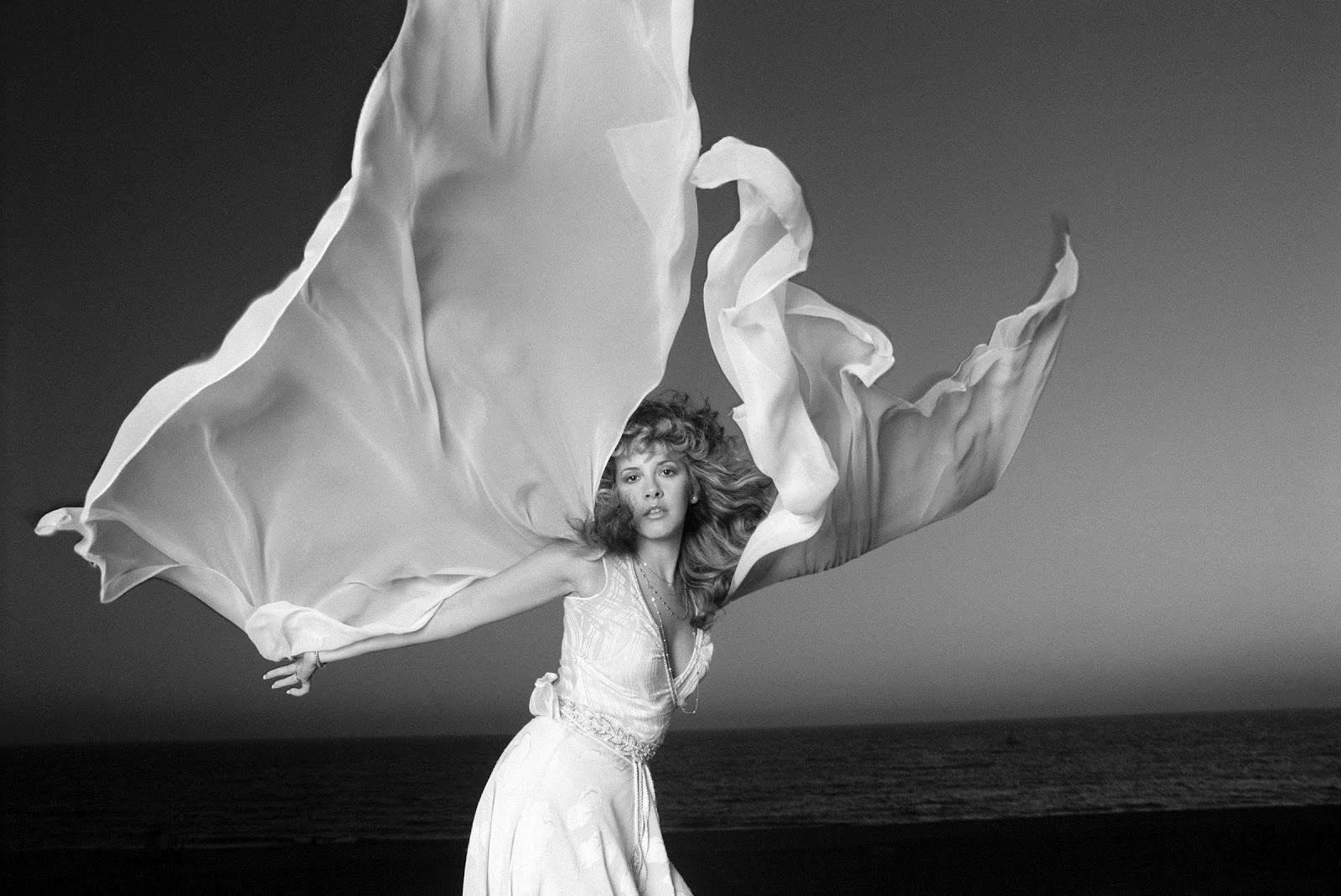
A fearsome Kabuki doll grimaces malevolently from atop an antique upright piano into a pastel pink room, where porcelain flamingos stand in fixed motion next to a beige satin-covered bed littered with pillows. Jungle plants complement a lush green velvet sofa. Black- and white-striped chairs stand next to a large wooden organ alive with colorful buttons. A light scent of gardenia filters through the rooms, and windows frame a perfect view of the white California beach and blue sea.
It seems the ideal setting for a fairy tale, and indeed it is — in a way. For here lives Stevie Nicks, who, after seven years with Fleetwood Mac, is being hailed as “Queen of Rock and Roll.” Nicks appears from the far reaches of the bedroom. Black sweater, black ruffled taffeta skirt, boots. The Queen doesn’t take long to show her humanity.
“What are you doing there, shorthand? I always got grounded for shorthand,” she says. “I’d get Ds, then work them up to Cs by the end of the semester, but still…”
The singer-songwriter’s mission today is promoting her first solo LP, Bella Donna — but after bulleting up the charts from the day of its release, the album doesn’t need much help. Nicks, 33, considers it the beginning of an important part of her career, an outlet for some of the things she’s wanted to do, but as a Fleetwood Mac member couldn’t. “In a group of five people, you can’t just be you — you have to be a part of them. This was a chance for me to really get into my feelings and my fairy tales — the things I really love — that I couldn’t impose on them.”

Stevie Nicks and Tom Petty perform onstage, 1981 (Lynn Goldsmith) Working with Tom Petty
Bella Donna also gave her the chance to work with singer Tom Petty, who’s featured on the track that has become the hit single, “Stop Draggin’ My Heart Around.” Nicks has been making surprise appearances at various Tom Petty and the Heartbreakers concerts around the country to sing the duet live.
She talks of Petty’s group in reverent tones, bringing to mind a little sister thrilled to be admitted into the realm of the boys. “They make me feel like a true Heartbreaker,” she says, “which is really something, because I know the Heartbreakers never planned to have a girl hanging around.”
When she had to miss a concert in Providence, R.I., she says, “Tom called and told me, ‘It was an incredible concert, but it just wasn’t the same without you. “That’s the nicest thing Torn Petty has ever said to me. It was just a simple thing, but it knocked me out.
“I’ve really become attached to them, because they’re all like my brothers and they’re all proud of me in their own little kind of male-type way. I go through a sort of ‘post Heartbreaker depression blues’ after I do a couple of dates with them and wake up the next morning and they’re gone and I have to go on all by myself,” She admits that at such times she calls the group to ask if the guys miss her,
The Heartbreaker experience
She’s written a song out of her Heartbreaker experience which will be featured on the next Fleetwood Mac LP. It’s called, “If You Were My Love.” Nicks says, “It’s like a love song, but it’s not. It’s about going outside your own life and getting attached to something that isn’t yours.
“It’s been kind of like falling in love with another band — for a minute. It has nothing to do with — and truly, clarify this — there is absolutely nothing going on between me and anybody in that band. They’re all married. They’re all expecting babies. That’s what makes it very easy for me to be with them and be their friend, and almost be one of the guys.”
Why does she make a point of clarifying her relationship with Petty and the Heartbreakers? Has someone implied it’s more than platonic?
“Well, not really,” she says, “but you know, you kind of wait for someone to start talking and I just don’t want anyone to start talking.”
Actually, the recent Rolling Stone cover story on Nicks made clear her relationship with record producer Jimmy lovine, who went from work on Petty’s Hard Promises LP to Bella Donna. She frowns at the reminder. “I don’t like people to know about that either. I just don’t want people talking about that part of my life,” she says.
The same celebrity status that’s made her a subject of the rumor mill has brought numerous acting offers. “I never wanted to be an actress and I don’t want to be an actress now,” she says. “I don’t like getting up early. I dislike being unspontaneous.
I’m not your person who’s going to sit around all day — I get real nervous and restless. So unless somebody brought me a story that just KILLED me, I wouldn’t do it. I don’t think it’s in the stars.”
 No conflict with ‘Mac’
Nicks is adamant about her solo career not interfering with her Fleetwood Mac work, “I don’t see why I can’t do both — unless everyone gets crazy. But if Fleetwood Mac doesn’t believe in my loyalty by now, I’ve made a big mistake,” she says. “I will be there for them ‘til the end. It’s just that I have to have time to do my music. I waited six years to put out the 10 songs on Bella Donna. Five of those songs were written before 1976. That’s a long time to wait. And those songs were all available to Fleetwood Mac.”
That there has been friction within the ranks of the group is hardly a secret. Nicks acknowledges the fact with a nod. “It’s like a family though. We can get mad at each other and yell, then not see each other for a few days or weeks, and when we get together again we look at each other and it’s like, ‘Were we mad?’ There’s such a feeling. You can’t replace seven years of solid togetherness.
“Outside people talking — that’s what corrodes a band. Someone could say something and by the time it goes through 15 people, it’s entirely different. You’ll tell the rest you didn’t, and they’ll say, ‘I believe you’ — but it’ll leave a mark. Sometimes those things take time to get over.”
Another irritant is the image people have of her. “Through the last seven years, I have wished people would consider me a songwriter instead of a girl singer in the pile with the rest, or a rock star who dances around a stage,” she says. “What I really want to hear is, ‘Did she really write all those songs?’ What I’ve done with Fleetwood Mac hasn’t been enough to convince anyone of my ability as a writer.”
But Bella Donna, she hopes, has opened a new door.
Marilyn Beck / Chicago Tribune-New York News / September 1981
The Charts
Pop
- ENDLESS LOVE — Diana Ross and Lionel Richie
- QUEEN OF HEARTS — Juice Newton
- SLOW HAND — Pointer Sisters
- STOP DRAGGIN’ MY HEART AROUND — Stevie Nicks with Tom Petty and the Heartbreakers
- URGENT — Foreigner
- WHO’S CRYING NOW — Journey
- ARTHUR’S THEME (BESTTHAT YOU CAN DO) — Christopher Cross
- THE BEACH BOYS MEDLEY — Beach Boys
- NO GETTIN’OVER ME — Ronnie Mllsap
- HOLD ON TIGHT — Elo
Fleetwood Mac’s siren soars with her first solo album Bella Donna
The view from the living room of Stevie Nicks’ Marina del Rey condominium is spectacular. As far as the eye can see there is nothing but an endless expanse of sand, ocean and sky. It is probably as close to a truly peaceful place as can be found in the Los Angeles area. Inside, the golden rays of a late afternoon sun cast a glow on the warm pinks and beiges that dominate the room. Two rooms away is the bustling nerve center of the household, where workers have been handling phone calls and a stream of interviewers awaiting an audience with the hottest-selling artist in rock and roll.
Actually, the word “audience” is terribly unfair, because it implies pretension, and Stevie Nicks doesn’t have a pretentious bone in her body. Though she has been a platinum-selling artist for six years as a member of Fleetwood Mac, and her face has been steadily gracing the covers of magazines as long, the Stevie Nicks I interviewed for two and one-half hours recently seemed remarkably unaffected by success and candid almost to a fault.
Her first solo album, Bella Donna, is already a smash hit–it is sitting at Number One on Billboard’s chart as this is being written, and it looks like it will only be a week or two before “Stop Draggin’ My Heart Around,” the gutsy, rock single that she sings as a duet with the song’s author, Tom Petty, also hits Number One. A new Fleetwood Mac album is due this fall, too, so it looks as though the airwaves will belong to Stevie Nicks for the next several months.
Nicks’ rise to fame was a relatively quick one. She and Lindsey Buckingham moved to Los Angeles in the early ’70s after several years as members of the once-popular Bay Area band Fritz. They cut an album as a duo (still available on Polygram) and then were asked to join Fleetwood Mac, which was struggling following the departure of Bob Welch. The first album the new five-piece Mac made, Fleetwood Mac, was an enormous hit, thanks largely to the presence of Nicks and Buckingham, whose songwriting and singing totally dominated the LP. “Rhiannon,” a swirling Nicks tune about a Welsh witch, immediately established Nicks as one of the top women singer-songwriters in rock.
The follow-up to that album, Rumours, remains the best-selling rock album of time, as well as one of the best. With the front-line songwriting the talents of Buckingham, Nicks and Christine McVie, and the always powerful and inventive rhythm section of bassist John McVie and Mick Fleetwood (who were founding members of the one-time British blues band) Fleetwood Mac was invincible on the record charts. They had one hit after another–Nicks’ “Dreams,” Buckingham’s “Go Your Own Way,” and “Second Hand News,” McVie’s “Don’t Stop.” They seemed to capture a spirit that had been virtually absent to pop bands since The Beatles. And then, of course, there was the personal side of the band, which made Fleetwood Mac so fascinating to the media. During the sessions for Rumours, John and Christine McVie were breaking up, as were longtime lovers Nicks and Buckingham. The songs on the LP “tell all,” as the National Enquirer would probably put it. America has always loved soap operas.
Two years later, the group emerged from thirteen months of recording with Tusk, a double LP that enjoyed relatively moderate success (about four million copies sold worldwide, a fourth of Rumours‘ sales) but which showed that the band was not going to be complacent and simply churn out same-sounding hits forever. It is a dark, moody album, filled with songs that are at once dense and accessible. The band followed the album with a year-long world tour that found them playing with more fire than ever before. A live record culled from the tour, Fleetwood Mac Live, was released at the beginning of the year.
When the tour ended last fall, the members of the band went their separate ways for the first time in several years. Mick Fleetwood went to Ghana and made his first solo LP, The Visitor. Christine McVie produced an album by Robbie Patton. John McVie sailed around the world. Lindsey Buckingham recorded a solo album which should be out in October. And Stevie Nicks made Bella Donna, using top studio players like Waddy Wachtel and Russ Kunkel, “Professor” Roy Bittan of Bruce Springsteen’s band, and Tom Petty & the Heartbreakers.
Bella Donna covers broad territory stylistically. “Edge of Seventeen” is a driving rocker; “After the Glitter Fades” has a country feel; “Stop Draggin’ My Heart Around” and “Outside the Rain,” two tracks featuring the Heartbreakers, sound like songs from a Petty album with a different singer; “Leather and Lace” is a beautiful ballad duet featuring Don Henley of the Eagles, and old friend of Nicks’. The album shows more facets of Nicks’ personality than anything she’s been involved with before. Certainly it proves her to be more than just the spacey siren in gossamer that she sometimes appeared to be during Fleetwood Mac.
As we sat together on a soft section couch in one corner of her massive living room (which is filled with stereo equipment, a piano, an organ and a large screen TV on which she watches cassettes of Greta Garbo movies, Roadrunner cartoons and The Muppet Show) the light of the afternoon sun cut through a glass of white wine she sipped from and cast a glow on her radiant face. Our discussions began with Bella Donna and covered various aspects of her career and songwriting craft. For the spacey side of Stevie Nicks — a side she makes no effort to hide, incidentally–I suggest you read Rolling Stone‘s recent cover story, “Out There With Stevie Nicks,” by Timothy White. What follows is Stevie Nicks, singer and songwriter.
BAM: Did it scare you at all to finally take the plunge to record Bella Donna?
Stevie Nicks: I’m always nervous about doing something new. I was particularly nervous about making this album because I knew I wouldn’t have four other people to blame if it didn’t do well. In Fleetwood Mac, if I fail I fail with four other people. Here, if I fail, I fail alone. It’s always scarier to be alone. Fortunately, I had great people to work with who encouraged me constantly. The vibe I got from everybody was so positive that it made me feel strong.
BAM: From what I can gather by the number of different players you used, it seems not too much was pre planned, that you recorded whenever you could get the players.
Stevie Nicks: That’s exactly right. It was very, very spontaneous. We did it in sort of a piecemeal way because we’d only get people in for a few days at a time. Tom Petty & the Heartbreakers don’t exactly sit around waiting for the phone to ring for session work. Russ [Kunkel] and Waddy [Wachtel] have impossible schedules. So we did the album around them. We’d get them for a couple of days and work fast.
BAM: Who worked out the arrangements for the songs? I know that in Fleetwood Mac, Lindsey would do almost all the arranging for you, putting on layers of different guitars and, in a sense, orchestrating your tunes.
Stevie Nicks: That’s one of the reasons I wanted to see if I could do it myself. When you work with somebody who is that much in control, and who has always been that much in control–from, like, 1970 on–you forget that you’re even capable of doing something yourself. I’d write my song and then Lindsey would take it, fix it, change it around, chop it up and then put it back together. Doing that is second nature to Lindsey, especially on my songs. He does better work on my songs than on anybody’s because he knows that I always give them to him freely. It’s a matter of trust.
So it was interesting to work without him, because my songs pretty much stayed the same; the only difference was what happened after I’d written them. When I write a song I sit down at the piano and play it front to back. For Bella Donna I would do that, or have a demo like that, and the other musicians would just listen to it, getting their own ideas of how to fill in the rest. Usually, by a couple of times through the song they had a good idea of what they could do with it. My songs aren’t complicated, to say the least. The sessions went very quickly, really.
BAM: You said you’d felt dependent on Lindsey in Fleetwood Mac. Was it difficult for you to think for yourself during the sessions for Bella Donna?
Stevie Nicks: No, it was exhilarating! Instead of just sitting around hour after hour, I got to be a part of it. Working with Lindsey, it’s so easy to just let him take it. On this album I didn’t have to fight to do my songs the way I wanted to. The other players just did them they way I wrote them and they came out great. We didn’t do a ton of overdubs. We didn’t put on 50,000 guitars because we didn’t have Waddy around long enough to do 50,000 guitar overdubs. We were lucky to get him to do one guitar part.
BAM: Stylistically the album seems very eclectic to me. There’s a little country, some gospel feel, rock and roll….
Stevie Nicks: Well, it represents ten years worth of songs. In Fleetwood Mac I usually get two or three songs on an album, but here I got to do ten. The album is sort of a chronology of my life. “After the Glitter Fades” was written in ’72, making it the oldest song on the record. “Highway Man,” “Leather and Lace” and “Think About It” were written in ’75. The most recent is “Edge of Seventeen,” which is also my favorite song on the record.
BAM: Did you change the lyrics to “After the Glitter Fades”? It seems moderately prophetic.
Stevie Nicks: Moderately? It’s very prophetic! [Laughs] No, the lyrics are the same. Believe me, I’d seen a lot of glitter fade by the time I wrote that song, which was two years before Lindsey and I joined Fleetwood Mac. That was a tough period for us professionally, because we were very serious about wanting to be professional musicians. And we’d done well in the Bay Area with Fritz, but moving to Los Angeles was a big step and it seemed that we were suddenly back at point “A” again. Also, our lives were so different from each other then. I didn’t have friends in LA and he made lots of musician friends — Warren Zevon, Waddy, Jorge Calderon. And while he was making friends and playing music, I had to work.
BAM: You sound a little bitter.
Stevie Nicks: No, I’m not really. It was the only way we could do it. Lindsey couldn’t be a waitress. He didn’t know how to do anything but play the guitar and I did, so it was obvious I was going to be the one to do the work if we were going to live. And he didn’t want us to play at places like Chuck’s Steak House or Charlie Brown’s. I would have gone for that in a big way, personally, because singing in horrible places like those four hours a night is a helluva lot better than being a cleaning lady. That was the only real rift we had then. He won. But I loved him. I loved our music, and I was willing to do anything I could to get us to point B from point A. It’s hard to keep the sparkly going when you face so many closed doors. But somewhere in my heart I knew that it would work out and that if I kept making enough money to pay the rent, that Lindsey would hang in there and get better and better on guitar and keep learning about the business.
BAM: You mentioned that Bella Donna is sort of a chronological portrait of your life. Do you have any sense of what sort of picture of you listeners will get from it?
Stevie Nicks: Not really. I’m too close to it to know. Things that I know are in a song some people might not see. And then I never know how others are going to interpret my songs based on things in their own lives. I just hope people like it and it makes them feel good. My songs talk about problems everyone in the world has. They’re not unique to me.
My songs don’t change much over the years. I write much the same way I did when I was 16. I’m no better on guitar or piano. I do exactly what I always did: I just write about what’s happening to me at the moment. I didn’t pick out the songs on Bella Donna because I wanted to document my life. I picked them because I liked them. It just sort of worked out that way. At the same time, though, I like the way “After the Glitter Fades” was premonitory. And “Edge of Seventeen” closes it — chronologically, anyway — with the loss of John Lennon and an uncle at the same time. That song is sort of about how no amount of money or power could save them. I was angry, helpless, hurt, sad.
I recorded sixteen songs for the album and I wanted all of them to get on. I agonized about it. If I had put them all on, though, there wouldn’t have been room for a label. [Laughs]
BAM: Well you managed to get “Blue Lamp” on the Heavy Metal soundtrack.
Stevie Nicks: It was very important that it found a place for itself. I love that song. It was really the beginning of Bella Donna because it was the first thing I’d ever recorded with other musicians, and it was the first time I’d ever recorded by standing in a room singing at the same time that five guys were playing. Fleetwood Mac doesn’t record that way. They record from a more technical standpoint. When I’m recording, I like to imagine that I’m at a concert singing in front of thousands of people. i record for feeling. I’m not good at the technical stuff. I don’t like standing there in a room, after the tracks have been done, and singing the same song fifty times in a row. I hate it. I want to sing a song once, maybe twice, and if it isn’t working, maybe go on to another song. Fleetwood Mac is the opposite. They labor over every detail. I care about the final feeling when you hear it on a car radio or at home on your stereo.
BAM: In fairness to Fleetwood Mac, Stevie, even though you know what a long process recording is, the group’s records don’t sound cold or detached. There’s plenty of feeling on every record Fleetwood Mac has done.
Stevie Nicks: That’s true. Don’t misunderstand me. I love the way Fleetwood Mac sounds. I wouldn’t be in it if I didn’t. I’m just saying that on Bella Donna we managed to make a really good record a different way. We went in and we just did it. Tusk took us thirteen months to make, which is ridiculous. I was there in the studio every day — or almost every day — but I probably only worked for two months. The other eleven months, I did nothing, and you start to lose it after a while if you’re inactive. You see, Lindsey, Chris, John and Mick all play, and I don’t. So most of the time I’d be looking at them through the window in the control room. After four or five hours, they’d forget I was even there, they’d be so wrapped up in little details. It was very frustrating.
BAM: There seems to be a bit of revisionism about Tusk going around. When the record came out, all of you said you were delighted with it. When it didn’t do so well commercially as it was expected to, the opinions within the band about the project seemed to turn more negative.
Stevie Nicks: I never felt any differently about it. I was always up-front about it. I loved the songs for the most part. I even liked almost all of Lindsey’s tunes, which were the most heavily criticized. I did not love sitting around for thirteen months and I never said I did. If Tusk had been terribly successful I wouldn’t have taken the credit for it because I was not that much a part of it. It was out of my hands. I didn’t want it to be called Tusk. I didn’t like the artwork. I’m being totally truthful — I had very little to do with that record.
BAM: How does it sound to you now?
Stevie Nicks: I love individual songs. Of my songs, I like “Sara” and “Angel” the best. I liked most of Chris’ stuff. Of Lindsey’s songs, I guess I like “Save Me A Place” and “Walk a Thin Line” the most. Those are beautiful songs.
I love Lindsey’s work. I didn’t hang around with him for seven years for nothing, listening to him play guitar every single night, watching him fall asleep with his electric guitar across his chest. There were nights I had to pry the guitar off of him so he could sleep in a normal position.
My main complaint with Tusk isn’t musical. It just went on too long. I think it could have been done in half the time. But again, I’m not a player. I’m the dancer and singer. I just want to get up there and dance and twirl my baton.
BAM: According to nearly everyone I’ve talked to, you are an amazingly prolific writer. Do you have a regular writing regimen?
Stevie Nicks: No. I just write when I feel like it, which is a lot of the time. Sometimes I write every day, sometimes a few days will go by when I don’t write anything. I get nervous that I’m drying up if I don’t write often.
I have entire filing cabinets filled with stuff I’ve written. It’s songs plus I’ve been keeping a journal for the past six or seven years, so I’ve got the history of Fleetwood Mac completely written. It could be an incredible book, but it would be a massive project to pull it all together. There are books within books within books, the making of all of the albums, the tours, the relationships; John and Chris trying to work together, Lindsey and Stevie trying to work together. It’s all there…
BAM: “Soon to be a five-part mini-series on ABC starring Morgan Fairchild as Stevie Nicks….”
Stevie Nicks: [Laughs] It really could be, and they wouldn’t have to sensationalize a thing! You have no idea of all the stuff that’s gone on. It’s been fascinating.
Getting back to songwriting, though, anytime I think a part of a song might be coming out, I’ll try to write it. Like I wrote a song in the middle of the night last night, which makes me very happy because whenever I write a new song I feel great for a few days. This new tune’s about how the house shakes when the waves hit the beach. I’ve got a whole cassette of me sitting at the organ singing lines over and over again. Writing is fun for me. I’ve got a wealth of things to write about.
BAM: I’ve always thought your songs presented an interesting view of womanhood. It’s not quite a “sisterhood is powerful” feeling, but some of your compositions seem to emphasize the bond you feel with other women in an almost spiritual way.
Stevie Nicks: I think that’s probably true. I’m surrounded by men in this business so I need a little feminine comfort, and one way to find that is to write about how I exist in this world of men, how I deal with them and how they deal with me. And I tend to talk about it as “we” instead of “I.” I’m no great women’s liberationist, though. I found out a long time ago that that doesn’t work, so–
BAM: That’s rather cynical.
Stevie Nicks: It’s true. I get a lot further with the men in this business by being feminine and sweet and not aggressive and quiet. They let me in. They don’t let in aggressive, pushy women. Say one word too much and you’re out. Well, I didn’t want to be out. I wanted to be friends with them. They’re my peers and contemporaries. They’re people I have to work with and I damn well am going to be part of them. It took me a long time to be anything to them besides just a “girl.”
BAM: How do you make the jump in men’s minds from being just another “chick singer,” as it is degradingly put so often, to being respected for your songwriting, which is obviously what you would like?
Stevie Nicks: I just keep writing, playing and telling people how important writing is. I tell writers that it’s not important to me to be a sex symbol. I tell them it’s not important to me what people think of me dancing around in gossamer clothing onstage. I happen to like wearing clothing like that. It’s fine for Gelsey Kirkland [a top ballerina] but it’s not fine for me. If I was a ballerina, nobody would say one word about what I wore, and they wouldn’t talk about my sex life — which writers don’t know anything about anyway. But put on a pair of platform boots and walk out on a rock and roll stage and — WOW! All people see is an image.
I’m not going to change because I get criticized for what I wear or because, as you said some people see only a “chick singer.” I keep persevering and doing what I do with the hope that someday people won’t care about any of that and instead they’ll look up and say, “You know, she really is a pretty good writer.” It’s starting to happen, actually. It’s taken six or seven years, but it is happening. You can’t give up for a second.
BAM: I can’t spot many specific influences in your songwriting. Who were you listening to when you started writing a lot?
Stevie Nicks: Well, I’ve written for years and been influenced by lots of people, but I guess the stuff that really got me was Joni Mitchell’s early songs. I learned so much from listening to her. In fact, I probably wouldn’t be doing this if it hadn’t been for her. It was her music that showed me I could say everything I wanted to and push it into one sentence and sing it well. Ladies of the Canyon taught me a lot. I remember lying on the floor, listening to Joni’s records, studying every single word. When she came out with a new album I’d go crazy — “Don’t bother me this week. I’m listening to Joni Mitchell.”
BAM: The inspiration was more attitudinal than actual?
Stevie Nicks: Right. I didn’t want to play music like her. I couldn’t if I’d wanted to — I can’t play the guitar worth shit, and Joni’s a great player. I just loved the way she was a very personal writer yet easy to relate to. She was doing what I wanted to do. I also loved all of Jackson Browne’s records. Again, the could make the most intimate, personal things universal. This might surprise you, but I loved Jimi Hendrix as a writer — he put words together in really amazing ways. I loved Janis Joplin — the way she sang, the way she performed. I saw her one time and was completely riveted. I never forgot it. I have so many influences, but I can’t really tell where they come in.
My writing style is very, very simple. I play so simply that I have to kill with my voice, especially in the beginning of a song or nobody gets it. The instrumental parts of my songs are not going to see them. And because the structure and chords and all are so simply, it forces me — and the players –to really experiment with phrasings and ways of bringing out the melody.
BAM: Some people believe that writers — artists in general– work best when they have inner turmoil: that happiness isn’t inspiring, but pain is. Do you agree with that?
Stevie Nicks: I think a little turmoil probably helps. I don’t go looking for it so I can write [laughs], but then I never sit down and write a happy song. I think there is something to that theory, because the person who is searching and never quite finding what he wants, who is constantly challenged, is going to write better songs than somebody who is blissfully happy. If you’re blissfully happy, what else is there to say? And how many people are blissfully happy enough that they can relate to what you’re writing?
As close as I get to writing happy songs are ones that aren’t un-happy. I’ve written my share of miserable songs, but I haven’t recorded many of them.
BAM: There definitely is an overriding optimism in most of your songs.
Stevie Nicks: People don’t mind a little misery, but they also like happy endings. It’s nice to leave some hope at the end that things will work out. See, Lindsey won’t do that. He’ll say, “Go your own way,” I wouldn’t, most likely.
Lindsey hates to write lyrics, though. Maybe that’s why some of his songs are so negative. [Laughs] He’ll have all these beautiful songs that are instrumentals for months. They have gorgeous melodies, layer upon layer of guitars. I exercise to his tapes, practice ballet to them. Then he’ll write lyrics for this beautiful song and it’ll have a different feeling than the music.
BAM: I’m surprised the two of you haven’t collaborated on songs since you’ve been in Fleetwood Mac. You love to write words and he’s a nut for melodies.
Stevie Nicks: I’m surprised, too. I always wanted to. It’s strange. You would think he would ask me, but I think he really doesn’t like my lyrics very much. They’re too spacey for him. We think differently, I guess.
BAM: You and Petty obviously have a good rapport. Can you see yourself writing with him?
Stevie Nicks: I think we will write together eventually. You see, Tom and I aren’t going out. Tom and I aren’t in love with each other, or haven’t been in love and out of love. We’re really just good friends so we probably could write together. Lindsey and I have so much behind us that it would be difficult to sit down and intensely get into lyrics. As it is he asks me, “Who’s that one about? What are you talking about in that line? What does that mean?” [Laughs]
BAM: What did you contribute to the next Fleetwood Mac album?
Stevie Nicks: I have three songs as it stands now, but I think we may replace one of them with another song. I wrote one of the songs a long, long time ago, even before Lindsey and I moved to LA. It’s called “It’s Alright.” It’s very simple: Lindsey just plays some really nice guitar behind me. There’s another song called “If You Were My Love” that I wrote about a year ago after I’d recorded “Outside the Rain” with Tom Petty & the Heartbreakers. I spent a week recording with them and I had so much fun that I was really bummed out when it was over. That’s when I wrote that song.
There was also a song called “Smile at You” that I don’t think we’ll put on. I think Lindsey wants me to record another one and so do I. It’s kind of a bitter song and that’s really not where any of us are at right now, even thought it’s a wonderful song. My songs don’t take long to record, so it shouldn’t be a problem.
BAM: Did the sessions for this album have a different tone than past Fleetwood Mac sessions?
Stevie Nicks: It went smoothly. It didn’t take us as long. I think right now everyone is into making a good album that doesn’t take a long time to make.
BAM: Is there any danger of Fleetwood Mac staying together beyond its natural lifespan? You wouldn’t stay together for business reasons, would you?
Stevie Nicks: Fleetwood Mac couldn’t stay together if we didn’t want to, because we’re all far too volatile and passionate that it would be unbearable if we didn’t want to be together. Fleetwood Mac is never boring. If it ever becomes boring, we would stop it.
BAM: It’s not like any of you would starve if Fleetwood Mac didn’t exist.
Stevie Nicks: That’s right. We keep it going because we want to, because we obviously feel there’s more good music to come out of us as a group. If that changes we’ll be the first ones to recognize it.
BAM: It must be an awfully good feeling for you, though, to know you’ve done so well on your first project outside of Fleetwood Mac.
Stevie Nicks: It feels wonderful. Now the trick is to keep my life going in a way where I can continue to do things outside of the group. I’d like to make more albums on my own. I’d love to do a record of songs aimed at children. I’d like to record songs by my grandfather, A.J. Nicks, who was a country singer. There’s so much to do. Bella Donna is just the first step, but it was an important first step.
I just decided when I came off the year-long Tusk tour that I wasn’t going to give up my life and die a lonely, overdone, overused rock star. That has no glamour. I didn’t want to be written up in 50 years as a miserable old woman who never got to do anything but tour and be famous for ten years and then everything was over.
I’m far too intelligent to not know that there will be a time when I won’t be 33 anymore, when I won’t be that pretty anymore. I won’t be sparkly anymore, and I’ll be tired. I want to be able to know that I can still have fun and be part of the world, and that I didn’t give it all away for Fleetwood Mac. That’s what Bella Donna is all about. It’s the beginning of my life.
Blair Jackson / BAM / September 11, 1981
Diversity marks Stevie Nicks’ solo

Fleetwood Mac singer borrows some hard-edged help from Petty.
Pop Album Reviews:
STEVIE NICKS, Bella Donna, Modern Records. MR38-139.What’s particularly attractive about Stevie Nicks’ solo plunge is the musical and stylistic diversity she has layered Bella Donna with. In the past, Nicks has cloaked herself exclusively in the simplistic sort of “June/moon/spoon” romanticized mysticism one might expect from someone who publishes her songs under the trade name of “Welsh Witch” music.
The first time one heard “Rhiannon” in 1976, it was an interesting touch. But after creamy cuts like “Sisters of The Moon” and “Gold Dust Woman,” it was easy to grow tired of hearing Nicks cheapen D.H. Lawrence to a sulky pop beat.
Here she comes off as a more accomplished, wide-ranging writer and singer. Much of the improvement comes from her hooking up with the rock-oriented producer/engineer team of Jimmy lovine and Shelly Yakus. In addition, Tom Petty and his band have provided the instrumentation and the result is a harder, punchier sound than the gooey pudding whipped up on the past couple Fleetwood Mac LPs.
The centerpiece cut, “Edge of Seventeen,” might have been an effort to listen to on Rumours or Tusk, but here all the lines like “just like the white winged dove” and “but the sea changes colours” (note the affected spelling of that last word — Welsh witch indeed!) are buoyed up by the punchy arrangements.
The Petty connection is interesting and made slightly more intriguing by the fact that Nicks seems to have unintentionally one-upped Petty. She sang on the relatively weak “Insider” that showed up on his recent Hard Promises LP and in return got one of the better new Petty songs, “Stop Draggin’ My Heart Around.” The passion of the piece suits Nicks well, and it’s a bit of a relief to hear her sing it in her husky voice rather than have to listen to the whiny version Petty might have turned out.
Besides Petty and the Heartbreakers, Nicks gets good use out of other familiar names. Eagle Don Henley adds some nice vocals to a pretty version of Waylon Jennings’ and Jessie Colter’s “Leather and Lace” while another Eagle, Don Felder, joins Nicks and Henley on the final piece on the record, the 1975 Nicks composition “The Highwayman.” E Street pianist Roy Bittan plays on “Edge of Seventeen,” “After the Glitter Fades” and “Leather and Lace,” and he also gets a writing credit for some very distinctive opening chords added to “Think about It.”
Past all the outside input, however, Bella Donna is Stevie Nicks’ record and it’s surprising how attractive she and it are. In addition to the previously mentioned doubts, it’s an acknowledged fact that Nicks’ voice is a delicate instrument that is beginning to fail. Overlooking the benefits of pacing one’s self in the studio (as opposed to the nightly strain of concerts), Nicks is in very full voice here. She belts out the country-style “After the Glitter Fades” without hesitation and only on “Kind of Woman” does her voice start to crack or fade.
Unlike Rickie Lee Jones, another singer who steeps herself in romanticism on a new solo album, Nicks is not as demanding or penetrating a writer. On the other hand, Nicks hasn’t fallen into the trap of self-absorption that alienates the listener from Jones’ Pirates — Nicks the writer is easily understood and enjoyed. The title track is slightly obscured by the foggy passions that are Nicks’ preoccupation, but other numbers like “How Still My Love” and “Outside the Rain” are effective pieces of mood and affection.
The only letdown in Bella Donna stems from this accessibility. In truth, these generally appealing songs don’t have a lot of impact when added up as an album. Nicks is not a Chrissie Hynde or even a Pat Benatar when it comes to generating vocal excitement — obviously, she’s not a fullblown rocker like those two, yet as a stylist she doesn’t quite generate the energy that other stylists like Linda Ronstadt or Joan Armatrading can turn out. There are points during some of the cuts, like “The Highwayman” or “Kind of Woman,” that are emotionally flat and unaffecting.
Still, one has to give Nicks credit for shaping a much fuller and better LP than her work with Fleetwood Mac might have indicated she was capable of. Her name alone and the tie-in with Petty virtually assure Bella Donna sales. It’s nice that there are actually some songs here worthy of that status.
C.P. Smith / Santa Ana Orange County Register / August 9, 1981
(This article was transcribed by Stevie Nicks Info)REVIEW: Bella Donna
Rickie Lee Jones’ Pirates and Stevie Nicks’ Bella Donna are both such long-awaited albums that you could all but hear the amens when they arrived in the stores.
It has been nearly two years since the release of Jones’ enchanting debut LP, which rode the success of “Chuck E.’s in Love” into the Top 10 and earned the singer a Grammy as the year’s best new artist.
It has been even longer since Nicks’ ethereal “Rhiannon” in 1976 helped make Fleetwood Mac one of the most commercially successful bands in recording history–a contribution that suggested Nicks would eventually attempt a solo album.
Now that the wait for the albums is over, the questions are: Does Jones live up to expectations? Will Nicks do OK on her own? The answers depend on whether you’re more interested in chart performance or music. Bella Donna (Modern Records) is a careful, respectable work that will chalk up sales, but it mostly repeats what we already know about Nicks’ music from her recordings with Fleetwood Mac. The album’s high points are the few times she steps into new territory.
[Editor’s note: The rest of the Rickie Lee Jones’ Pirates album review has been omitted from this article.]
The strange thing about Stevie Nicks’ Bella Donna is that someone who presumably has been looking forward for years to recording away from the shadow of one band steps in the LP’s key track into the shadow of another: Tom Petty and the Heartbreakers.
Not only did Petty write and co-produce “Stop Draggin’ My Heart Around,” but he also sings on it with nicks, and the Heartbreakers bands plays on the track. The arrangement–from Benmont Tench’s sinuous keyboard touches to Michael Campbell’s cymbal-like guitar licks– summarizes the feel of Petty’s moody, midtempo rockers so fully that it’s almost a caricature.
Still, the Nicks-Petty teaming is a classic pairing of two of rock’s heart-throbs and the single will be smash, adding even more to the audience for this album. The problem aesthetically is the song adds nothing to Nicks’ musical identity. Unfortunately, the same things can be said about the rest of the LP.
That’s not going to necessarily be a disappointment for hard-core Nicks fans, but I’ve always felt quivering, trance-like vocals are most effective in small doses.
One of Fleetwood Mac’s strengths is the flexibility that results from three singer-songwriters in the band. Just when Nicks’ initially seductive approach wears thin, the group shifts to one of the velvety Christine McVie ballads or rollicking Lindsey Buckingham numbers.
Using guitarist Waddy Wachtel and other musicians who have worked with Linda Ronstadt, producer Jimmy Iovine gives Nicks’ music a harder edge than it usually receives on the Mac recordings. Still, most of the songs on Bella Donna are built around the same swirling rhythms and frequent mystical allusions of such familiar Nicks tunes as “Sisters of the Moon,” “Rhiannon,” and “Dreams.”
Some of the songs–notably the upbeat “Think About It”–work especially well. Others, however, are ponderous. Among them: the title track, which is yet another reflection on pop stardom (“No speed limit…this is the fast lane”), and “Edge of Seventeen,” an over-wrought romantic flashback.
The high points in the album are the times she steps farthest form the Mac mold. Besides the Petty track, there’s “After the Glitter Fades,” a marvelous country ballad, and “Leather and Lace,” a folkish song with much of the delicate emotion of Tim Hardin’s best tunes. On both numbers, Nicks, who is joined on “Leather and Lace” by Eagles’ Don Henley, seems far more approachable and genuine vocally.
“After the Glitter Fades” is such an evocative account of loneliness amid the glamour of Hollywood rock ‘n’ roll that it’s surprising to note on the album’s lyric sheet that it was written before Nicks joined Fleetwood Mac and became a star herself. Sample lyric: “The dreams keep coming when you forget to feel.”
If Nicks could have broken awa a few more times from the relatively conversative shackles of her Fleetwood Mac image, Bella Donna would have been a lot easier to toast as it goes up the sales chart.
Robert Hilburn / Los Angeles Times / August 2, 1981
Stevie Nicks gets serious, down to business on Bella Donna
“Look, enough with these heavy interviews,” the guys upstairs told us. “Szasz, Anton Wilson, Leary, Turner, Bukowski. Give ‘em a break, give ‘em some gossamer. Mind candy. Set ‘em up for the heavy DEA informant rap next month.”Okay, we say. We think music. We think lace and vaseline-soft images. Doll-houses and rainy-day dreams. Good witches. We think Stevie Nicks.
So we sent Liz Derringer, first lady of rock journalism and a specialist at corralling big names for us (Mick Jagger, June ’80; Pat Benatar, Jan. ’82). She tracked Stevie down to her penthouse suite at the Plaza Hotel and found the ethereal songstress just dying to talk about her solo career and her number-one album, Bella Donna. They sipped coffee and wine and spoke of many things: of shoes and discs and Fleetwood Macs and cabbages and kings.
HIGH TIMES: What I’ve gotten out of your album so far is your special way of combining vulnerability with strength—qualities that are hard to put together.
STEVIE NICKS: That’s what “Bella Donna” is about. I mean, the song “Bella Donna,” which says “come in out of the darkness,” was, as you said, what rock ‘n’ roll is. You live with somebody — well, it doesn’t make for a terrifically strong and independent women. It doesn’t allow you to be that very much. I think the music industry is very male oriented. Although there are a lot of wonderful girl singers around, still I think it’s their world. I fought through six years to make this LP. In Fleetwood Mac, they would have done it. I wouldn’t have. And I would’ve let them make me as dependent as I have always been on them, because when somebody is dependent, they’re under your thumb. And they knew that I had to go and do this by myself because I had to prove to myself that I could exist on my own.
HIGH TIMES: That’s the process of growing up.
STEVIE NICKS: And what are you gonna do without them if they’re not there anymore some day? (Record producer) Jimmy (Iovine) expected a lot from me from the very beginning. Well, he did bring me back to some reality. My life had to change in order to do an LP with him. I had to change. I couldn’t be Stevie Nicks with Fleetwood Mac. I had to be much stronger and much more in control of myself, because he would not waste his time working with an out-of-control, flaky girl singer with Fleetwood Mac. He had no reason to be in the studio with that person and it was made very clear to me from the very beginning that if I was gonna do this, I was no longer the coddled, dependent baby of Fleetwood Mac.
It was like he said, if you’re gonna come into my studio and there’s going to be ten of the best musicians in the world waiting for you, then you’d better damn well come in ready to work, and not two hours late and not fluffing in and expecting everyone to just forgive you, and too bad that you’re late, and it cost eight million dollars because you didn’t bother to show up, and they did two sessions and they made it over to the studio at seven o’clock. And I just realized right away that I wanted more than anything in the world to put these songs down and play them for all those wonderful people who seemed, for whatever their reasons, to love my songs. And I love my songs. That’s what I do — I write songs. I’m a tune writer. And I wanted this LP to be really wonderful. And without somebody like Jimmy, I could not have done it. Because I wouldn’t have been disciplined enough.
HIGH TIMES: Did he put together the duets?
STEVIE NICKS: He put it all together. But Don Henley (of the Eagles) and I did “The Highwayman” and “Leather and Lace” in 1975. Those duets were put together because they were done five years ago. And we have really wonderful demos of them.
HIGH TIMES: Didn’t you write “Leather and Lace” for Waylon Jennings and (his wife) Jesse Colter?
STEVIE NICKS: I wrote it for them and I wanted them to do it. Waylon Jennings asked me to write a song called “Leather and Lace.” That’s his title. So I did and I spent a lot of time on the psychology of the man and the woman in the music business both being stars in their own right and trying to live with each other and work and give Waylon a break and let him be a little weaker for a minute and let Jesse be a little stronger for a minute. This is a long time ago. This is what I was searching for even then. I mean, I was writing about Waylon Jennings and Jesse Colter, but I was writing about me and Lindsey (Buckingham, of Fleetwood Mac). And I was, at that point, going out with Don Henley and I was writing about Don and me. I was writing about the few couples that I knew and what they went through to try and work it out. And I guess Jesse and Waylon sort of broke up around then. And I felt in my heart that either I had to do this song with Don, or Waylon had to do it with Jesse, or Waylon and I had to do it. Those were the only three possibilities for that song to be done. It was the most disciplined song I had ever written and I had to finish it.
HIGH TIMES: With your success you must feel stronger now.
STEVIE NICKS: See, that’s so amazing to me because I — This is the first interview I’ve done as just Stevie. It’s nerve-wracking for me too, because for the first time, I’m not forced to sit here and tell all the old stories. Even though I still tell them, and people want to know, for the first time, I’m free to talk about the particular songs that were — one-half of them were fully available to Fleetwood Mac. And for some reason, they weren’t done. I was very lucky, because these are really the perfect songs for this LP. I think that’s why this album seems to be very dear to people already, at least to my friends. They’ve lived it. This is my life. Every single thing that is written in this LP happened to me.
I’m not kidding. It’s real serious. And I didn’t have to beg to do these songs. In Fleetwood Mac I have to talk them into it. I get it as soon as I write the song. I know what it’s going to be. If I don’t, nobody ever hears it. I don’t ever go with it to anyone. It was very important to me to let people know that this is something that I wanted to do for them, the public. I don’t need to make any more money. I’m fine, I’m comfortable. I’ve got all my wonderful little stage clothes that I can wear forever and my boots, and I’ve got enough jewelry and I’m fine. I don’t need to do this to make money. I need to do this to fulfill myself as a writer. I mean, it says, “come in out of the darkness.” That’s saying, save yourself and come back. And it’s a serious thing. I had to do that to do the LP. I had to stop being crazy, or it wasn’t going to be done.
HIGH TIMES: But they’d still do it if you came two hours late.
STEVIE NICKS: But it wouldn’t have been the same. See, my reception from these men that played on my LP — they were only wonderful to me because I went in there strong. Otherwise they would’ve said, “This is some flaky chick from Fleetwood Mac, which is what we don’t need to work with.” And you can’t pay those guys enough to hang around.
HIGH TIMES: I don’t relate to you being flaky.
STEVIE NICKS: These guys, they’d really rather sit in a room with a bunch of guys and play. But because I made an incredible effort to be there for them when they needed me, to be there for them when they needed to talk to me, to try to understand, to try to explain. To explain to Waddy (Wachtel) that “Bella Donna” was serious — I was not talking about a beautiful woman. I was talking about a beautiful woman becoming old and not beautiful. And skinny and too tired, the woman disappears.
HIGH TIMES: Is that what you consider some of the pitfalls that you said were written in “Bella Donna”?
STEVIE NICKS: Oh, yeah. Absolutely. There’s a decision you make at a certain point whether you can go right on staying up all night and being very spoiled and very into your own world. Because the world that you live in has really made you do that. It’s very easy to become dependent in rock ‘n’ roll. My world was a phone call to tell me to get up, to get in the car, to get into the airplane, and a phone call to tell me that I had fifteen minutes before the concert.
HIGH TIMES: Isn’t it easy to fall into that again?
STEVIE NICKS: Very easy. But I won’t ‘cause I won’t come out of it again.
HIGH TIMES: That’s where age and experience help.
STEVIE NICKS: Yeah, if I want to do this again, which I do, then I have to be strong enough to deal with my life in Fleetwood Mac and deal with my life alone. Because when I’m alone, I’m alone.
HIGH TIMES: You’ve said that in middle age, you’d like to be on top of a mountain with a piano and typewriter.
STEVIE NICKS: I would, I look forward to that. I love my performing and I’ll do that for another five or six years, but there will be a point in my life when what I’ll really want to do is go away and write. And I’ll write about all of this. I’ve already written thousands of pages. The story’s written already. I’ll want to add to it and I want to put it together and it’ll be an incredible book. It’ll be full of poetry and all of the songs that you’ve heard. All the real happy parts and all the sad parts. And the real difficult parts are there. And that’s what I want to do eventually. I’ll want to go and really put that together. But now I’ll work toward being able to tell as much of my personal life in my songs — that’s as much as I have to give right now.
HIGH TIMES: Do you find it hard to maintain relationships in this business?
STEVIE NICKS: I find it nearly impossible. Anyone that you meet is going to be in some way in the business. I don’t meet people who aren’t in the business. I don’t go anywhere to meet them. What am I going to do, sit in a bar? And at some point or another, my job gets to them. It’s easy to understand. “No, I can’t have dinner, I have interviews.” “But we were in New York all week and we didn’t get to have dinner once.” “I’m sorry, what do you want me to do, call everybody and cancel?”
It’s incredible. That’s why you wish for some time that you won’t be so busy. You end up really hurting people because you get angry. You have fifteen things scheduled and you would love to sit here and watch a movie with someone, but you can’t because you have to get ready. You have to do your hair and your makeup and take a shower and do all that, and that takes a long time. Then you have to get everything ready. And then when it’s over, you are so tired. You have been under so much pressure because you have been talking all day. Or you’ve been traveling all day, you’ve been to the sound check, you’re getting home and you thank God you have fifteen minutes to lay down on your bed before you have to start the whole thing over – the shower, the hair, do the makeup and get down there. So you’re down there an hour before the concert so you don’t feel like a jerk walking into the concert and you’re not vibed out at all, you just feel like you dropped by.
So you’ve got to make time, and what happens is you make the time for rock ‘n’ roll. You make the time for Fleetwood Mac, you make the time for the interviews, you make the time to go to the record company, you make the time to go stop by a radio station, but you don’t make the time for your boyfriend. And slowly that creeps into their head, that you are not making the time for them, but you make the time for everyone else. Because you can’t say no to everyone else.
HIGH TIMES: What about someone like Don Henley, who knows that? He’s in the same position.
STEVIE NICKS: When I was going out with Don, it was five years ago and I was much less busy; Fleetwood Mac was much less popular, we were just beginning. When I was with Lindsey, we lived together and were famous. It was the opposite extreme. I’ll never forget the day I was up at Don’s house having dinner with him and his manager, Irving Azoff, who is now my manager five years later, and Glenn Frey of the Eagles walked in and looked at me and said, “Spoiled yet.” Like no mention of Fleetwood Mac. I was not even in the league of a singer. I was nothing more than a girl. My claws went out and I wanted to get out of there.
HIGH TIMES: I don’t know him well, but that sounds typical of Glenn Frey.
STEVIE NICKS: He’s witchy! And I love Glenn, and that was a long time ago. That was my first taste of what it was like to be a happening girl rock ‘n’ roll singer. Going out with a very famous man rock ‘n’ roll singer and have people not relate to me like I even had a job. I went out with John David Souther for a while, who is very, very, very male chauvinistic and very sweet and cute and wonderful but very Texas, and I found when I was with him, I didn’t mention Fleetwood Mac ever. It didn’t help my status with the man to bring up anything I did, so I didn’t. And then you start saying, “But I work too. I’m happening. I write songs, but you aren’t giving me a break.”
HIGH TIMES: I think that what keeps couples together is an understanding, you live your life and I live my life.
STEVIE NICKS: That’s all it is, if somebody just knows and understands. My mother said, “Stevie, you were born guilty. You never lied, you never did anything bad, and you always looked guilty. But you were willing to take on the guilt of everyone else immediately.” And I am that way. If I ever think that someone thinks that I did anything wrong, it’s a neon sign across my face that blinks guilty guilty guilty.
HIGH TIMES: You feel the weight of the world sitting on your shoulders.
STEVIE NICKS: And you didn’t even do anything, but you wake up sick to your stomach the next day, thinking that you did. For whatever reasons —which aren’t important — my relationship with Paul (Fishkin, co-founder of Modern Records) stopped, he is the one man in my life that was truly good. Truly understood. I was in an emotional trauma all through that fifteen months. And he stood by and watched it, and was as much help as he could be. While the rest of the world questioned me constantly, including my very close friends. About everything.
HIGH TIMES: I guess being a superstar, people want to get involved in your life and tell you what to do.
STEVIE NICKS: They want you to be dependent. I always know what’s right, and when I get pushed into something — which I do a lot — that I knew wasn’t right from the beginning, I’m the hardest on myself and punish myself severely. I just lay in bed and think about it over and over until I can’t think about it anymore. I start to go crazy. Just now, I’m calming down with this album because this was the freest thing I’ve ever done — though I had a disciplinarian behind me with a little stick going nananananana. And not being treated as a child — being treated as a grown-up.
HIGH TIMES: You become more together with age.
STEVIE NICKS: I absolutely love being thirty-three years old. I think it’s wonderful. You can see things clearer. You don’t have to get so crazy. You start making your own decisions. You’re a woman, not a child. You’re grown up and have to fend for yourself. You’re the only one who’s here and no one is going to save you. And nobody can tell you that, because my mom has been telling me that for years. And I call her sometimes and she’ll say to me, “I wish you’d let somebody take some of this pressure off your little bitty shoulders for a moment, Stevie.” And that’s what I did. I gave it to Jimmy. I said, “Here it is, here’s the pressure, here’s my weird life, here’s how crazy it is. Now figure out how to make this album.”
HIGH TIMES: Where does your fascination with witches come from? Did you dream about things like that when you were a little girl?
STEVIE NICKS: I dreamed only about giving a little fairy tale to people. That’s what the outfit is on my album cover, that’s what that bird is. (Reaches for the album jacket.) That bird belongs to my brother, that’s the only reason I could work with a wild animal. That’s Max on the front. With my clothes and the things that I wear, I have so much fun with them. I was talking to a lady today and were talking about dress-up and about how much fun dress-up used to be. And if there was a trunk in the attic, I was in it looking. And I would rather wear that drape than anything you could sell me from Bloomingdale’s. I don’t like all that stuff. I love the Muppets. Miss Piggy on the front of the TV Guide kills me with her portable TV, and Kermie in the back sitting, and with her little shoes. I just adore Miss Piggy to death. I collect marionettes and dolls so I have an incredible collection and I carry these things all over the world. They’re so real. See, that’s a fantasy. The Muppets are no different from my fantasy. My fantasy is giving a little bit of the fairy princess to all the people out there that maybe don’t have the Hans Christian Andersen books, and the Grimm’s fairy tales. If that’s the only thing I can do for them, well, that’s fine.
HIGH TIMES: I couldn’t imagine you as a type that sits around and puts black spells on people.
STEVIE NICKS: I don’t do that. That’s silly and stupid, and anyone that does that is making up their own character and has nothing to do with me. I love good witches. I like the good witch of the north, Glinda. Glinda is my friend, not the other one. And I don’t want them around. My love of that fantasy fairy-tale thing is the good part, and I’m a coward and I get very scared. I don’t go see any of those scary movies. I just watch old movies and good sad movies, but I don’t want to be scared and frightened.
HIGH TIMES: Any particular movies you like?
STEVIE NICKS: My favorite old movie is Beauty and the Beast, the 1946 one, and I love Mary, Queen of Scots. I love those kinds of movies. I can watch these movies over and over again. I love anything that is wonderful, and it can have some sadness. I don’t mind that, but like evil, bad things, I don’t like them in my life.
HIGH TIMES: Books, too? The same?
STEVIE NICKS: I read a lot of Taylor Caldwell books. I get a lot of ideas for things that I’m writing. I just read anything that comes in my way that’s interesting. I pick up bunches of little old poetry books. I love serenity since I don’t have much of it in my life. The outfit I wear on the cover of Bella Donna is the same as the one I wore on Rumours, except it’s opposite, it’s white. It’s a strange turn-around that I’ve come from black to white.
HIGH TIMES: Who designed it? You?
STEVIE NICKS: It was my idea, six years ago. Margi Kent designed it. She just keeps making it longer. She makes everything, and these are my boots that my little Jewish cobbler who’s seventy years old makes. A five-foot one-inch-tall person needs six inches. Onstage especially. Standing next to Mick Fleetwood is ridiculous. Anybody standing next to Mick is ridiculous, so imagine a five-footer. You blend into his drums, which he loves because then he’s the star. So I say, “Wait a minute, Mick, I’m going to get tall.” I get far on these boots. They are very out of style and I don’t care. I love them. They are beautiful suede and they are soft. I tried to get this boot a long time ago, and it was going out then. We searched London, and I found one pair that was like a size five, and I wear a five and a half or six, but I bought them anyway. I stuffed my little feet into them.
HIGH TIMES: You mention in “After the Glitter Fades” that the one-night stand is hard to take. What are you talking about?
STEVIE NICKS: That was written in 1972 and Lindsey and I had never been on the road at all. We had certainly never had a one-night stand because we had been together and there were no one-night stands between Lindsey and me. That was a real premonition. I just had some idea about Fleetwood Mac. I wasn’t talking about one-night stands with a man. I was talking about your one-night stands in a concert where you run in, played, and left.
HIGH TIMES: After a concert is over, do you feel sad?
STEVIE NICKS: Yes. When you come back to your hotel, and you’ve been in front of fifteen thousand people…I would like to sit down in the audience and talk to them about what’s happened. Bring like a podium up and ask questions and have everybody tell me what they think. It’s very hard to just walk away from them. You certainly don’t go to sleep; you can’t. It’s like falling in love with somebody and having yourself turn into a pumpkin and you’re back mopping the floor. That’s the hardest thing — all that energy around you and walking away from it. You have much less than they do because you come back to a motel, they go home. If I could go home after every concert and have my puppies and my cats and my friends, whoever, it wouldn’t be so difficult. To go back by myself to a hotel room is a real downer.
HIGH TIMES: On Bella Donna you seem to be saying how strong and confident you can be. Do you think you are a dominating person?
STEVIE NICKS: It’s very easy for me to be dominated because I’m used to being part of a rock ‘n’ roll band that dominates your life.
HIGH TIMES: Is the Fleetwood Mac album finished?
STEVIE NICKS: The tracks are done and we worked for five days last week on one of Chris’s songs and it is fantastic, positive, wonderful.
HIGH TIMES: You must have a great relationship with Christine McVie. You dedicated “Think About It” to her.
STEVIE NICKS: Yeah, when I really love something that she does, I really get in there and help her with it. She can do it alone, she really doesn’t need anyone, but when she writes something that I really take to heart, then I go for it. I stay up all night with her and we work on it. I really work on it and I drag Lindsey and her in there and make them sing, because that’s what they forget—they forget that there’s three of us and how good we sing. I irritate them to death, it’s like a little bug. I keep saying, “Lindsey, you and I should sing this part. It’s important that we sing this part, it would sound terrific.” And they eventually do it. Especially because I am not going to stand by and watch no singing go on this album.
HIGH TIMES: It sounds like there has been some dissatisfaction on your part in the past.
STEVIE NICKS: That’s because they’re players, they get really wrapped up in the playing of it, and I don’t get to play. I don’t have anything to do. I sit around and watch them play — it’s boring. The thing I do real well is vocal production. I can really get them happening on singing, but if it wasn’t for me, there wouldn’t be nearly half the vocals.
HIGH TIMES: You did a duet with Kenny Loggins, “Whenever I Call You Friend.”
STEVIE NICKS: That was a discipline thing. I call him Slave-Driver Loggins. He cracked the whip on me for two days to get that particular performance. And I was downright angry at points where I was going, “I’m not going to do this.” He said, “Yes, you are.” He’s a real good producer, Kenny, he got exactly what he wanted. When it was done and I left, I was knocked out. I really had to keep my mouth shut and do what I was told. And it worked. He wasn’t interested in a dull vocal.
HIGH TIMES: How does he get the performance out of you? Does he have to create a mood?
STEVIE NICKS: Yeah, that’s exactly what I do, I light a little incense. Jimmy did it for me too. If I get mad enough, he’ll say, “This is really uncool” over the talkback. We have the most hysterical video of him giving us a lecture telling us we were doing something wrong. We don’t answer him, we just talk to each other. He says it’s like tuning in on my mother’s poker game. He walks out carrying my little bottle of brandy that I use when I sing, which he hates because he doesn’t drink. I asked him for some and he’s swinging it at us as he’s talking. He said, “Okay, you want a little drink?” He goes into this incredible thing about us being magpies. And we’re totally ignoring him. We would turn to each other and forget what he said completely. He’d say, “Wait one second everybody, stop talking and listen to me.” Then someone would make some sly comment about little girls who have been caught doing something wrong, and then we’d get back on the track. That was basically what Kenny did too. He let me kind of tangent off to a point and then he’d say, “That’s it, now we have to start doing this for real.”
HIGH TIMES: When you were sixteen and received your first guitar, were you into singing?
STEVIE NICKS: I was into singing but not into being trained. I never studied music. I took a few guitar lessons.
HIGH TIMES: You never played guitar onstage?
STEVIE NICKS: I’m not good enough. There’s no reason. If I was terrific, then maybe they’d find a part for me, but I’m not, so it would be for the look of it, and I’d be too nervous. I’d be so nervous, it wouldn’t look or sound good and then everybody would be mad at me, and Lindsey would be screaming at me that it was out of tune. And I don’t need that for sure.
HIGH TIMES: How do you muster up the discipline it takes to do what you do?
STEVIE NICKS: If I have any discipline at all, it’s come slowly over the years. I was never trained. Nobody ever sat down and taught me how to play the guitar or write a song or play the piano. I love to do it to this day, it’s the greatest love of my life. That doesn’t take any discipline for me, that’s what I like to do. Where other people would rather go out and party, I would rather stay at home with my grand piano and candles and incense and a glass of wine and an idea.
HIGH TIMES: Does that come from upbringing?
STEVIE NICKS: I was always singing and they never told me not to sing. My granddad sang with me. We had a thing going always. By the time I got to be old enough for them to care, I was so heavily into music that they gave up. I mean, they knew I was on my way to something. The only thing my dad ever said to me was — because my dad was very successful and very ambitious — he said, “If you’re going to do this, you better be the very best.” That was the only thing he ever said to me. “I don’t want to see you being second.” And that was a pretty heavy thing to say to me. When I write my different songs and take them home, I’ll play them for him and he’ll say, “Well, that comes a little closer to what your potential as a songwriter is.” And then he’ll give me a big hug. My mother says he’s very cool, he’s like Jimmy. He strives to get the best out of me, and you don’t get the best out of me by hugging and kissing me and telling me how wonderful I am. That doesn’t work. The best thing to do is really be serious with me and I’ll work hard.
Liz Derringer / High Times / March 1982
