Tag: klonopin

  • The Last Word: Stevie Nicks

    Stevie Nicks, Rolling Stone, The Last Word, March 23 2017, klonopin, Buckingham McVie, Fleetwood Mac album
    (Rolling Stone, RS1283)
    Stevie Nicks, Rolling Stone, The Last Word, March 23 2017, klonopin, Buckingham McVie, Fleetwood Mac album
    (Rolling Stone, RS1283)

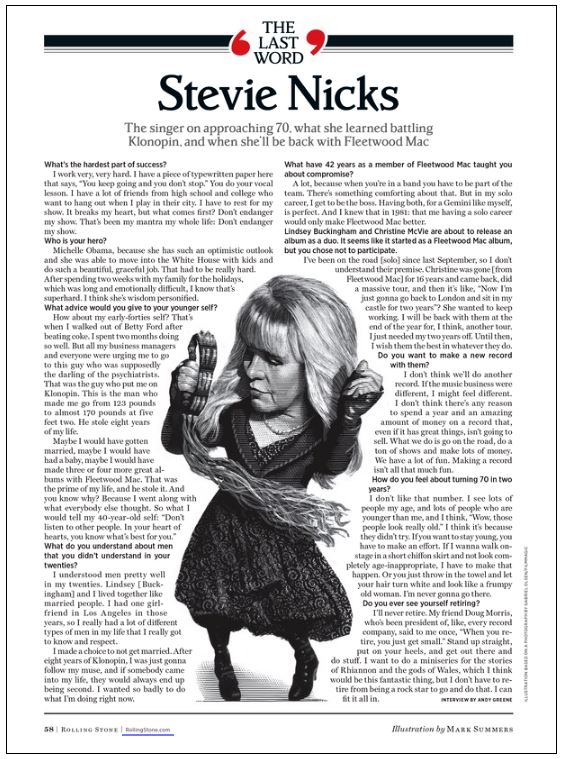
    Stevie Nicks appears in the March 23, 2017 issue of Rolling Stone (RS1283). She is featured in “The Last Word,” a Q&A column on page 58 of the magazine. Here is an exclusive transcript of the feature.

    The Last Word: Stevie Nicks

    The singer on approaching 70, what she learned battling Klonopin, and when she’ll be back with Fleetwood Mac

    What’s the hardest part of success?

    I work very, very hard. I have a piece of typewritten paper here that says, “You keep going and you don’t stop.” You do your vocal lesson. I have a lot of friends from high school and college who want to hang out when I play in their city. I have to rest for my show. It breaks my heart, but what comes first? Don’t endanger my show. That’s been my mantra my whole life: Don’t endanger my show.

    Who is your hero?

    Michelle Obama, because she has such an optimistic outlook and she was able to move into the White House with kids and do such a beautiful, graceful job. That had to be really hard. After spending two weeks with my family for the holidays, which was long and emotionally difficult, I know that’s superhard. I think she’s wisdom personified.

    What advice would you give to your younger self?

    How about my early-forties self? That’s when I walked out of Betty Ford after beating coke. I spent two months doing so well. But all my business managers and everyone were urging me to go to this guy who was supposedly the darling of the psychiatrists. That was the guy who put me on Klonopin. This is the man who made me go from 123 pounds to almost 170 pounds at five feet two. He stole eight years of my life.

    Maybe I would have gotten married, maybe I would have had a baby, maybe I would have made three or four more great albums with Fleetwood Mac. That was the prime of my life, and he stole it. And you know why? Because I went along with what everybody else thought. So what I would tell my 40-year-old self: “Don’t listen to other people. In your heart of hearts, you know what’s best for you.”

    What do you understand about men that you didn’t understand in your twenties?

    I understood men pretty well in my twenties. Lindsey [Buckingham] and I lived together like married people. I had one girlfriend in Los Angeles in those years, so I really had a lot of different types of men in my life that I really got to know and respect.

    I made a choice to not get married. After eight years of Klonopin, I was just gonna follow my muse, and if somebody came into my life, they would always end up being second. I wanted so badly to do what I’m doing right now.

    What have 42 years as a member of Fleetwood Mac taught you about compromise?

    A lot, because when you’re in a band you have to be part of the team. There’s something comforting about that. But in my solo career, I get to be the boss. Having both, for a Gemini like myself, is perfect. And I knew that in 1981: that me having a solo career would only make Fleetwood Mac better.

    Lindsey Buckingham and Christine McVie are about to release an album as a duo. It seems like it started as a Fleetwood Mac album, but you chose not to participate.

    I’ve been on the road [solo] since last September, so I don’t understand their premise. Christine was gone [from Fleetwood Mac] for 16 years and came back, did a massive tour, and then it’s like, “Now I’m just gonna go back to London and sit in my castle for two years”? She wanted to keep working. I will be back with them at the end of the year for, I think, another tour. I just needed my two years off. Until then, I wish them the best in whatever they do.

    Do you want to make a new record with them?

    I don’t think we’ll do another record. If the music business were different, I might feel different. I don’t think there’s any reason to spend a year and an amazing amount of money on a record that, even if it has great things, isn’t going to sell. What we do is go on the road, do a ton of shows and make lots of money. We have a lot of fun. Making a record isn’t all that much fun.

    How do you feel about turning 70 in two years?

    I don’t like that number. I see lots of people my age, and lots of people who are younger than me, and I think, “Wow, those people look really old.” I think it’s because they didn’t try. If you want to stay young, you have to make an effort. If I wanna walk onstage in a short chiffon skirt and not look completely age-inappropriate, I have to make that happen. Or you just throw in the towel and let your hair turn white and look like a frumpy old woman. I’m never gonna go there.

    Do you ever see yourself retiring?

    I’ll never retire. My friend Doug Morris, who’s been president of, like, every record company, said to me once, “When you retire, you just get small.” Stand up straight, put on your heels, and get out there and do stuff. I want to do a miniseries for the stories of Rhiannon and the gods of Wales, which I think would be this fantastic thing, but I don’t have to retire from being a rock star to go and do that. I can fit it all in.

    Andy Greene / Rolling Stone (RS1283) / March 23, 2017

  • Stevie Nicks: My favorite mistake

    Stevie Nicks: My favorite mistake

    On the shrink who almost ruined her life.

    The biggest mistake I ever made was giving in to my friends and going to see a psychiatrist. It was in the mid-1980s, and I had just gotten out of Betty Ford. I was feeling buoyant and saved and fantastic. But everyone said, “We’re sure you’re going to start using again. You should go to a psychiatrist.” Finally, I said, “All right!” and went. What this man said was: “In order to keep you off cocaine we should put you on the drug that we’re using a lot these days called Klonopin.” Stupidly, I said, “All right.” And the next eight years of my life were destroyed.

    Klonopin is in the Valium family, but Valium is fuzzy and Klonopin is insidious because it’s so subtle that you can hardly tell you took it. I got through 1986 and 1987. Thank God I’d already written the words for my record The Other Side of the Mirror. But what started happening was that if I didn’t take it, my hands started to shake. I felt like I had a neurological disease or Parkinson’s. I started not being able to get to Lindsey Buckingham’s house on time, and I would get there and everybody was drinking, so I’d have a glass of wine. Don’t mix tranquilizers and wine. Then I’d sing horrific parts on his songs, and he would take the parts off. I was hardly on Tango of the Night, which I happen to love.

    The next six years were terrible. Looking back on it, I think this therapist was basically a groupie. He loved hearing stories of rock and roll and he started upping my dose. He watched me go from a beautiful, 125-pound, newly sober woman who had the world at her feet to a 170-pound woman who had the lights go out in her eyes.

    Finally, in 1993, I’d had enough. I said, “Take me to a hospital.” I went in for 47 days, and it made Betty Ford look like a cakewalk. My hair turned gray and my skin molted. I could hardly walk. You can detox off heroin in 12 days. Coke is just a mental detox. But tranquilizers — they are dangerous. I was terrified to leave, and I came away knowing that that would never happen to me again.

    I learned so much in that hospital. I wrote the whole time I was there, stuff that I consider to be some of my best writing ever. I learned that I could have fun and laugh and cry with amazing people and not be on drugs. I learned that I could live my life and still be beautiful and fun and still go to parties and not even have to have a glass of wine. I never went to therapy again after that — why would I?

    CAREER ARC

    1974

    Nicks joins Fleetwood Mac with then-boyfriend Lindsey Buckingham.

    1977

    Fleetwood Mac’s Rumours album rockets to the top of the charts, ultimately selling 40 million copies.

    1981

    Nicks begins her solo career with the critical-hit record Bella Donna.

    1986

    Nicks begins an eight-year struggle with addiction to Klonopin.

    2011

    Nicks releases In Your Dreams, including a song from the 1970s that didn’t make it onto Rumours.

    Stevie Nicks / Newsweek (p64) / May 9, 2011

  • High Priestess

    High Priestess

    Shedding drugs, weight and breast implants, Stevie Nicks whirls back

    ENTHRONED UPON HER FOUR-poster bed, incense and candles burning as the clock nears midnight, Stevie Nicks nestles into a stack of pillows and tries to remember the last 10 years of her life. It doesn’t come easy: Nicks, the hottest femme in pop’s pre-Madonna firmament of the 1970s, degenerated into a bloated, drugged-out cliché of the era’s rock-and-roll excess. “I know how serious things were, and it scares me to death,” she says. Her nightmarish fall began with a cocaine habit that consumed millions of dollars and burned a hole through the cartilage of her nose. But as the Fleetwood Mac singer reveals for the first time, in a bedroom interview in her sprawling, adobe-style Phoenix home, cocaine was just the start of her long slide into darkness. It seems late in the day to meet the press, but for Nicks the bewitching hour is the right time to conjure up her ghosts: “This is when my life gets going.”

    In more ways than one. Nicks, now 49, slimmed-down, drug-free and in her best health in years, has executed a turnaround worthy of her heyday as Fleetwood Mac’s doe-eyed dervish. Enjoying a rebirth of interest in her music and even her over-the-top look—designers Isaac Mizrahi and Anna Sui aped her slit maxis and sky-high platforms in their recent collections—Nicks has been riding a new career high since last May. That’s when her old band regrouped after a seven-year recording hiatus to cut a No. 1 album, Dance, and launch a three-month, sold-out tour. This week, Nicks’s once contentious, newly copacetic Mac mates—her former flame, guitarist Lindsey Buckingham, 50, drummer Mick Fleetwood, 50, bassist John McVie, 52, and his ex-wife, keyboardist Christine McVie, 54—are to be inducted into the Rock and Roll Hall of Fame during ceremonies in New York City. For Nicks the event will be especially sweet. “Stevie bridges the gap between the powerful rock singers of the ’60s, like Janis Joplin and Grace Slick, and what’s going on today,” says alternative diva Sheryl Crow, echoing a chorus of surprising fans that includes the Smashing Pumpkins’ Billy Corgan and Courtney Love. Adds Crow, who will deliver the induction speech: “She is the woman all young girls wanted to be and all men wanted to be with.”

    That proved too heavy a burden for Nicks, who grew up in Northern California as the daughter of a well-traveled executive, Jesse Seth Nicks, and his homemaker wife, Barbara (they now live near Stevie in Phoenix). In 1974, Nicks and Buckingham, her former high school classmate, joined Fleetwood’s struggling blues band, helping to transform it into one of the most successful groups in pop history.

    But like others who made the leap to stardom in the 1970s, Nicks fell for cocaine’s allure. Recalls Fleetwood: “Sometimes I worried myself sick about whether she would survive.” His own addiction, he adds, landed him in that “same dark place.” While she remained a member of the band, Nicks launched a solo career with her hit Bella Donna album in ’81. Meanwhile she continued to snort so much coke that in 1986 a plastic surgeon told her, “If you want your nose to remain on your face, stop right now.”

    Nicks took his advice, completing a 28-day stint at the Betty Ford Center in Rancho Mirage, Calif., that year. “But after I quit cocaine,” she says, “things got even worse.” She continued to gain weight and looked constantly fatigued. In 1987 friends who feared she would relapse on cocaine persuaded her to see a psychiatrist, who prescribed Klonopin, a powerful tranquilizer to which she became addicted. “The drug changed me from a tormented, productive artist to an indifferent woman,” says Nicks, who became so zonked-out that she barely remembers an entire solo tour in 1989. “I vegetated into my own little world.” While hosting a bridal shower for a friend in late 1993, Nicks crashed into a fireplace and gashed her head but didn’t feel a thing. That scare gave her the courage to face a brutal, 45-day detox. “It would have been so easy for me to call a limo from rehab, go to another hospital and ask for Demerol because I was in so much pain,” she says. “Instead I stood on the edge of the cliff and said, ‘I need to live.’ ”

    Back home and drug-free in 1994, Nicks embarked on a six-month solo tour despite weighing 175 pounds and still feeling tired. Described by one critic as “twirling toward oblivion,” Nicks recalls walking off the stage at tour’s end and vowing “I would never sing in front of people again. Singing is the love of my life, but I was ready to give it all up because I couldn’t handle people talking about how fat I was.”

    While her growing lethargy had been diagnosed as the effects of Epstein-Barr virus, which causes constant fatigue, Nicks and her mother suspected it might be related to silicone breast implants that she had received in 1976. “Like cocaine, the whole world was getting them back then, and everyone was told they were safe,” Nicks says. “But I’m living proof that they aren’t safe.” Indeed, several doctors advised that removing her implants would be painful and unnecessary, but Nicks had the surgery anyway in 1994. “It turned out they were totally broken,” she says.

    With her health restored, Nicks also decided to slim down, and in 1995 she lost 30 pounds on a high-protein, low-carbohydrate diet. When her band-mates called last April suggesting a reunion, Nicks was game. A highlight of the ensuing tour was her performance of her previously unreleased 1977 tune “Silver Springs,” which chronicled the breakups of Nicks and Buckingham’s relationship and the McVies’ marriage. “There was such a multilayered story being told,” drummer Fleetwood says of the song. “It was our moment of high passion. It floored me every night Stevie sang it.”

    No old romances were rekindled during the tour, says Nicks, who has remained single since a brief 1983 marriage to Kim Anderson, the grieving husband of her best friend, Robin Stucker, who had died that year of leukemia. Though she has also been involved with rockers Don Henley, Joe Walsh and producer Jimmy Iovine, Nicks says she doesn’t mind being single. “I’m free,” she says. “So when someone starts telling me what to do, it’s like, ‘See ya!’ ” Nicks appears to have cast off her troubles with equal assurance. “I’m so far away from that now, it’s almost like another person,” she says of her stoned past. “I don’t want to be her ever again.”

    Steve Dougherty & Todd Gold / People, Vol. 49 No. 2 / January 19, 1998