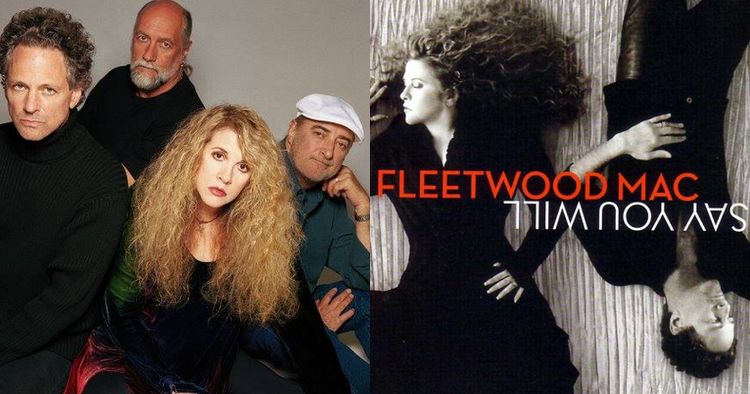
Tag: Say You Will

  • The Watkins Family Hour covers ‘Steal Your Heart Away’

    The Watkins Family Hour covers ‘Steal Your Heart Away’

    The Watkins Family Hour has covered Fleetwood Mac’s country-flavored “Steal Your Heart Away.” The original track, penned by Lindsey Buckingham, appears on the Fleetwood Mac’s 2003 album Say You Will and features guest vocals from Christine McVie, who was not regularly recording with the band at the time (view this version at the bottom of the page).

    The Watkins Family Hour’s rendition appears on their 2015 debut album Watkins Family Hour, which was released on July 24.

    About Watkins Family Hour

    For singer-songwriter-multi-instrumentalists Sara Watkins and Sean Watkins, the Watkins Family Hour has long been an oasis from the rigors of the road, a laboratory where they can try out new material or master beloved cover songs. Their monthly show at L.A.’s famed venue Largo has been hailed as a convivial, communal event where they welcome an impressive array of musician friends old and new. While it’s true that fans who aren’t lucky enough to be in L.A. and score a coveted ticket can check out the proceedings via youtube or on the podcasts the Watkins siblings have created, the fun of these evenings is really in being there as the unscripted show unfolds. The Watkins Family Hour is always full of surprises, unexpected guests, one-of-a-kind match-ups; serendipity plays as much of a role as virtuosity. Fiona Apple often joins them, and recent guests have included Dawes, Jackson Browne, Nikka Costa, Booker T. and actor-singer John C. Reilly, as well as comedians Paul F. Tompkins, Nick Kroll and Pete Holmes.

    Now Sara and Sean have decided to take their Family Hour format on the road — a kind of musical pop-up shop, if you will — to clubs and concert halls around the country. And to mark this undertaking, this summer they are releasing the first-ever Watkins Family Hour LP on their own Family Hour Records imprint. The album, recorded live over three days in the studio of their friend and producer-engineer Sheldon Gomberg, beautifully captures the freewheeling spirit of the shows. It features Apple and the stellar players who have become a de facto house band: drummer Don Heffington, pedal steel and dobro player Greg Leisz, bassist Sebastian Steinberg, and keyboardist Benmont Tench, each of whom take a vocal turn at the mic. The Watkins Family Hour is an all-covers affair; tracks include Sara doing Lindsey Buckingham’s “Steal Your Heart Away,” Sean essaying Roger Miller’s wistful “Not In Nottingham,” from Disney’s 1973 animated Robin Hood, and Apple singing “Where I Ought To Be,” originally performed by Skeeter Davis.

    On tour, the Watkinses plan to make every venue they visit a home away from home. In each town, they’ll extend an invitation to the many artists they’ve befriended over the years — through their touring in Nickel Creek, as solo artists, and as frequent collaborators with other like-minded musicians from the worlds of bluegrass, folk, country and rock.

    “Taking the Watkins Family Hour on tour and releasing this record feels like the right next step,” says Sara. “The show is about a community of players and that community stretches across the country. If we can’t get everyone to L.A. to do our show, we’ll come to them.”

    “The Family Hour has always been something we’ve really loved,” echoes Sean. “It’s been an amazing outlet for us for so many years. Until recently we had thought of it as just an L.A. thing at Largo. But now we feel it’s time to take the show out to more people.”

    Steal Your Heart Away (Fleetwood Mac)

  • Going his own way

    Going his own way

    Lindsey Buckingham stakes his claim in the Fleetwood Mac legacy

    The man doesn’t need Perry Mason to argue his case. It’s clear from one spin through the recently-remastered mid-’70s Fleetwood Mac masterpieces (Fleetwood Mac, Rumours and 1979’s underrated Tusk) that guitarist/vocalist/arranger Lindsey Buckingham was, is and always will be the heart, soul and brains of this stadium-filling supergroup. After all, the band foundered when he went solo after ’97’s Tango in the Night, only to whirr back to life last year when he returned to oversee the Mac’s creative, well-kudoed comeback, Say You Will, as well as the spanking-new concert CD/DVD Live in Boston. A true renaissance man, the crafty Buckingham developed his own finger-pickings style as a rockabilly-obsessed Palo Alto teen, then settled on a particular guitar, as well — the customized, viola-shaped Tuner Model 1 that now provides that signature Mac-chimey sound. Is this unexpected reunion all that he hoped it would be? During a Los Angeles rehearsal, Buckingham weighed in on this and other issues.

    The Wave: Have your bandmates finally conceded that, yes, indeed, you are truly the Alpha Wolf?

    Lindsey Buckingam: Well, I dunno… I dunno if anyone would wanna define it quite that way. But when we regrouped, everyone had sorta gotten their shit together, so it was really great to see all these people and realize that there was still a lot of care, a lot of love and that the chemistry was certainly as good as ever. We were playing better than we ever did, so that alone made it worthwhile. And one of the things that happened was a male-bonding kinda-thing. It was interesting to watch Mick [Fleetwood, founding drummer] and John [McVie, bassist/co-founder] talk, for example. Because without Christine [McVie, founding keyboardist and ex-wife of John] there, John was able to be a little looser, with no baggage or buttons to be pushed. It was really neat to see some business get taken care of that might’ve been 30 years old. Same with Stevie Nicks and me, in some ways. There was a renewed appreciation.

    TW: But you’ve got to claim some credit, right?

    I was cynical about our success because I perceived the pitfalls. And I felt that I was pretty much holding it together on a musical level, and in a way wasn’t getting credit for it. But it wasn’t as if there was any kind of organized suppression — people gravitated to what was most obvious, and Stevie was almost immediately singled out in terms of her personage and the witchy image she’d put together. Maybe if I’d been the one who was singled out, I wouldn’t have been so cynical. But I had to fight for myself in the band, fight for what I thought was right without anybody’s help. To get to Tusk, I had to punch some holes in the status quo.

    TW: People probably forget the dramatic U-turn you took with Tusk. It wasn’t exactly what folks were expecting after Rumours.

    We came out with Rumours, which was certainly a beautiful album, musically and otherwise. But the musical soap opera aspect of that, I think, became more the focal point than the music. And then you’re in this spot: Where do you go from there? Well, you can make a Rumours 2 — certainly, the record company’s gonna ask you to make Rumours 2 for all the wrong reasons. But in the meantime music from England had come out — new wave and punk — and although it wasn’t anything that influenced me directly, it did give me the courage to say, “Hey, look, I wanna try some new things.” But I had a meeting with the band, and everyone was dead set against it and we had a fight about it. But somehow I managed to prevail and do it. And by the end of it, everyone was totally on the same page. But I mean, releasing “Tusk” as a first single, compared to “Go Your Own Way”? It took everyone by surprise, and that was part of the beauty of it for me. It confounded everyone’s expectations.

    TW: And now, of course, every marching band in the world has to learn “Tusk” by heart.

    Ha! I know, I know. It’s crazy. And at the time, everyone was happy with the album, until, of course, it didn’t sell 16 million records. Then there was a backlash again. So then you got Mirage, which is not a bad record, but it’s sorta drifting in hazy waters. Tango was better, but it’s still way under duress.

    TW: But Mac songs from that era still mean the world to people. You helped compose and conceive some all-time classics.

    And it’s hard to be as connected with that as one might think. You’re not necessarily in touch with the illusion it creates. Obviously, you figure if you’re selling 16 million albums, something is happening, but you’re just too insulated to be in touch with that collective effect.

    Tom Lanham / The Wave (Vol. 4, Issue 16) / July 28-August 10, 2004

  • Fleetwood Mac: An epochal band in its twilight years

    Fleetwood Mac: An epochal band in its twilight years

    Fleetwood Mac Say You Will (2003)Just hours after the release date of the new Fleetwood Mac album was announced, I was summoned to London’s leading talk radio station, LBC, to comment on this important piece of breaking news. The presenters, both seasoned news reporters, made no effort to conceal their excitement. Was it true that the “classic” line-up was back together again? Did that mean the new album would sound like Rumours? Tell us again about the good-bad old days of the Mac — the feuds, the drugs, the squillions of records sold, the money squandered, the sheer, glorious, wanton excess of it all.

    We should all know better by now, and yet a part of me is just as eager as my radio show hosts were to discover what developments lie in store as the latest chapter in this unseemly, yet strangely gripping saga begins. If you have been able to follow the Byzantine twists and turns in the plots so far — the disappearances, sackings, resignations, bust-ups, stand-ins, solo albums, reconciliations and all the rest — you are probably something to do with the group. But it isn’t the blow-by-blow detail which matters now so much as finding out what happens next.

    People miss an important point when they dismiss old troopers like Fleetwood Mac as mere peddlers of nostalgia with no contemporary relevance. All great pop acts have a powerful narrative thread running through their activities and there are any number of them — from The Rolling Stones to Ozzy Ozbourne — whose scriptwriters are now tantalizingly close to revealing what happens in the end. Go and see Paul McCartney on his current tour and of course it’s a nostalgia trip, but you also get to find out what eventually happened to all those Beatles songs and, for that matter, what became of the teenagers who screamed themselves hoarse in the black and white newsreels of the 1960s. But beware; exposure to such knowledge at close quarters is not necessarily for the faint-hearted.

    Unseemly, yet strangely gripping

    Listen to Say You Will and you hear the sound of a group which 25 years after its finest hour, is still riven by dissent and disharmony while staffed by individuals who know that they will never make music apart to rival the music they can still, sometimes, make together. We know it too. Indeed, Say You Will, began life as the fourth Lindsey Buckingham solo album when the guitarist, singer, songwriter and producer was made painfully aware that his record company — like the rest of the world — had little interest in it as a solo offering.

    Having buried the hatchet with his former paramour Stevie Nicks and re-tooled the same songs as part of a Fleetwood Mac album, Buckingham finds himself playing a starring role in a different story. Nine of the 18 compositions are his, while the other nine (not that anyone’s counting, of course) are written and sung by Nicks. Glueing these elements together, over the course of a 76-minute marathon, is the redoubtable rhythm section of drummer Mick Fleetwood and bass player John McVie.

    The velvet-voiced Christine McVie has “finally” dropped out of the picture, so it is not in fact the “classic” line-up, despite a lot of group and record company spin to suggest that it is. Even so, Say You Will, represents something of a renaissance in the band’s artistic fortunes, if not quite the return to Rumours-era form that has been suggested.

    Fleetwood Mac Say You Will
    (Neil Preston)

    Buckingham, ever the most experimental member of the outfit, takes his brief to new extremes on several strange and surprisingly powerful excursions into heavy, prog-rock territory. “Murrow Turning over in His Grave” is a fire and brimstone protest song: “Would you feel the ooze as your brain drains out/From the pneumatic drills and sharpened knives?/Blood in the sky/Are you dead or alive?” And on a gothic-rock extravaganza called “Come” he piles into a long, squealing guitar solo while Fleetwood Mac’s snare drum explodes like a fusillade of cannon shots.

    But however far out on a limb Buckingham takes them, Nicks is always on hand to guide the group gently but firmly back to it core, soft-rock sound. Her willowly, siren voice rises above the acoustic riffing of “Illume” — a dark if predictably vague response to 9/11 — and brings a worldly-wisdom to bear on the bittersweet lovers’ tale of “Thrown Down.” “I am older now, but I still remember,” she sings on “Smile at You,” her weathered tone soaring over a wall of ghostly, wailing harmonies.

    The album ends with two farewell songs — first Buckingham’s “Say Goodbye” and then Nicks’s “Goodbye Baby,” the eternal rivals divvying up the honours as meticulously as children claiming their fair share of going-home gifts at the end of the party. “There’s blood and guts and disagreements still to this day,” Fleetwood said recently, “But that’s what makes it mean a shit.” And so another of rock’s epochal groups enters its twilight years with a renewed mixture of pragmatism and passion which may come as a surprise to even their most ardent fans.

    David Sinclair / Word (Issue 4) / June 2003

  • The eternal return

    Once again, Lindsey Buckingham gets pulled back into Fleetwood Mac

    It’s fair to say that Fleetwood Mac probably would never have achieved such mega success had it not been for Lindsey Buckingham. Not to marginalize guitarists Peter Green, Jeremy Spencer, or Bob Welch-all of whom contributed immensely to making Fleetwood Mac one of the most progressive blues-rock-pop bands of the ’60s and early ’70s — but it was Lindsey Buckingham’s unique guitar style and savvy arranging, producing,and songwriting skills that guided the band to the top of the charts in the mid 1970s with Fleetwood Mac and Rumours.

    Born in Palo Alto,California, in 1949, Buckingham was inspired at an early age by the sounds of Elvis Presley and other ’50’s-era rock-and-rollers. “I had a brother who was seven years older, and when he started bringing those records home, I got very interested in trying to lay the songs,” explains Buckingham. “I eventually got a 3/4-sized guitar, but I never took any lessons. I just played to the records, and used a chord book to figure out how the songs went. Listening to Scotty Moore eventually led me to Travis picking and other folk styles, and it just went from there.”

    Buckingham’s first group was the Fritz Rabyne Memorial Band, which he co-founded with several friends-one of whom was singer Stevie Nicks. The group plied to San Francisco scene for a few years (with Buckingham on bass), and then broke up in 1971. Now a duo, Buckingham and Nicks relocated to Los Angeles, landed a record deal, and released Buckingham Nicks in 1973. After drummer/bandleader Mick Fleetwood heard the album, he invited them to join Fleetwood Mac.

    Buckingham, Nicks and keyboardist Christine McVie subsequently churned out a string of hits that made fortunes for the band and its record label. Despite their storied personal difficulties during the making of Rumours, the band stayed the course, releasing Tusk in 1979 and Mirage in 1982. However, Buckingham was also pursuing a solo career — having released Law & Order in 1981 and Go Insane in 1984 — and he left the group in 1987 after recording Tango in The Night.

    But even after the release of his third solo album, Out Of The Cradle in 1992, it still wasn’t over for Buckingham and Fleetwood Mac. In 1996, the band reunited to tour and film The Dance — a live DVD that featured the classic lineup performing its classic songs. Following the departure of Christine McVie after The Dance tour, Buckingham went back to work on what was supposed to be his fourth solo album. But that project would eventually turn into a new Fleetwood Mac double album to be released early in 2003.

    Or would it? At press time, Warner Brothers was still debating whether to release a single or double CD set, and the album title and final song sequence was undecided. So here is the story of a work still in progress-one with a wealth of new songs by Buckingham and Nicks, and a huge dose of Buckingham’s wickedly expressive finger-style playing.

    How did you solo album turn into a Fleetwood Mac production?

    I started working on this record after coming off the road for a small tour in support of Out Of The Cradle. One day I ran into Mick Fleetwood, who I hadn’t seen in quite a while, and we started talking about working together. At the same time, Rob Cavallo — who was producing Green Day at the time — became interested in working with me. So the three of us just started cutting tracks. I took most of the songs back to my house to finish them, and while that was happening — as has occurred a few times in the past-the gravity of Fleetwood Mac just sucked me in.

    At that time, there was a big push to do The Dance tour, so I put all my new stuff on the shelf throughout 1996. After the tour, I went back in and finished what was going to be my next solo album. This was about the time that Warner Brothers was preparing to change a lot of staff, though, and I was a little worried that my record would get buried. I felt strongly that it was the best solo thing I had done, so I thought, “Well, I’ll just wait.” In the meantime, Stevie was around, and the whole idea of getting her in the picture came about. I wasn’t sure that I was going to use my stuff for a Fleetwood Mac album, but we just decided to start cutting some of Stevie’s songs while I waited for for the new regime at Warner to come in. From there, the whole project morphed into as Fleetwood Mac thing.

    But without Christine McVie.

    Yeah. At the end of the 40 or so dates of The Dance tour, Christine announced she didn’t want to go out on the road anymore. I wasn’t completely unhappy with her decision because I had my solo stuff to get back to.

    How did her absence affect the sessions for this new album?

    The band had to explore new creative options because Christine wasn’t there. For example, we were forced to play differently because, suddenly, we were a three piece. Her absence also forced Stevie and I to establish a different dynamic with each other, and, ironically, it’s a bit more like Buckingham Nicks. But I think that working through Christine’s departure is one of the reasons this album sounds as fresh as it does.

    Did it make a difference that your songs had been written specifically for a solo album?

    I don’t know if the songs would have turned out any different had I known I was going to use them for a Fleetwood Mac album — although the process in which they were brought along would have changed. When you’re working with a band, a communal sensibility influences things, and the songs that make it are the ones that everyone think are appropriate “band” songs. Obviously, that’s not the case if I’m going off in a more esoteric direction on my own.

    Which process do you prefer?

    Well, there’s an analogy that working with a band is like making movies, and working alone is like painting. I’ve spent many years alone in my garage experiencing the contemplative aspects of songwriting, and I think that has contributed positively to my ability to write songs and make records.

    When you’re writing a song, do you typically start with a guitar part?

    Yes. I’ve always admired Stevie for her ability to have the vocal melody be the center of the song. In theory, that’s how it should be. But the guitar is always the center of my songs, and writing is always a case of wondering, “What do I put over that?”

    The great thing about Stevie is that she really isn’t a musician, so 95 percent of her psyche is driving the melody. As a guitarist, I often find myself defining a guitar part before I even have a melody. There’s nothing wrong with that, but it can be more problematic when you’re trying to develop a song idea.

    At one time, you and Stevie and Christine were masters of turning personal difficulties into hit songs. Is the ability to reflect on what’s happening around you still a factor in your songwriting?

    I don’t really think of myself as a commentator of anything. I just try to find a lyric that has some truth, grace, and mystery. Hopefully, it will bridge the line between something personal and something that’s about the world in a broader sense.

    On Rumours — which was probably the primary example of our lives laid bare — I don’t think we were aware of what we were doing. Our situation was unique because two couples were breaking up while making a record, and the personal difficulties were fueling everything.

    You were playing a Telecaster before you joined Fleetwood Mac, and then you started using a Les Paul. Was there any reason for the switch?

    The band wanted me to play a humbucker guitar because Mick tuned his drums fairly low and Christine’s keyboard sounds were kind of Wurlitzer-like and Rhodes-y. All that lower midrange stuff tended to make the Telecaster sound really scratchy and thin.

    I did use the Telecaster onstage before Fleetwood Mac was released. Those weren’t big shows, but Mick was very adamant that we get out there and get some chops as a band. So there was a certain amount of obscurity working in our favour in terms of being able to play around and make some mistakes. I guess using the Tele live was one of them.

    Were there any other things you had to change to fit in with the band?

    Yes — it was quite a lesson in adaptation. I did everything from switching my guitar to become a less present as a player in order to do the right thing for the band as a whole. They even tried to get me to use a pick!

    What were you using for distortion when you first joined Fleetwood Mac?

    It was a old Sony 2-track tape machine that I’d rigged up. The deck had input and output gain controls, and you could overdrive one gain stage with the other. It was solid-state sounding, but it worked.

    I bought the deck when I first got interested in recording, and had read about Les Paul doing his sound-on-sound thing. I cut my teeth on recording and overdubbing with that machine. It eventually broke down, but the fuzz part still worked, so I plugged into it for my lead tone.

    You are the most noted use of the Turner Model I. How did you discover that guitar?

    Rick Turner had worked for Alembic for a long time, and the guitars they made were the equivalent of the basses the John [McVie, Fleetwood Mac bassist] still has. There were so much stuff on those instruments-parametric EQ and all this other cleverness. Anyway, Rick would ask me to try these different Alembic guitars, and they were always big and heavy with dense, exotic woods and brass hardware. They felt very sterile to me, and I finally said to him, “Why don’t you make me something that’s a cross between what you do and a Les Paul.”

    One day, during the sessions for Tusk, Rick showed up with the Model I. It was more about finding the ideal stage guitar, because as much as the Les Paul was fitting the bill in a fairly good way, it wasn’t giving my picking a fare shake. The Turner sounded slightly ore percussive and articulate-somewhere between a Les Paul and an acoustic guitar-and the tone worked better with my fingerstyle playing. I even used to put a set of .012-.052 flatwounds on it, but now I’m using a .010-.046 roundwound set.

    I’ve noticed you sometimes rotate the pickup on your Turner so that the bass side is closer to the bridge.

    That’s the sweet spot for me. It delivers a little more definition on the low end-which helps me cut through the band-and having the treble side of the pickup closer to the neck sweetens the top strings.

    Do you still use single-coil guitars in the studio?

    Yes. I use the Turner for lead playing and chunky rhythm parts in the studio, but a Strat or a Tele works better when I’m trying to orchestrate guitar parts, and I need something that’s voiced more sublimely.

    Who was your main lead guitar influence?

    I can’t say it was one person. I used to love Led Zeppelin, but I never sat around trying to learn Jimmy Page licks. In terms of developing a sense of melody, I was helped along by Dave Mason’s Alone Together -a wonderful album with a very pretty kind of lead-guitar style. But I never thought of myself as someone who was going to go out there and burn it up. In fact, the lead stuff came very late for me.

    How has technology influenced the way you make records?

    It hasn’t. I still have a traditional console — it’s not even computerized-and I still record to tape. I would like to change the way I record, though, because I now wish I had some of the editing capabilities that allow you to do things quicker.

    But you did use a Roland VG-8 to record much of the album. Were any conventional amps used in the studio?

    Well, you’re right about that level of technology-we hardly used any amplifiers. Although for Gift Of Screws, we put a bunch of amps in different rooms, and mixed and matched the sounds until we got what we wanted. The amps included a Fender Bassman and a Vox AC30.

    You get a very clearly defined sound on both your nylon — and steel — string acoustics. Do you record them with a mic or a pickup, or both?

    A lot of times, I’m running direct with a pickup-although I’ll sometimes mic the guitar to capture a little more air in the acoustic sound.

    When you layer acoustic sounds, you often seem to include your Dobro.

    Yeah, that same riff I’ve been playing for years! The Dobro is tuned to dropped D. I probably got that from listening to Stephen Stills in the late 60’s.

    You flail the strings aggressively with your right hand, yet your sound is very articulate and precise. Can you give us some insight into your technique?

    Flailing-and bit of frailing-pretty much describes it. I don’t think about it much because I’ve never had any formal training. I never sat around and practiced scales, and I never took any lessons. I’m still very limited in some ways.

    Is it that guitar playing comes so natural to you that you tend to focus more on the songs and less on the instrument?
    Even when I was eight years old, the most important thing was learning to play and sing that Elvis tune. For me, it as always been about the music and the songs, and how to make the big picture as interesting as possible.

    Tone Toys 

    “We got a loud, clean stage sound, and we used tube amps and EV speakers,” says Buckingham’s long-time guitar tech, Ray Lindsey. “Lindsey’s fingerstyle playing creates huge dynamics and lots of low-end, and we want to be able to keep the sound clean and tight so that when he goes for a solo, it really stands out.

    “The Boss OD-1 has always suited Lindsey for his distortion tone. It adds sustain, but it still allows him to get a pretty clean lead sound. We also split his guitar signal before the amp so that the front-of-house guy can add some of the direct sound to the mix. This helps overcome the mushiness of the room, and it also adds attack and definition to the guitar sound.

    “Lindsey prefers a heavier, more industrial tone onstage, and for The Dance we used Mesa/Boogie Dual rectifiers set up for the cleanest possible sound. They did the job, but I still think we could take it a step further. We just wanted a huge clean tone, but it’s hard to find in the Dual Rectifier because there are so many overdrives stages that you have to neutralize to get there. We used custom cabinets, which were closed-back on the bottom and open-back on top. I think that setup worked okay for The Dance video because of the smaller stage, but when we got to the arenas it couldn’t quite go to the next level.

    “Lindsey used a Roland VG-8 extensively for the new album. I’ve experimented with a few different modelling amps, and the VG-8 seems more true in its sampled sounds. It also has less bells and whistles to deal with, and that allows us to get to the music faster.” — AT

    Buckingham’s Licks

    Although the song selection and running order of the new Fleetwood Mac album was up in the air as we went to press, I was treated to a special preview of the planned two CD release in the Warner Brothers offices last December. Later on, Buckingham graciously detailed the 6-string highlights of some of his favorite songs. We can only hope that the final version of the album lets you hear these gems.”— AT

    I Am Waiting. “The straight sound is a Baby Taylor with gut strings,” says Buckingham. “Then I played the same part through a very ethereal patch on the Roland VG-8. I like the idea of mixing different textures with a single guitar part.”

    Gift of Screws. “I don’t think I’ve ever done this on a record before, But I doubled my lead part with my voice on this song-just like George Benson. It’s an interesting device, and I did a bit more of it on the song “Miranda.”

    Thrown Down. “It sounds like I used a high-strung guitar here, but I’ve also been known to do an old Les Paul trick to re-voice my guitar parts. For example, I’ll track a part with the tape machine slowed down a half step, and the part will sound sweeter and more “miniature” when the deck is run at normal speed. You have to be careful not to slow down the machine too much, though, because the guitar ca sound wimpy. I also did this trick on the chorus riff, which was tripled with little speed tweaks on either side of the correct pitch.”

    Not Make Believe. “The shimmering tones are courtesy of a doubled part and the speed-tweak trick. What you’re hearing is ‘natural’ phasing.”

    Bleed To Love Her. “The backwards guitar is my Strat through a Lexicon delay, and manipulated with a volume pedal.”

    Say Goodbye. “This song was written quite a long time ago, after I had left the band. I don’t know if I was going for anything in particular, but I was in a place where I could feel compassionate, understanding, and nonjudgmental about the other people in the band, and about everything that had happened. The lyric was really important to me, and the fingerpicking part makes it a really nice guitar piece.”

    Red Rover. “The speed and aggressiveness in my fingerpicking is a big part of what I have to offer these days. Here, the very percussive, fingerpicked part was doubled, and then I slowed down the tape machine and bounced the double to another track. This allowed me to control the doubled part with a fader, and I moved the fader back and forth in time with the music. It almost sounds like some of that gating stuff they did in the ’80s — that on-off kind of thing — except this method is more organic. My idea was to create some negative space to take the place of the drums, and I had to slow the tape machine way down to get the rhythmic manipulations as precise as possible. It’s all about being in the pocket.”

    Murrow Turning Over In His Grave. “The very strange-sounding distortion part is based around a cluster of atonal vocals. You get five, six, or seven different tones together that are out of tune with each other, and it just becomes this arrgh kind of sound. I think there might be some slide in there, too. This song has elements of something quite traditional and recognizable in an almost generic sort of way, yet it departs from that at the chorus when you’re suddenly into this weird Brian Wilson/Yardbirds acid thing. I would never want to do something that was generic all the way through.”

    Art Thompson / Guitar Player (Issue 399, Vol. 37, No.4) /April 2003

  • Fleetwood Mac say new album

    Fleetwood Mac say new album

    Say You Will due in April, world tour in May

    Fleetwood Mac will release their new album, Say You Will, on April 15th. The album is their first full collection of new material with Lindsey Buckingham onboard since 1987’s Tango in the Night. However, Say You Will, the group’s first release since the half-new/half-unplugged The Dance five years ago, doesn’t feature keyboardist/singer Christine McVie, who had been with the band since 1970.

    Some of Buckingham’s contributions to Say You Will are as many as nine years old, as he initially considered using some for a solo release. “[Christine’s departure] kind of freed the Fleetwood Mac situation to be looked at in a fresh light and in some ways in the dynamic that Stevie and I had going before we joined the band,” Buckingham told Rolling Stone. “But this music is the best that I’ve ever done on my own, or with Fleetwood Mac, tapping into some new areas. And after all of this time, Stevie and I have managed to get to a point where we’re comfortable. There’s nothing we can’t talk about. I talked to Don Henley one time about the Eagles, and it seemed like there was so little love or idealism left in that group of people and perhaps that’s more the norm for people our age. But we seem to be slightly more arrested, and I think there’s some potential for some good stuff because of that.”

    Drummer Mick Fleetwood says that Buckingham’s input on the record reminds him of the band’s segue from 1977’s Rumours to the more sprawling 1979 release, Tusk. “His whole life is so involved in doing what he does,” Fleetwood said. “Quite frankly, I’m not sure how he stays focused all those years on pieces of music, but he does. It has a lot of the sensibilities [of Tusk] and Lindsey’s definitely pushed some envelopes that are exciting. I don’t think people will accuse us of standing still.”

    Nicks’ contributions came from a similar flood of material. The singer gave Buckingham, Fleetwood and bassist John McVie eighteen songs to work with, before she went out to tour behind her 2001 release, Trouble in Shangri-La. “So it was the power trio,” Fleetwood said. “And that was great, because we did a lot of reconnecting.” Nicks’ friendship with Sheryl Crow also resulted in a guest appearance by Crow, who added harmony vocals and keyboards to Say You Will.

    Fleetwood Mac are planning a world tour, to launch in May.

    Rolling Stone / Friday, February 7, 2003

  • Fleetwood Mac plans tour behind new album

    Fleetwood Mac plans tour behind new album

    Fleetwood Mac will embark on a 40- to 60-date North American tour of arenas and amphitheaters in April 2003, Billboard.com has learned. The group’s most popular lineup of Mick Fleetwood, Stevie Nicks, Lindsey Buckingham, John McVie, and Christine McVie last toured in 1997 with an arena run that grossed $36.2 million in 44 shows; the upcoming tour will include everyone but Christine McVie. The same lineup’s first new studio album since 1987’s Tango in the Night will arrive next spring via Reprise.

    A greatest hits package, The Very Best of Fleetwood Mac, is due Oct. 15 on Reprise. The 36-track, double disc album spans 1975-1997, omitting material recorded by the more blues-oriented edition of the group prior to Buckingham and Nicks’ arrival. Nine top-10 hits are included, including “Dreams” (No. 1), “Don’t Stop” (No. 3), “Little Lies,” and “Hold Me” (both of which reached No. 4).

    Three tracks are culled from the group’s 1997 reunion album The Dance: “Go Insane,” “I’m So Afraid,” and “Big Love” (the original version of which hit No. 5 in 1987). Other tracks include “As Long As You Follow” and “No Questions Asked” from the band’s 1988 Greatest Hits album.

    The Very Best of Fleetwood Mac will also feature footage of the band recording the new album, as well as rare live performances, interviews, and music videos.

    In related news, Buckingham sings on the cut “The Man Who Loved Women” on Tom Petty’s new album, The Last DJ, due Oct. 8 from Warner Bros.

    Here is The Very Best of Fleetwood Mac tracklist:

    Disc one:
    “Go Your Own Way”
    “Dreams”
    “You Make Loving Fun”
    “Rhiannon”
    “Monday Morning”
    “Silver Springs”
    “Say You Love Me”
    “Second Hand News”
    “Over My Head”
    “Sara”
    “Never Going Back Again”
    “Love in Store”
    “Landslide”
    “Songbird”
    “What Makes You Think You’re the One”
    “Storms”
    “Go Insane” (live, 1995)
    “Tusk”

    Disc two:
    “Don’t Stop”
    “The Chain”
    “Little Lies”
    “Gypsy”
    “Think About Me”
    “Gold Dust Woman”
    “World Turning”
    “Hold Me”
    “Seven Wonders”
    “Everywhere”
    “Family Man”
    “Sisters of the Moon”
    “As Long As You Follow”
    “No Questions Asked”
    “Skies the Limit”
    “Paper Doll”
    “I’m So Afraid” (live, 1995)
    “Big Love” (live, 1995)

    Jonathan Cohen / Billboard / September 4, 2002