Tag: review

  • ALBUM REVIEW: Rock a Little

    Stevie Nicks Rock a Little album coverRock A Little
    Stevie Nicks
    Modern, dist. by Atlantic

    Rock a little, cry a little, a bit of this, a bit of that – Stevie Nicks will not commit to much. She’d rather remain elusive, an enigma, a dreamer whose “problems” add up to so much Southern California angst.

    She’s here to tell you, because she knows first-hand, that money isn’t everything. No, love is everything – and nothing. The man of her visions is there, and she will wait. But she can’t wait. She’d do anything for him. But he’s not there. Well, he “is” there, but they don’t communicate. She needs him, but back come only unspoken words. She is so alone, but in her heart she knows he will stand by her.

    And so on.

    As Nicks furthers her solo career apart from the triennial offerings of parent group Fleetwood Mac, she continues to be vague, calling in wispy references to water and sky and wind. All answers are somewhere “out there”. Existential pop.

    About all that has changed since “When Doves Cry” is that she’s gone from white to black in dress, and her voice has gotten more gruff in parts. Otherwise, backed by her stable of reliable LA session players and augmented by female backup vocals, it’s difficult to tell where the songwriting ends and the production and engineering begin. She uses five – count ’em – producers and an amazing 10 different studios. There are too many musicians and engineers to count.

    What’s it all add up to? Rock a little, cry a little…

    Marty Racine / Houston Chronicle / December 22, 1985

  • REVIEW: Stevie Nicks The Wild Heart

    REVIEW: Stevie Nicks The Wild Heart

    Stevie NicksStevie Nicks was following both her debut solo album, Bella Donna (1981), which had topped the charts, sold over a million copies (now over four million), and spawned four Top 40 hits, and Fleetwood Mac‘s Mirage (1982), which had topped the charts, sold over a million copies (now over two million), and spawned three Top 40 hits (including her “Gypsy”), when she released her second solo album, The Wild Heart. She was the most successful American female pop singer of the time.

    Not surprisingly, she played it safe: The Wild Heart contained nothing that would disturb fans of her previous work and much that echoed it. As on Bella Donna, producer Jimmy Iovine took a simpler, more conventional pop/rock approach to the arrangements than Fleetwood Mac’s inventive Lindsey Buckingham did on Nicks’s songs, which meant the music was more straightforward than her typically elliptical lyrics.

    Iovine did get a Mac-like sound on “Nightbird,” in which Nicks repeated her invocation to “the white winged dove” from Bella Donna‘s “Edge of Seventeen,” and on “Sable on Blond,” a “Gypsy” soundalike. His most daring effort was the album’s leadoff single, “Stand Back,” which boasted a disco tempo.

    Elsewhere, the songs were largely interchangeable with those on Bella Donna, even down to the obligatory duet with Tom Petty. Nicks seemed to know what she was up to — one song was called “Nothing Ever Changes.” As a result, The Wild Heart sold to the faithful — it made the Top Ten, sold over a million copies, and spawned three Top 40 hits (“Stand Back,” “Nightbird,” and “If Anyone Falls”). And that was appropriate: if you loved Bella Donna, you would like The Wild Heart very much.

    William Ruhlmann / AllMusic / Undated

  • REVIEW: Fleetwood Mac on Mirage tour

    FLEETWOOD MAC’S records have always been better than its live shows. On records, the band has achieved a lovable blend of lyrical effervescence and studio polish. In concert, subtleties have been coarsened and Stevie Nicks in particular has undercut her impact with raw singing and loopy stage behavior.

    But the band’s only New York area show on its current Mirage tour, Tuesday night at the Brendan Byrne Arena in East Rutherford, N.J., was the best Fleetwood Mac show in this writer’s experience. Miss Nicks has found a persuasive way of capitalizing on her assets, and the band as a whole performed with tightness and intensity.

    ”Pleasing” is the operative word, however. Even with as tight and powerful a rhythm section as rock can offer, in Mick Fleetwood and John McVie, Fleetwood “hit” Mac is not a band to build to overwhelming concert climaxes. Quirky, buoyant pop, soulful lyricism and mysterious witcheries are more its game. The set meandered over its two-hour length, bursting out at the beginning with some of the group’s most impassioned songs but then settling down to more commonplace ups and downs.

    Miss Nicks provided several of the ups. She has lost the reedy fragility of her mid-1970’s voice. But she compensates with a hoarser, rougher rock contralto, and her stage demeanor blends glamour and a kind of dangerous charm. Lindsey Buckingham still has an underlying streak of bizarreness that seems more unsettling than stimulating, and his rave-up guitar solo — as well as Mr. Fleetwood’s drum solo — lacked the communicative artistry that such solos can entail; it was mostly note-ridden bedazzlement, and as such elicited the predictable ovation. But Mr. Buckingham is also responsible for some of the group’s best songs, and his clear, effortlessly produced tenor is now the highest voice in the band.

    Christine McVie, the keyboard player and third singer — there was also an anonymous guitarist on stage for some songs — was disappointing. Or, more properly, the uses to which she was put were disappointing. Her songs have always served as calm, cool contrast to the rest, but Tuesday they were slighted or arranged in an overly forceful manner.

    The set as a whole proved valuable beyond its function as tightly crafted entertainment. Never before has the band’s post-Buckingham Nicks material seemed so much of a piece. The Fleetwood Mac album established this configuration, with Rumours as a venturesome yet commercially potent follow-up. Tusk is generally considered a deviation, however, and Mirage a calculated return to form.

    But Tuesday’s performance stressed the disquieting oddities of the supposedly “safe” material and the accessibility of much of Tusk. It’s all one band, a perilous but potent mixture of unstable ingredients. And while it may not aspire to the heights of rock passion, it still makes honorable, even moving music lower down on the slopes.

    John Rockwell / New York Times / September 16, 1982

  • THE POP LIFE: Fleetwood Mac – Mirage

    Fleetwood Mac Mirage cover 1982FLEETWOOD MAC’S Mirage (Warner Bros.) has already climbed to the top of the album best-seller charts, just a few weeks after its release. It sounds as if it could repeat the phenomenal commercial success of Rumours, which made the present Fleetwood Mac lineup into a supergroup several years ago and went on to become one of the best-selling pop-rock albums of all time.
    It also sounds a lot like a tinkly, trebly musical wind-up toy. The group’s experienced rhythm section and founders, Mick Fleetwood (drums) and John McVie (bass), lock into step so perfectly that they seem to go puttering along on their own momentum. And the dabs of glockenspiel, vibraphone and chiming guitars and stacks of sighing vocal harmonies float so ethereally that one has to remind oneself that there originally was a human agency behind them.

    Yet human agencies are precisely what separates Fleetwood Mac from its competition. Lindsey Buckingham, one of the group’s three singer-songwriters and the album’s chief producer, has always had a quirky voice (high-pitched, like so much of the rest of Mirage), and a quirkier knack for worshiping and subverting pop conventions at the same time. Stevie Nicks, whose voice is so trebly it can sound positively adenoidal, has a penchant for soft-focus, quasi-mystical hippie-airhead imagery that’s certainly individual, if not very deep, and Christine McVie, the most mature and consistently satisfying of the band’s frontpersons, brings a simple, bluesy elegance to everything she writes and sings.

    That puttering rhythm section has personality, too; closer listening reveals its tick-tock patterns to be the fruits of a seasoned, tersely eloquent ensemble style that recalls, if only distantly, Fleetwood Mac’s roots in the British blues revival of the 1960’s.

    Couple of Former Couples

    The ostensible subject of most Fleetwood Mac songs is the romantic entanglements and disentanglements of the group’s five members. The bassist John and singer-keyboard player Christine McVie used to be married but aren’t anymore, and Lindsey Buckingham and Stevie Nicks were a couple whose romance hit the skids after they joined Fleetwood Mac and hit the big-time. Most of the 12 new songs on Mirage relate to these romantic ups and downs in one way or another, but increasingly the band’s real subject seems to be pop music itself, and particularly the way pop music sounds.

    Mr. Buckingham’s corny lyrics for his “Book of Love” take a back seat to his ravishing vocal harmonies, which constitute an overt homage to the Beach Boys’ Brian Wilson. There are so many Stevie Nicks vocals overdubbed on her “That’s Alright” that the somewhat unfocused words seem to evaporate like smoke; the song’s feeling of loss is communicated more by the singer’s inflections than by anything she says. Only in Christine McVie’s “Love in Store” and “Hold Me” do the simple emotions expressed in the words and the artful arching simplicity of the melodies and arrangements successfully complement each other.

    But these are quibbles. The wind-up-toy sound of Mirage clearly has seduced the nation’s pop listeners. Like this summer’s most successful movies, the album is pure escapist entertainment. But the music has been so cleverly crafted, and polished to such a mesmerizing high-gloss sheen, that by the time one notices that nothing much is being said, it’s too late.

    Robert Palmer / New York Times (Late Edition) / August 11, 1982

  • Fleetwood Mac: Mirage

    Fleetwood Mac: Mirage

    1982-mirage-album-coverFORMULA, BEATS-per-minute, ahhh. Fleetwood Mac really do have a lot of honour for folks with such a pile of cash. Coming after this line-up’s eponymous breakthrough platter and the sullen beauty of Rumours, the double Tusk was a brave but shrewd sidestep; people who milk and milk and milk one day find that their tits have fallen off. So not FM (thost apt initials!), the general usefulness of their extravagances forgiving, perhaps, the economically appropriate live double sloggo.
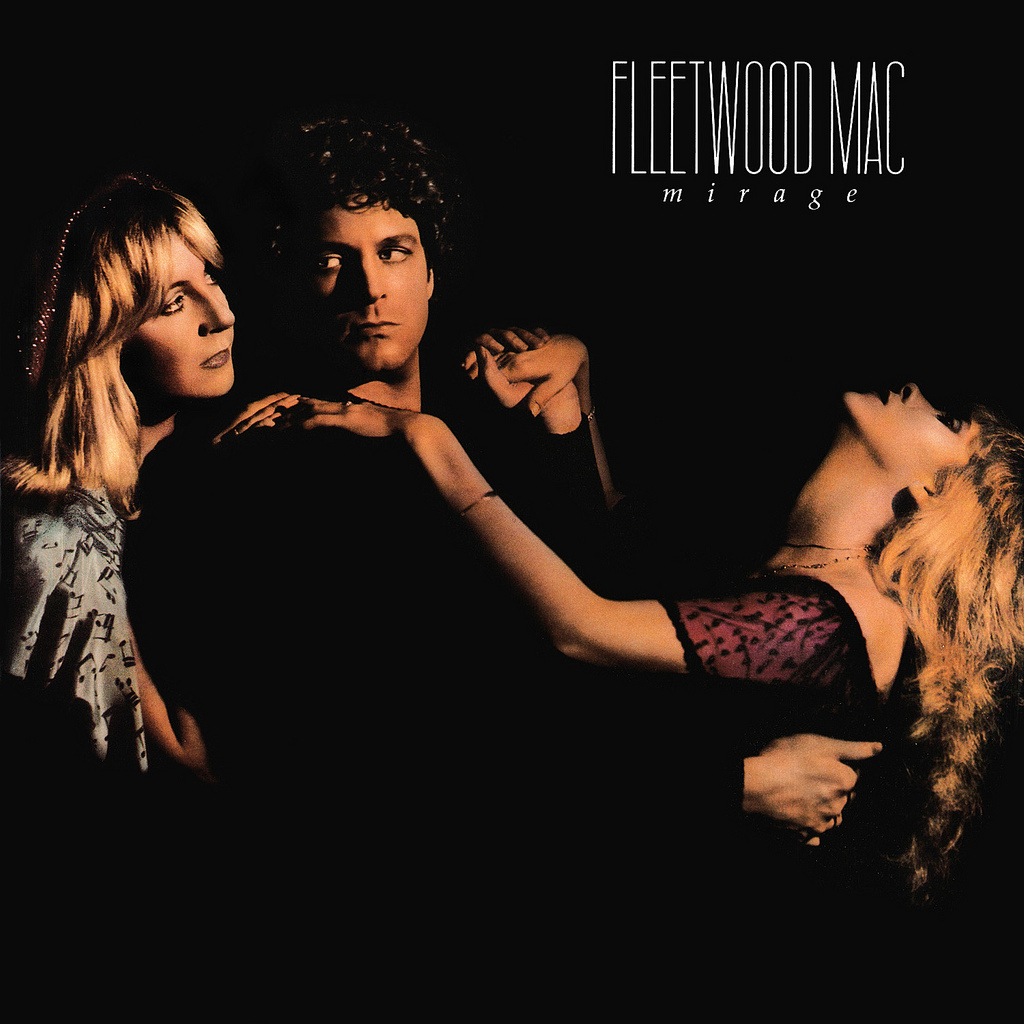
    Now, Mirage may bear superficial resemblance to Rumours, but in actuality it’s far more UP, the lightweight feel locking with the title; it’s Parallel Lines (of what?) for Beverly Hills.

    The cover photo, by George Hurrell, seems set to portray Lindsey Buckingham as sex-object supreme with Stevie and Christine fawning over him, while like a good Cheap Trick album the two dodgy geezers are consigned to the back. Like ABC, the Mac are still concerned with love: lost, tossed, reborn…Love in all its aspects. That many of the tunes cannot be called to mind after several plays is, for once, not a minus. It’s the ringing, flighty nature of the creatures, all harmonies and gossamer backing, that maketh the magic.

    As always, Christine McVie is still perfect (geddit?), offering two of the best in the miraculous, meticulous cirrus hymn to a Beach Boy “Only Over You” and side two’s ecstatic, catchy rave-up of slinky repetition, “Hold Me.” And yes, Stevie Nicks is still in fairyland and it’s still fine by me, especially when on “Gypsy” she comes up with the amazing line “So I’m back, to the velvet underground”.

    Of course, too, all would not be right in the garden if weird Lindsey Buckingham wasn’t still putting broken glass in the pate sandwiches: “Empire State” is tetchy, odd-rock about lusting after NYC instead of LA, the guitar as idiosyncratic as ever, as it is on his frantically compelling flare-up “Eyes Of The World.” Just to prove he’s a nice guy he also contributes “Book Of Love” and “Oh Diane,” the latter being positively, perversely Bobby Vintonesque in its unashamed schoolboy schlockiness.

    Fleetwood and McVie the male are perhaps consigned to the valley of the back cover for a reason: They contribute nothing to Mirage (except, of course, their not inconsiderable performing talents). Still, they look mighty pissed-off over there. “Wish You Were Here” sings Christine at the end of the record. Mirage is sooo good…

    Let’s start a Rumour.

    Sandy Robertson / Sounds / July 17, 1982

  • Inside the Sleeve: Fleetwood Mac – Mirage

    Fleetwood Mac Mirage cover 1982This long-awaited studio follow-up to Tusk doesn’t harken back to that somewhat disappointing 1979 album, nor does it bear much semblance to the band’s earlier, more successful releases, such as Fleetwood Mac and Rumours. It is unique — pleasant enough — but hardly destined for the multi-platinum status of its predecessors.

    The over-all feel is one of understatement. Nothing stands out in particular, and the group seems more interested in creating a pleasant little summertime groove than in grabbing listeners by the shoulders and shaking them up. It is an album of fair-to-mediocre songs that somehow add up to more than the sum of their parts.

    The writing credits are divided fairly equally among Christine McVie, Stevie Nicks and Lindsey Buckingham, whose five numbers are all fairly banal. He writes silly, lightweight pop songs in the Paul McCartney vein, and none of the band’s remaining four members seem very interested in adding anything inspiring. As a result, “Empire State” and “Book of Love” have that same thin, unexciting feel as the numbers on Buckingham’s recent solo release, Law and Order.

    However, the material by McVie and Nicks is strong enough to save the album. McVie’s songs are unassuming, but pleasant. “Only Over You” is dedicated to Beach Boy Dennis Wilson, and utilizes some nice little Beach Boys harmonies. As for Nicks, although her “Gypsy” is a song in search of a melody, “Straight Back” is the best thing on the album. Nicks’ vocals soar over a simple and pervasive backbeat, raising the song almost to the status enjoyed by such Fleetwood classics as “Rhiannon.”

    Over all, though, Mirage seems a touch uninspired. In the rhythm section, drummer Mick Fleetwood and bassist John McVie appear to be going through the motions, straining themselves as little as possible. In fact, there’s more meat to one side of Nicks’ recent solo effort, “Dreams,” than Mirage can boast in total.

    • Pop
    • Mirage Fleetwood Mac
    • Saturday, July 17, 1982
    • Warner Brothers 92 36071

    Alan Niester / Globe and Mail (Canada) / July 17, 1982

  • REVIEW: Bella Donna

    REVIEW: Bella Donna

    Rickie Lee Jones’ Pirates and Stevie Nicks’ Bella Donna are both such long-awaited albums that you could all but hear the amens when they arrived in the stores.

    It has been nearly two years since the release of Jones’ enchanting debut LP, which rode the success of “Chuck E.’s in Love” into the Top 10 and earned the singer a Grammy as the year’s best new artist.

    It has been even longer since Nicks’ ethereal “Rhiannon” in 1976 helped make Fleetwood Mac one of the most commercially successful bands in recording history–a contribution that suggested Nicks would eventually attempt a solo album.

    Now that the wait for the albums is over, the questions are: Does Jones live up to expectations? Will Nicks do OK on her own? The answers depend on whether you’re more interested in chart performance or music. Bella Donna (Modern Records) is a careful, respectable work that will chalk up sales, but it mostly repeats what we already know about Nicks’ music from her recordings with Fleetwood Mac. The album’s high points are the few times she steps into new territory.

    [Editor’s note: The rest of the Rickie Lee Jones’ Pirates album review has been omitted from this article.]

    The strange thing about Stevie Nicks’ Bella Donna is that someone who presumably has been looking forward for years to recording away from the shadow of one band steps in the LP’s key track into the shadow of another: Tom Petty and the Heartbreakers.

    Not only did Petty write and co-produce “Stop Draggin’ My Heart Around,” but he also sings on it with nicks, and the Heartbreakers bands plays on the track. The arrangement–from Benmont Tench’s sinuous keyboard touches to Michael Campbell’s cymbal-like guitar licks– summarizes the feel of Petty’s moody, midtempo rockers so fully that it’s almost a caricature.

    Still, the Nicks-Petty teaming is a classic pairing of two of rock’s heart-throbs and the single will be smash, adding even more to the audience for this album. The problem aesthetically is the song adds nothing to Nicks’ musical identity. Unfortunately, the same things can be said about the rest of the LP.

    That’s not going to necessarily be a disappointment for hard-core Nicks fans, but I’ve always felt quivering, trance-like vocals are most effective in small doses.

    One of Fleetwood Mac’s strengths is the flexibility that results from three singer-songwriters in the band. Just when Nicks’ initially seductive approach wears thin, the group shifts to one of the velvety Christine McVie ballads or rollicking Lindsey Buckingham numbers.

    Using guitarist Waddy Wachtel and other musicians who have worked with Linda Ronstadt, producer Jimmy Iovine gives Nicks’ music a harder edge than it usually receives on the Mac recordings. Still, most of the songs on Bella Donna are built around the same swirling rhythms and frequent mystical allusions of such familiar Nicks tunes as “Sisters of the Moon,” “Rhiannon,” and “Dreams.”

    Some of the songs–notably the upbeat “Think About It”–work especially well. Others, however, are ponderous. Among them: the title track, which is yet another reflection on pop stardom (“No speed limit…this is the fast lane”), and “Edge of Seventeen,” an over-wrought romantic flashback.

    The high points in the album are the times she steps farthest form the Mac mold. Besides the Petty track, there’s “After the Glitter Fades,” a marvelous country ballad, and “Leather and Lace,” a folkish song with much of the delicate emotion of Tim Hardin’s best tunes. On both numbers, Nicks, who is joined on “Leather and Lace” by Eagles’ Don Henley, seems far more approachable and genuine vocally.

    “After the Glitter Fades” is such an evocative account of loneliness amid the glamour of Hollywood rock ‘n’ roll that it’s surprising to note on the album’s lyric sheet that it was written before Nicks joined Fleetwood Mac and became a star herself. Sample lyric: “The dreams keep coming when you forget to feel.”

    If Nicks could have broken awa a few more times from the relatively conversative shackles of her Fleetwood Mac image, Bella Donna would have been a lot easier to toast as it goes up the sales chart.

    Robert Hilburn / Los Angeles Times / August 2, 1981