Tag: The Other Side of the Mirror

  • Rupert Hine, Stevie’s ‘Mirror’ producer, dead at 72

    Rupert Hine, Stevie’s ‘Mirror’ producer, dead at 72

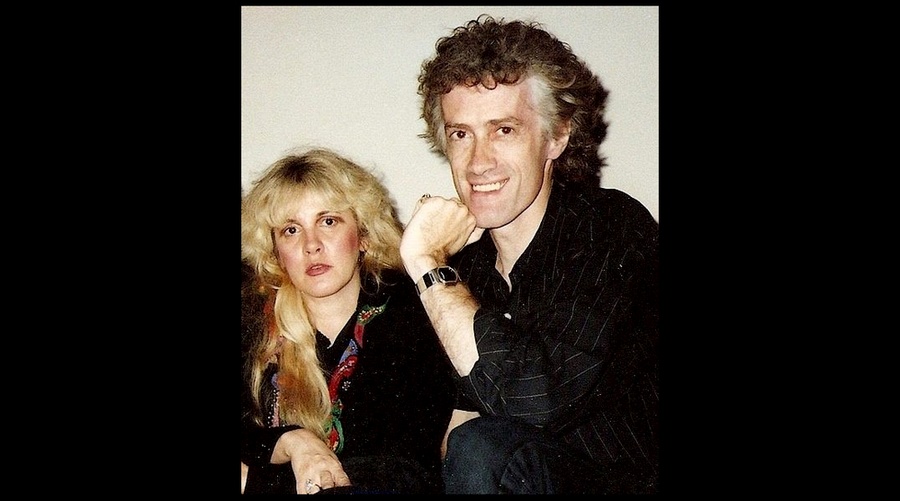
    Rupert Hine, British music producer, has died at 72, according to a tweet from The Ivors Academy where he served as Board Director. Rupert produced Stevie Nicks’ fourth solo album, The Other Side of the Mirror (1989), a concept record inspired by Lewis Carroll’s Alice’s Adventures in Wonderland.

    Rupert and Stevie dated for a short time; their relationship was the subject of Stevie’s Billboard Top 20 single “Rooms on Fire,” also a No 1. Billboard Rock Track. In her 1991 Timespace compilation liner notes, Stevie described their instant connection: “It always seemed to be that whenever Rupert walked into one of those rooms…that the rooms were on fire. There was a connection between us that everyone around us picked up on, and everyone was very careful to respect our space…our Timespace.”

    Stevie’s 1989 album The Other Side of the Mirror featured a more whimsical sound, a sonic landscape that Rupert Hine had created with keyboard-driven arrangements. In addition to the Top 40 “Room on Fire,” the album also featured standout cuts “Long Way to Go,” “Ooh My Love,” and the blues rocker “Whole Lotta Trouble.” 

    During his long music career, Rupert Hine also worked on material for The Fixx (1981’s Shuttered Room and 1984’s Reach the Beach), Rush, (1989’s Presto and 1991’s Roll the Bones), and Howard Jones, (1985′ Dream into Action) among many others.

    Rupert Hine’s friends and colleagues have tweeted warm tributes of the talented musician, songwriter, and producer.

    Billboard has published an obituary for Rupert Hine.

    https://twitter.com/agraham999/status/1268722647052894209

    Rooms on Fire

    Whole Lotta Trouble

  • Review: Stevie Nicks – The Other Side of the Mirror

    SONG

    The title’s allusion to Through the Looking-Glass is no coincidence. This album also includes a tune called ”Alice,” and it’s not that hard to think of Nicks as the little blond from the Disney cartoon 20 years and some measure of frowsiness later. Nicks’s lyrics, too, often have a surreal quality. Line by line, they don’t add up to much. Read the title of ”Doing the Best I Can (Escape from Berlin)” and try to make sense of it. But Nicks knows which words can carry a serious burden, and her impressions do create vivid images: ”And the angel said, ‘Well you must have had a dream . . . / And you remember it . . .’ Till the dream followed through . . . / Till the — end of the dream . . . and the dream came true/ When I want something . . . I get it.” (Nicks has a Cheshire cat sense of punctuation; all those ellipses and dashes are hers.) She continues to sound darker and more substantial on her own than she does with Fleetwood Mac, and her nanny-goat-with-a-head-cold voice, while it’s nobody’s textbook instrument, conveys the passion, anger and persistent curiosity of her language. It’s hard to imagine, say, Judy Collins singing most of these songs without sounding silly. Nicks makes them both poetic and musical. Bruce Hornsby sits in (and sings in) on a couple of tracks, to the best effect on ”Juliet,” where his jangly piano complements Nicks’s vocal. There’s also a reggae-ized version of the Johnny Cash standby ”I Still Miss Someone (Blue Eyes)” on which Nicks succumbs to blatant romanticism. Most of the time the images are less sweet, as in ”Rooms on Fire” or ”Fire Burning,” which make Nicks seem to be someone interested in neither lighting any candles nor cursing the darkness, though she might be talked into sitting down and spending some time discussing the topic ”All Right, Just Exactly What Is Going on Here?” (Modern/Atlantic)

    Ralph Novak / People / July 3, 1989

     
  • ALBUM REVIEW: The Other Side of the Mirror

    ALBUM REVIEW: The Other Side of the Mirror

    Stevie Nicks The Other Side of the Mirror 1989The Other Side of the Mirror (Modern/Atlantic)
    Stevie Nicks

    The title’s allusion to Through the Looking-Glass is no coincidence. This album also includes a tune called ”Alice,” and it’s not that hard to think of Nicks as the little blond from the Disney cartoon 20 years and some measure of frowsiness later. Nicks’s lyrics, too, often have a surreal quality. Line by line, they don’t add up to much. Read the title of ”Doing the Best I Can (Escape from Berlin)” and try to make sense of it. But Nicks knows which words can carry a serious burden, and her impressions do create vivid images: ”And the angel said, ‘Well you must have had a dream . . . / And you remember it . . .’ Till the dream followed through . . . / Till the — end of the dream . . . and the dream came true/ When I want something . . . I get it.” (Nicks has a Cheshire cat sense of punctuation; all those ellipses and dashes are hers.) She continues to sound darker and more substantial on her own than she does with Fleetwood Mac, and her nanny-goat-with-a-head-cold voice, while it’s nobody’s textbook instrument, conveys the passion, anger and persistent curiosity of her language. It’s hard to imagine, say, Judy Collins singing most of these songs without sounding silly. Nicks makes them both poetic and musical. Bruce Hornsby sits in (and sings in) on a couple of tracks, to the best effect on ”Juliet,” where his jangly piano complements Nicks’s vocal. There’s also a reggae-ized version of the Johnny Cash standby ”I Still Miss Someone (Blue Eyes)” on which Nicks succumbs to blatant romanticism. Most of the time the images are less sweet, as in ”Rooms on Fire” or ”Fire Burning,” which make Nicks seem to be someone interested in neither lighting any candles nor cursing the darkness, though she might be talked into sitting down and spending some time discussing the topic ”All Right, Just Exactly What Is Going on Here?”

     Ralph Novak / People Weekly Vol. 32, Issue 1 / July 3, 1989

  • Review: Stevie Nicks – Other Side of the Mirror

    (Modern/Atlantic)

    ** (2 stars out of 5)

    Other Side of the Mirror is Nicks’ first solo album in more than three years and follows her three successive solo platinum releases away from the confines of Fleetwood Mac. Don’t look for many new sounds here. Nicks has finally slipped away into a world of darkness and candles, eerie pop and flirtations with rock ‘n’ roll. A tough voice and wild hair can take an artist only so far, and Nicks never gets much farther on this album.

    Nevertheless, “Rooms On Fire” and “Two Kinds of Love,” a duet with Bruce Hornsby, no doubt will make their way up the charts-they’re pure sellers, not music. In all, a disappointing sound-alike with no new ground broken.

    David Silverman / Chicago Tribune / June 8, 1989