“Dreams,” Fleetwood Mac’s Number One single from the band’s iconic 1977 album Rumours, returns to the charts this week, according to Billboard Magazine, thanks to a meme showing a color guard dancing to the song. The humorous observation, tweeted by i m m i g r ❀ n t @bottledfleet, has received thousands of likes and retweets since March 22.
“Dreams” re-emerges at Number 14 on the Hot Rock Songs chart for the weekending April 7, 2018. The reaction to the Twitter post also bumps up Rumours on the Top Rock Albums chart, from 21-13 with 7,000 equivalent album units, up 12 percent, according to Billboard.
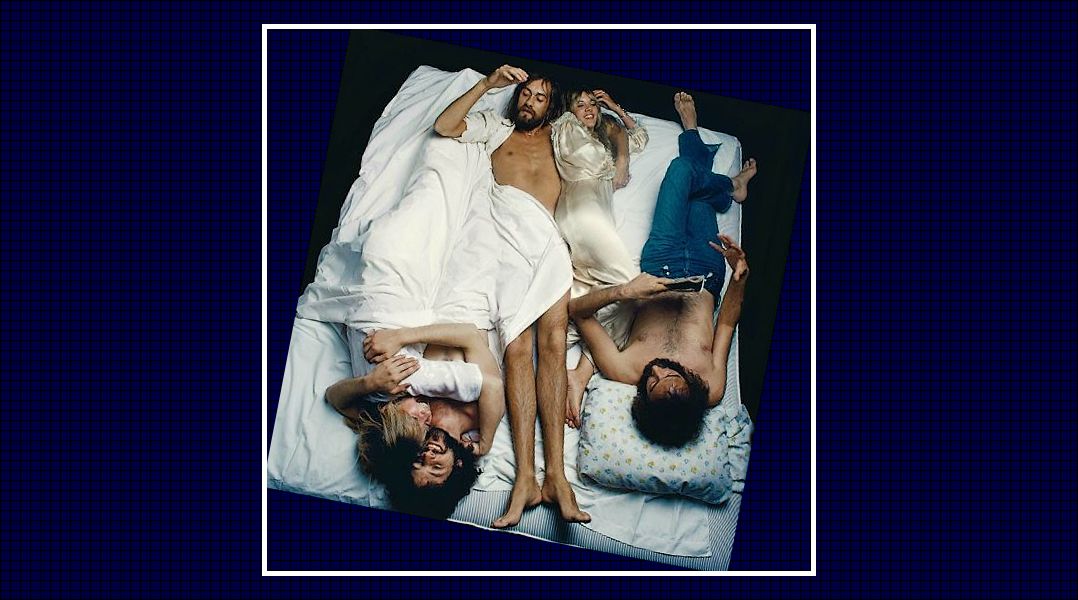
Fleetwood Mac’s (in)famous Annie Leibovitz photograph (March 24, 1977) appears in the November 2, 2017 issue of Rolling Stone (Tom Petty: 1950-2017/The Photo Issue).
Fleetwood Mac posed for their first ROLLING STONE cover shortly before Rumours took over the world. But the romantic turmoil they laid bare on that album also made Annie Leibovitz’s idea for the shoot — the whole band, together on a bed — tricky. Christine McVie didn’t want to be near her ex, John McVie, and Stevie Nicks didn’t want to be besides Lindsey Buckingham. Nicks ended up in Mick Fleetwood’s arms — a hint of a torrid affair to come. “I don’t know how healthy all this display of our personal life was,” said Buckingham. “But that’s showbiz.”
Sex and Drugs and Lighting Guys: The Fleetwood Mac Story
The 4th of February marked the fortieth anniversary of something great. This month in 1977, the album Rumours was released by Fleetwood Mac. Filled with memorable tracks, acerbic jabs and drug-fueled romantic angst, there is plenty for listeners of all ages and backgrounds to sink their auditory teeth into.
The Album’s Background
Rumours was designed first and foremost as an album that would contain no “filler” tracks; every track must be up to the standard of a single. Indeed, while this factor raised the bar and probably put an already high-pressure situation in a quality-analysis vice, it is undoubtedly instrumental to the album’s success. Every track is at a standard that it could be released and stand on its own two feet independently. Beyond this, the band retains its signature sound throughout, yet the trio of singers give each song a distinct and unique twist, preventing the album from stagnating or losing any magic upon repeated plays. However, beyond the acoustics and the standard of the tracks themselves is the story of the band’s turmoil, imprinted on the lyrics. The band consisted of five members, the on-again-off-again American couple Stevie Nicks and Lindsay Buckingham, who were finally heading towards calling it off for good; and the Brits, the divorcing John and Christine McVie, and lastly Mick Fleetwood, who had just discovered his wife had been having an affair with his best friend.
The Creation Process
The emotional confusion and acrimony is incredibly prevalent in the lyrics of the album. ‘You Make Loving Fun’ is a feel-good song about finding the joy of being in a relationship with someone new, penned by Christine about the group’s lighting guy and with a bass line played by her ex-lover. She also claims her song ‘Oh Daddy’ is dedicated to drummer, Mick Fleetwood, but some members of the band believe this is actually a love song dedicated to someone else. Buckingham and Nicks, in turn, use the album as a cathartic method of digesting their own views on the breakdown of their relationship. ‘Go Your Own Way’, written by Buckingham, claims “shacking up’s all you want to do”, much to Nick’s chagrin, whilst her song ‘Dreams’ analyses the ephemeral nature of love through a series of metaphors, and a quiet awareness of the relationship’s end. The McVies didn’t talk between takes, and conversely recordings were the only time Nicks and Buckingham stopped screaming at each other. In addition, friction between the Brits and Americans in the group distanced all the members further. The recording sessions are a rumour-mill in and of themselves, with it being alleged the group didn’t see daylight for days; that John McVie was descending into serious alcoholism; Nicks tried to take cocaine anally and wrapped her head in a black scarf to record ‘Gold Dust Woman’, as well as the alleged affair between Fleetwood and Nicks.
The Album Title
The group has retrospectively confirmed, as well as all the Rumours surrounding the recording, that the album was named Rumours because the tracks were the only way the band knew what was happening with the other members. This disjointed and, at times, abusive exchange of monologues was the only stream of communication between the members at such a dysfunctional time.
Where You May Have Heard The Tracks
The gravitas of these tracks is evident as they permeate day-to-day popular culture. Bill Clinton used ‘Don’t Stop’s distinctive hook “don’t stop thinking about tomorrow”, as his campaign song in his successful 1993 run for office, with the band even re-uniting to play it live. Though this perhaps overlooks the message of the song that heartbreak is eventually a memory. ‘The Chain’ and its distinctive bassline riff, the sole song that all five members have writing credits for, can be heard on the BBC’s coverage of Formula One. Several songs have been covered by the likes of Eva Cassidy (‘Songbird’) and The Corrs (‘Dreams’), and have featured in soundtracks of high profile media such as The Simpsons, Forrest Gump, Skins, Cuckoo and Guitar Hero World Tour. The album was also voted 25th out of the 500 greatest albums of all time by Rolling Stone magazine.
The Hidden Gem
Even if you are familiar with the album, you may not know of the unreleased track that Mick Fleetwood and Stevie Nicks had a copyright tug of war over, ‘Silver Spring’. Replaced on the album by the marginally peppier ‘I Don’t Want To Know’, Nicks’ lyrical and musical genius is sorely overlooked. The song was recently added to the line-up in album re-releases and focuses on the breakdown of her relationship with Buckingham, with the eponymous ‘Silver Spring’ being an idealised and romantic sense of perfection. It was named after the band drove through Colorado and Nicks commented to Fleetwood that it seemed like a perfect place. For those who appreciate discovering new tracks, iTunes has many demos you probably haven’t heard before from the super-deluxe version of the album. ‘Planets of the Universe’ is particularly haunting, with poignant piano and vocals and a very raw, stripped back power behind it.
The Legacy
Rumours still hits a raw nerve with a lot of people; beyond the catchy tunes, familiar riffs and powerful vocals, the group is exploring the very real pain of being unable to hold a relationship together in a time of emotional turmoil. The album receives a lot of praise, and is almost seen as pejoratively mainstream since it has sold so many copies. So, is it overhyped? To quote Murray from Flight of the Conchords; “Rumours? No, it’s all true.”
40 years after Fleetwood Mac’s Rumours, Stevie Nicks is still one of rock’s biggest icons
The iconic 1977 Fleetwood Mac album Rumours turned 40 last week. This album has meant a whole lot to me over the course of my life, and this anniversary has forced me to reflect on that more than ever.
As a female writing about music, I have a special appreciation for women in music, and Stevie Nicks is one of the best the world has seen. As she approaches 70, she remains one of the most incredible women in rock, releasing album 24 Karat Gold: Songs from the Vault, in 2013. She is currently touring and recently added 20 tour dates for 2017, kicking off on Feb. 23, in Reno, Nevada, and wrapping up on April 6 in Uniondale, New York.
In the music industry as a whole, women are typically confined to the roles of solo performers or singer-songwriters. This is what makes Fleetwood Mac stand out — it’s a mixed-gendered rock band, and by far the most successful one to ever grace the industry. Of course, there was drama that came along with it, but from that drama emerged some of the greatest music of the 70s, specifically the album Rumours.
Nicks was involved in a tumultuous relationship with her bandmate Lindsey Buckingham, and their relationship came to an end while the band remained whole. Instead of conforming to the heartbroken damsel in distress stereotype that people may have expected, Nicks continued working with Buckingham and the rest of the band, and went on to write the song “Dreams,” which is the only Fleetwood Mac single to reach number one on the United States charts. The drama and heartbreak being felt by almost every member of the band produced their most successful era because of the fact both the male and female perspectives were on display. There is dialogue within and between the tracks of the album, and this is what makes it stand out among most albums in rock history.
Nicks is also notable in the sense that she chose her career over settling down and starting a family. Women are often expected to be tame and take their so-called “biological duty” more seriously than their career or passions. Nicks never conformed to that. From the age of 16, she has been a songwriter and musician, and has let nothing get in the way — whether it was her affairs and relationships, or the societal pressure of settling down to have a family. Nothing could stop her passion for her craft, and as a result she has led an incredibly successful career both with Fleetwood Mac and as a solo artist.
At the age of 68, it is expected that her career as a rock star may be approaching its end, but that doesn’t signal the end of her relevance. She is more than just a rock star — she is an incredibly wise and knowledgeable woman who uses her art to convey her experiences to the world and offer solace to those that have had similar experiences. All the while, she has paved the way for women in rock, and has simultaneously been exemplary to women in general, with her good-naturedness and her ability to overcome all sorts of obstacles — while still finding incredible success. She uses this success as a platform to share what she has learned as a woman in the rock genre, and simply as a student of the universe.
In a 2015 issue of Mojo magazine, Nicks said, “I think every band should have a girl in it, because it’s always going to make for cooler stuff going on than if it’s just a bunch of guys.” The world, and music in general, can learn a lot from the success of Fleetwood Mac, and of Stevie Nicks in particular.
Jenny Bourque is a freshman English and textual studies major. Her column appears weekly in Pulp. You can email her at ja******@*yr.edu.
Jenny Bourque / Syracuse University Daily Orange / February 7, 2017
Fleetwood Mac’s Rumours is 40 – here are 10 reasons why it’s their best album.
It’s safe to say everyone has heard of Fleetwood Mac.
Whether you’re 50 or 15, chances are there’s at least one track you know and love – and it’s pretty likely it comes from their most successful album, Rumours.
The record turns 40 this month, so what better way to mark the occasion than to provide 10 reasons why it’s their best album ever?
Dig out the tunes, get listening and read on.
Mick Fleetwood called Rumours ‘the most important album we ever made’, because it was this record’s success that allowed Fleetwood Mac to continue making music for years afterwards.
VH1 placed the album at number 16 during its 100 Greatest Albums countdown in 2003, and Rolling Stone ranked it at number 25 in its ‘The 500 Greatest Albums of All Time’ issue.
Rumours was Fleetwood Mac’s 11th studio album, and was released almost a decade after their first record – to achieve multi-platinum, record-breaking success so long after starting out is incredibly rare.
The album has received diamond certification in several countries, such as the U.S., Canada and Australia. What is diamond certification? In 1999, the diamond certification was introduced to signify that a recording had sold 10 million copies.
All five band mates worked through painful breakups while they created the record – The McVies were going through a divorce, Buckingham and Stevie Nicks were reaching a bitter end to their long term relationship, and Fleetwood’s wife was about to leave him for his best friend.
Each track on the album provides a tale of love and loss that everyone can identify with.
“Second Hand News” is a classic ode to rebound relationships, inspired by Buckingham’s experiences in finding new women after Stevie.
“Go Your Own Way” managed to be upbeat with a ‘f*** you’ vibe – quite the achievement.
What’s more, the line “Shackin’ up is all you wanna do” accuses an ex-lover of being a slut – then has Buckingham’s ex-lover harmonise on the hook.
Nicks wrote “Dreams” in a few minutes, recorded it onto a cassette, then went back to the studio and demanded the band listen to it. This simple ballad soon became part of the masterpiece – and was a number one hit.
This weekend (the 4th February, to be exact) marks the 40th anniversary of the release of Fleetwood Mac’s bestselling album, Rumours. The Grammy Award-winning album was released in 1977, and marked a turning point in Fleetwood Mac’s musical career. Fuelled by immense hedonism and heavy drug-use, Rumours is an album about relationships, and trying to move on after their failure. Now the ninth best-selling album of all time, Rumours has, in the words of AllMusic editor Stephen Erlewine, “transcended its era to be one of the greatest, most compelling pop albums of all time.”
“Fleetwood himself has noted the “tremendous emotional sacrifices” made by the band simply to attend the studio to record”
The production of Rumours came after a tumultuous period in the band’s history. Following the success of Fleetwood Mac’s eponymous tenth album, released in 1975, and six month of non-stop touring, Christine and John McVie (keyboard/vocals and bass guitar respectively) divorced. Lindsey Buckingham and Stevie Nicks had been in an on-off relationship during the tour as well, but their relationship began to suffer, and they fought often.
Mick Fleetwood was also struggling with family matters, after discovering that his wife had been having an affair with his best friend. Despite these problems, the band line-up remained the same for the recording of Rumours, though Fleetwood himself has noted the “tremendous emotional sacrifices” made by the band simply to attend the studio to record.
Rumours was recorded at the Record Plant in Sausalito, California, with the band living in (separate) accommodation nearby, and originally went by the working title of Yesterday’s Gone. Though the band worked well together during the recording of the album, they did little together outside the studio, and often indulged in the prevalent San Francisco drug culture.
Chris Stone, one of the owners of Record Plant, reminisced in 1997 that the band “would come in at 7 at night, have a big feast, party till 1 or 2 in the morning, and then when they were so whacked-out they couldn’t do anything, they’d start recording.” Despite their heavy drug use and intense emotional conflicts, Nicks has suggested that Fleetwood Mac produced their best music when they were in the worst shape.
“The impact and legacy of Rumours shows no signs of stopping…”
The songs on the album are not without their significance. “The Chain” (the only song written by the whole band in collaboration) and “Oh, Daddy” (written by the McVies about Fleetwood and his wife, who had reconciled their differences and got back together) are about reluctance to leave a lover, even after they have treated you wrong.
“Dreams,” “Second Hand News” and “Go Your Own Way” are clearly about break-ups and an attempt to move on, while songs like “Songbird” (the only song on the album not recorded at Record Plant) and “Don’t Stop” are a little more optimistic; they seem hopeful of a better future that will come as a result of the breakup that has just occurred. “Gold Dust Woman” is a testament to Los Angeles and the hard life that such a metropolis provided; Nicks herself became addicted to cocaine after her time there, and the song references this several times.
Rumours has continued to be a classic in and of itself since its release 40 years ago. Production fraught with emotional tension and difficulty is replicated in the music itself, which is full of “raw, immediate emotional power” (Stephen Erelwine).
Now having reached 2x Diamond certification in the US and 11x Platinum in the UK, the impact and legacy of Rumours shows no signs of stopping, and will be remembered as Fleetwood Mac’s greatest contribution to music.
Ellen Smithies / Impact Magazine (University of Nottingham) / February 5, 2017
As Rumours turns 40, tributes to Fleetwood Mac’s pinnacle work pour in from music critics.
Fleetwood Mac‘s classic 1977 album Rumours turns 40 today! Featuring some of the most recognizable tunes in rock music, Rumours has influenced generations of music listeners, providing the melodic soundtrack to their lives.
One of the album’s most popular tracks is the optimistic “Don’t Stop,” which Bill Clinton famously used as his 1992 presidential campaign song. But it’s the all-too-relatable relationship turmoil — expressed in songs like “Dreams,” “Go Your Own Way,” and “The Chain” — that still connects with audiences 40 years later.
“It was not awful at all, it was fantastic! We were rich, we were young, we were falling out of love with each other, but, hey … there was a lot of other men and women in the world, and we were all moving on. … So as bad as it was, it was still great.” —Stevie Nicks
The tributes to Rumours have poured in all week from music journalists, who dissect the album’s enduring appeal.
“It’s an album that has eerie soothing powers when you hear it in the midst of a crisis, which might be why it hits home right now, with our minute-by-minute deluge of apocalyptic news, the rottenest month to be an American since FDR died.” —Rob Sheffield, Rolling Stone
“Rumours is a brutal examination of the politics of relationships, personalities, and ambition.” —Jules LeFevre, Faster Louder
“To simply call Rumours a breakup album doesn’t do it justice. Most breakup albums have an end point — some triumph, a reward or promise about how some supposed emotional resilience might pay off. Rumours is an album of continual, slow breaking.” —Hanif Willis-Abdurraqib, MTV
“Was it the drama, musicality, character or celebrity culture which made Rumours so iconic? Likely, all of the above.” —Tom Cameron, Happy
Many albums lay claim to being the best of all time. But Rumours was designed not to have an inch of filler and achieved its goal with room to spare. Perhaps only the Beatles’ Revolver could muster that defence so convincingly. —Graeme Marsh, Stereoboard
Co-producer of Fleetwood Mac’s Rumours sparks effort to buy Sausalito’s historic Record Plant Studio
Forty-one years ago, record producer Ken Caillat loaded his dog in his car and drove from Los Angeles to the Record Plant in Sausalito to work on an album by an up-and-coming band named Fleetwood Mac. The album that came out of four months of intense recording sessions was Rumours, a blockbuster that would go on to sell more than 45 million copies worldwide and earn critical acclaim as one of the greatest pop records of all time.
In recent days and months, Caillat has made that same trip with his dog (not the same one) many times. This time his purpose has been to help form the Marin Music Project, a three-member group that’s on a mission to save the long-shuttered Record Plant as a piece of Marin’s storied rock ’n’ roll history.
“It was dirty, the wood was flaking off and I thought, ‘I’m gonna wake up one morning and read that it burned down,’” he said. “I’ve seen so many great studios that either burned down or were turned into computer places or real estate offices or coffee shops. I said, ‘I’m going to do everything I can to try and save this place.’”
So he hooked up with Novato marketing consultant Kevin Bartram and Frank Pollifrone, a sports and entertainment marketer from Los Gatos, to launch the Marin Music Project.
39 years ago today, Fleetwood Mac’s Rumours began a long run at the top of the Billboard 200 chart, where it would stay for a (nonconsecutive) 31 weeks. The only brief interruptions in the number one spot were from The Eagles Hotel California and a live Barry Manilow album. No thanks. Since its release, Rumours has sold over 40 million copies worldwide—behind Michael Jackson’s Thriller (makes sense), and, for some reason, Meat Loaf’s Bat Out Of Hell.
Anyway, Rumours is flawless—don’t listen to this guy. And not only is it flawless in and of itself (Robert Christgau wrote that it “it jumps right out of the speakers at you”) but the tales of its recording are notoriously batshit crazy, too.
“It really was the beginning of the dream…” says the band’s Stevie Nicks.
The arrival of Lindsey Buckingham and his then-girlfriend Stevie Nicks to Fleetwood Mac in 1974 kicked the band’s commercial fortunes into serious high gear. Although the group was founded in 1967 and had already released nine studio albums, they had never visited the top 20 of the Billboard 200 chart. In contrast, the Mac’s first album with Buckingham and Nicks, the 1975 self-titled set, shot to No. 1 and sold five million in the U.S., according to the Recording Industry Association of America (RIAA).
But even bigger success was on the horizon with 1977’s blockbuster Rumours, which spent 31 weeks atop the list and has shifted 20 million.
Its second single, the Nicks-penned “Dreams,” became the band’s first (and so far only) No. 1 on the Billboard Hot 100 (on the list dated June 18, 1977) and was their first gold-certified single by the RIAA.
“My small pink 45 gold record of ‘Dreams’ hangs in my ocean apartment [in Santa Monica, Calif.] as we speak,” Nicks recalls to Billboard. “It has hung in every house I have lived in since the day I first received it. When I pass by it, I reach out and touch it. It really was the beginning of the dream …”
“Dreams” is one of 25 entries on the Hot 100 for the band, who also visited the top 10 eight other times with such hits as “Little Lies” and “Don’t Stop.”
The dreamy Rumours-era lineup of the band (Buckingham, Nicks, Mick Fleetwood, Christine McVie and John McVie) released three more top 10 studio albums before fracturing in 1987 after the departure of Buckingham. The quintet reconvened in 1997 for that year’s No. 1 live album The Dance and once more in 2014 for the On With the Show world tour. That trek continues through Europe, Australia and New Zealand this year. A new studio album is also in the works – and would be the first from the Mac’s fab five since 1987’s Tango in the Night.
Keith Caulfield / Billboard / Thursday, June 18, 2015